AI Glasses: Still Chasing the iPhone Moment
 03/24 2026
 517
517
Author | Wu En
Disclaimer | The featured image is sourced from the internet. This original article by Jingzhe Research Institute requires permission for reprinting.
In January 2026, Meta founder Mark Zuckerberg, during the company's fourth-quarter earnings call, propelled AI glasses back into the spotlight with a confident statement.
Zuckerberg stated that billions worldwide wear glasses or contact lenses for vision correction, making it hard to imagine most people not wearing AI glasses in a few years. He compared the current development stage of AI glasses to smartphones in their infancy over a decade ago. More convincingly, Meta's AI glasses sales surged over 300% year-on-year in 2025, signaling industry-wide potential for explosive growth.
Meanwhile, the AI glasses market in China has already reached fever pitch, with the notion of "2025 as China's inaugural year for AI glasses" widely circulated in tech and capital circles. But beneath the hype, is AI glasses' breakthrough truly ready? Can it revolutionize lifestyles like smartphones and become the next mainstream smart terminal?
Logic of Major Players
The AI glasses sector's heat (hype) is evident from frequent market layout (strategic moves) by relevant parties. Among international giants, Meta's commitment is unwavering. In early 2026, it strategically adjusted, cutting jobs in VR and metaverse departments to redirect resources and talent to AI glasses.
In China, major players have jumped in, leveraging their ecosystems to launch tailored AI glasses products.
On November 10, 2025, Baidu's Xiaodu Technology launched Xiaodu AI Glasses Pro, featuring AI translation, meeting minutes, object recognition, and AI memos. On November 27, 2025, Alibaba's Kuake released AI glasses, deeply integrating core Alibaba ecosystem scenes like Alipay, Gaode Maps, and Taobao.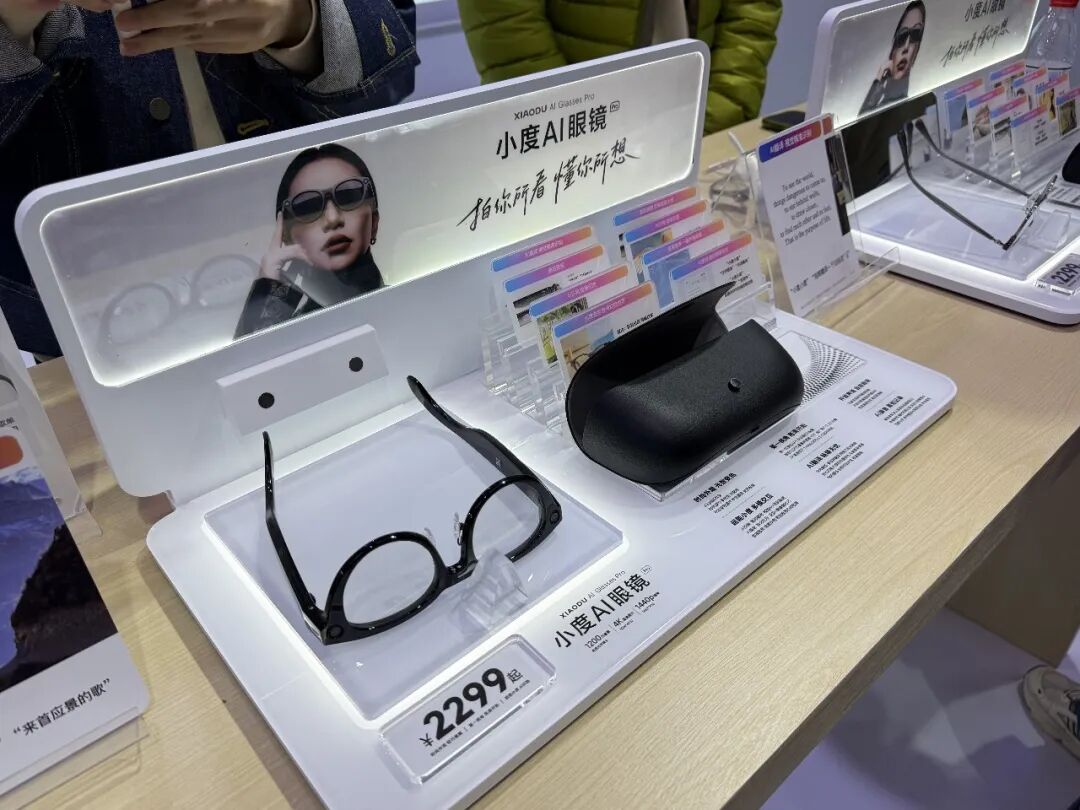
Notably, AI glasses' entry is not limited to traditional tech firms but spans automotive, mobile, and even pharmaceutical industries, creating a fierce "Hundred Glasses Battle" landscape.
On December 3, 2025, Li Auto unveiled its first AI smart glasses, priced at 1,999 yuan. Powered by Li Auto's self-developed MindGPT-4o model, "Li Xiang Tongxue" supports Q&A, navigation, and integrates with Li Auto's vehicle ecosystem. Wearing the glasses, users can remotely control vehicles via voice commands. It also features a 12MP camera with a 105° ultra-wide angle, supporting 0.7-second quick shots, live photos, and video recording. Li Auto executives revealed that demand outstripped supply, with tens of thousands of units sold in three hours and two months' production capacity exhausted in three days.
The mobile industry, as traditional smart terminal leaders, has not missed AI glasses as a potential "next-gen product." Xiaomi, OPPO, and other mainstream mobile manufacturers have made strategic moves, viewing AI glasses as crucial for extending their ecosystems and securing future entry points. Xiaomi's 2025 debut AI glasses, equipped with a 12MP camera and Xiaomi HyperOS, enable first-person video calls, live streaming, and feature Super Xiaomi AI for intelligent Q&A, 10-language translation, meeting minutes, smartphone and smart home control, and glasses-based Scan to Pay (scan-to-pay).
Additionally, China's three major telecom operators have entered the fray. In April 2025, China Mobile's Smart Home Operations Center unveiled "Mobile AiJia AI Glasses" at the 5th China International Consumer Products Expo, highlighting four key scenarios.
In July 2025, China Telecom Tianyi AI launched its first smart wearable device—Tianyi AI Smart Glasses. Powered by Qualcomm Snapdragon AR1 chips and Tianyi Xingchen large model, they enable hands-free photography, food calorie recognition, intelligent tourism guides, and intelligent Q&A.
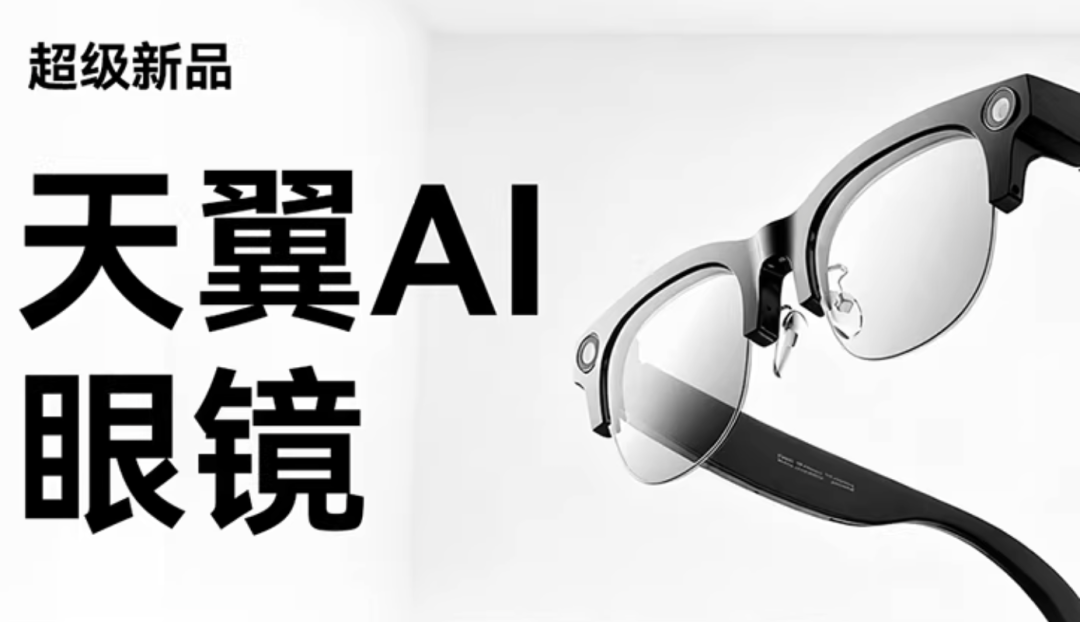
*Image source: Tmall China Telecom Official Flagship Store
China Unicom, as early as September 2024, co-developed eSIM AI sports glasses with partners, though these lean more toward AR glasses. For AI glasses, China Unicom adopted an "indirect approach." On January 5, 2026, Rayneo Innovation announced a C+ round financing exceeding 1 billion yuan, with China Unicom's Lianchuang Innovation Fund participating. Notably, China Mobile's Chain Leader Fund was a lead investor.
Numerous brands, like Rayneo Innovation, specialize in AR and AI glasses. Dubbed the "AR Glasses Five Dragons" alongside StarVR, XREAL, Rokid, and INMO, they now lead the AI glasses market.
In essence, giants' bets on AI glasses stem from a clear, firm logic.
The World Health Organization reported 2.6 billion myopic people globally in 2020, projected to rise to 3.4 billion by 2030. Converting even a fraction into AI glasses users could sustain a vast market.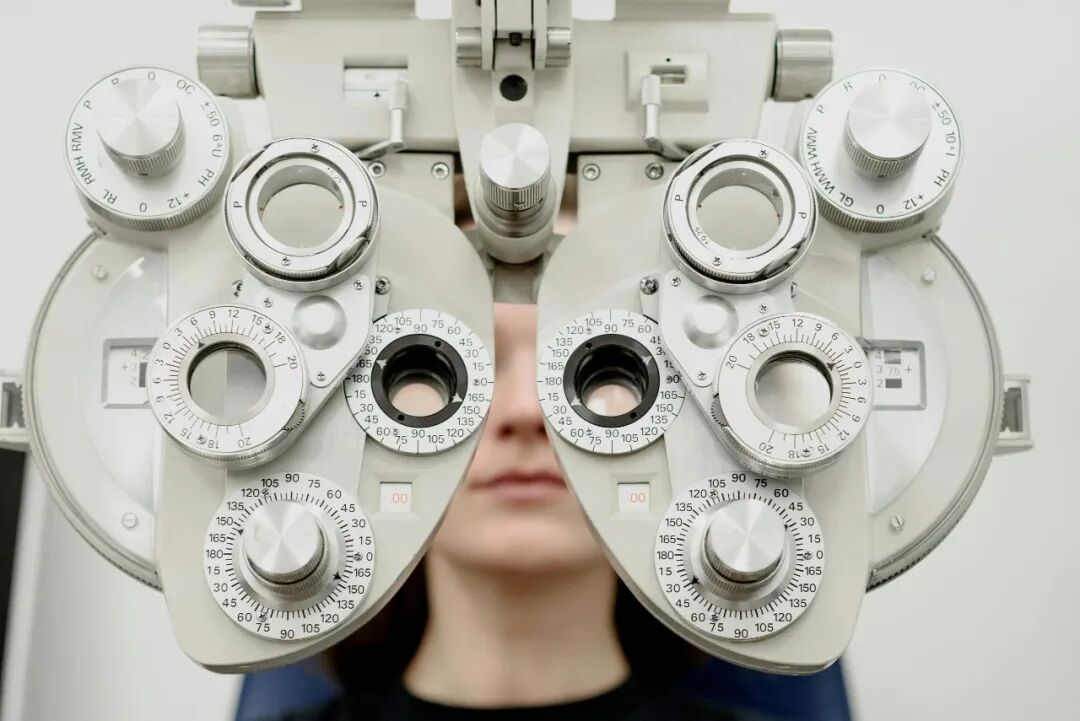
More crucially, giants see AI glasses as the next internet gateway. During the PC era, Microsoft and Intel dominated with Windows and chips. The smartphone era spawned giants like Apple, Huawei, and Xiaomi, fostering social, e-commerce, entertainment, and office industries.
Now, with smartphones in a maturity phase, giants seek the next core terminal for internet traffic. But can AI glasses shoulder this responsibility amid the hype?
Practical Obstacles
NVIDIA CEO Jensen Huang used "iPhone moment" to describe revolutionary shifts from concept to commercialization. The current industry focus on AI glasses suggests this moment is near.
Yet, beyond idealized visions, AI glasses face practical hurdles, far from mainstream terminal status. In short, they're still chasing the "iPhone moment."
Most visibly, hardware shortcomings impact user experience. Constrained by physics, AI glasses struggle with a painful balance of "weight, computing power, battery life, and heat dissipation." Nearly all manufacturers compromise across these four dimensions.
For instance, traditional glasses typically weigh under 15g, often below 10g. AI glasses, packing cameras, microphones, chips, and batteries, weigh several times more, causing nasal bridge pressure, soreness, and even cervical strain from prolonged wear.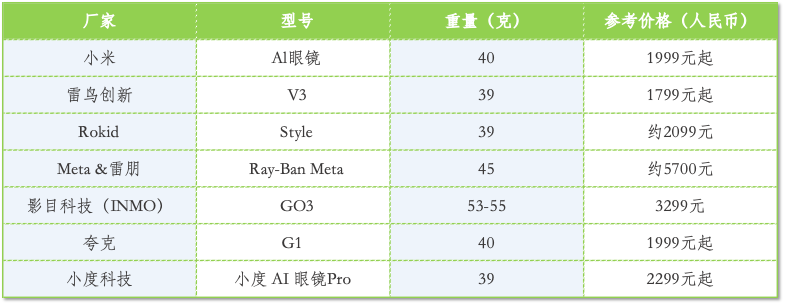
Reducing weight requires shrinking battery capacity, directly leading to short battery life. A January 2026 Guotai Haitong Securities report, "Smart Glasses Product Power Series 2: Large Models Catalyze, AI Glasses Emerge," showed most AI glasses last 2.5-4 hours, insufficient for full-day use. Many brands now offer charging cases to mitigate this.
Heat dissipation is equally problematic. AI glasses' chips lie close to the skin; heat from high-speed operations causes discomfort. Forcing chips to slow down leads to lag, degrading user experience.
Immature craftsmanship keeps AI glasses in a trial-and-error phase. Even Meta's glasses faced frequent "mishaps" at launch, embarrassing Zuckerberg. Consequently, AI glasses suffer high return rates. XR Vision statistics show a 30% return rate on JD.com and Tmall.
Beyond product issues, compliance risks loom. AI glasses' built-in cameras and microphones collect visual and auditory data in real-time. Leakage or misuse of this data severely threatens user privacy.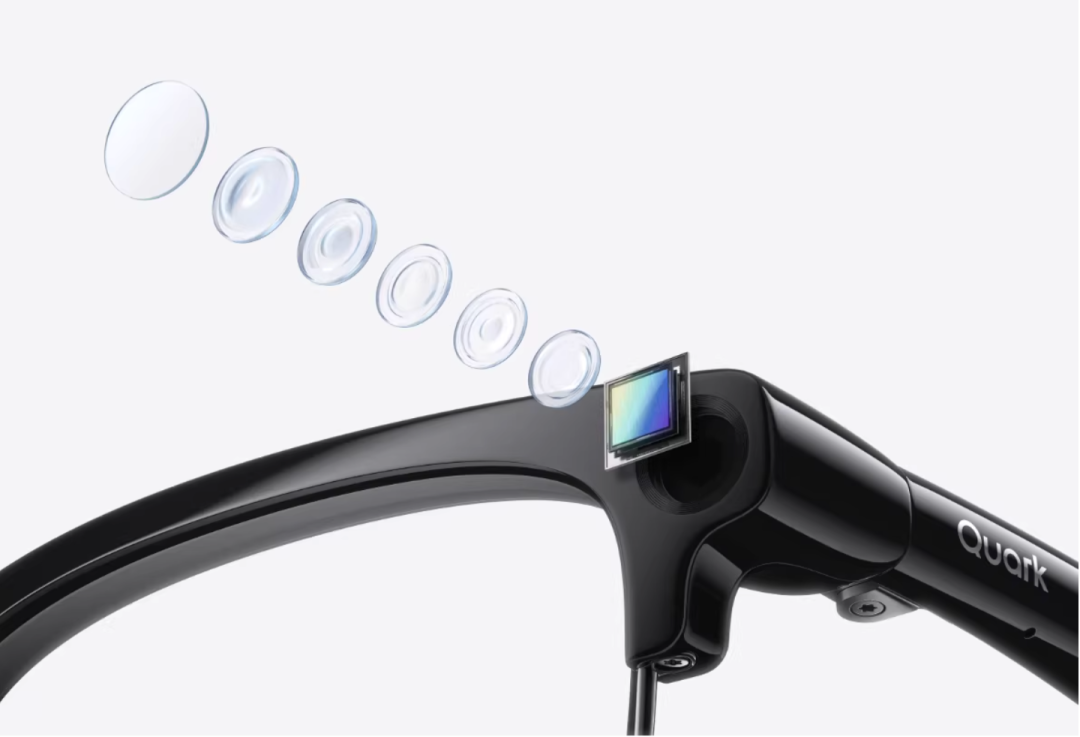
*Image source: Tmall Kuake Smart Devices Flagship Store
Some manufacturers have taken steps to mitigate privacy risks. Meta's AI glasses light up an LED indicator when recording; Xiaodu, Xiaomi, and others added "mandatory recording/camera indicator lights" and "one-click camera/microphone off" features to ease privacy concerns.
However, indicators may go unnoticed in bright light, encryption systems can be breached, and physically covering indicators allows recording. Firms cannot fundamentally resolve privacy risks.
Notably, using AI glasses as recording devices generates significant data storage needs for high-definition content. Many vendors now offer cloud storage services for AI glasses, improving user experience but requiring ongoing subscription fees.
Jingzhe Research Institute also notes that AI glasses, as digital products with multiple electronic components used around-the-clock (around-the-clock), often have subpar waterproofing. On Xiaohongshu, users report AI glasses damaged by rain or water washing, with lens malfunctions. Others worry about sweat seeping through temple joints during prolonged use.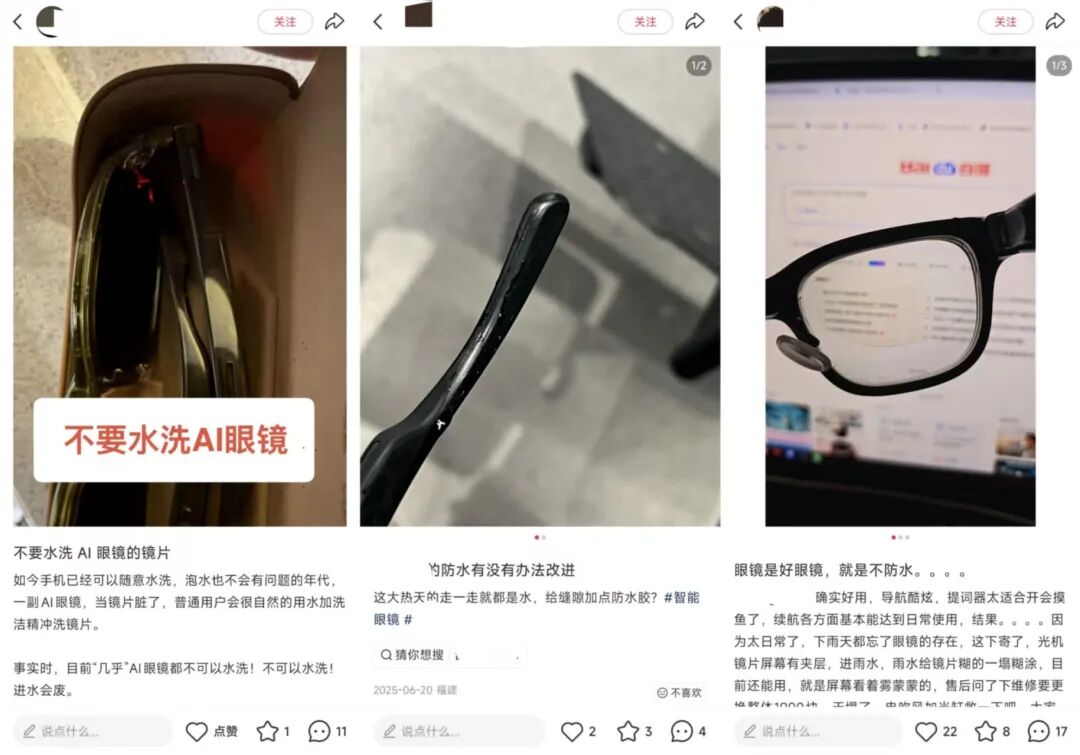
Reviewing product specs, most AI glasses only resist sweat and rain splashes. Few brands clarify if they withstand rinsing, soaking, or use while swimming or showering.
Some products, with open or magnetic charging ports, lack waterproof certification. When asked, brand Taobao flagship store customer service (customer service) explicitly warned against water contact on lenses and charging ports. If water damage occurs from misuse, users face repair costs ranging from hundreds to over a thousand yuan, steep compared to AI glasses' 1,000-2,000 yuan price range.
The Ultimate Form of AI Glasses
Despite obstacles, AI glasses, as consumer electronics "stars," show rapid sales growth.
Wellsenn XR reported 1.52 million global AI glasses sales in 2024, projected to rise to 3.5 million in 2025 (+130% YoY). By early 2025, actual sales reached 7.46 million units, double the forecast. This surge stems from AI glasses' low base and Meta's efforts—over 7 million Meta AI glasses sold in 2025, accounting for over 90% of total sales.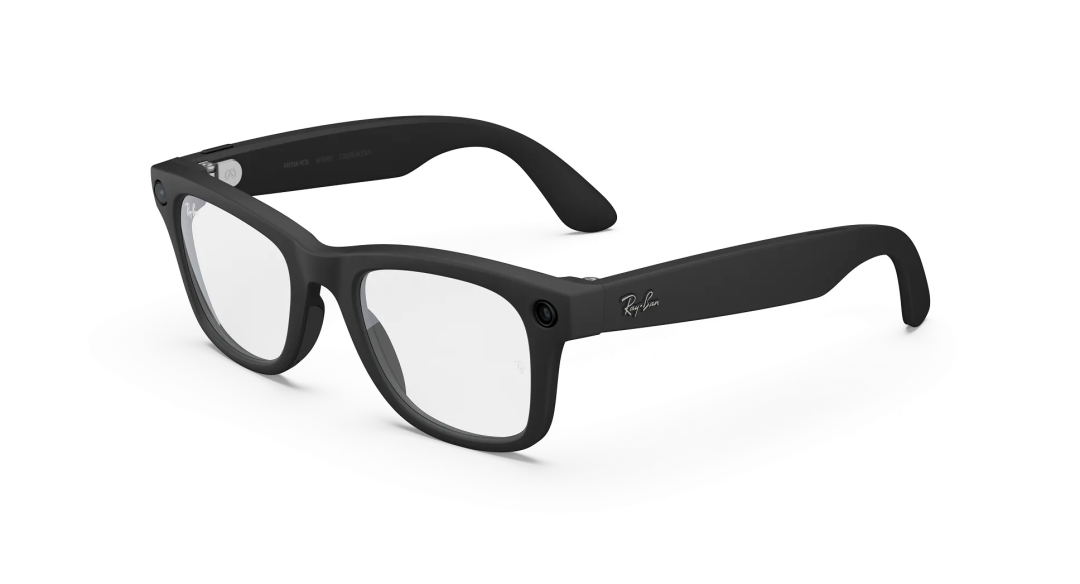
*Image source: Meta official website
Yet, by market size, AI glasses remain a "niche toy," distant from their "iPhone moment." Their 2025 shipments were less than a third of global monthly PC shipments and under a tenth of monthly smartphone shipments. The key to further growth lies in functional richness and scenario applicability.
Currently, most AI glasses focus on first-person recording, real-time translation, near-eye navigation, and voice assistants. These functions see infrequent use; many users find AI glasses idle most of the time, offering limited practicality beyond occasional first-person videos or navigation.
Thus, AI glasses' future path should be as "hands-free, near-eye interactive" smart devices for specific scenarios, not smartphone replacements.
For outdoor enthusiasts, Vloggers, and fitness buffs, first-person video frees hands for more authentic shots. Near-eye navigation eliminates "phone- lower one's head (looking down)" while walking or cycling. Real-time translation aids cross-border travel and foreign language communication.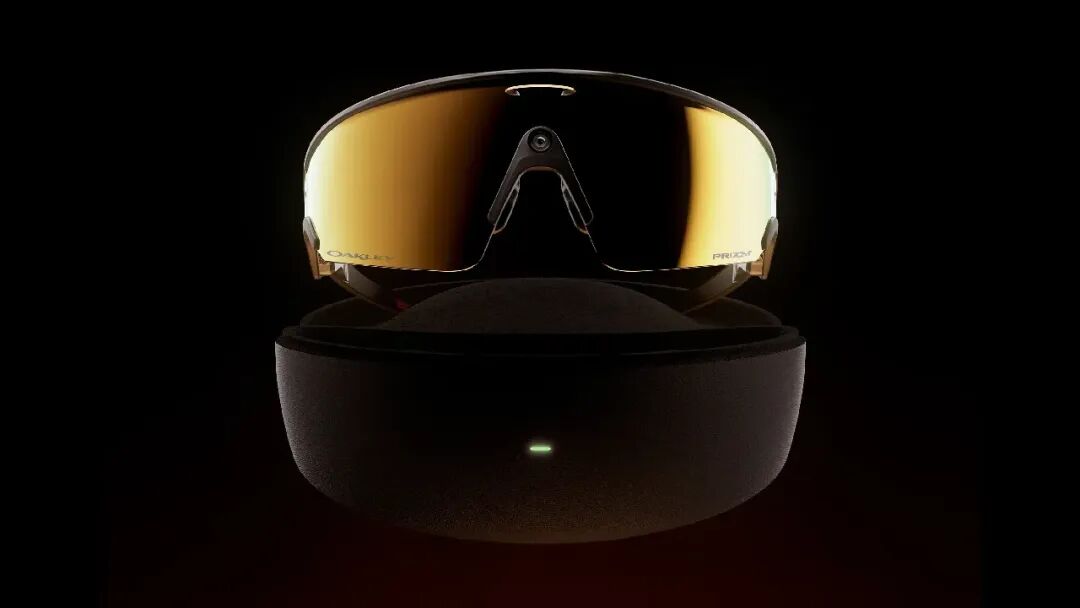
*Image source: Meta official website
Beyond mainstream functions, AI glasses are finding niche applications. Hangzhou Tongxing Technology launched China's first AI glasses for the visually impaired, based on Tongyi Qianwen Qwen-VL and OCR models. Designed for travel (travel) and daily life, they offer obstacle avoidance, object identification, voice assistants, and one-click emergency relatives and friends (relative/friend) alerts, helping the visually impaired integrate better.
The person in charge of Xiaodu Glasses also told Jingzhe Institute that Xiaodu has never positioned AI glasses as a 'smartphone replacement' from the very beginning. In his view, over the next 1-3 years, AI glasses will evolve in the direction of 'making interactions more natural, integrating deeper into scenarios, and creating a more seamless experience.'
In terms of interaction, the focus will shift from 'primarily voice-based' to multimodal fusion, integrating gestures, eye tracking, environmental awareness, and other interaction methods to make interactions more intuitive. In terms of scenarios, the focus will shift from 'finding scenarios' to 'deeply cultivating scenarios.' For example, improving the accuracy of meeting summaries, the practicality of translation, and the image stabilization quality in photography scenarios, thereby establishing genuine barriers through continuous scenario capabilities. In terms of form, various product forms such as business, fashion, and sports models may emerge in the future, and even be customized for different face shapes and scenarios.
Therefore, rather than rushing in blindly with the slogan of 'competing for the next internet entry point,' a product development approach that combines the needs of specific user groups, identifies application scenarios, and creates practical functions is more worth pursuing.
In fact, the potential applications of AI glasses in industries such as industrial manufacturing and healthcare are already becoming apparent. In 2022, Thunderbird Innovation applied AR glasses to 'industrial internet' solutions, providing frontline workers with real-time operational prompts and standardized guidance through a 'virtual-real overlay' approach, thereby reducing human error rates.
In medical scenarios, AI glasses may also follow the example of smartwatches, serving as auxiliary devices to help doctors in rapid diagnosis, remote collaboration, and other scenarios—currently, many AI glasses have also incorporated health data monitoring functions.
Initially, smartwatches were also highly anticipated by major companies as the 'next internet terminal beyond smartphones.' However, in actual development, smartwatches have gradually accepted their role as 'smartphone accessories' and have unleashed significant market potential in specific scenarios. 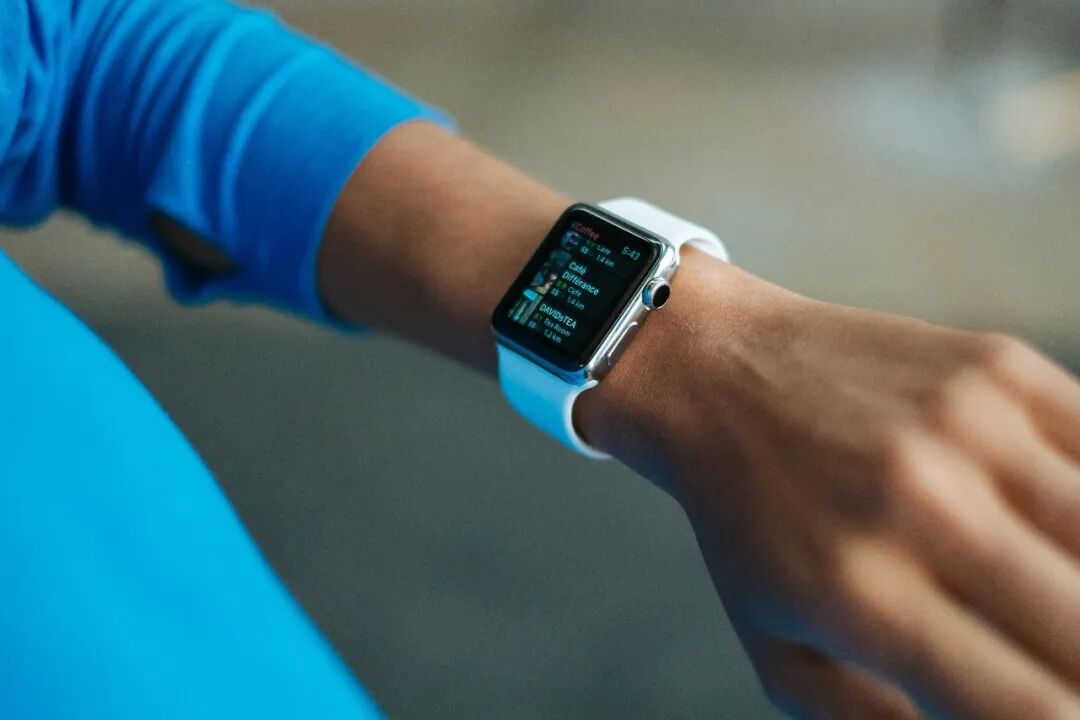
Take sports scenarios as an example. According to a survey by iiMedia Research, nearly 70% of users purchase smartwatches primarily to track their exercise. Another survey by iResearch shows that there are over 400 million running enthusiasts in China.
According to the 'Quarterly Tracking Report on the Global Wearable Device Market' released by the International Data Corporation (IDC), global shipments of smartwatches reached 120 million units in the first three quarters of 2025, representing a year-on-year increase of 7.3%. Meanwhile, shipments in the Chinese smartwatch market reached 40.04 million units, up 21.8% year-on-year, indicating continued rapid growth.
Objectively speaking, AI glasses are far from reaching an 'iPhone moment' in terms of either functional innovation or scenario application. However, this does not prevent AI glasses from following the example of smartwatches and achieving market penetration before the widespread adoption of a new generation of intelligent interaction experiences centered around 'hands-free and near-eye interaction.' While the ideal of becoming the 'next internet terminal' is certainly appealing, the process of technological refinement and product iteration is equally indispensable.
-
![]()
Smartphone Prices Surge Amid Manufacturer Anxiety
-
![]()
Orbbec Soars to Record Heights, Eyes Further Capital Influx of 980 Million!
-
![]()
Tongding Interconnect Sets Up Shop in Shaoguan with 800 Million Yuan in Registered Capital
-
![]()
Before Kimi’s A-Share Debut, Zhipu Aims to Secure More 'Strategic Funding'
-
![]()
Innovative Leap | Fiber-Pluggable 1470nm Laser Source: Revolutionizing Precision Laser Weeding
-
![]()
73-Day Rapid Listing: Where Does Unitree's Wang Xingxing's 'Sense of Urgency' Come From?
-
![]()
AI Project Mindverse, Backed by Meituan, Faces Data Inflation Allegations Over Its Macaron Product
-
![]()
3000-word In-Depth Analysis | What Makes Physical AI So Magnetic? It Has Captivated Masayoshi Son, Jensen Huang, and Justin Sun All at Once