Apple Enters the Arena, Huawei Doubles Down: The Microdisplay Sector for AI Glasses Approaches a 'Tipping Point of Transformation'
 04/23 2026
 500
500
The Divergence and Future of Microdisplay Technologies in AI Glasses
By VR Gyroscope Ran Qixing
In 2026, as news spreads about Apple's plan to launch its first AI glasses, tech giants including Google, Huawei, Meta, Alibaba, Samsung, and Snap are intensifying their efforts, rapidly escalating industry competition.
From a product technology perspective, while AI-powered camera glasses are the current entry ticket, visual interaction represents the inevitable path to the future. At CES 2026, the year's first major tech expo, over 50% of the 59 XR-related companies showcased smart glasses with 'display' capabilities.
Among the many solutions, a notable industry signal has emerged: single-chip full-color Micro-LED has entered real-world glasses products and received public validation on the international stage. At CES 2026, Mojie Technology's 38g binocular full-color AI+AR glasses won the CES Global Innovation Award. At its core, the glasses feature a single-chip full-color Micro-LED optical engine, achieving binocular full-color display in an ultra-lightweight form factor.
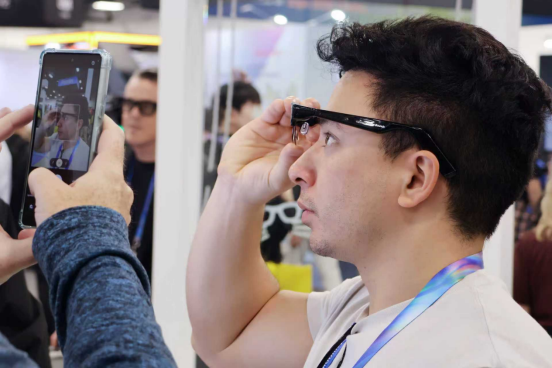
Mojie's 38g binocular full-color glasses (Source: Mojie Technology)
In reality, for AI glasses to deliver 'clear full-color visuals' while remaining 'as light as regular glasses,' the optical system must strike a relative balance between volume, weight, and display performance. In near-eye display optical systems, the choice of underlying microdisplay technology largely determines the product form and limitations of AI glasses. Currently, microdisplay technology is undergoing a cyclical transformation, with industry focus accelerating toward Micro-LED.
01
Early Exploration of Microdisplay Paths: The Limitations and Trade-offs of Micro-OLED Microdisplays and Small-Size LCoS
On the road to the ultimate form, Micro-OLED and LCoS were once highly anticipated, but due to physical limitations, their application boundaries in lightweight AI glasses have become increasingly apparent.
Micro-OLED (silicon-based OLED) microdisplays offer excellent color performance and contrast, with relatively mature manufacturing processes. However, their biggest drawback lies in the 'brightness ceiling.' As an organic light-emitting material, Micro-OLED's lifespan significantly shortens under high-brightness conditions. Faced with the extremely high light loss of waveguide lenses, Micro-OLED's eye-entry brightness struggles to meet outdoor usage demands, making it more suitable for immersive AR devices using Birdbath solutions or VR/MR headsets rather than lightweight AI glasses designed for all-day wear.
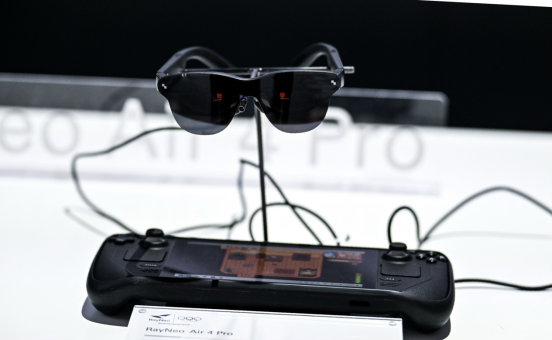
Thunderbird Air 4 Pro (Source: Thunderbird Innovation)
Small-size LCoS (silicon-based liquid crystal on silicon), leveraging its high resolution and cost advantages from mature manufacturing, has become the 'optimal transitional solution' for current full-color demands. Take Magic Leap, an early AR unicorn, as an example—its Magic Leap 2 uses LCoS technology to achieve 1440 x 1760 resolution and a 70-degree FOV, but at the cost of a bulky form factor.
In contrast, Meta's 2025 Ray-Ban Display represents a more minimalist approach to LCoS, compressing the optical engine volume to around 1cc through customization. While sacrificing some resolution and field of view, it successfully achieves a consumer-friendly form. From a market positioning perspective, small-size LCoS solutions suit cost-sensitive products aiming for rapid mass production. However, LCoS inherently relies on external light sources (backlighting), imposing physical limits on optical system miniaturization. As Micro-LED microdisplay technology advances and costs decline, LCoS's competitiveness may gradually weaken.
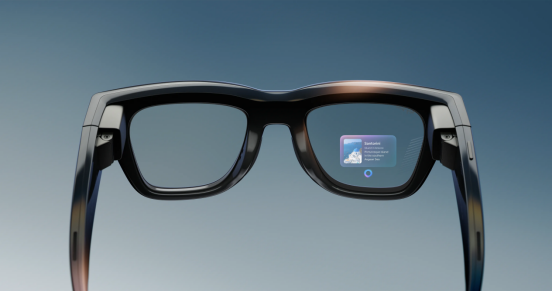
Meta Ray-Ban Display (Source: Meta)
02
Micro-LED Accelerates into Consumer Markets: From Single-Green Trials to Full-Color Adoption
Self-emissive and inorganic-based Micro-LED microdisplay solutions are widely regarded as the 'holy grail' of AI glasses microdisplays, thanks to their high brightness, long lifespan, and potential for simplified optical paths. Within the Micro-LED technology roadmap, clear stage-based advancements are evident.
(1) Single-Green Micro-LED: The Gateway to Lightweight AI Glasses for Information Display
Currently, single-green Micro-LED, with its ultimate (extreme) volume advantages and low power consumption, dominates lightweight information-display glasses.
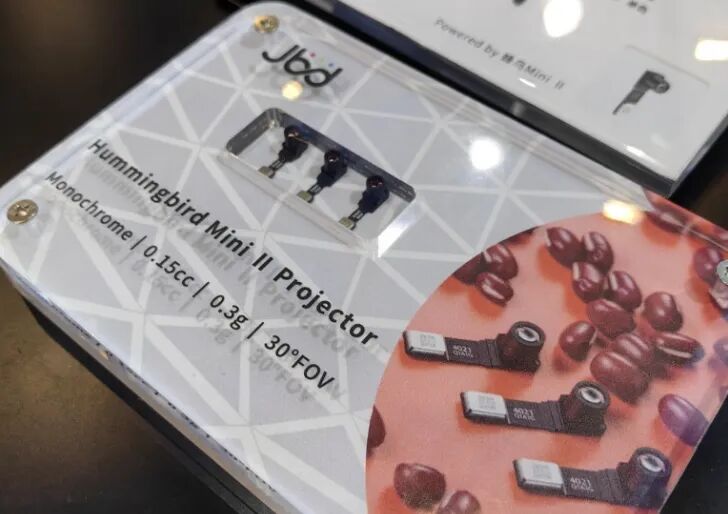
JBD's single-green optical engine (Photographed at OptoElectronics Expo 2025)
Typical examples include Rokid's Leqi glasses, which use single-green Micro-LED with diffractive waveguides to achieve 640x480 resolution and up to 1500 nits of eye-entry brightness while maintaining a 49g weight. Alibaba's Quark AI Glasses S1 employs dual Micro-LED optical engines, delivering up to 4000 nits of brightness at just 51g. These products effectively meet basic needs like teleprompters, navigation, and translation.
From a long-term product evolution perspective, single-green Micro-LED serves as a pragmatic solution during periods of technical immaturity. The true determinant of AI glasses' experience boundaries remains full-color display capability. Meta unveiled its full-color Micro-LED-based AR prototype, Meta Orion, as early as 2024. Rokid has hinted at a potential 2026 release of a full-color Leqi glasses model, while rumors suggest XREAL is developing full-color AI glasses (distinct from its current tethered XR glasses).
(2) Three-Color Combination vs. Single-Chip Full-Color: The Two Paths to Full-Color Micro-LED
The pursuit of full-color Micro-LED microdisplays represents the current trajectory for the entire microdisplay industry. Two primary technical paths have emerged: 'three-color combination' and 'single-chip full-color.' Companies like JBD, Raysun, Hongshi Intelligence, Sitantech, and Saphlux are all active in this space, with varying degrees of commercialization due to differences in underlying materials, manufacturing processes, and strategic focuses.
The color-combination approach achieves full-color display by combining RGB three-panel Micro-LED arrays with a Cube prism. Its advantages lie in relatively mature technology, early mass-production readiness, and its critical role in early full-color Micro-LED products as a transitional solution for industry-wide full-color adoption. However, its limitations are significant—it requires extremely precise physical alignment of three optical paths, involves inevitable light loss through the prism, and the three-panel design makes further miniaturization challenging.
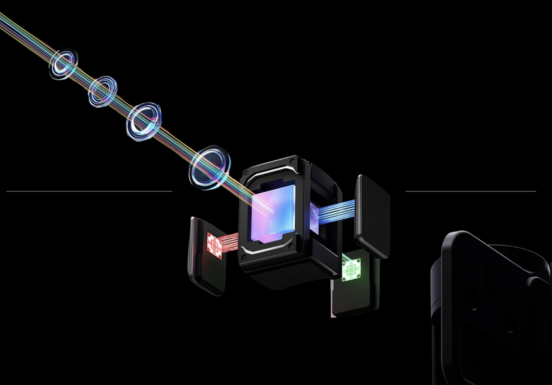
Cube-based Micro-LED color-combination scheme (Source: Online)
In contrast, the single-chip full-color approach is widely recognized as the key breakthrough. As the name suggests, it achieves full-color display with just one chip. Compared to color combination, it eliminates complex physical alignment, offers a more robust structure, and enables significant reductions in optical engine volume, with clear cost advantages for mass production. For example, Mojie's aforementioned 38g glasses use Raysun's 0.13-inch single-chip full-color Micro-LED microdisplay, with its ultimate (extreme) volume advantage directly translating into design space for lightweight glasses.
Delving deeper into single-chip full-color technology, two main routes compete: 'vertical stacking' and 'QD (quantum dot) color conversion,' with the latter gradually gaining traction.
The vertical stacking scheme integrates red, green, and blue light-emitting epitaxial layers sequentially within a single pixel unit, achieving highly overlapping emission regions. Theoretically, this enables ultra-high pixel density and minimal optical crosstalk, aligning well with AR microdisplays' ultra-high PPI requirements. However, this approach demands integrating heterogeneous materials like InGaN and AlInGaP within a single device, involving multiple epitaxial growth steps, wafer bonding, high-aspect-ratio etching, and precise 3D electrode interconnection matched with CMOS backplanes. The process window is extremely narrow, with low mass-production yields and high manufacturing costs. Meanwhile, the substantial investment in bonding and supporting equipment acts as both a research prerequisite and a core barrier to low-cost mass production.
The QD color conversion route circumvents complex multi-color epitaxy and heterogeneous bonding through material substitution. It starts with a mature monochromatic blue Micro-LED array on a CMOS backplane, then deposits red and green quantum dots in corresponding subpixel regions via photolithography or inkjet printing, converting part of the blue light into full-color output. This approach significantly simplifies multi-color epitaxy and 3D stacking but introduces new challenges like quantum dot conversion efficiency and excitation light color purity. 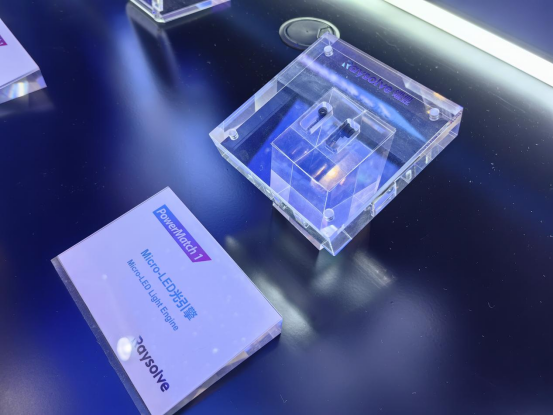
Raysun's single-chip full-color Micro-LED optical engine (Photographed at OptoElectronics Expo 2025)
From a process complexity standpoint, vertical stacking requires multi-layer epitaxy, bonding, and etching across multiple material systems, pushing each step to its process limits. The QD route, by contrast, builds upon mature blue Micro-LED technology and adds quantum dot deposition and encapsulation, offering a shorter development pathway. In terms of yield and cost, vertical stacking suffers from heterogeneous interface and 3D interconnection defects, making high-yield, low-cost mass production difficult in the short term. The QD approach can leverage existing GaN/CMOS production lines, focusing R&D efforts on QD color conversion layer uniformity and reliability, making it widely regarded as one of the more feasible single-chip full-color microdisplay technology routes today.
This explains why single-chip full-color solutions using quantum dot photolithography technology became the first to enter real-world products from Mojie, Zeiss, and other AR optical solution providers in 2026, debuting at CES and SPIE Photonics West. This marked a crucial transition from 'technical validation' to 'product integration validation,' serving as a pivotal milestone in industry development.
03
Final Thoughts
With tech giants like Apple and Huawei entering the fray, the acceleration of the AI glasses industry is now inevitable. Adding microdisplay modules to traditional AI camera glasses has shifted from an 'optional feature' to a 'definite trend.'
Currently, the divergence in microdisplay technologies reflects product positioning differentiation. High-resolution, larger-size Micro-OLED suits Birdbath-based entertainment glasses for movie-watching and VR/MR headsets. Small-size LCoS, leveraging mature technology and cost advantages, will remain active in the AI glasses market in the short to medium term. Single-green Micro-LED, with its ultimate (extreme) energy efficiency, will continue to dominate the lightweight AI glasses segment for basic information display needs in the same period. However, it is clear that full-color Micro-LED will ultimately define the long-term form factor of AI glasses.
This year, single-chip full-color Micro-LED has begun entering real-world product systems and undergoing validation in complete device environments. Whether it achieves true mass-scale application in the coming years will directly shape the competitive landscape of AI glasses.
2026 may well mark the starting point of this watershed moment.
Only when full-color visuals float effortlessly in our field of view, enabling natural and deep interaction with humans, will AR technology's true potential be fully unlocked. 2026 heralds the dawn of this industrial transformation.
-
![]()
"3D Vision Pioneer" Grapples with Internal Strife: $120 Million in Share Reductions Offset by $147 Million Private Placement
-
![]()
The domestic auto sales have declined so much that dealers who can't hold on have started closing stores en masse
-
![]()
Five Brands Team Up with Huawei: Will Dongfeng Still Pursue Independent R&D?
-
![]()
The Large Six-Seater SUV Market: Overhyped and Overrated
-
![]()
The Smart Driving Blue Light: Urgent Need for Rectification
-
![]()
Would OpenAI Be Fascinated by Anthropic’s Concepts?
-
![]()
Tencent: Few Great Queries, Yet Possessing the Ultimate One
-
Does DingTalk Need Revolutionaries or Reformers?