Malaysia’s 100-Inch TV Market Booms: Hisense Secures 48% Market Share in Q1
 05/27 2026
 579
579
In the first quarter of 2026, Malaysia’s color TV market saw a slight overall decline in sales. However, a closer look at the market structure reveals a more significant trend of differentiation.
One notable shift is the sustained increase in demand for large-screen TVs. But this growth is not evenly spread; instead, it is concentrated within specific size categories.
From a brand performance perspective, Hisense has established a strong presence across multiple size segments, consistently ranking high overall. However, its leadership is not confined to a single niche—it is expanding across a range of sizes simultaneously.
At a chain store in Kuala Lumpur, a salesperson’s observation reflects this trend: “The 55-inch is still the most popular size customers ask about, but many end up comparing larger models after browsing.”
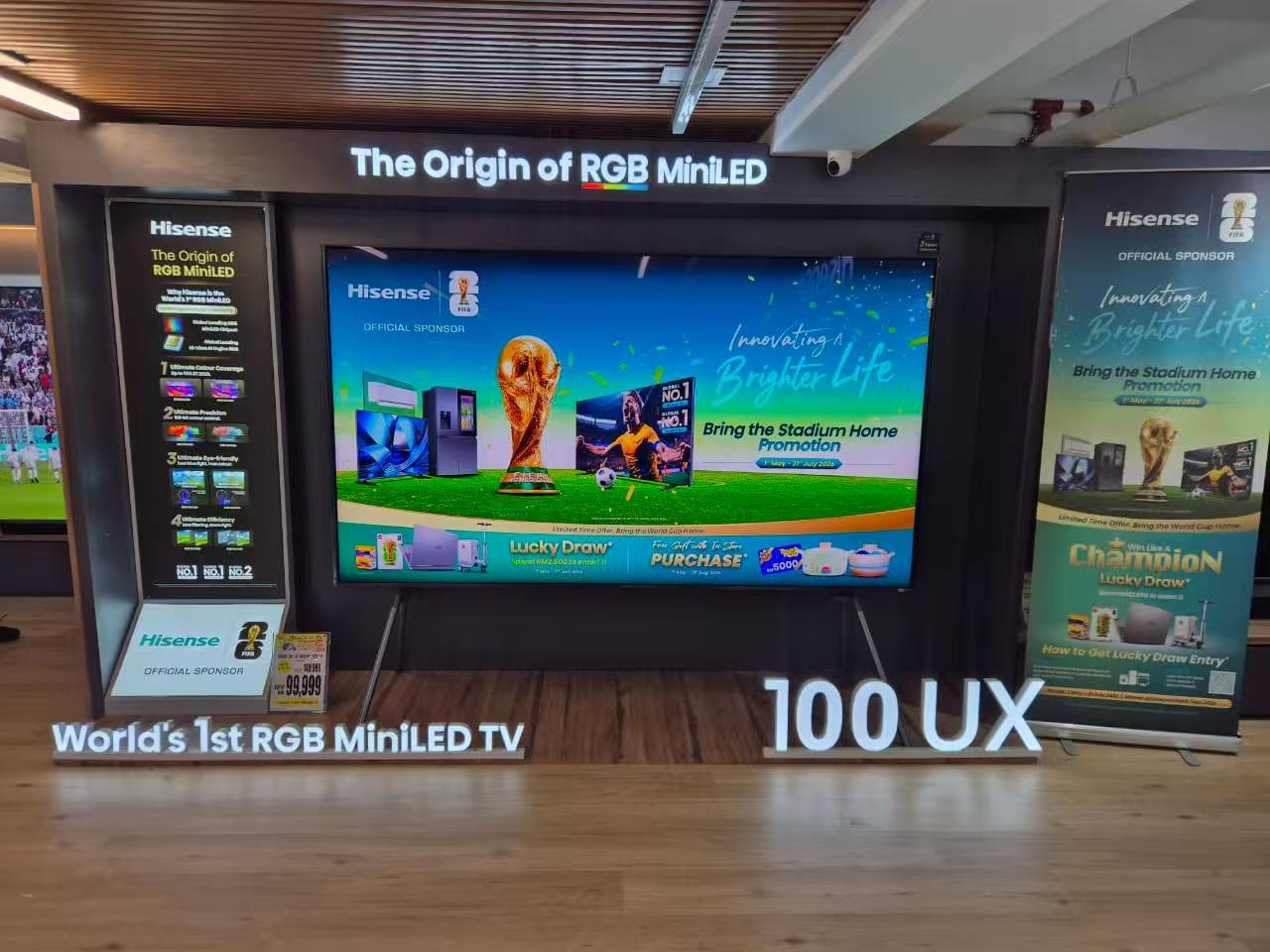
55-Inch TVs Remain Dominant but Are No Longer the Only Growth Engine
From a broader structural standpoint, the 55-inch remains the most popular size in Malaysia’s TV market.
According to AVI data, the 55-inch ranked first in sales during the first quarter, with a year-on-year increase of approximately 20%. Its stability appears to stem from its long-established market position rather than being driven by a single factor.
In terms of pricing, the 55-inch strikes a balance: it is noticeably larger than the 50-inch while generally avoiding the steep price hike associated with the 65-inch.
Practical considerations also play a role. Malaysia’s housing landscape, dominated by apartments and terraced houses, typically features living room viewing distances of 2 to 3 meters—conditions under which the 55-inch is a reliable choice.
However, a distributor in Penang noted, “While the 55-inch still sells the most, profit margins are thinner than they were a few years ago.”
In some physical stores, the 55-inch requires minimal explanation to customers, often serving as the default option.
Thus, its continued dominance seems to be a combination of pricing, spatial constraints, and entrenched consumer habits.
100-Inch TVs Experience Rapid Growth, Fueled by Multiple Drivers
Compared to the 55-inch, the 100-inch segment is undergoing more dramatic changes.
AVI data shows that 100-inch TV sales in Malaysia surged by 181% year-on-year in the first quarter, the fastest growth rate among all size categories.
However, feedback from retail channels suggests that the 100-inch market is still evolving and appears to be driven by a confluence of factors.
While prices are indeed declining, the primary driver of sales is the upgrade cycle—consumers moving up from 75-inch and 85-inch models.
At a store in Johor, a salesperson observed, “Many customers show interest, but they often take time before making a decision.”
Some stores report that 100-inch TVs are becoming more visible but are still primarily displayed in showcase areas rather than being the main focus of sales efforts.
Opinions vary across different retail channels.
Hisense Captures Nearly Half of the 100-Inch Market
In this dynamic segment, Hisense has established a strong foothold.
AVI data indicates that Hisense accounted for approximately 48% of Malaysia’s 100-inch TV market share in the first quarter.
This level of market concentration is relatively high for the current stage of development.
Traditionally, this market was dominated by Samsung and LG. However, in niche segments like the 100-inch, which rely heavily on supply chain efficiency and size availability, the competitive landscape is shifting. Success now hinges not just on individual product performance but also on supply timing and comprehensive size offerings.
Hisense’s strength lies more in its strategic rhythm and product coverage than in the success of a single model.
85-Inch TVs Emerge as a Key Transitional Segment, Beyond Just 100-Inch
Focusing solely on the 100-inch segment would overlook broader structural shifts in the market.
AVI data reveals that among the top 10 models in the industry, Hisense has three products listed—more than any other brand.
In the 85-inch category, Hisense’s 85A7Q, 85Q6Q, and 85U6 rank first, third, and seventh, respectively.
The 85-inch size occupies a unique position—it is neither a traditional mainstream size nor fully part of the 100-inch narrative. Instead, it serves as a transitional option for consumers upgrading from 75-inch models.
In actual sales, some stores describe this size as straightforwardly as: “More expensive than the 75-inch, but not yet requiring serious budget planning.”
Thus, it functions more as a stepping stone than an independent high-end category.
From this perspective, Hisense is building a continuous size portfolio rather than relying on a single standout model.
Large-Screen Market Consolidates Around Top Brands
In the 75-inch segment, AVI data shows that among the top 10 models, LG holds three spots, while Hisense and Samsung each have two, collectively accounting for seven positions.
This structure indicates a clear trend: top models are consolidating, but the market remains competitive.
At some retail stores, this shift is more tangible—certain models perform well, but differences between stores persist.
March Data Reinforces Structural Shifts
Examining single-month data provides additional insights.
AVI’s March figures show that Hisense ranked first in TV sales volume market share and second in sales value market share, with Samsung leading in sales value.
This structure is revealing. Leading in sales volume suggests strong channel penetration, while trailing slightly in sales value indicates ongoing efforts to improve the product mix.
Some channels also note, “Sales are brisk, but the high-end segment is still developing.”
Thus, the strategy appears to be: secure market scale first, then gradually enhance the product portfolio.
Large-Screen Adoption Continues to Rise
When viewed as a whole, the first-quarter data shows that the 55-inch remains stable, large-screen adoption continues to grow, and the 100-inch market is becoming more defined.
However, these changes are not uniform; they are concentrated within specific size segments.
Hisense’s performance involves covering multiple key positions simultaneously, but evaluations from different channels vary—some view its lineup as relatively complete, while others believe its high-end offerings are still evolving.
In this structure, competition is no longer just about individual products but about the ability to offer a comprehensive size range.
The difference between brands lies not in a single size but in their capacity to continuously fill gaps across sizes and create a cohesive upgrade path.
Hisense currently sits at the center of this structural transformation.
-
Ofilm Teams Up with ADSensE to Propel Large-Scale Deployment of All-Solid-State LiDAR Powered by ADS6311 Chip!
-
![]()
Loss of 2.5 Billion Yet Facing Strong Demand for Shares? Another Battle for Control of Lianchuang Electronics
-
![]()
Huawei’s Enjoy Series Flies Off the Shelves, Prompting Xiaomi to Double Down on Budget Smartphones
-
![]()
Beijing Hyundai's Top Executive Criticizes Industry Disorder: Certain Brands Treat Customers as Beta Testers
-
![]()
The domestic mobile phone market has declined for five consecutive quarters! Huawei defies the trend with significant growth: maintains its top market share
-
Annual Revenue Surpasses 3 Billion: An Automotive Trim 'Little Giant' Makes Its Debut on the Beijing Stock Exchange
-
![]()
The Space Force Wants to Spend $30 Billion on Rocket Launches: Is Trump Doubling Down, and Is SpaceX the Big Winner?
-
![]()
Going Crazy! One out of Every Three Plug-in Hybrids Sold in Europe is a Chinese Vehicle