After Being Used to Android Phones, I Snagged a Cheap New iPhone for 2500 RMB and It’s Actually Awesome
 05/28 2026
 690
690
Who Is the Budget iPhone Suited For?
From a business perspective, the iPhone Air is far from a successful product, but it has gained popularity among geek enthusiasts. At least, in the Leitech editorial department (ID: leitech), nearly everyone owns an iPhone Air.
They love this phone primarily because it is an extremely slim and lightweight model, offering a fresh experience in today's era of highly homogenized smartphones. Of course, the iPhone Air has obvious shortcomings, which is why they mostly use it as a backup phone.
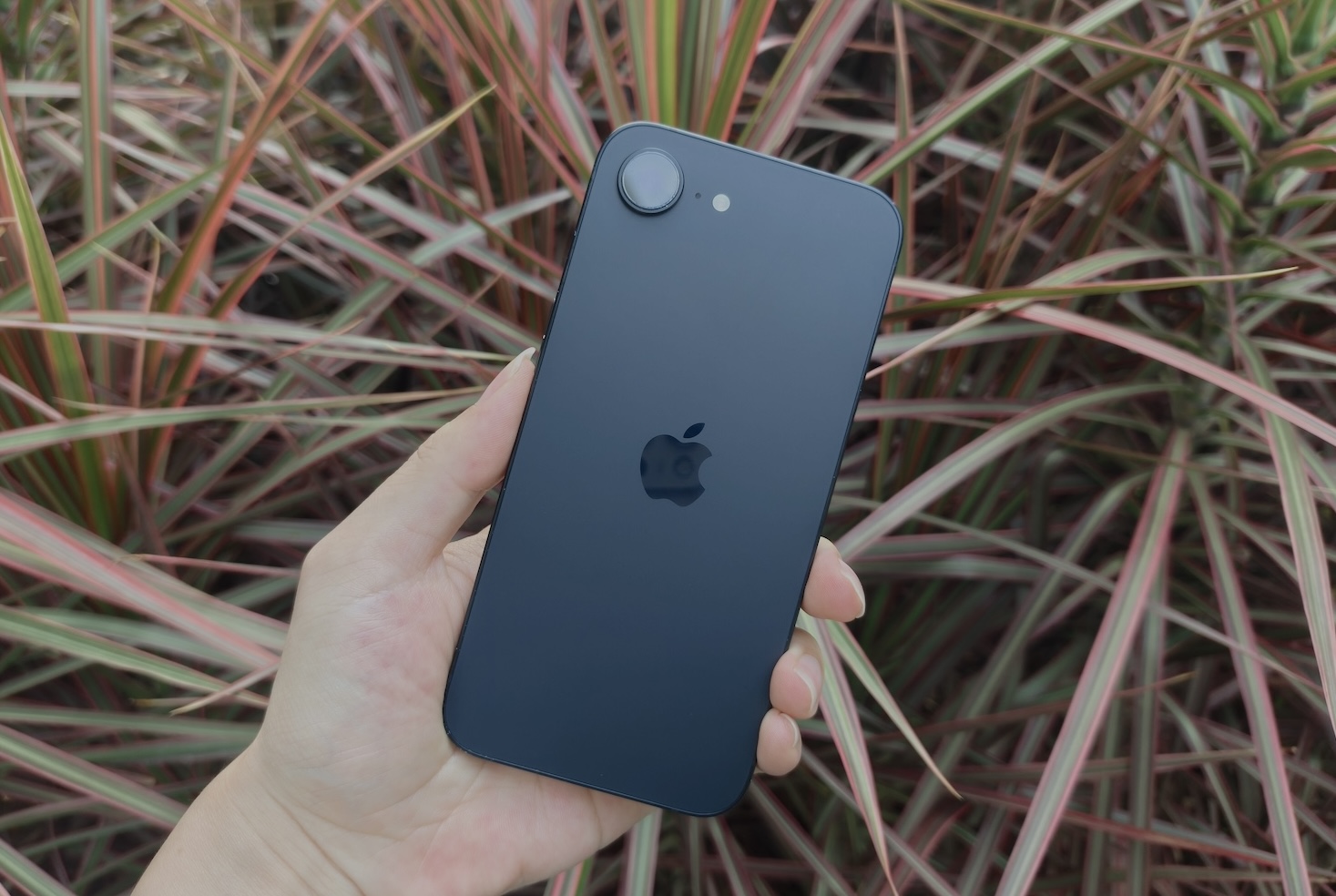
In recent years, my primary device has always been an Android, and I suddenly got the idea of buying an iPhone as a backup. However, my budget was limited, and the iPhone Air, priced at over 5000 RMB, was a bit expensive. After much deliberation, I ultimately opted for the iPhone Air's "budget alternative"—the iPhone 16e.
(Image Source: Leitech)
Undoubtedly, the iPhone 16e is a budget iPhone with unremarkable configurations and design, but after using it for a month, I can still clearly perceive its advantages. Next, I will share my experience over the past period.
Why Did I Choose the 16e as a Backup Phone?
My requirements for an Apple backup phone are not complicated, with price and performance being the core factors. First, I wanted to keep the budget under 3000 RMB; spending five or six thousand on a backup phone seemed too extravagant. Second, the performance didn't need to be extremely powerful, but at least it shouldn't lag during daily use.
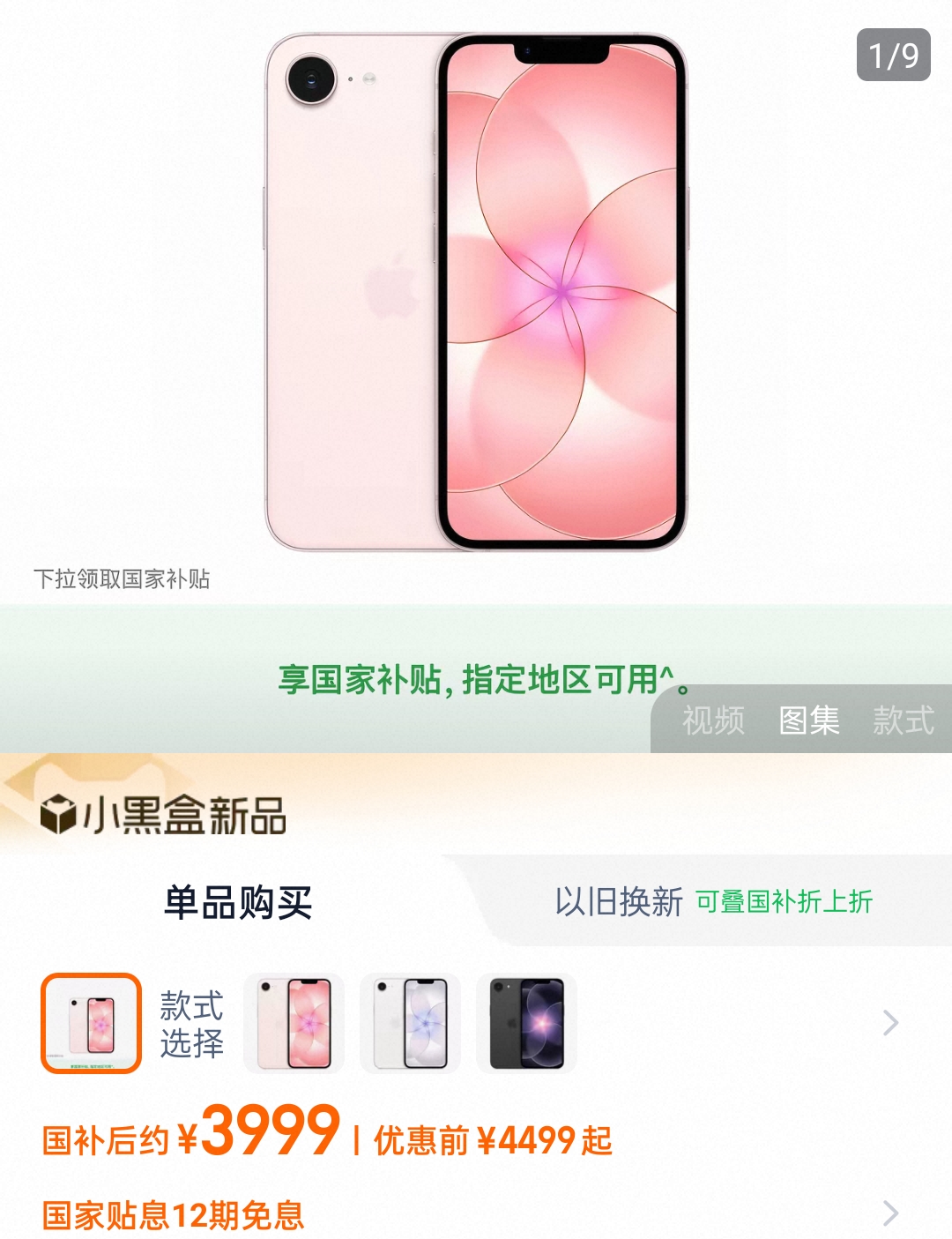
With a 3000 RMB budget, the iPhone 17 series was out of reach. Even the cheapest iPhone 17e, the Chinese version, would cost 3999 RMB even with subsidies and discounts, making it more sensible to spend a bit more for the iPhone 17.
(Image Source: Taobao)
Of course, if I bought a U.S. version locked iPhone 17e, I could get it at that price, but the restrictions on using a locked physical SIM were too numerous, so I dismissed that option. Ultimately, the iPhone 16e met my requirements.
After briefly debating between the Chinese version and international versions, I chose the latter mainly for eSIM functionality and future AI capabilities. There are many options for international versions, primarily the Japanese, U.S., and Hong Kong versions.
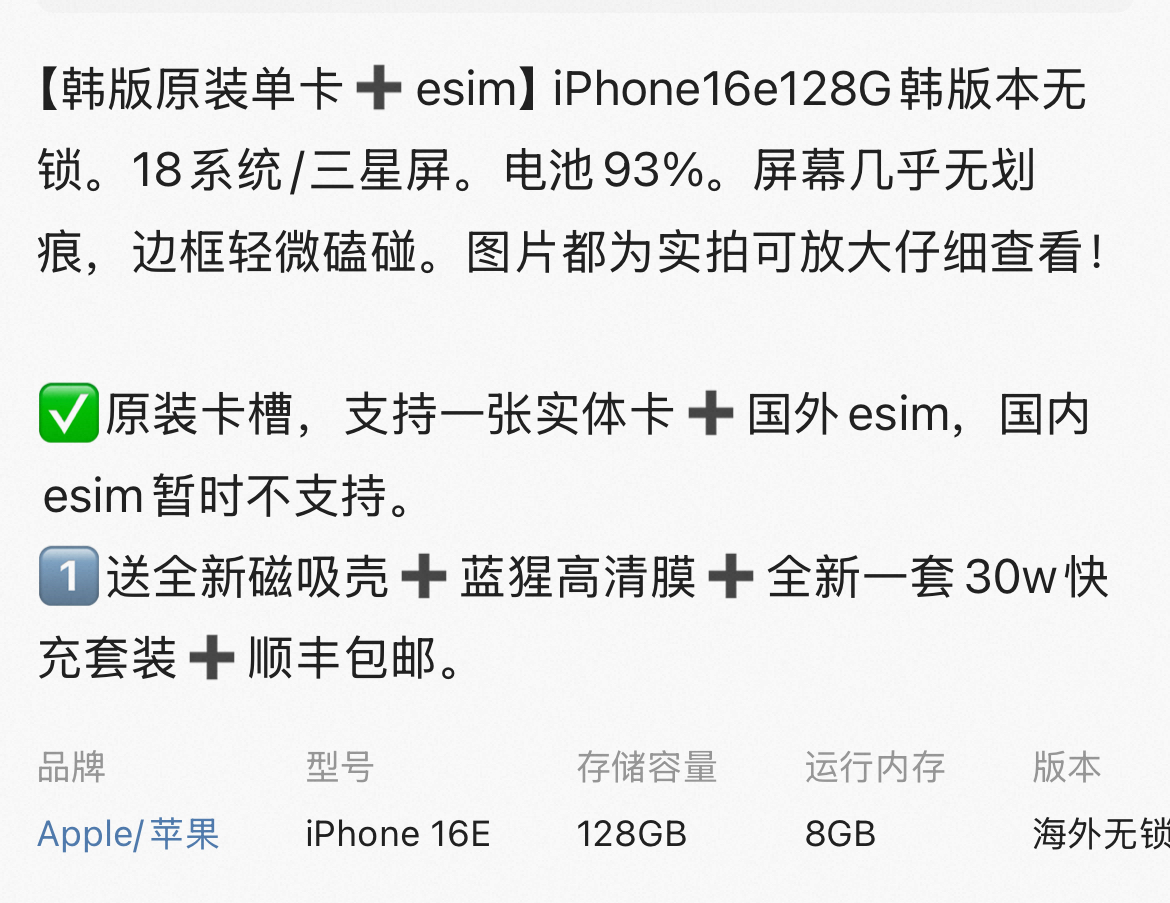
The U.S. version iPhone 16e lacks a SIM card slot, so to use a mainland Chinese SIM card, the seller would need to open a slot, inevitably requiring disassembly. In the end, I opted for a second-hand Korean version iPhone 16e, which has a native SIM card slot and also supports eSIM.
(Image Source: Xianyu)
The phone's condition was decent, with 93% battery health, which was acceptable, and the price was just over 2500 RMB, offering relatively good cost-effectiveness.
The iPhone 16e was released in Spring 2025, equipped with the A18 chip and 8GB of RAM. Compared to the iPhone 16, the main compromises are in the camera (single lens), screen (notch display, no Dynamic Island), wireless charging (no Qi2 support, no magnetic charging, max 7.5W), and UWB (no Ultra-Wideband precise finding).
Decent Daily Performance and Photography, Surprising Battery Life
The A18 chip is still competitive today, and the iPhone 16e offers high smoothness in daily use. Since I don't play large mobile games, I haven't encountered any performance bottlenecks leading to lag. The screen is a 60Hz OLED, while my primary Android device has a 120Hz high refresh rate. However, I'm not very sensitive to the lower screen refresh rate during daily use, so I didn't notice a significant drop in smoothness.
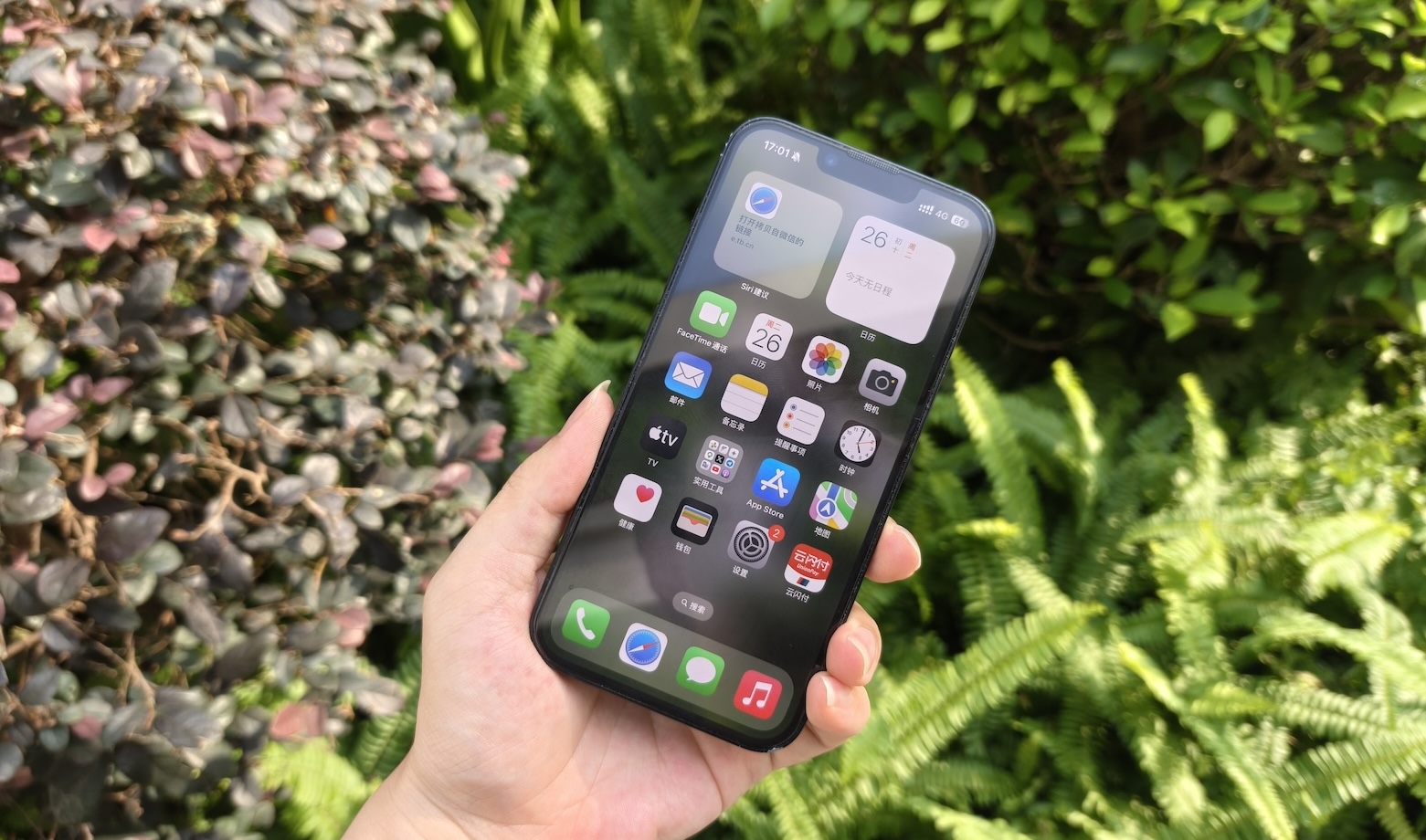
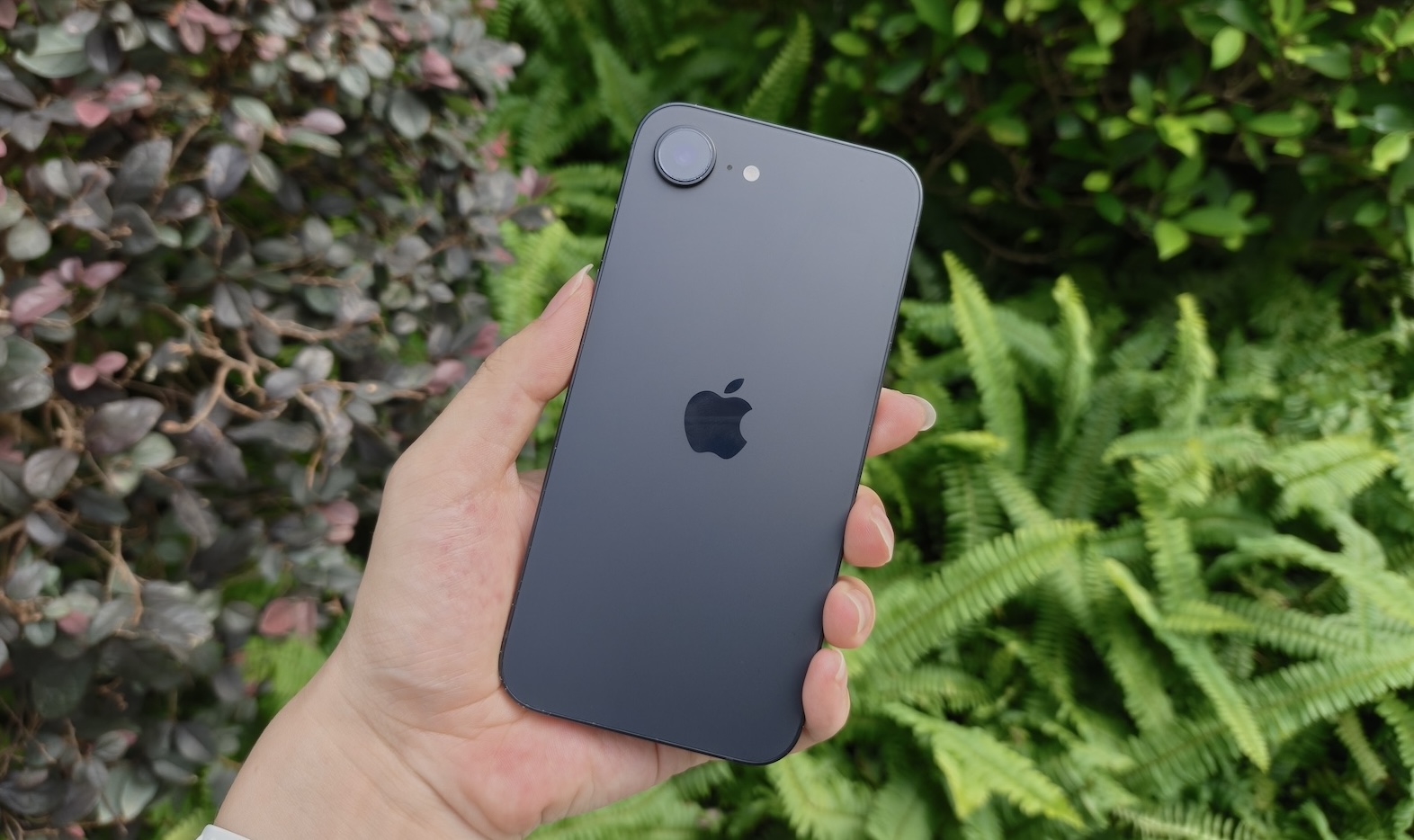
The iPhone 16e is a 6.1-inch small-screen phone, with the significant advantage of controlled weight at only 170 grams, feeling quite light compared to my 200+ gram Android device. As for aesthetics, the iPhone 16e is quite ordinary, as not many products still use a notch display design these days.
(Image Source: Leitech)
A pleasant surprise was the battery life. The iPhone 16e has a battery capacity of around 4000mAh, larger than that of the iPhone 16 and iPhone 17. Even accounting for battery degradation, its actual capacity is about 3600mAh, considered a standard capacity for an iPhone, though small for an Android device.
In terms of battery life, my daily usage mainly includes browsing Bilibili videos, Xiaohongshu, WeChat, and map navigation. A simple test showed that with 5G network and manual brightness set to half, one hour of Bilibili 1080P video playback consumed about 12% battery; half an hour of Xiaohongshu browsing consumed about 5%. Most of the time, moderate usage throughout the day is not a problem. It's worth mentioning that the iPhone 16e uses Apple's self-developed C1 baseband, which has lower peak speeds than Qualcomm's baseband but offers better power efficiency.
As for photography, I didn't have high expectations for the camera from the start, as it lacks both ultra-wide and telephoto lenses. The single 48-megapixel main camera is only sufficient for daily use, producing decent photos in well-lit conditions during the day, as long as you don't compare it to Android flagships.
In less complex scenarios, the sample photos are quite good, with accurate color reproduction and no major issues.

(Image Source: Leitech)
In more complex scenarios, the photos tend to show some weaknesses, with reduced edge sharpness.

(Image Source: Leitech)
A feature I'm very satisfied with is eSIM. The only physical SIM card slot is used for a mainland Chinese mobile SIM card, while the second card can be activated for overseas data services via eSIM, which is very convenient for international travel.
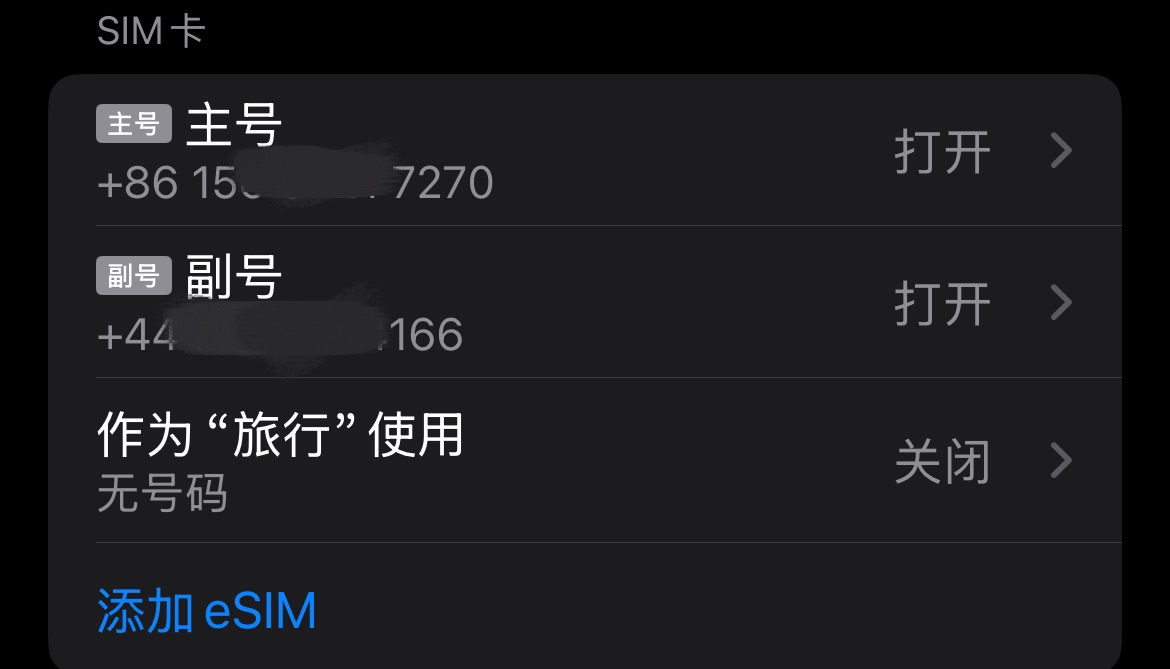
(Image Source: Leitech)
Moreover, international version iPhones generally have no eSIM storage limits, allowing you to activate multiple SIM cards in advance in mainland China and manually switch between them in different regions. eSIM truly enables phones to easily purchase SIM cards and data plans, switching anytime and anywhere, eliminating the need to buy physical SIM cards online or offline.
Why Do the 16e and iPhone Air Have Opposite Fates?
Frankly, the iPhone 16e has a weak presence, far less than the iPhone Air, but in terms of market performance, the former has been much more successful. Market research firm Counterpoint releases a global top 10 best-selling phones list every quarter. The iPhone 16e, released in February 2025, made it to 22nd place in Q1 just over a month after its release, jumped to sixth place in Q2, and ranked fourth in Q3, just behind other members of the iPhone 16 series. In contrast, even with a 2000 RMB price drop, the iPhone Air's shipments didn't increase significantly.
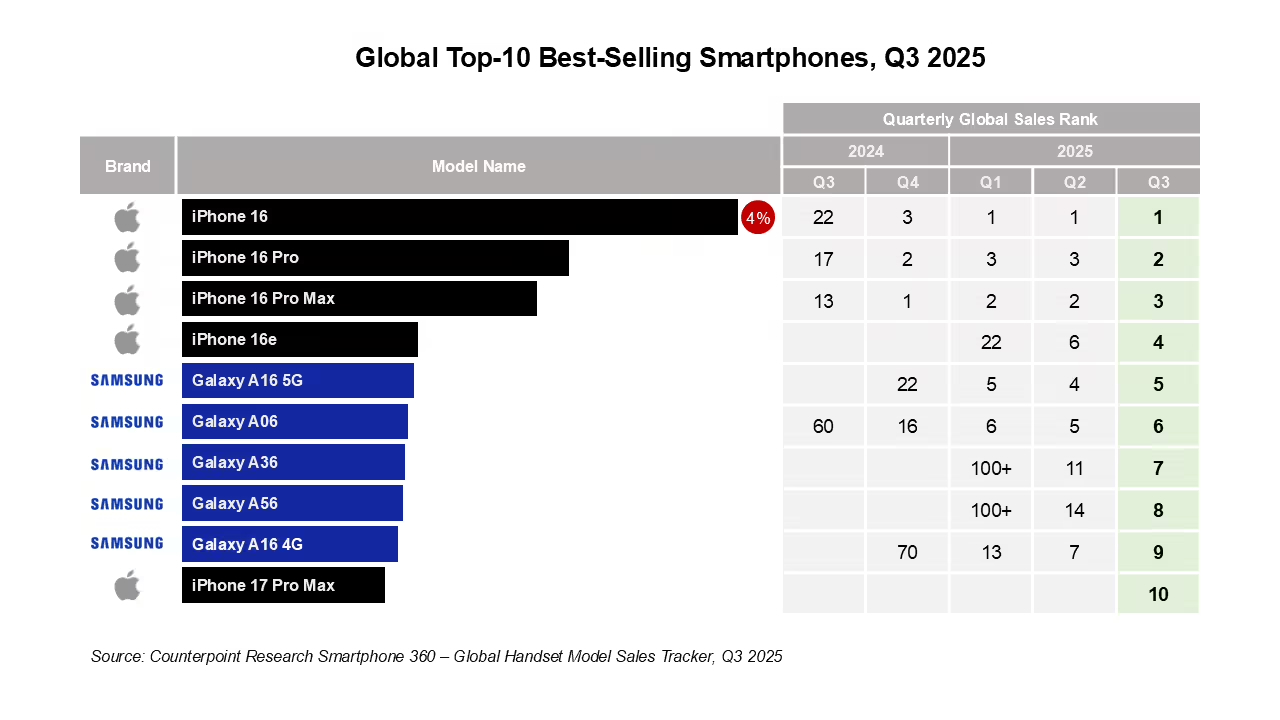
(Image Source: Counterpoint)
The iPhone 16e's positioning is clear: it's a simplified version of the iPhone 16, retaining core configurations like performance, Face ID, and OLED screen, but making significant compromises in camera and design. Thus, this phone is labeled as budget and practical.
Of course, the iPhone 16e's target audience is not existing iPhone digital series users. Those who have consistently upgraded from the iPhone 14 Pro to the iPhone 15 Pro are likely to choose the iPhone 16 Pro or iPhone 17 Pro next, rather than suddenly opting for a lower-positioned, less-featured iPhone 16e or iPhone 17e.
Ultimately, Apple launched the iPhone e series to attract Android users and seek market growth. Apple hopes these users will further increase their likelihood of purchasing Apple services and other hardware products through the iPhone e series.
(Image Source: Leitech)
The iPhone Air is clearly different; it's positioned higher than the iPhone 17, attempting to attract target users of the iPhone 17 Pro. However, the problem is that the iPhone Air is not a well-balanced product, failing to meet the broadest user needs. Sacrificing key features and experiences like camera, speaker quality, and USB-C speed for the sake of a single selling point—slimness— It's destined iPhone Air It can only be a niche product 。
Interestingly, on the surface, the key configurations cut from the iPhone 16e and iPhone Air seem similar, but their positioning is vastly different. The iPhone 16e, while compromised, is relatively cheap and has a clear positioning, allowing it to achieve decent sales. From my personal experience, I was aware of its shortcomings from the start and had sufficient psychological expectations, so I was more forgiving of the imperfections I encountered during use.
The iPhone Air is different. When consumers spend five, six, or even seven or eight thousand RMB on a flagship iPhone, only to find that many basic features done well by mid-range phones are missing, they will inevitably be greatly disappointed. Based on existing leaks, a second-generation iPhone Air will be released, but if the product form remains unchanged and the original flaws are not addressed, it will likely continue the failure of the first generation.
Who Is the iPhone 16e Suited For, and Who Is It Not Suited For?
Based on my experience over the past month, I am quite satisfied with the iPhone 16e. Its battery life, especially on cellular networks, exceeded expectations, while daily use was quite smooth, and the convenience of eSIM functionality was fully utilized during international travel.
However, I am also aware that the iPhone 16e is not suitable for everyone, as its drawbacks are quite apparent and do not match the needs of many people.
It is almost certain that it is not suitable as a primary device.
As mentioned earlier, as a budget iPhone, it compromises too much. The camera is significantly downgraded, and anyone who cares a bit about mobile photography can rule it out based on this alone. The low wireless charging power and lack of magnetic charging are also intolerable for those accustomed to MagSafe. Additionally, the lack of UWB and high refresh rate screen will make many people very unhappy.
Without the Apple brand's halo, its cost-effectiveness still cannot match that of Android devices.
Even with soaring storage prices, at 2500 RMB, you can still buy many high-performance, cost-effective products among domestic Android devices. For example, during the 618 promotion, the Xiaomi 15, with a 12+256GB version priced around 2500 RMB, features the Snapdragon 8 Elite chip, 120Hz high refresh rate screen, 50W wireless fast charging, and Leica full-focal-length triple cameras, with better configurations than the iPhone 16e in every aspect.
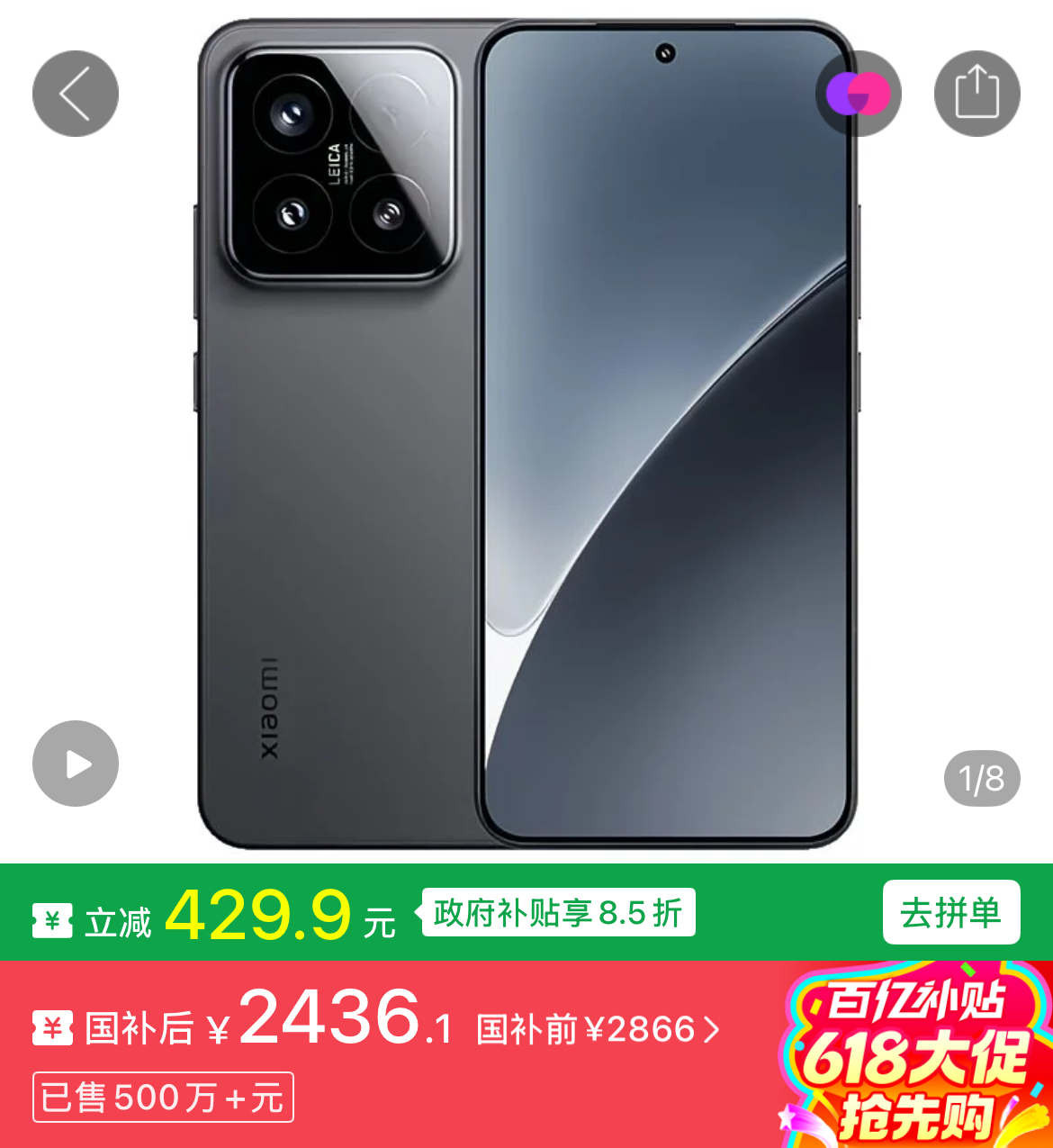
(Image Source: Pinduoduo)
Who is the iPhone 16e suited for?
Those reliant on the Apple ecosystem who need an iPhone, as the 16e has all the core configurations and functions at a relatively cheap price, meeting their needs.
Tech novices who dislike hassle, such as middle-aged and elderly people, for whom using an iPhone is relatively more worry-free than an Android device.
Those who need the iPhone's "international" features, including frequent international travelers like foreign trade personnel. Most iPhones, regardless of version, support a wide range of frequency bands, ensuring compatibility with local base station networks worldwide; full-featured NFC supports various protocols, making it convenient to directly activate local virtual transit cards; the App Store with foreign region IDs allows easy downloading of overseas apps; eSIM enables users to conveniently purchase local data plans for internet access in every place.
Overall, the iPhone 16e has very apparent strengths and weaknesses, and the suitable user base is not as broad as that of universal products like the iPhone 17. Ultimately, whether to buy it depends on whether your needs match its offerings.
Apple iPhone iPhone 16e Smartphone iPhone Air
Source: Leitech
All images in this article come from the 123RF licensed image library. Source: Leitech
-
Ofilm Teams Up with ADSensE to Propel Large-Scale Deployment of All-Solid-State LiDAR Powered by ADS6311 Chip!
-
![]()
Loss of 2.5 Billion Yet Facing Strong Demand for Shares? Another Battle for Control of Lianchuang Electronics
-
![]()
Huawei’s Enjoy Series Flies Off the Shelves, Prompting Xiaomi to Double Down on Budget Smartphones
-
![]()
Beijing Hyundai's Top Executive Criticizes Industry Disorder: Certain Brands Treat Customers as Beta Testers
-
![]()
The domestic mobile phone market has declined for five consecutive quarters! Huawei defies the trend with significant growth: maintains its top market share
-
Annual Revenue Surpasses 3 Billion: An Automotive Trim 'Little Giant' Makes Its Debut on the Beijing Stock Exchange
-
![]()
The Space Force Wants to Spend $30 Billion on Rocket Launches: Is Trump Doubling Down, and Is SpaceX the Big Winner?
-
![]()
Going Crazy! One out of Every Three Plug-in Hybrids Sold in Europe is a Chinese Vehicle