Xiaomi and Tecno Finally Harvested the 'Black Dividends' of the AI Era in 2026!
 05/29 2026
 438
438
While many companies are enjoying the 'red dividends' of the AI boom, leveraging AI for product testing, project research, and development, thereby reducing reliance on manual labor, two companies have faced significant challenges, reaping what could be termed the 'black dividends' of this era.
These two companies, Xiaomi and Tecno, are prominent players in the mid-to-low-end smartphone market.
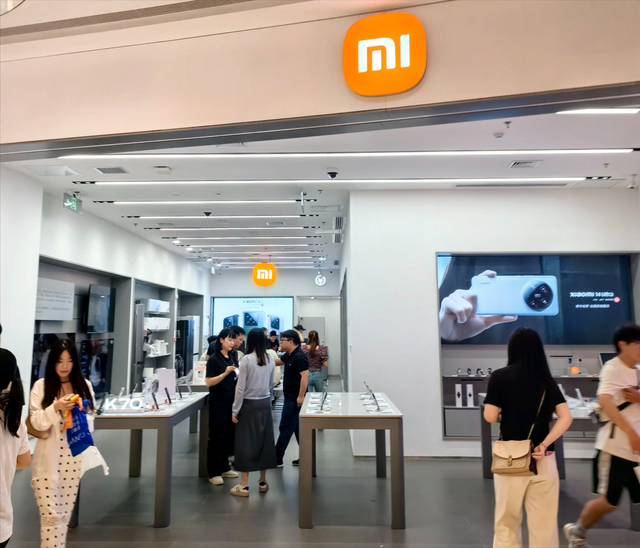
Why do we refer to their experience as reaping the 'black dividends' of the AI era? The rationale is straightforward: the AI boom has triggered a sharp increase in memory prices, effectively killing off the market for 'cheap smartphones.' Given that Xiaomi and Tecno primarily focus on budget smartphones, they have naturally been hit hard.
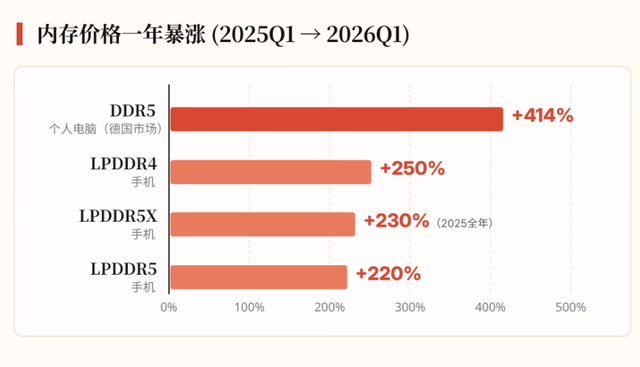
Let's delve into the data. According to industry institutions, memory prices have surged dramatically over the past year.
Specifically, DDR5 memory for personal computers has seen a 414% increase, while LPDDR4 mobile memory has risen by 250%, LPDDR5X memory by 230%, and LPDDR5 memory by 220%—at least doubling in price.
For a budget smartphone costing around 1,000 yuan, the cost of 8GB of memory was approximately 100 yuan (contract price, not retail). After a 200% increase, this cost has risen by more than 200 yuan.
However, the profit margin for a budget smartphone for manufacturers is only about 20-50 yuan, meaning they actually incur a loss of 150-180 yuan per unit sold. Consequently, smartphone prices have no choice but to rise.
Furthermore, a phone that originally cost 1,000 yuan would theoretically need to increase to 1,200 yuan to avoid losses. But will consumers still buy it at this new price point? Some will, but sales will inevitably decline.
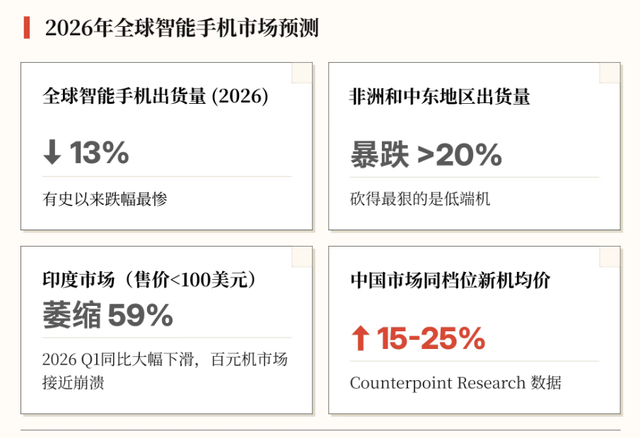
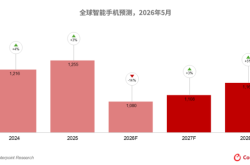
Here's another set of data, this time showing the predicted global smartphone market situation in 2026, as forecasted by industry institutions.
It is evident that global sales are predicted to decline by 13%, the worst drop on record, with regions like Africa and the Middle East experiencing declines of over 20%, and the Indian market for phones under $100 possibly dropping by 59%.
Clearly, in less economically developed regions where the average selling price of smartphones is lower, the decline in sales will be more pronounced due to heightened price sensitivity. If a phone that originally cost 1,000 yuan now costs 1,200 yuan, who will be willing to buy it?
On the other hand, more expensive phones have larger profit margins, and users are less price-sensitive, so they will be less affected by these price increases.
Tecno and Xiaomi (primarily through its Redmi brand) are highly popular in India, Africa, and the Middle East. With such a significant drop in sales, they will naturally be the most affected.
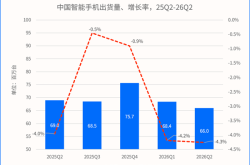
While Tecno's specific data remains unknown, Xiaomi's performance is public knowledge: global sales dropped by 19% in the first quarter, and sales in the Chinese market dropped by 35%, making it the worst performer among the top five brands.
Looking ahead, as AI continues to surge in popularity and demands large amounts of HBM and server memory, storage manufacturers like Samsung, SK Hynix, and Micron will increasingly shift their production capacity towards AI. Consequently, mobile memory production will decline, and prices will continue to rise.
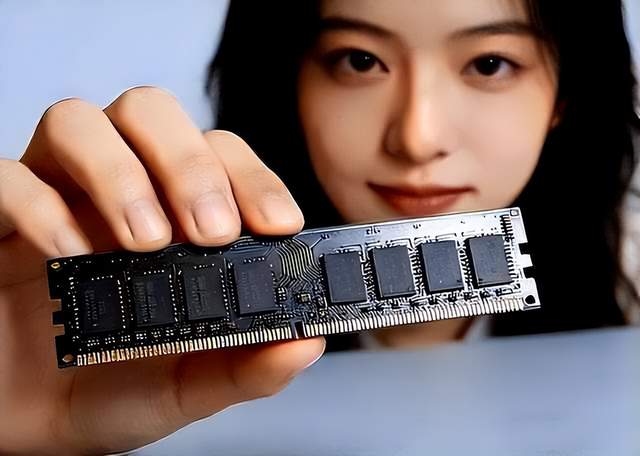
For manufacturers like Xiaomi and Tecno, this situation is truly adding insult to injury.
Previously, memory might have been one of the core components but not the most critical. However, for some low-end Android phones today, memory has become the most expensive component.
In any case, the future will see fewer and fewer budget smartphones, especially those offering 'high specs at a low price,' which are now almost impossible to find. Xiaomi and Tecno have truly harvested the 'black dividends' of the AI era in 2026, and it's a particularly dark chapter for them.
-
Ofilm Teams Up with ADSensE to Propel Large-Scale Deployment of All-Solid-State LiDAR Powered by ADS6311 Chip!
-
![]()
Loss of 2.5 Billion Yet Facing Strong Demand for Shares? Another Battle for Control of Lianchuang Electronics
-
![]()
Huawei’s Enjoy Series Flies Off the Shelves, Prompting Xiaomi to Double Down on Budget Smartphones
-
![]()
Beijing Hyundai's Top Executive Criticizes Industry Disorder: Certain Brands Treat Customers as Beta Testers
-
![]()
The domestic mobile phone market has declined for five consecutive quarters! Huawei defies the trend with significant growth: maintains its top market share
-
Annual Revenue Surpasses 3 Billion: An Automotive Trim 'Little Giant' Makes Its Debut on the Beijing Stock Exchange
-
![]()
The Space Force Wants to Spend $30 Billion on Rocket Launches: Is Trump Doubling Down, and Is SpaceX the Big Winner?
-
![]()
Going Crazy! One out of Every Three Plug-in Hybrids Sold in Europe is a Chinese Vehicle