OPPO, Honor, and Insta360 Jointly Launch 'Digital Badges'
 05/29 2026
 493
493
In an age where 'grain consumption' (a term referring to the trend of collecting small, cute items) reigns supreme and everything seems to have a 'pain-themed' (a playful term for items that evoke strong emotions or nostalgia) twist, it's no longer surprising to see backpacks adorned with an array of anime character badges.
Now, tech giants are hopping on the bandwagon, and even electronic products are getting the 'pain-themed' makeover.
On May 25th, OPPO and Honor simultaneously unveiled their respective 'digital badge' accessories. A few days prior, Insta360 also joined the fray, transforming a microphone into a digital badge.
All three products boast a small, round screen device that allows users to change images at will, resembling 'digital badges.' However, there are subtle differences in their functional positioning. Nevertheless, the manufacturers are all shouting out 'otaku (geek) slang' and promoting 'grain consumption freedom.'
Insta360 even took a backseat to performance selling points, directly highlighting 'pain-themed microphone' and 'true digital badge' in bold, large letters.
Song Yuqi's 'badge bouquet' has drawn significant attention to OPPO. Coupled with unboxing videos by major 3C (Computer, Communication, and Consumer Electronics) bloggers and trendy KOLs (Key Opinion Leaders), the 'small round screen' has been elevated to a 'trendy companion.'

The so-called 'digital badge,' such as OPPO's OPPO Bubble and Honor's 'Magic Xiaoyao Screen,' is essentially a magnetic secondary screen accessory for smartphones that can be attached to the back of the phone, offering various interactive possibilities.
According to Honor's official introduction, this accessory combines '4K Live display + selfie preview + three-level fill light + remote control' functionalities, allowing users to remotely browse Douyin (Chinese TikTok) and like videos.
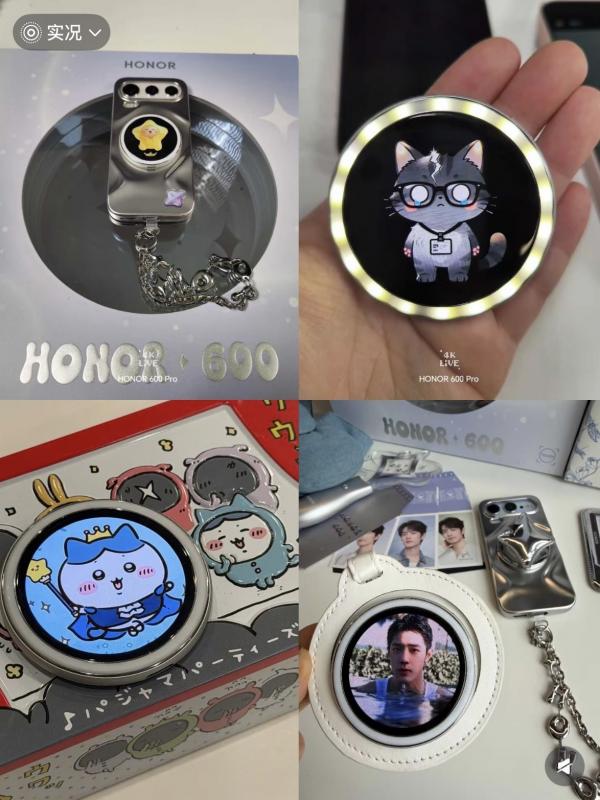
Honor Xiaoyao Screen
From a practical standpoint, this small screen can serve as a rear camera monitor and a selfie preview screen. This feature eliminates the embarrassment of 'raising the phone, pressing the shutter blindly, and deleting eight out of ten shots,' greatly facilitating selfie and travel photography scenarios without the uncertainty of blind box-like results.
However, what truly resonates with young people is the 'grain consumption freedom' and the joy of 'holding my favorite character in my hands,' delighting otaku and fan circles alike.
Both OPPO Bubble and Xiaoyao Screen can connect to smartphones via Bluetooth, allowing users to change images on the screen at any time, supporting static images, live photos, and video loops. Based on blogger reviews, both devices feature high refresh rates and clear image presentation.

OPPO Bubble
As a 'tech upgrade version' of traditional badges, digital badges address pain points such as display visibility in low-light environments and interactivity, creating a new way to freely change and update content, naturally inheriting the consumption habits of the grain economy.
'When you have one digital badge, you have countless badges.'
Moreover, the implicit positioning of this 'badge' is as a fashion accessory. OPPO's sales package includes not only a gift box but also a limited-edition star-shaped bag charm and lanyard. It can serve as a phone stand or an accessory, attached to bags, shoulder straps, or DIYed into the classic CP (Couple) of 'bag + badge.' Even 'PopSockets' would take notes on this highly personalized way to play.

Honor also offers a 'pet-raising gameplay.' By connecting to a mobile app, users can choose their favorite electronic pets and interact with them on the small screen.
Insta360's Mic Pro is essentially a microphone + e-ink screen. According to product testing by @LINKEE, 'the e-ink screen design does not reflect light and remains very clear even in strong sunlight.' Many unboxing reviews mention that 'turning a boring audio tool into a highly personalized badge' is a creative move.

Insta360 Mic Pro
How much is such a cyber badge worth, considering it can be shown off, played with, offers high-definition smoothness, and serves as a selfie fill light?
The price of OPPO Bubble is 499 yuan.
The standalone price of Honor Xiaoyao Screen is 599 yuan, and it can be obtained for an additional 399 yuan when purchasing the Honor 600 series limited-time set.
Insta360 Mic Pro starts at a standard retail price of 698 yuan, with the top-tier model featuring two transmitters and one receiver priced at 1998 yuan.
Truly, a new trendy luxury!
In social media comment sections, you can see a complete attitude reversal: Some people dissect the functions into modules and compare prices, saying, 'Its only useful function is as a rear camera for selfies, but similar white-label products can be had for tens of yuan, with even more options under 200 yuan and larger screens.'
Is it worth spending the money for two hot pot meals on an electronic companion? Or should you add a bit more and buy a wearable watch? This is also a dilemma for netizens.
However, considering that both are deeply integrated with their respective product ecosystems—OPPO's product can only be used with corresponding phones, and Honor's requires compatibility with the 600 series new models—many buyers are still shut out.
'Whoever adapts to Apple first will get my purchase!' Parameters can't save them, but fashion can change their fate.
In fact, in the past two years of the grain economy's rapid spread, white-label brands have already tested the waters before the major players.
Baoshijiao, which claims to be the 'first to create dynamic digital badges,' has achieved sales of 13,000 units for a single product link on Douyin. There are also merchants specializing in digital badges who have attracted 13,000 fans on a single platform.
These cyber new species are springing up like mushrooms... Their shapes have evolved from round to square, with square electronic screen hang tags appearing. Later, they incorporated AI concepts, becoming touch-screen phone airbag brackets; or combined with nurturing interactive gameplay, encased in plush jackets to create AI companion hardware-like products.
There are also trendy clothing brands that use digital badges as replaceable decorative accessories. Even 'the tears of the era' electronic photo frames are attempting to make a comeback in the market.
However, digital badges faced some skepticism in their early days on the market.
After all, the core group of grain consumers pursues physical ownership, the limited nature of authentic collections, and the emotional satisfaction of high-density displays filled with 'my favorite characters everywhere.'
Nevertheless, these 'mood electronics' have never lacked eager consumers. On a certain social media platform, the topic volume for #digitalbadge has reached 45 million.
It cannot be denied that consumer technology is evolving into a fashion statement. Vogue Business, in its annual market forecast, uses the term 'Cute Tech' to define this trend of consumer electronics becoming more fashionable and accessory-like.
'2025 marks the embryonic stage, where consumer-grade tech products transition from tools to fashion accessories, emphasizing 'warmth and emotional connection,' and this trend continues.'
The pioneer of electronic pets, the 'Tamagotchi,' is a typical example. This electronic toy product, born in the last century with a colorful plastic shell and a mini pixel screen, once faced billions in losses.

Tamagotchi x POPSOCKETS Collaboration
It wasn't until recently that it 'turned the tables' on social media, becoming a bag accessory and trendy item. Especially with the resurgence of Y2K style in recent years, Tamagotchi has become widely popular with its combination of 'retro digital gadgets + fashion accessories.'
Today, people consume it not just for its functions but because it represents an aesthetic and an emotion.
Its parent company, Bandai Namco, has also recognized this and has engaged in numerous collaborations, limited-edition shells, and partnerships with the fashion consumer industry, showcasing it on runways and having KOLs continuously demonstrate its fashionable wearability.
This lifestyle-oriented operational approach has doubled Tamagotchi's global sales from 2022 to 2023, with cumulative shipments exceeding 100 million units by August 2025.
Similarly, wired headphones have also embraced fashion expression. With the millennial retro trend, young people are abandoning minimalist styles and embracing retro wired headphones as personalized accessories.
Even 'electronic antiques' that were once obsolete have become trendy favorites among young people. These old 'digital wastes' retain the free, bold, and romantic spirit of a certain era, which people repeatedly savor and explore for fun.
The current emphasis on emotional value is also catalyzing consumer electronics.
The 'digital badges' from major smartphone manufacturers are also playing the fashion and trend card openly: attempting to create a new generation of 'social currency.'
The smartphone industry has now entered a phase of stock competition, with diminishing space for hardware innovation. The room for competing on performance parameters and hardware functionality of screens and cameras is increasingly limited.
Smartphones have grown 'bangs' (notches), and desktops have added 'Dynamic Island' (a feature on iPhones); after smartphones defeated cameras, they are now rediscovering camera-like ultra-large circular camera modules... These 'not-so-impactful' innovations are increasingly failing to impress consumers.
The global 'purchase power slump' is evident.
According to Counterpoint data, the global user replacement cycle for smartphones reached around 43 months (about three and a half years) in 2024. 'Three years new, three years old, and another three years with a phone case' is becoming a reality.
Merchants are also consciously enriching and constructing the entire digital life experience. Especially since various manufacturers have established their own ecosystems, future hardware may not only compete on performance but also on content within their ecosystems.
Digital badges are a product of this background—'You're not just replacing a hardware device but adopting a new way to socialize.'
However, when manufacturers' product actions become uniform, will it lead to another round of comparative competition?
-
Ofilm Teams Up with ADSensE to Propel Large-Scale Deployment of All-Solid-State LiDAR Powered by ADS6311 Chip!
-
![]()
Loss of 2.5 Billion Yet Facing Strong Demand for Shares? Another Battle for Control of Lianchuang Electronics
-
![]()
Huawei’s Enjoy Series Flies Off the Shelves, Prompting Xiaomi to Double Down on Budget Smartphones
-
![]()
Beijing Hyundai's Top Executive Criticizes Industry Disorder: Certain Brands Treat Customers as Beta Testers
-
![]()
The domestic mobile phone market has declined for five consecutive quarters! Huawei defies the trend with significant growth: maintains its top market share
-
Annual Revenue Surpasses 3 Billion: An Automotive Trim 'Little Giant' Makes Its Debut on the Beijing Stock Exchange
-
![]()
The Space Force Wants to Spend $30 Billion on Rocket Launches: Is Trump Doubling Down, and Is SpaceX the Big Winner?
-
![]()
Going Crazy! One out of Every Three Plug-in Hybrids Sold in Europe is a Chinese Vehicle