Rumor Refuted: ByteDance Not Developing Its Own Smartphone | Pencil News Exclusive
 05/29 2026
 542
542
Author | Pencil News Aiyu
Editor | Pencil News Wang Fang
Is ByteDance venturing into smartphone manufacturing? "This is baseless speculation," a reliable source close to ByteDance clarified to Pencil News this morning, refuting recent market rumors about ByteDance "relaunching its self-developed smartphone project."
- 01 - Over 300 Smartphone-Related Positions Open for Recruitment
Previously, several media outlets reported that ByteDance was "mass-recruiting for a smartphone team" and "restarting its self-developed smartphone project." The rapid dissemination of these rumors can be attributed to a key factor: ByteDance has indeed been actively recruiting for numerous positions related to "core smartphone capabilities" recently.
According to Pencil News' review of public job postings, ByteDance currently has over 300 open positions related to smartphones, mobile operating systems (OS), and on-device AI. Among these, approximately 83 positions are associated with the Doubao smartphone assistant, around 236 positions are related to mobile OS development, and these roles are primarily based in Beijing, Shanghai, and Shenzhen.
The areas of expertise covered by these positions include Android Framework, HAL/Vendor interface adaptation, chip drivers, power and thermal management, Telephony/RIL, RF antennas, on-device AI deployment, Agent long-term memory, and ODM/OEM mass production collaboration. Some positions even incorporate typical smartphone mass production keywords such as "foldable screens," "LIPO packaging," "IP68/IP69K," and "NPI trial production introduction."
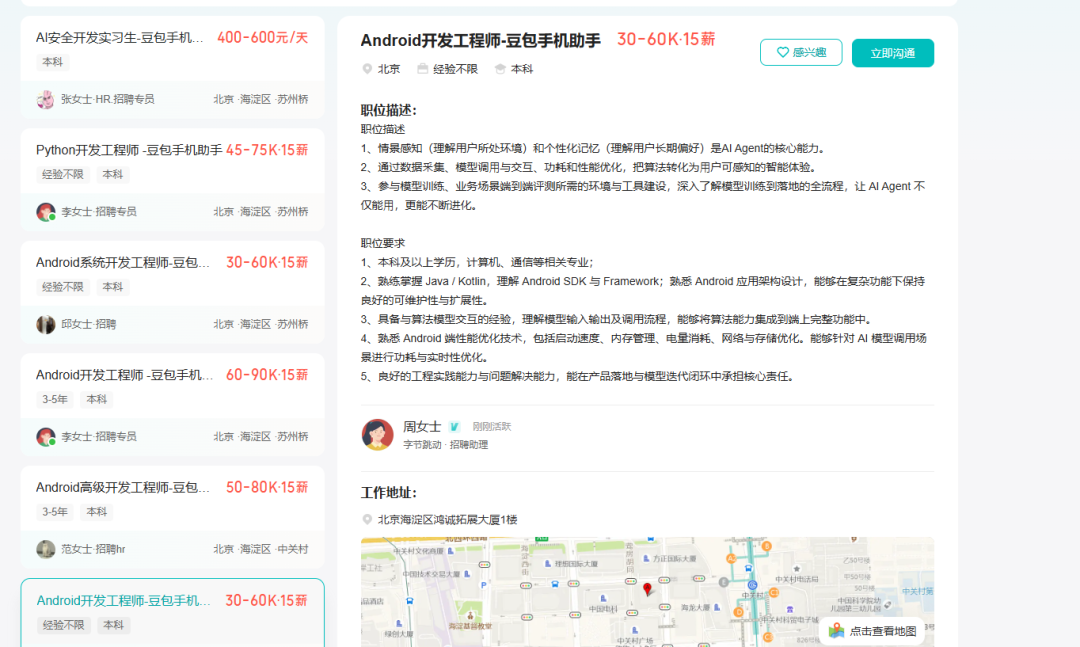
Some of ByteDance's recruitment positions are highly relevant to smartphone development.
This has led to swift speculation in the outside world: Is ByteDance planning to re-enter the smartphone market? However, the latest information indicates otherwise.
- 02 - Focusing on AI Terminal Infrastructure
Nevertheless, the truly noteworthy aspect of this recruitment drive may not be whether ByteDance is developing smartphones.
A closer examination of these positions reveals an important characteristic: many of them are not merely "traditional smartphone R&D positions" but rather "AI terminal infrastructure positions."
For instance, the Telephony RIL Modem Architect position requires familiarity with Qualcomm/MediaTek cellular network delivery, Telephony systems, RIL drivers, CTA certification, field testing, and RF development.
The Android System Expert position entails oversight of the entire process, from project initiation and system design to integrated development and mass production delivery.
What does this imply? AI is transitioning from "chatbots" to the "system layer." In the past, large AI models primarily answered questions; now, more and more AI systems are directly operating smartphones.
For example, they can automatically book tickets, compare prices, claim coupons, execute tasks across apps, access photo albums, calendars, and contacts, and maintain long-term user behavior memory. These capabilities require deeper system permissions than what App-layer permissions can provide.
In other words, even if AI companies do not manufacture smartphones themselves, they must acquire more mobile OS capabilities; otherwise, their AI agents will remain as mere "external assistants."
- 03 - Competing for Entry Point Control
Another reason for the heightened sensitivity from the outside world is ByteDance's previous experimentation with "AI + smartphones." In December 2025, ByteDance collaborated with Nubia to launch an AI engineering smartphone equipped with Doubao capabilities.
According to public reports, the initial batch consisted of approximately 30,000 units, priced at 3,499 yuan, and sold out on the first day. This marked Doubao's first attempt to transition from a chatbot to an "Agent within a smartphone," capable of completing tasks such as checking train tickets, comparing prices, claiming coupons, placing orders, and performing cross-app operations with a single voice command.
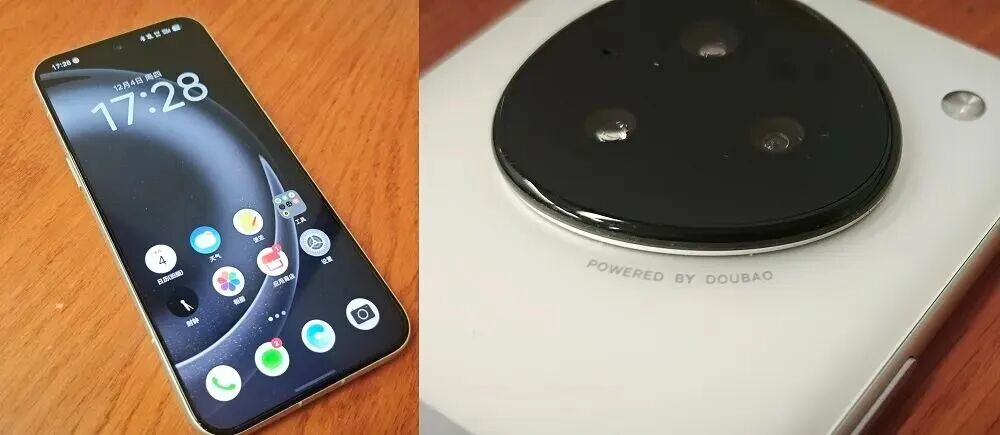
The ByteDance × Nubia M153 Doubao AI Engineering Smartphone, launched in December 2025.
However, issues soon arose: platforms like WeChat, Taobao, and Alipay began to block access.
The reason is straightforward: these super apps are unwilling to cede control over entry points to AI. Once AI agents truly take over operations, questions arise about who controls the traffic, recommendations, and transaction data.
Thus, a more practical issue emerges: if AI companies lack system entry points, they essentially operate within someone else's ecosystem.
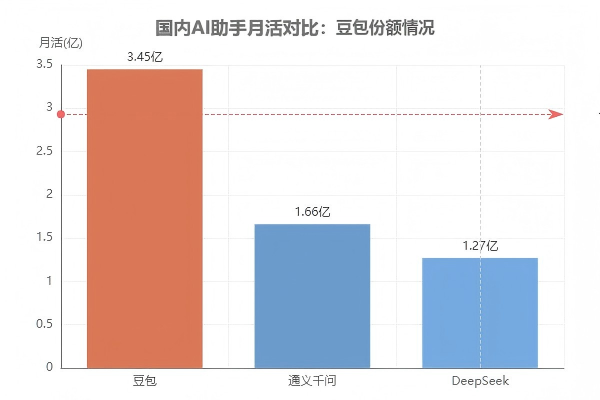
This is why, despite Doubao achieving 345 million monthly active users (according to QuestMobile data from March 2026), it still faces a significant problem: users cannot complete truly closed-loop tasks within Doubao.
Checking flight tickets requires accessing Ctrip, ordering food delivery requires Meituan, and payments require Alipay or WeChat.
Once interfaces are restricted, AI agent capabilities are weakened. This is why the AI industry is now competing not just for "chat capabilities" but for system entry points.
However, the challenge in the smartphone industry has never been solely about AI; it also involves channels, supply chains, branding, and after-sales service—areas where ByteDance has historically been weakest.
In 2019, ByteDance acquired some teams and patents from Smartisan Technology, subsequently releasing the Smartisan Pro 3 in 2019 and the Smartisan R2 in 2020, before halting smartphone R&D in 2021.
As of today, cumulative sales of the Smartisan R2 on JD.com and Taobao remain below 100,000 units.
- 04 - Previous Hardware Attempts
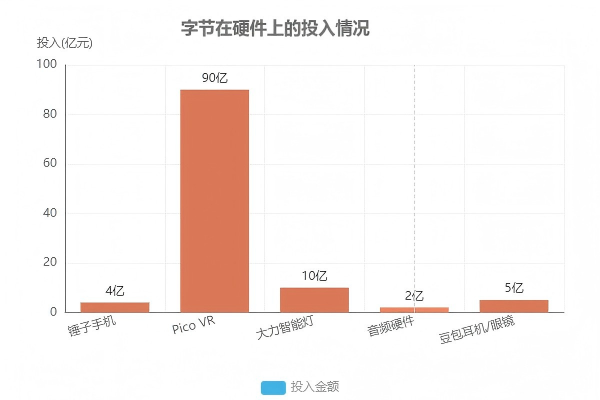
ByteDance's hardware ambitions extend beyond smartphones. Over the past few years, the company has explored nearly every segment of consumer hardware: Pico, acquired for 9 billion yuan, has continued to incur losses, with its consumer business significantly contracting and cumulative losses exceeding 20 billion yuan according to some media estimates; the Dali Smart Lamp was impacted by the "Double Reduction" policy; some audio hardware projects were halted before launch; and Doubao earphones and AI glasses have yet to achieve significant scale.
Why? One core reason is the lack of offline channels.
Today, one of the most invisible yet challenging barriers in China's smartphone industry is offline stores. Public data shows that Huawei has over 10,000 offline stores, Xiaomi Home exceeds 16,000, and the total number of offline terminals for OPPO and Vivo has long been in the hundreds of thousands. In contrast, ByteDance has virtually no offline consumer electronics infrastructure.
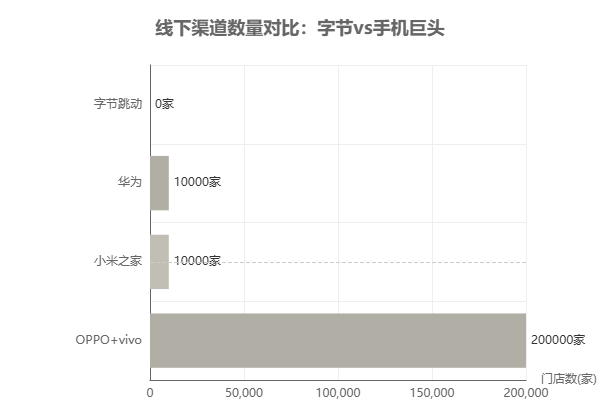
This means that, regardless of how strong its AI capabilities are, the smartphone industry remains an extremely capital-intensive sector.
More importantly than whether "ByteDance will make smartphones" is the fact that the entire AI industry is beginning to re-compete for terminals.
Recent supply chain and industry news indicates that OpenAI is exploring AI hardware; Apple is fully advancing Apple Intelligence; Google is strengthening the integration of Gemini with Android; Huawei, Xiaomi, and Honor are continuing to advance AI OS; and AI glasses, AI earphones, and AI Agent devices are gaining momentum.
The reason is straightforward: the competition among large AI models is shifting from "who chats better" to "who truly owns user entry points."
Because once AI agents mature, they will invoke not just apps but also cameras, microphones, contacts, payments, calendars, file systems, location permissions, and system scheduling rights—capabilities that essentially belong to terminal sovereignty.
From this perspective, ByteDance's massive recruitment for mobile OS, on-device AI, and system capabilities positions today does not necessarily mean it will "immediately make smartphones." However, it at least suggests that ByteDance may have realized that without terminal control, AI may forever remain confined to someone else's system.
This article does not constitute any investment advice.
In the AI era, "one-person companies" are emerging. Now, Huawei Cloud has launched the "2026 AI OPC Application Innovation Contest." Companies at all stages are eligible to participate. Click on the image to register now.
-
Ofilm Teams Up with ADSensE to Propel Large-Scale Deployment of All-Solid-State LiDAR Powered by ADS6311 Chip!
-
![]()
Loss of 2.5 Billion Yet Facing Strong Demand for Shares? Another Battle for Control of Lianchuang Electronics
-
![]()
Huawei’s Enjoy Series Flies Off the Shelves, Prompting Xiaomi to Double Down on Budget Smartphones
-
![]()
Beijing Hyundai's Top Executive Criticizes Industry Disorder: Certain Brands Treat Customers as Beta Testers
-
![]()
The domestic mobile phone market has declined for five consecutive quarters! Huawei defies the trend with significant growth: maintains its top market share
-
Annual Revenue Surpasses 3 Billion: An Automotive Trim 'Little Giant' Makes Its Debut on the Beijing Stock Exchange
-
![]()
The Space Force Wants to Spend $30 Billion on Rocket Launches: Is Trump Doubling Down, and Is SpaceX the Big Winner?
-
![]()
Going Crazy! One out of Every Three Plug-in Hybrids Sold in Europe is a Chinese Vehicle