Hisense's World Cup Sponsorship 'Hat-Trick': A Journey of Globalization
 06/01 2026
 662
662
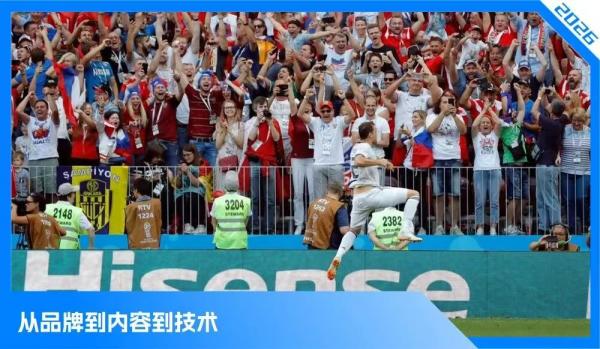
With only half a month to go until the opening match, the excitement surrounding the World Cup is finally palpable.
The protracted negotiations between CCTV and FIFA (henceforth referred to as FIFA) were finally concluded on May 15, with numerous media outlets reporting a final deal price of $60 million. Subsequently, Migu and Xiaohongshu secured the rights to distribute World Cup matches. With access to the games, Chinese fans' enthusiasm truly began to soar.
Also heaving a sigh of relief were FIFA's Chinese sponsors: Hisense, Mengniu, and Lenovo. Media reports indicate that Chinese brands have invested over $500 million in sponsoring the World Cup, a clear signal of their ambition to expand into global markets and internationalize. However, without opportunities for exposure in Chinese media, brands would be unable to complete their marketing cycle, significantly diminishing the value of their investments. This led to Lenovo's intervention, which facilitated the copyright cooperation agreement.
Lenovo is a newcomer to World Cup sponsorship, but Hisense likely has the deepest understanding of the value and challenges associated with sponsoring the event. From the 2018 Russia World Cup to the 2026 USA-Canada-Mexico edition, Hisense has achieved a 'hat-trick' of World Cup sponsorships.
In 2017, Hisense invested nearly $100 million to secure sponsorship for the 2018 Russia World Cup, becoming the first Chinese consumer electronics brand in World Cup history. For the Qatar World Cup, Hisense's investment remained around $100 million. For this year's event, reports indicate Hisense's investment reached $150 million, making it the largest single sponsor among all Chinese companies.
The World Cup has been a driving force behind Hisense's global ambitions. Hisense Group President Jia Shaoqian once stated in an interview, "From a global perspective, if you aspire to become a world-class brand, sports marketing is a universal tool that can break through political, cultural, and linguistic barriers between countries."
From venturing into sports marketing to 2021, Hisense invested over 10 billion yuan over five years to pave the way for its globalization.
For most brands participating in World Cup marketing, it's a month-long traffic bonanza. But for Hisense, the World Cup represents a glorious stepping stone to the global stage, occurring once every four years, with steady progress each cycle.

The World Cup: More Than Just a Traffic War – It's a Long-Term Investment
Eight years later, people still reminisce about it fondly.
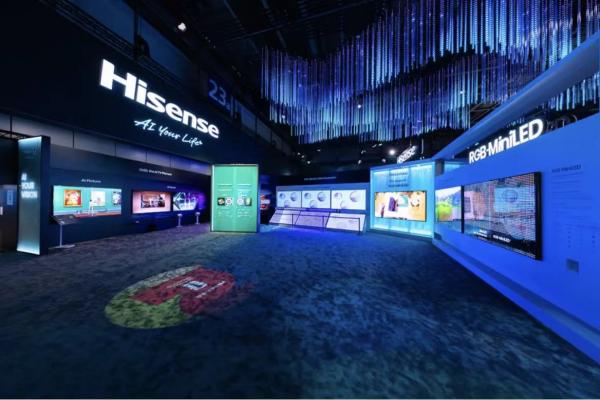
On July 15, 2018, at Russia's Luzhniki Stadium, Mbappé's 64th-minute long-range shot secured France's championship. As the ball hit the net, Hisense's blue-and-white English logo became the backdrop for that historic moment.
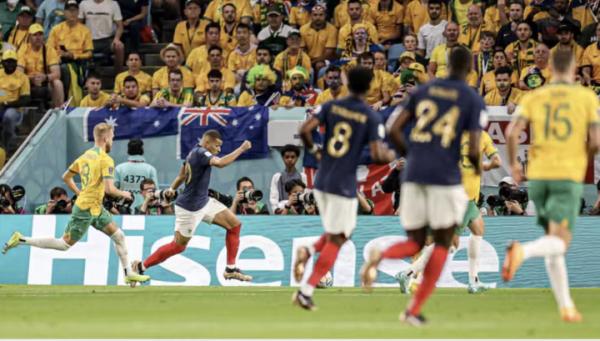
With a $100 million sponsorship fee, plus additional investments in advertising and product marketing during the tournament cycle, Hisense spent at least 1 billion yuan on this World Cup, exceeding its 2017 annual profit. That year, Hisense Electric's net profit attributable to shareholders was 942 million yuan, down 46.44% year-on-year due to the sluggish TV market and soaring panel prices.
2017 marked a turning point for Hisense's operations. Profits had been declining since 2015, and Hisense's bet on laser TVs failed to keep pace with international markets, falling behind in the OLED technology wave. While Hisense waited for OLED supply chains to mature, it acquired Toshiba's TV business overseas in 2018 to test OLED TVs, but by the time it launched products domestically in 2019, Skyworth had already dominated the market for five years, with Skyworth, Sony, and LG capturing 80% of China's OLED TV market.
At that juncture, sponsoring the World Cup was a bold move for Hisense.
Hisense's debut in Russia in 2018 at least failed to generate explosive domestic buzz. During TV broadcasts, BOSS Zhipin's ear-grating, brainwashing ads dominated, having spent 100 million yuan for maximum impact. On social media, Hisense's competitor brands like Vatti and TCL capitalized on trending topics. Vatti's promise to refund purchases if France won the championship drove 1 billion yuan in sales with just 63 million yuan in refunds.
In comparison, Hisense, as an official World Cup sponsor, was overshadowed. Beyond paying FIFA's sponsorship fee, Hisense spent an additional $30 million on rights usage fees. Many sports marketing experts at the time believed Hisense hadn't fully leveraged its official sponsorship rights.
Around 2018, debates erupted over whether brands should still invest heavily in official sponsorships for events like the World Cup or Olympics. During last year's Winter Olympics, official sponsors Mengniu and Li-Ning failed to fully capitalize on their status, even being outmaneuvered by industry competitors. Yili cleverly stole Mengniu's thunder with aggressive advertising, even taking subtle jabs.
Official sponsors face "helpless" realities. After paying exorbitant fees for event sponsorship, brands have less budget for complementary marketing. According to Value Planet, during the Winter Olympics, Yili mobilized resources, hiring multiple external advertising firms for marketing planning, plus athlete endorsement fees. While not excessive compared to sponsorship costs, it was still a significant investment compared to regular brand marketing. Generosity in one area leads to caution elsewhere—a common sentiment. Industry norms dictate that activating sponsorship identities can cost 2-3 times the sponsorship fee.
Additionally, official sponsors face stricter restrictions on using event-related materials for advertising. Creating ads or collateral with World Cup imagery requires approval not just from FIFA but also closer scrutiny from corporate management, increasing approval layers and complexity. Sponsoring the World Cup is harder than piggybacking on it.
As media fragmentation dilutes exposure, the era where event sponsorships alone could catapult a brand is over. The window to become the next Coca-Cola or Adidas through the World Cup has closed. The event is no longer a project with calculable ROI within a month. Foreign media surveys show 84% of brand marketing executives believe the World Cup's return on investment is hard to quantify, a figure expected to rise above 90% by 2028.
FIFA statistics show sponsor brand awareness rises 15-20% during events, but conversion rates from awareness to purchase average just 2-5% industry-wide.
Thus, Hisense has been clear-minded from the start, with internal consensus: Using sports marketing for globalization is a long-term investment. Sponsoring international sports events should not be a short-term tactic but align with the brand's internationalization pace.
Moreover, TVs are durable goods. Expecting massive conversions within a month-long exposure window, unless all fans are like Su Xing smashing TVs during games, defies industry reality.
After the Russia World Cup, Hisense's UK market executive reflected on its debut in an interview. He mentioned that while sales performance was a metric, the primary goal was boosting awareness in unfamiliar markets. Regarding the UK, he said, "I'm not claiming we've surpassed LG, Samsung, or all household brands—it's too early for that. But if Hisense gradually enters some consumers' consideration sets, we're satisfied."
Understanding why you're sponsoring and aligning goals and resources accordingly, rather than purely chasing immediate returns, is the essence of World Cup sponsorship.
Debates over sponsoring the World Cup or Olympics will continue, especially as distribution channels and even AI emerge, further questioning the concentrated exposure effects of such events. But the World Cup's value endures, much like China's Spring Festival Gala. As everything becomes more fragmented, only sports retain such universal influence.

From Brand to Content to Technology
If Hisense seemed inexperienced in 2018, by 2022 in Qatar, it appeared more at ease. From logo exposure to emotionally resonant ad content, Hisense's World Cup marketing strategy matured.
A year before the 2022 Qatar World Cup, the global color TV market remained sluggish. As the pandemic neared its end, high raw material and shipping costs suppressed TV demand. Yet Hisense bucked the trend globally. In 2021, global TV shipments fell 6.2% to a six-year low. Hisense, ranked fourth globally, maintained 8.8% growth—the fastest among top-5 brands.
That year, overseas markets contributed 12% growth for Hisense. In 2020, Hisense became a UEFA Euro sponsor for the second time. After six years and three major global sports event sponsorships, Hisense's sports marketing marathon began paying off. By October 2022, Hisense's global shipments reached 19.6 million units, up 18% year-on-year, claiming the "global second" spot.
The labels "global second" and "Hisense" became deeply intertwined, thanks to the Qatar World Cup.
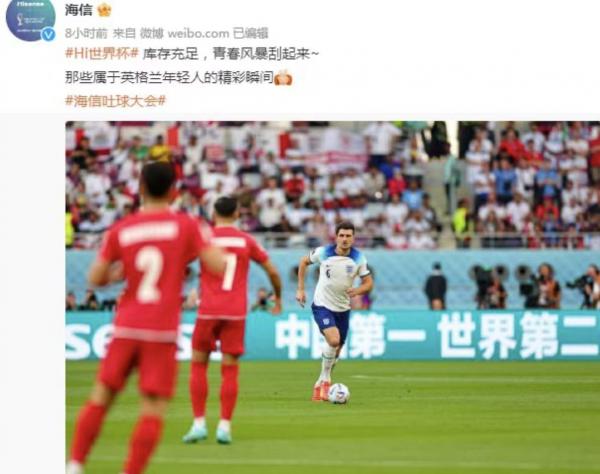
Let's revisit that goal. In Qatar's opening match, Ecuadorian star Valencia scored the tournament's first goal via penalty. Behind the goal, Hisense's LED ad screen reappeared—blue and white, with "Hisense" in English, now accompanied by eight Chinese characters: "World's No. 2, China's No. 1".
Clearly, this Chinese ad targeted domestic viewers. Four years prior, Hisense had lost focus in the Chinese context; now, it grabbed attention bluntly. The effect was immediate—domestic audiences noticed and discussed it. Especially in the third group-stage match, Hisense unveiled a new Chinese slogan, "Made in China, let's work together", sparking speculation about compliance with domestic advertising laws.
Hisense clarified to media that these were pre-planned.
Later, English slogans like "CHINA'S NO.1 WORLD'S NO.2" appeared, split into "WORLD’S NO.2" and "CHINA’S NO.1" for different ads, along with product-focused messages like "Hisense LASER TV, GO BIGGER."
Speculation arose over whether the shifting slogans were reactive risk-avoidance or premeditated. Either way, Hisense's content adaptability and impact in Qatar improved. Chinese ads targeted domestic viewers, English ones international audiences, with customization likely based on broadcast demographics—a common practice for international stadium ads.
Hisense's content strategy in Qatar showed more design and hierarchy, with clearer communication goals. Whether asserting industry status, promoting products, or positioning itself as a champion of Chinese manufacturing, the content logic progressed layer by layer.
Around 2022, Hisense launched a full-scale assault on premium large-screen TVs. From 2021-2026, China's color TV market saturated, with sluggish sales. Leading Chinese TV makers sought opportunities through price premiumization and global expansion. Large screens, high definition, and technological upgrades became key structural drivers.
People once assumed new devices like phones and tablets would replace TVs, evidenced by weak sales. But as demand for experiential consumption grew, consumers returned to the living room. Especially for immersive World Cup viewing, large-screen TVs were irreplaceable. That year, CCTV and Douyin offered 4K HD broadcasts, further stimulating demand. Before the 2022 World Cup, JD.com's orders for 75-inch+ large-screen TVs more than doubled during the period, with Hisense contributing 8 of the top-10 bestsellers.
By 2026, TV replacement seems increasingly unlikely, as rapid technological iteration transforms current TVs.
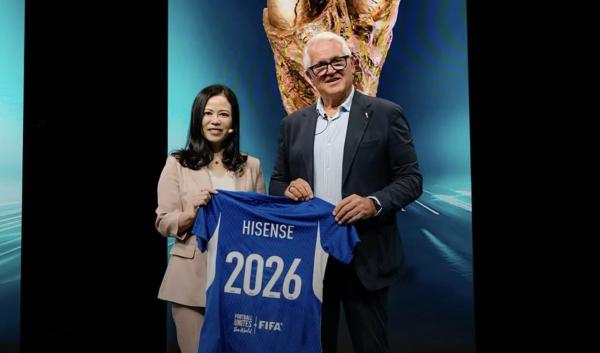
In September 2025, Hisense announced at IFA Berlin it would sponsor the 2026 USA-Canada-Mexico World Cup. On April 15 this year, Hisense officially became the VAR display technology partner for the 2026 World Cup. Hisense RGB-Mini LED TVs will be installed in the VAR center. This collaboration marks a deep technological partnership with FIFA.
In TV display tech (Mini LED, OLED, Micro LED), Chinese firms have long been followers. Until early 2026 at CES, Hisense launched the world's first RGB-Mini LED TV UX, achieving mass production—a premium tech path led by a Chinese company for the first time.
"Industry second" Hisense now aims to define a technological field on the World Cup stage. Partnering with VAR teams was a smart move. Since VAR's introduction to football, new tech hasn't guaranteed fairness but undoubtedly sparked endless debate. Every controversial call sees referees rush to the sidelines, with VAR footage scrutinized by billions.
At the 2026 USA-Canada-Mexico World Cup, Hisense's visibility and attention may surge even higher.

One Football, a Decade-Long Overseas Journey
After the Qatar World Cup, a Hisense representative stated, "Based on sponsoring two World Cups, Hisense sees strong results and intends to continue. We understand how scarce this opportunity is and how difficult it is to sponsor the World Cup. Once you leave this (sponsorship) team, rejoining becomes extremely hard."
Hisense sponsored the World Cup at a time when Sony was withdrawing. The exclusivity of World Cup sponsorship is a valuable resource for brands.
Especially since Hisense has always had a global vision. As early as 1996, just two years after the establishment of Hisense Group, Zhou Houjian, the former chairman of Hisense who has now retired, declared: 'Satisfying and confining oneself to the vast domestic market is a myopic behavior. Offense is the best defense.' In that era, this statement was nothing short of revolutionary.
The story of Hisense's global expansion initially took root in South Africa, a pivotal location where the company first ventured into the realm of sports marketing. During the 2006 FIFA World Cup, Hisense strategically placed advertisements on major South African television networks during peak viewing hours, maintaining this presence for five consecutive days. The brand's inaugural foray into genuine sports marketing occurred in 2008, when it began to seriously consider sponsoring the Australian Open. This ambition materialized in 2013, when Hisense became the sole Chinese sponsor of the prestigious tennis tournament. Furthermore, Hisense has extended its sponsorship to Formula 1 racing teams, among other sporting ventures.
Undoubtedly, Hisense's most notable strategic move has been its substantial investment in football, the world's most beloved sport. Commencing with the 2016 UEFA European Championship, Hisense has sponsored three European Championships and three FIFA World Cups, solidifying its position as a major player in the global football industry.
These sustained investments have culminated in tangible commercial benefits. Data indicates that since sponsoring the 2018 FIFA World Cup in Russia, Hisense's overall revenue has surged by 70%, with its international revenue nearly doubling. The company has also claimed the top global market share for laser TVs exceeding 100 inches. Moreover, its brand value has more than doubled, escalating from RMB 45.6 billion in 2018 to RMB 116.7 billion in 2025. Concurrently, its global brand recognition has risen from 30% to 56%.
These accomplishments were not achieved overnight. Hisense has dedicated a full decade to this endeavor, with the groundwork being laid as far back as 20 years ago.
From its humble beginnings at No. 11 Jiangxi Road in Qingdao, Hisense has now expanded its reach across Asia and Europe, traversed the Pacific Ocean, and established a global footprint. Throughout this journey, football has consistently served as the driving force propelling Hisense forward amidst the challenges of international expansion.
-
Ofilm Teams Up with ADSensE to Propel Large-Scale Deployment of All-Solid-State LiDAR Powered by ADS6311 Chip!
-
![]()
Loss of 2.5 Billion Yet Facing Strong Demand for Shares? Another Battle for Control of Lianchuang Electronics
-
![]()
Huawei’s Enjoy Series Flies Off the Shelves, Prompting Xiaomi to Double Down on Budget Smartphones
-
![]()
Beijing Hyundai's Top Executive Criticizes Industry Disorder: Certain Brands Treat Customers as Beta Testers
-
![]()
The domestic mobile phone market has declined for five consecutive quarters! Huawei defies the trend with significant growth: maintains its top market share
-
Annual Revenue Surpasses 3 Billion: An Automotive Trim 'Little Giant' Makes Its Debut on the Beijing Stock Exchange
-
![]()
The Space Force Wants to Spend $30 Billion on Rocket Launches: Is Trump Doubling Down, and Is SpaceX the Big Winner?
-
![]()
Going Crazy! One out of Every Three Plug-in Hybrids Sold in Europe is a Chinese Vehicle