Chinese Vocabulary Flashcard Market Soars Yearly; Baicizhan, New Oriental, and Science Canister Top Q1 Sales
 06/02 2026
 580
580
Vocabulary flashcards emerged in China in early 2022 as a novel category within the "language learning smart hardware" sector of electronic education. Following the implementation of the "Double Reduction" policy and the "Five Management" measures the previous year, students' fragmented study time was liberated, sparking demand for dedicated learning tools free from entertainment distractions. The compact design of vocabulary flashcards, featuring an electronic paper display (e-ink screen), swiftly and precisely met students' needs for vocabulary memorization. Their low power consumption, eye-friendly properties, and portability made them the go-to tool for K12 English learning.
RUNTO has been closely monitoring the technological advancements and sales performance of electronic education hardware in both global and Chinese markets, tracking the evolution of China's vocabulary flashcard market since its inception. Given their standardized functionality and affordable pricing, these products are predominantly sold through e-commerce channels.
According to RUNTO's online data, in 2025, online sales of vocabulary flashcards in China reached 810,000 units, marking a 66.6% year-on-year increase. In the first quarter of 2026, the market expanded further, with 206,000 units sold, up 45.6% year-on-year, and sales revenue hitting RMB 61.227 million, an 80.4% year-on-year surge.
The sustained market growth is attributed not only to shifts in the educational landscape and changing perceptions among parents and students but also to the products' active evolution. Over the past two years, new features such as personalized review algorithms, team-based check-in social gameplay, and AI pronunciation assessment have significantly boosted user retention and engagement. Additionally, brands have expanded their word libraries to include GRE, Japanese N1, and postgraduate entrance exam core vocabulary, along with thematic card resources, broadening their user base.
Market Competition:
High Industry Concentration: Top 5 Brands Dominate with 98.3% Market Share
In terms of brand participation, the first half of 2022 saw only 38 brands in China's electronic paper vocabulary flashcard market. Following Zuoyebang, companies like NetEase Youdao, FLTRP, Roobo, Haoxueduo, Mingxiaotang, Gaotu, Tuwa, New Oriental, and tech firms like Lenovo and iFLYTEK entered the fray. By the end of 2025, at least 195 brands were selling online.
According to RUNTO's online data, in the first quarter of 2026, the top five brands—Baicizhan, New Oriental, Science Canister, iFLYTEK, and MiaoMiaoJi—accounted for a combined sales share (CR5) of 98.3%, indicating a highly concentrated market structure.
Baicizhan, a language learning tool brand, claimed the top spot in the vocabulary flashcard market with approximately 79.0% of the sales share. Leveraging its mature word library ecosystem and user base, it caters to language learning needs across all educational stages. Baicizhan MAX, its flagship model, not only contributed 82.9% of the brand's sales but also accounted for a staggering 65.5% of the overall vocabulary flashcard market, becoming an "industry sensation."
The success of Baicizhan MAX can be attributed to three key factors: First, its product design features four vibrant color options—Little Starfish, Little Honeydew, Green Grape Bubbles, and Peanut Butter—named in a youthful and playful manner to resonate with student preferences. Second, in marketing, it collaborated with the popular IP "CHIIKAWA" to launch an officially licensed co-branded version, quickly becoming a trending topic among students. Third, in content, the product offers multilingual learning capabilities and, with the addition of AI multilingual translation, further meets the language learning needs of diverse age groups.
New Oriental ranked second in the online vocabulary flashcard market with approximately 14.3% of the sales share. Leveraging its educational R&D heritage and multilingual licensed word libraries, it focuses on exam preparation and study abroad-oriented models, continuously strengthening its professional edge. In 2026, on its 30th anniversary, New Oriental launched the 99.9 yuan limited-edition Vocabulary Master T2 30th Anniversary Edition and the upgraded "Close-Eyes Memorization" function in the Vocabulary Master Pro (third generation) in the first quarter, quickly capturing the market with its cost-effectiveness and practical innovations.
Science Canister secured the third position in the electronic paper vocabulary flashcard market with a 3.2% sales share, focusing on early language education for young children and capturing a niche market with its fun-oriented positioning. In January, it launched a new generation of phonics pocket vocabulary device, featuring an innovative physical full-spelling keyboard and a combined "phonics + keyboard spelling" mode, along with AI vocabulary PK gamification design, becoming a hit for English enlightenment (early English education) among young children during the winter vacation and reinforcing its differentiated advantage in the kindergarten-to-primary transition market.
Ranking fourth and fifth are iFLYTEK and MiaoMiaoJi. Although their market shares are relatively small compared to the top three, they are significant contributors to China's vocabulary flashcard industry. iFLYTEK's strength lies in its deep brand heritage and technological barriers in the education sector, with its AI speech recognition and intelligent oral assessment capabilities providing a differentiated competitive edge and outstanding language learning experiences. MiaoMiaoJi, backed by Zuoyebang, launched the first vocabulary flashcard in 2022 and has a stable user base. However, after Zuoyebang shifted its strategic focus to learning tablets, MiaoMiaoJi's market share declined.
Sales Share of Top Brands in China's Online Vocabulary Flashcard Market in Q1 2026
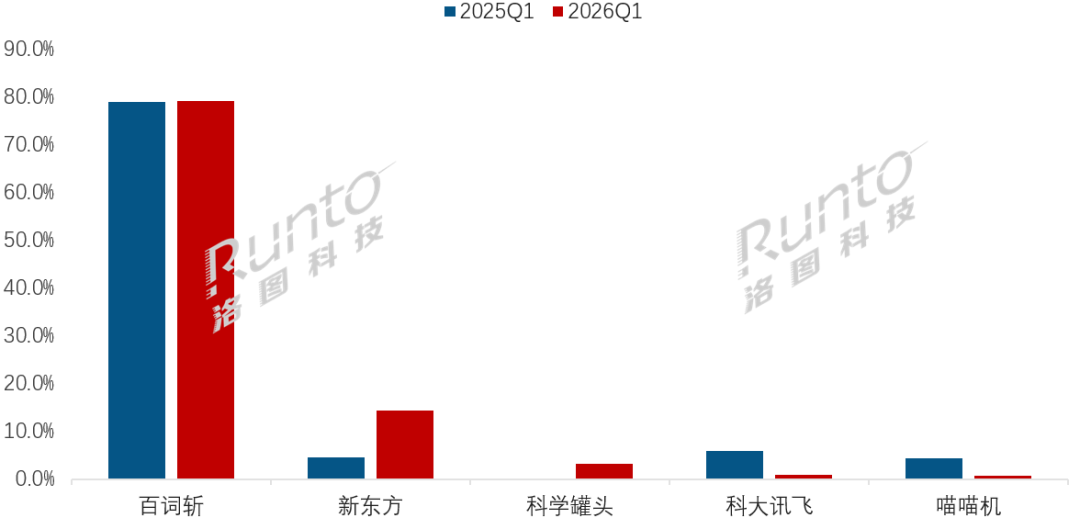
Data Source: RUNTO Online Data, Unit: %
Price Distribution:
Price Range Shifts Upward, with 300-399 Yuan Accounting for 2/3 of Sales
Vocabulary flashcards are primarily priced in the "low hundreds of yuan" range, with an average price of 228 yuan in 2022. By 2025, the market average rose to 274 yuan, continuing to attract new users with its "price increase but still affordable" market characteristic.
According to RUNTO's online data, in the first quarter of 2026, the market average price increased to approximately 297 yuan.
The 300-399 yuan price range accounted for 66.6% of sales, up 37.1 percentage points from the first quarter of 2025, doubling its market share.
Products in this price range meet users' rigid demand for upgrading from "usable" to "high-quality," while keeping prices within the comfort zone of mass consumption, making it the preferred pricing choice for mainstream brands' flagship products.
Future Market Forecast:
China's Vocabulary Flashcard Market Expected to Reach 440,000 Units in the First Half of the Year, Up 46%
Jiang Hui, an analyst at RUNTO, believes that entering the second quarter, China's online vocabulary flashcard market is expected to continue its growth trajectory, with sales in the first half of the year projected to reach 440,000 units, up 46% year-on-year.
In the long term, driven by educational reforms such as the integration of general and vocational education and the expansion of English enlightenment (early English education) to lower grades, the effective K12 user base is expected to remain stable in size over the next 3-5 years, laying a solid user foundation for the development of the vocabulary flashcard market. Even as English education and examination directions undergo reforms, the correlation between foreign language exam performance and vocabulary size remains a rigid demand.
From the perspective of language learning tool hardware, vocabulary flashcards, dictionary pens, and portable handheld translators form the core categories. Vocabulary flashcards, with their eye protection and portability as core advantages, complement dictionary pens focused on lookup and translators focused on communication, filling the market gap in fragmented memory scenarios.
According to RUNTO's forecast data, the sales volume of China's dictionary pen market is approximately 5.3 million units. In comparison, the lightweight, compact, and aesthetically pleasing vocabulary flashcard still offers significant blue ocean potential.
RUNTO has been monitoring the development of China's electronic education hardware market, including personal terminals like learning tablets, readers, dictionary pens, vocabulary flashcards, translators, learning lamps, and early education robots; classroom devices like educational interactive flat panels, recorded broadcasting systems, digital class signs, and visual presenters; as well as auxiliary teaching tools like VR/AR educational devices and error/learning printers.
Thank you for reading. If you found this insightful, please like, share, and follow.
-
Ofilm Teams Up with ADSensE to Propel Large-Scale Deployment of All-Solid-State LiDAR Powered by ADS6311 Chip!
-
![]()
Loss of 2.5 Billion Yet Facing Strong Demand for Shares? Another Battle for Control of Lianchuang Electronics
-
![]()
Huawei’s Enjoy Series Flies Off the Shelves, Prompting Xiaomi to Double Down on Budget Smartphones
-
![]()
Beijing Hyundai's Top Executive Criticizes Industry Disorder: Certain Brands Treat Customers as Beta Testers
-
![]()
The domestic mobile phone market has declined for five consecutive quarters! Huawei defies the trend with significant growth: maintains its top market share
-
Annual Revenue Surpasses 3 Billion: An Automotive Trim 'Little Giant' Makes Its Debut on the Beijing Stock Exchange
-
![]()
The Space Force Wants to Spend $30 Billion on Rocket Launches: Is Trump Doubling Down, and Is SpaceX the Big Winner?
-
![]()
Going Crazy! One out of Every Three Plug-in Hybrids Sold in Europe is a Chinese Vehicle