Insta360 Initiates Bounty Hunt for 'Black PR' Trolls, Offering 100,000 Yuan Golden Slipper Reward Amid Patent Dispute with DJI
 06/23 2026
 355
355

Produced by Leida Finance Text by Ding Yu Edited by Meng Shuai
In the wake of a patent dispute with DJI, Insta360 has declared a public campaign against online black PR trolls.
On June 17, Yuan Yue, the head of Insta360 China, stated that the company had faced coordinated attacks from online black PR trolls during its ongoing patent infringement lawsuits with a competitor.
Media reports indicate that within 24 hours of the lawsuit announcement, Insta360 detected over 1,490 abnormal accounts across various platforms posting highly similar comments.
More astonishingly, an enthusiastic user who infiltrated the troll group for a week discovered that the payout for posting a negative comment was a mere 6 yuan.
In response, Insta360 launched a counteroffensive. Starting June 17, some of its offline stores began a campaign to foster a healthy online environment. Customers visiting these stores received a 6 yuan red envelope and an initiative letter, while online informants could earn rewards ranging from 666 to 10,000 yuan, with the top prize being a pure gold slipper worth 100,000 yuan.
Financially, Insta360 reported revenue of 2.481 billion yuan in the first quarter of this year, marking an 83.11% increase year-on-year. However, net profit attributable to the parent company was only 85 million yuan, a 50% decline from the same period last year.
According to Tianyancha, Insta360 Innovation went public on the STAR Market in June last year. As of June 22, the company's stock price closed at 143.35 yuan per share, down more than 60% from its peak, with a market capitalization of approximately 57.5 billion yuan.
Insta360 Targeted by Black PR Trolls, Offers Pure Gold Slipper to 'Eliminate the Vermin'
On June 17, Yuan Yue, head of Insta360 China, posted two consecutive articles on social media, denouncing the chaos caused by online black PR trolls.
Yuan stated that after Insta360 filed mutual patent infringement lawsuits with a competitor, the company was subjected to organized online black PR attacks.
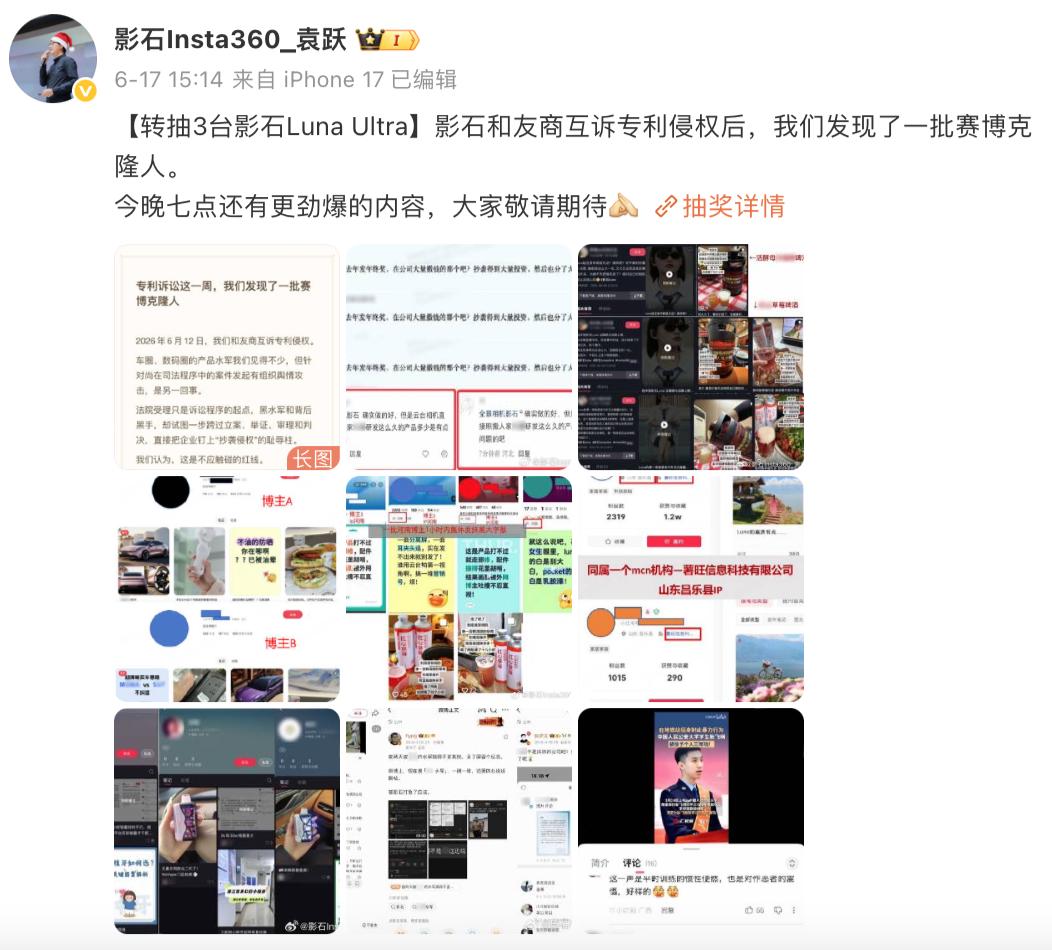
Yuan bluntly said, "We've encountered our share of product trolls in the automotive and digital sectors, but launching organized public opinion attacks on cases still in judicial proceedings is a different matter."
Yuan argued, "Court acceptance is just the starting point of the litigation process, but black PR trolls and their backers are trying to bypass filing, evidence submission, hearings, and judgment to directly brand the company with the mark of shame for 'plagiarism and infringement.'" In Yuan's view, "this is a red line that should never be crossed."
That evening at 7 p.m., Yuan revealed another bombshell, sharing the real-life story of "an enthusiastic user who infiltrated a black PR group for a week," only to find that trolls earned just 6 yuan per negative post.
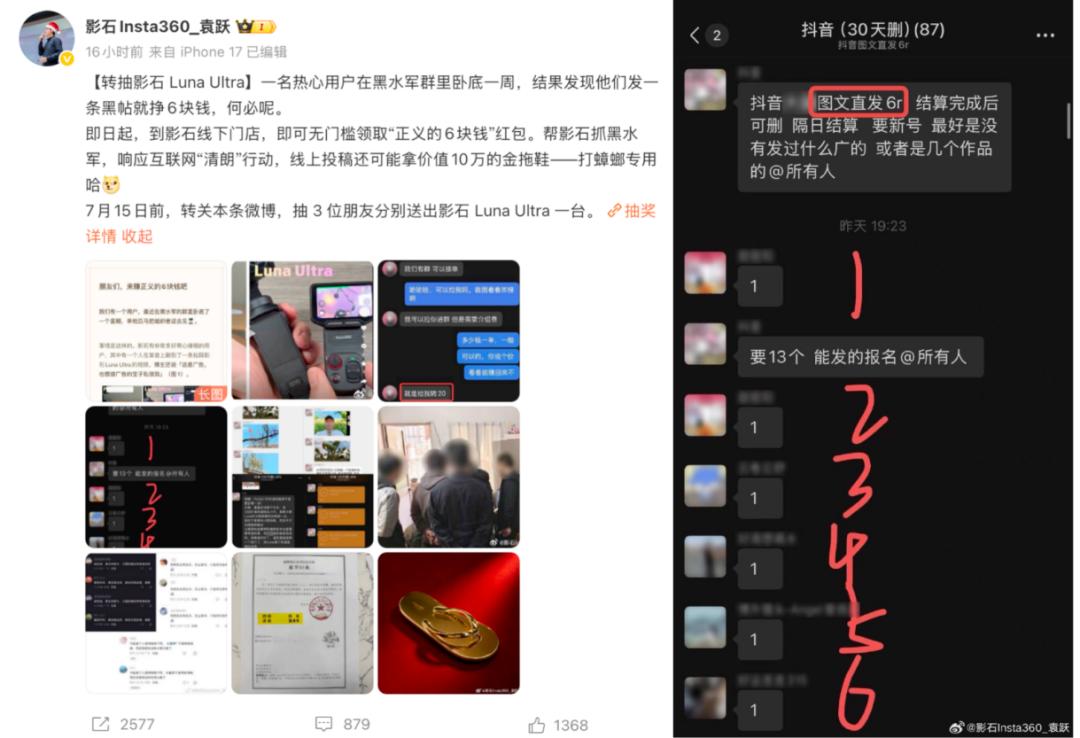
In response, Yuan announced that starting June 17, Insta360 would launch a series of internet health initiatives at some of its offline stores nationwide. Customers visiting these stores could directly receive a 6 yuan red envelope and a green internet initiative letter.
Netizens could also submit tips online. If deemed valuable after official review by Insta360, the company would award the providers with bonuses ranging from 666 to 10,000 yuan.
Yuan also revealed that Insta360 had created a pure gold slipper worth 100,000 yuan, which would be awarded as the ultimate prize to the provider of the most valuable tip. "In Guangdong, this is our most effective tool for eliminating vermin," he joked.
Leida Finance noted that as early as December 23 last year, Insta360's legal department had posted an article stating that the company had launched a black PR clue collection campaign, offering rewards for tips on illegal activities such as malicious rumors and organized defamation against the Insta360 brand. Tips and evidence adopted by the company would be rewarded with 1,000 to 10,000 yuan each; if adopted by public security authorities, rewards would range from 10,000 to 100,000 yuan each.
Yuan also stated in his Weibo post that since publicly soliciting black PR troll clues, Insta360 had identified over 2,000 black PR accounts, with multiple troll groups being investigated and several suspects arrested and subjected to criminal coercive measures. Currently, the cases have been transferred for prosecution, with multiple related clues still under investigation.
Regarding the aforementioned 'infiltration case,' Insta360 had already filed a report with the Bao'an Branch of the Shenzhen Municipal Public Security Bureau on June 3.
According to Yuan, the 'infiltrator' user was later invited to visit Insta360 and said, "The number of black PR trolls online is not determined by the troll leaders or social platforms, but by those who hire them."
Patent War Erupts Between China's Imaging Giants
Although Yuan's Weibo posts did not directly name names, the implications were clearly aimed at DJI.
The 'mutual patent infringement lawsuits with a competitor' referred to by Yuan precisely describe the patent war that erupted between Insta360 and DJI in June this year.
On June 9, Insta360 premiered its Luna series handheld gimbal cameras in the United States. Subsequently, DJI and its Osmo brand filed patent infringement lawsuits against Insta360 and its affiliated companies in the U.S. District Court for the Eastern District of Texas, targeting the new Insta360 products.
DJI alleged that Insta360's Luna cameras infringed on two of its design patents and four invention patents, involving technologies and designs from DJI's Osmo Pocket series, including core underlying technologies such as gimbal electromechanical control and shooting control.
In response to DJI's patent offensive, Insta360 launched a counterattack on June 12, filing a patent countersuit against DJI in the United States, involving five invention patents related to gimbal cameras and panoramic cameras, covering key technologies such as gimbal stabilization algorithms, gimbal pointing control, camera smooth stabilization, motion data overlay, and panoramic video stabilization.
At the same time, Insta360 also filed related patent invalidation requests with the China National Intellectual Property Administration.
According to China Entrepreneur, a source close to DJI revealed that DJI's lawsuit in the United States was based on the 'place of occurrence' principle in global business rules. Since Insta360 chose to globally premiere and sell its Luna cameras in the United States, DJI initiated rights protection actions at the first time and place where commercial infringement occurred. "DJI is not only suing in the United States but may also file lawsuits in other places simultaneously," the source said.
The source stated that DJI claims the appearance and core underlying control algorithms of the Pocket series are its own creations.
However, Insta360 denied these claims. Allen, the product manager of Insta360's Luna series, told China Entrepreneur, "We were fully prepared for competition from the very beginning of the project and conducted extensive simulations during the design phase."
Allen recalled that his first task after joining Insta360 was to build a gimbal team from scratch. "In 2020, our first demo was a dual-camera route because multi-focal-length creation offers greater freedom than single-focal-length," he said.
More Players Enter the Fray, Intensifying Industry Competition
The recent strategic maneuvering between Insta360 and DJI is essentially a struggle for dominance over the popular consumer category of handheld gimbal cameras.
Public reports indicate that handheld gimbal cameras can be traced back to 2013. At that time, Feiyu Tech, a manufacturer of drone aerial photography gimbals, adapted its technology to launch a handheld gimbal compatible with GoPro action cameras.
Two years later, DJI, the dominant player in the drone industry, entered the market with its Osmo series, integrating the camera and gimbal handle into one but requiring a smartphone connection to view the footage.
In 2017, Removu, a Korean company that had previously made accessories for GoPro, introduced an all-in-one handheld gimbal camera with its own lens, screen, and gimbal handle. This marked the point where handheld gimbal cameras shed their piecemeal assembly form and officially became an independent consumer electronics category.
The following year, DJI released the first-generation Osmo Pocket, precisely targeting the vast potential of Vlog creators.
According to the product manager of the Osmo Pocket series, during the product development phase in 2016-2017, the concept of Vlogs was still in its extremely early stages. DJI had to make more aggressive attempts at product form factors amid scattered user demands and the fact that overseas users were already accustomed to using action cameras as their primary Vlog devices.
Two years after the initial product release, DJI's Pocket 2 made a strong entrance with a mini joystick, a 20mm Vlog golden focal length, and an all-around handle. This round of product updates propelled the Pocket category from 'usable' to 'user-friendly'.
However, it was the Pocket 3, released in 2023, that truly made the Pocket series a hit, thanks to its 1-inch sensor, which significantly differentiated its image quality from smartphones.
In 2024, the Pocket 3 sold 5 million units, generating nearly 20 billion yuan in revenue. By the third quarter of 2025, 23 months after the Pocket 3's release, its cumulative sales had surpassed 10 million units.
Some believe that the Pocket series' successful breakout from a niche Vlogger tool into the mainstream market relied not only on continuous product iteration and refinement but also on the explosion in short video and Vlog content demand in the post-pandemic era, which provided fertile ground for category growth.
According to the China Network Audio-Visual Development Research Report (2024), in 2023, China's network audio-visual industry, including long-form videos, short videos, live streaming, and audio, exceeded 1 trillion yuan in market size for the first time, reaching 1.15 trillion yuan. By the end of 2023, the total number of short video accounts across the internet had reached 1.55 billion, with 15.08 million professional streamers.
IDC data shows that global shipments of handheld smart cameras reached 16.65 million units in 2025, up 83% year-on-year, with the gimbal camera market growing by over 100% year-on-year.
The debut of Insta360's Luna also reflects its optimism about the market's vast potential. In January this year, foreign tech media thenewcamera leaked images of Insta360's pocket gimbal camera prototype.
On February 11, sources close to Insta360 revealed that the company's handheld gimbal camera, the Luna, would be released in the first half of this year.
"This is definitely not another Pocket," the source said, describing the Luna as a product with multiple innovative definitions and refinements. As early as 2023, Insta360 had invested tens of millions of yuan in researching and developing a modular handheld gimbal camera.
On April 19, Insta360 showcased the single- and dual-camera versions of the Luna at the NAB show in Las Vegas, USA. However, until early June, Insta360 and DJI continued to probe each other, negotiating the release timing and pricing of their new products.
According to China Entrepreneur, the Luna Ultra was initially scheduled for release on June 19 but ultimately went live on June 10, with a starting price of 3,999 yuan.
Five days later, the 'breath-holding competition' ended, and DJI released the Pocket 4P, priced at 3,799 yuan for the standard version, 200 yuan cheaper than its competitor.
Allen stated that DJI defines the Pocket as a 'shooting tool,' while Insta360 approaches it with the product philosophy of 'CameraMan,' focusing on lowering the barrier to shooting. In Allen's view, "What users want is not a camera but a shooting assistant."
Notably, besides Insta360, more players are expected to enter the handheld gimbal camera market.
According to market news, smartphone manufacturers OPPO, vivo, and Xiaomi have products in the pipeline, expected to be released in the fourth quarter of this year. Honor is also exploring Pocket-like products through ODM models while developing its own smartphones with built-in gimbal cameras.
With more players entering the market, how will the industry landscape of the handheld gimbal camera sector evolve? Leida Finance will continue to monitor the situation.
-
Three-Year Cumulative Losses Reach 4.4 Billion! Can AI Revolutionize Yonyou’s Future?
-
![]()
Zhipu: Trillion-dollar Market Cap, Is China's Anthropic Really Here?
-
![]()
Why Are Automakers Hesitant to Offer Consumer Guarantees?
-
![]()
Targeting 12 Million in Exports! China’s Auto Industry Faces a Pivotal Test of Maturity
-
![]()
One in Six Employees at Volkswagen Faces Layoffs Amidst Largest Strategic Retrenchment in 88 Years
-
![]()
Breaking Free from Involution: How These Four Automakers Are Charting New Courses
-
![]()
From National Pride to WPS Controversy: The Dilemma Faced by Zou Tao of Kingsoft Office
-
![]()
He Xiaopeng: Ant Group's 'AI Visionary'