Can Apple No Longer Hold On? Across-the-Board Price Hikes of $300: Cook 'Outmaneuvered' by Suppliers
 06/29 2026
 377
377

Has Apple Lost Its Bargaining Power?
Produced by | US-HK Detective
Who would have thought that Apple, which has leveraged its unparalleled procurement scale and bargaining power to dictate terms to upstream suppliers for decades, would find itself in this position today?
In the past, whenever Apple pressed for lower prices, suppliers had little choice but to accept them. However, the 'supplier myth' that has prevailed for over twenty years has now been shattered.
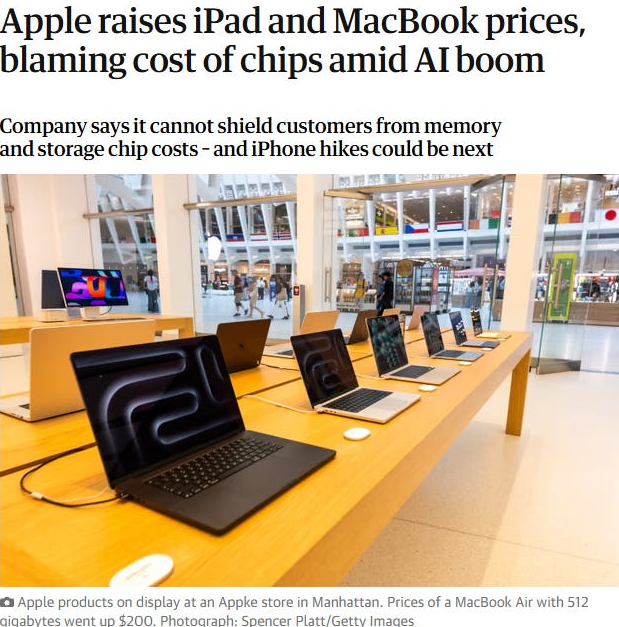
Recently, Apple unexpectedly posted new prices on its global websites, implementing across-the-board price hikes for key hardware products such as MacBook, iPad, and Vision Pro, with increases ranging from $100 to $300. Some high-end Mac Studio models have even seen price jumps exceeding $500.
According to a previous report by IT Home, Apple raised the prices of 14 products, including Mac, iPad, Vision Pro, and HomePod, just the day before. The starting price of the MacBook Air increased from RMB 8,499 to RMB 9,999, a RMB 1,500 hike. The iPad Pro's starting price rose from RMB 8,999 to RMB 10,799, an increase of RMB 1,800.

Apple explained that the price hikes were primarily driven by rising costs of memory (RAM) and storage (SSD) components:
This is concrete evidence that the entire tech industry value chain is being redistributed by artificial intelligence.
1. Clash in the Air: Cook Calls Out, Micron Stands Firm
Just a week before the price hikes, outgoing Apple CEO Tim Cook, in a rare public interview with The Wall Street Journal, explicitly named 'memory vendors as transferring significant cost pressures':
'Supply has decreased, while consumer demand for devices remains, and memory vendors are passing on substantial price increases.'
'We absolutely need memory pricing and supply to return to reasonable levels for consumer products. That's the bottom line.'
'Unfortunately, price hikes are inevitable. We've been doing everything possible to sustain our significant growth and protect our customers from its impact, but the situation has become unsustainable.'
However, this time, mainstream manufacturers are no longer choosing to remain silent.
Shortly after Cook's remarks, Wall Street Journal reporter Rolfe Winkler interviewed Micron's Chief Business Officer, Sumit Sadana.
Sadana responded firmly, almost face-to-face, to Apple's public accusations.
He stated that during the severe downturn in the memory market from 2022 to 2023, when Micron's gross margin even fell into negative territory, certain 'specific customers' exploited their immense negotiating leverage to extract 'rock-bottom prices.'
'We told some of these valuable, forward-looking customers at the time that their approach was unconstructive,' Sadana said.
He pointed out that the brutally low prices squeezed to the extreme during that period directly led the entire memory industry to slash or even shut down significant capital expenditures and capacity investments in 2023.
While Sadana did not directly name Apple, it was widely understood that this customer 'squeezing every last drop of blood from suppliers' was clearly Apple.
2. Apple's 'Exploitative Tactics' No Longer Work
Those familiar with Apple's financials and supply chain operations know that Apple once had a nearly unbeatable 'gross margin defense' mechanism and negotiating playbook:
- **Maximum Scale Threat**: As the world's largest buyer of memory, Apple used its massive and stable orders to force suppliers to offer the lowest market prices.
- **Multi-Sourcing Predatory Competition**: Simultaneously certifying 2-3 suppliers, such as Samsung, SK Hynix, and Micron, and pitting them against each other to compete on price during downturns.
- **Extreme Financial Terms**: Imposing payment terms of 60 to 90 days or longer, shifting financial pressure upstream.
- **Mandatory Annual Cost-Down Targets**: Requiring yearly price reductions in contracts due to process shrinks or yield improvements.
In the pre-AI era, this system operated flawlessly because memory was highly 'commoditized,' and Apple reigned supreme.
But now, pricing power has shifted decisively upstream.
This time, the memory trio (Samsung, SK Hynix, Micron) holds a strategic trump card more valuable than Apple: HBM.
Compared to traditional DRAM used in phones and computers, HBM offers extremely high profit margins and is in short supply. Critically, those eager to build AI data centers are vying for HBM capacity with strong cooperation intention (willingness).
They are even proactively signing long-term 'Strategic Customer Agreements' (SCAs) with memory vendors, committing to 'price floors' and paying massive upfront deposits to secure capacity.
Traditional memory for phones and computers has become a 'residual capacity' scarcity, and Apple can no longer fully absorb or negotiate away these costs.
When vendors like Micron can easily sell their capacity to AI customers offering high margins and strong commitments, Apple's threat to 'cut orders if prices don't drop' loses its magic instantly.
3. Deconstructing the 'Supply Chain Master' Myth?
This power shift has prompted the market to reexamine a long-proud myth: Is Tim Cook's Apple truly invincible in 'supply chain management'?
Globally, business schools have long held up Apple's supply chain as a textbook example. Surveys show Apple's success was never just about 'bullying the small with its size.'
They excelled in joint R&D for manufacturing process yields, early investments in critical equipment (e.g., buying out ASML's advanced lithography machine capacity), maximizing inventory turnover, and precisely manipulating upstream components—demonstrating unmatched management artistry and genuine expertise.
However, behind these superb management arts lay a crucial hidden driver: Apple was the market's irreplaceable 'super-single buyer.'
Historically, for most semiconductor and component vendors, losing Apple's orders was tantamount to bankruptcy. Under this 'absolute monopoly' structure, Apple's management artistry could exert its full power. Suppliers were willing to endure razor-thin margins and harsh terms to stay on Apple's list.
But the AI era has completely erased Apple's 'uniqueness.'
When giants like Microsoft, Meta, Google, and Amazon stormed the market with billions in AI capital expenditures, they competed for HBM, advanced manufacturing processes, and high-end packaging.
This led to a subtle shift: Apple remains a major buyer, but it's no longer suppliers' 'only and most critical' customer.
When suppliers gain the confidence that they can 'survive and even profit more without Apple,' Apple's negotiating leverage, built on 'absolute scale advantage,' begins to crumble.
When market structure fundamentally shifts and hegemonic advantages dilute, even the top management gurus find their hands tied when facing upstream price hikes en masse.
This raises the question: As the umbrella of scale advantage shrinks, will Apple redefine its supply chain strategy for the new era?
4. Historic Profit Surge
The memory industry is highly cyclical. During the 2016-2018 'DRAM supercycle,' suppliers briefly regained dominance, with Micron's gross margin reaching a record 40-45%.
This AI cycle surpasses historical madness, with gross margins soaring to an astonishing 85%.
Such staggering spikes naturally raise doubts: Can such windfall profits be normalized?
But for memory vendors, the key question isn't 'how long high margins will last'; it's that having deeply experienced the cycle's cruelty, they must now ruthlessly secure every cent of profit.
Memory has always been an extremely brutal, even destructive, cyclical industry. During the 2022-2023 downturn, vendors like Micron faced massive losses, inventory write-downs, and gross margins plunging into negative territory.
During oversupply, downstream customers showed no mercy, exploiting the market to drive prices below depreciation and production costs.
For memory vendors, this is a survival game of 'digging bomb shelters while the sun shines.'
Having barely regained pricing power through the AI boom, HBM capacity constraints, and advanced process limits, why not push profit margins to the limit now, rather than wait for the next downturn to be at the mercy of others again?
These 'windfall' profits are essentially 'life-saving provisions' that cyclical industries stockpile during peacetime for war. They must capitalize on the boom to accumulate enough excess profits to cover losses and fund the next multi-billion-dollar fab construction.
This explains Micron CEO Sanjay Mehrotra's confidence this time.
He publicly stated that the floor prices of new long-term agreements (LTAs) would ensure Micron's future gross margins 'far exceed previous cycle peaks.'
This signals that memory vendors no longer settle for being bit players who 'make small profits in good times and lose half their lives in bad times.' Instead, they aim to use this structural shift to overturn the game rules entirely.
5. The 'Edge Dilemma' in AI's Golden Age
The memory price hikes have triggered a chain reaction with a profound second-order effect:
The development of cloud AI is cannibalizing the progress of edge AI.
The market's hottest narrative is that 'AI will drive a new wave of smartphone and PC replacement cycles.' But the physical reality is:
- To run local AI models, smartphones must equip with larger, faster memory.
- But cloud AI has consumed all memory capacity, causing memory costs to skyrocket.
- These cost increases have led to sharp price hikes for smartphones and computers (e.g., iPads rose by $100-$200).
- When devices become significantly more expensive, consumer replacement cycles (already extended to ~3.7 years) will only lengthen further.
This creates a subtle vicious cycle: More frenzied cloud construction → More expensive upstream components → Harder to sell end devices → Slower edge AI adoption.
For the past two decades, Apple has perfectly 'digested' all costs and risks upstream through impeccable supply chain management.
This time, the structural power shift brought by the AI tsunami means even mighty Apple must accept this 'AI tax' bill and pass it directly to global consumers.


Disclaimer: This article is based on the public company attributes of listed companies. US-HK Detective strives for objectivity and fairness in the content and viewpoints presented but does not guarantee their accuracy, completeness, or timeliness. The information or opinions expressed herein do not constitute any investment advice, and US-HK Detective assumes no responsibility for any actions taken based on this article.
-
![]()
The Suffering Endured in E-commerce, Walmart Doesn't Want to Repeat in AI
-
![]()
What Does the Doubling of New Energy Vehicle Exports Mean?
-
![]()
Ghosn: 'Only I Can Save Nissan'
-
![]()
Volkswagen Lays Off 100,000 Employees, The Elephant Sits Down
-
![]()
Expanding Production Capacity! Yutong Optics Acquires Approximately 1.5 Hectares of Industrial Land in Chang'an, Dongguan
-
![]()
Why Is Nokia Making a Comeback in the AI Era?
-
![]()
618 Battle Report | China's Online Learning Tablet Market Sees Significant Decline in Volume and Value; Zuoyebang, Xueersi, iFLYTEK, and Xiaoyuan Account for Nearly 90% of Sales
-
![]()
AI Revolutionizes Automotive PR: The Renaissance of In-Depth Graphic Content!