What Does the Doubling of New Energy Vehicle Exports Mean?
 06/29 2026
 465
465

Text by | Xiaofeng
Source | Bowang Finance
Domestic new energy vehicles are now vying for a slice of the overseas market.
According to relevant data, from January to May 2026, China exported 4.059 million vehicles, a year-on-year increase of 63%. Among them, new energy vehicle exports reached 1.833 million units, up 1.1 times year-on-year, further increasing their share in total vehicle exports to approximately 45%.
Meanwhile, the domestic auto market continued to weaken at the start of 2026. According to data from the China Passenger Car Association, from May 1 to 31, retail sales of passenger vehicles nationwide reached 1.510 million units, a year-on-year decline of 22.1%.
It is no exaggeration to say that the contrast between a cold domestic market and a hot overseas one has become almost certain. Is the doubling of exports merely a temporary solution for excess capacity, or the true starting point for China's auto industry to go global?
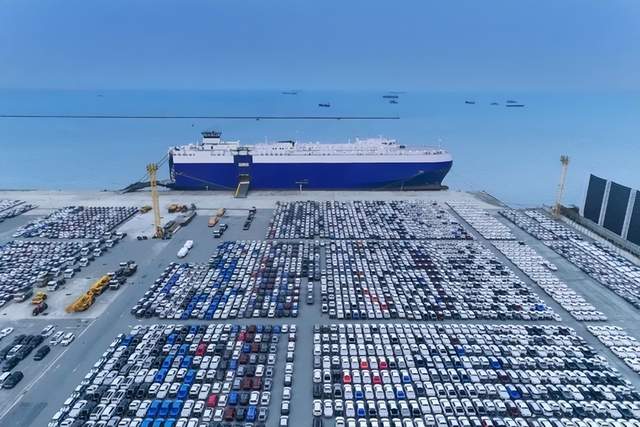
For now, the entire industry faces at least three key contradictions: the peak of domestic stock versus the opening of overseas growth, rapid scale expansion versus weak profitability, and domestic involution versus global long-termism.
As China's new energy vehicles accelerate their global expansion, with exports shifting from an option to a necessity, what will domestic automakers compete on in the future?
01 Is the Domestic Market Really Stagnant?
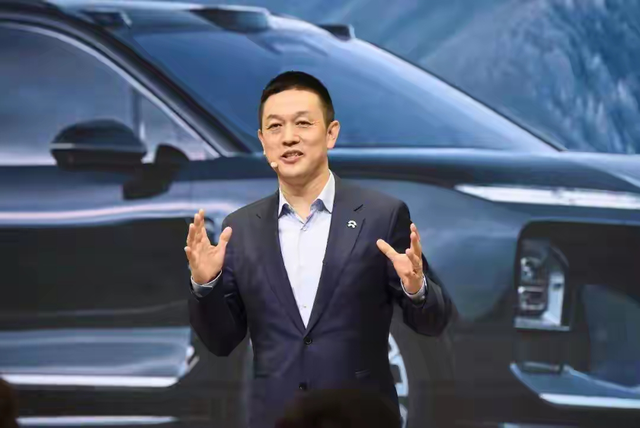
At this year's Chongqing Auto Forum, William Li, founder of NIO, bluntly stated that this year has felt exceptionally difficult since entering the industry. Why such a conclusion?
It likely stems from several factors. Regarding NIO itself, Li once admitted, "The new EL6 still has a gross margin—we won't lose money on every unit sold—but it's tough. Supply chain costs have risen too much."
This undoubtedly (undoubtedly) poured cold water on the entire industry. Broadly speaking, the industrial cycle dividends of new energy vehicles are no longer as robust as they were a few years ago. Currently, China's passenger vehicle ownership has reached 370 million units, officially bidding farewell to rapid growth and entering a phase of stock competition (stock competition). Based on market trends, domestic auto retail sales are expected to decline by 15% to 20% year-on-year this year, pushing industry competition into an increasingly brutal final stage.
This forecast is not unfounded. Data from the China Passenger Car Association shows that cumulative retail sales since the start of the year have reached 7.099 million units, a year-on-year decline of 19.5%.
Five years ago, no one would have believed China's auto market would experience a double-digit year-on-year decline. In 2025, domestic new energy vehicle sales hit a record high of 16.49 million units, with a penetration rate of 47.9%, ranking first globally for over a decade. Yet, in just one year, the industry shifted from rapid growth to deep adjustment—a turning point that arrived faster than most expected.
Rapid growth previously drove the development, expansion, and upgrading of the entire industrial chain. Now, as the industry approaches saturation, competition has become increasingly fierce. This means that past growth models—relying on channel expansion and price cuts—are losing effectiveness. After two years of price wars, diminishing marginal returns have set in. If price cuts could still stimulate orders early in the year, by mid-year, consumers have begun to hold onto their cash and wait.
The industry's past consensus was "trading price for volume," but the reality now is "falling prices and falling volumes." Once stock replacement becomes the main theme, with users extending replacement cycles and making more cautious decisions, simple price incentives can no longer drive effective demand.
The temporary changes in the domestic market essentially reflect the gradual exhaustion of growth-era dividends, forcing automakers to shift from scale expansion to efficiency competition. Against this backdrop, the importance of overseas markets has never been greater.
However, while the domestic market's logic has changed, the overseas story is just beginning. Booming export data has become the brightest spot in an otherwise challenging industry landscape. But behind this warmth lies a less visible side.
02 The Two Sides of Overseas Sales
Side A is the obvious success story: China's new energy vehicles are going global at a remarkable pace.
According to General Administration of Customs data, in 2025, China exported 8.324 million vehicles, a year-on-year increase of 30%, ranking first globally for multiple consecutive years. New energy vehicles contributed the most growth, with 3.43 million units exported, up 70% year-on-year. The top five export destinations were Belgium, the UK, Mexico, Brazil, and the Philippines, with Europe and Southeast Asia emerging as the two core growth regions.
Not only has volume expanded, but prices have also risen significantly. The pre-sale price of the BYD Yuan PLUS in Germany was €38,000, while the Han and Tang models were priced at €72,000 (approximately RMB 500,000)—double their domestic prices. Overall, overseas per-unit vehicle prices are 40% to 60% higher than in China.
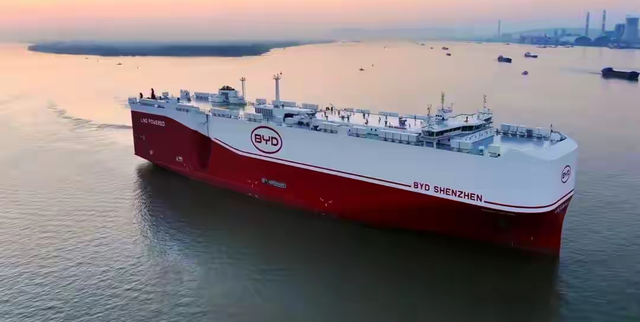
Additionally, BYD's overseas gross margin reached 19.46% in 2025, higher than its domestic margin of 16.66%. This clearly shows that for many automakers, going overseas is no longer just a temporary solution for excess inventory but a genuine profit-driving growth curve.
Flipping to Side B, the reality is less glamorous.
The most critical gap remains profitability. Data from Netcom Auto shows that Toyota's operating profit margin was around 10.5% in fiscal 2025, while Tesla's was about 8.2%. In contrast, leading Chinese automakers generally have profit margins below 4%.
A more intuitive (intuitive) comparison might be per-unit profit: sometimes, Chinese new energy automakers earn around RMB 8,000 per vehicle, while Toyota earns as much as RMB 130,000. Despite exporting vehicles worth trillions of yuan, China's total profit may not even match Toyota's alone.
Such a large gap typically stems from three dimensions. First, price bands are low: Chinese electric vehicles in Europe sometimes sell for €30,000 to €50,000, slightly cheaper than Tesla's Model Y, reinforcing a cost-effective reputation. Second, compliance costs are high: for example, the EU's New Battery Regulation alone has forced companies to invest billions in green energy transformations, with certification fees often starting in the millions of dollars. Third, brand premium is lacking: in mainstream Western markets, Chinese brands are still positioned as mid-to-low-end options, and breaking into the luxury segment's profit core will take more time.
However, a deeper issue is that most automakers' overseas expansion is still in the "land-grabbing" phase. Everyone is busy capturing market share, expanding channels, and building factories, but little has been done to build lasting brand equity or customer loyalty. Toyota took half a century to establish its global brand recognition and profitability system. Expecting Chinese automakers to catch up in just three to five years of rapid expansion is unrealistic.
In economics, there's a fundamental rule: scale is the enemy of profit, especially when scale is built on low prices. The A-side of export doubling is a victory for Chinese manufacturing, but the B-side reminds us that from trade-based exports to industrial exports, and finally to brand exports, we've only completed the first step. Leading in volume is easy to replicate, but closing the profit gap takes time.
Once we see both sides of exports, it's easier to understand the next question: if domestic competition stagnates and everyone rushes overseas, could the global market become the next battleground for involution?
03 Is the Domestic Market the Foundation, While Overseas Becomes the Next Involution Battleground?
The domestic market will always be the foundation. With 16 million units of internal demand, it is an irreplaceable cornerstone that any overseas market cannot match. It supports the industrial chain's scale effects, R&D cost-sharing, and talent development.
Without the depth of the domestic market, overseas expansion would be unsustainable.
But the reality is that domestic growth has peaked irreversibly. With 370 million vehicles on the road, annual replacement demand will likely stabilize around 20 million units, making it difficult to replicate past rapid growth. Meanwhile, production capacity continues to expand—just the planned capacity of a few leading automakers far exceeds domestic market demand. Capacity overflow is inevitable, making overseas expansion the only outlet.
The real risk lies in replicating domestic involution tactics overseas.
At a forum on overseas expansion, Yin Tongyue of Chery emphasized the importance of recognizing oneself as a guest, not a host, and avoiding bringing domestic strategies overseas. He noted that while joint ventures have earned substantial profits in China, they have also left a deeper impact.
Yet, the domestic market has developed a mature "involution formula" over the years: stacking features, price wars, rapid iteration, and channel saturation attacks. This approach works domestically due to the market's size, price sensitivity, and responsive supply chains. However, it may not translate well overseas.
If price wars spread overseas, the first casualty will be China's brand image. Signs of this have already emerged in Southeast Asia, where several Chinese brands have engaged in mutual price-cutting, collapsing the entire category's pricing structure and leaving everyone unprofitable. Second, compliance risks loom large: overseas labor laws, environmental standards, and consumer protections are far stricter than in China, making cost-cutting and feature simplification unsustainable. Finally, brand backlash is a concern: long-term reliance on low prices to capture market share will only reinforce the "cheap Chinese manufacturing" stereotype, making future brand upgrades even harder.
Li Shufu once said, "The auto industry is a marathon—endurance and fundamentals matter more than short-term speed." This remains especially relevant in the context of global expansion.
When Toyota entered the U.S. market, it took two decades to establish a foothold, relying not on low prices but on quality, service, and localization. Volkswagen took 30 years to build its brand momentum in China. Globalization has never been a sprint but a long-distance race spanning cycles.
Looking back from mid-2026, the doubling of new energy vehicle exports serves as a mirror, reflecting both China's auto industry strengths and vulnerabilities.
We have the world's most complete supply chain, the fastest iteration speed, and the largest domestic market—these are our strengths in going global. But we also face inertia (inertia) of path dependence, a lack of brand premium, and a shortage of long-termism—these are our weaknesses in this long march.
-
![]()
The Unstoppable Rise of 'Optical Progress and Copper Decline': Sunny Optical’s Strategic Vision for the Next Decade
-
![]()
AI + Going Global in the Second Half: No Intermission for Robot Vacuum Cleaners
-
![]()
The Suffering Endured in E-commerce, Walmart Doesn't Want to Repeat in AI
-
![]()
What Does the Doubling of New Energy Vehicle Exports Mean?
-
![]()
Ghosn: 'Only I Can Save Nissan'
-
![]()
Volkswagen Lays Off 100,000 Employees, The Elephant Sits Down
-
![]()
Expanding Production Capacity! Yutong Optics Acquires Approximately 1.5 Hectares of Industrial Land in Chang'an, Dongguan
-
![]()
Why Is Nokia Making a Comeback in the AI Era?