The Suffering Endured in E-commerce, Walmart Doesn't Want to Repeat in AI
 06/29 2026
 491
491

PART01 The Story of Access Points
Walmart seems to have accepted the reality: AI will transform consumer access points.
A Walmart supermarket in a city center, the Walmart App or mini-program offering home delivery services—all were once meticulously managed access points. But in the AI era, consumer access points could shift to ChatGPT, Gemini, Doubao, or Qianwen: users input their shopping needs, and AI handles the rest.
In 2025, it partnered with ChatGPT to launch Instant Checkout, allowing users to purchase select Walmart products directly on ChatGPT. However, the conversion rate was subpar. Moreover, for Walmart, users coming through external AI access points were indistinct. It couldn't build complete user profiles or offer better services in inventory and delivery.
In March this year, after Walmart's new CEO took office, the embrace of AI took a step further. Walmart's own AI shopping assistant, Sparky, was embedded into ChatGPT and Gemini. Users log in to Sparky via their Walmart accounts, enabling synchronization. The entire transaction is completed through Walmart's proprietary checkout system. Additionally, Sparky can tap into Walmart's systems to manage inventory, pricing, and delivery data in real-time.
In short, ChatGPT and Gemini are just access points; based on Sparky, users can still enjoy a complete Walmart experience.
Walmart certainly understands the importance of access points.
Stores as traffic access points—Sam Walton knew this when he opened the first Walmart store in Arkansas. He excelled at using low-priced blockbusters as 'hook products' to attract users to the store—people would drive from tens of miles away, lured by $1 women's pants. But once they arrived, Walmart had ways to make them spend more.

The first Walmart store in Arkansas, USA, opened in 1972
For decades, this offline retail king built the world's strongest retail system through large-scale procurement, low-price strategies, store networks, and supply chain efficiency. However, its overwhelming 'access point' advantage once trapped it in the Innovator's Dilemma, leaving it lagging in the e-commerce era: it launched an online mall in 1999, but it remained a marginal business, overlooked by management for years.
It paid a hefty price for this.
In 2016, Walmart acquired e-commerce site Jet.com for approximately $3.3 billion, with founder Marc Lore joining Walmart to lead its U.S. e-commerce business. However, at this point, Walmart was still catching up using Amazon's playbook. It wasn't until the pandemic that it truly realized stores—its old assets—could become infrastructure for the e-commerce era.
Walmart operates nearly 5,000 stores in the U.S., with 90% of Americans living within 10 miles of a store. During the pandemic, these stores seamlessly transformed into forward-stocking locations + online pickup points, becoming 'new access points.'
In 2020, Walmart surpassed eBay to become the second-largest seller in the U.S. e-commerce market. Since then, it has continued to grow its e-commerce business. By FY2026 (ending January 31, 2026), Walmart's global e-commerce sales reached $150.4 billion, accounting for about 21% of revenue, up 24% year-over-year. Moreover, it has maintained double-digit growth for 15 consecutive quarters.
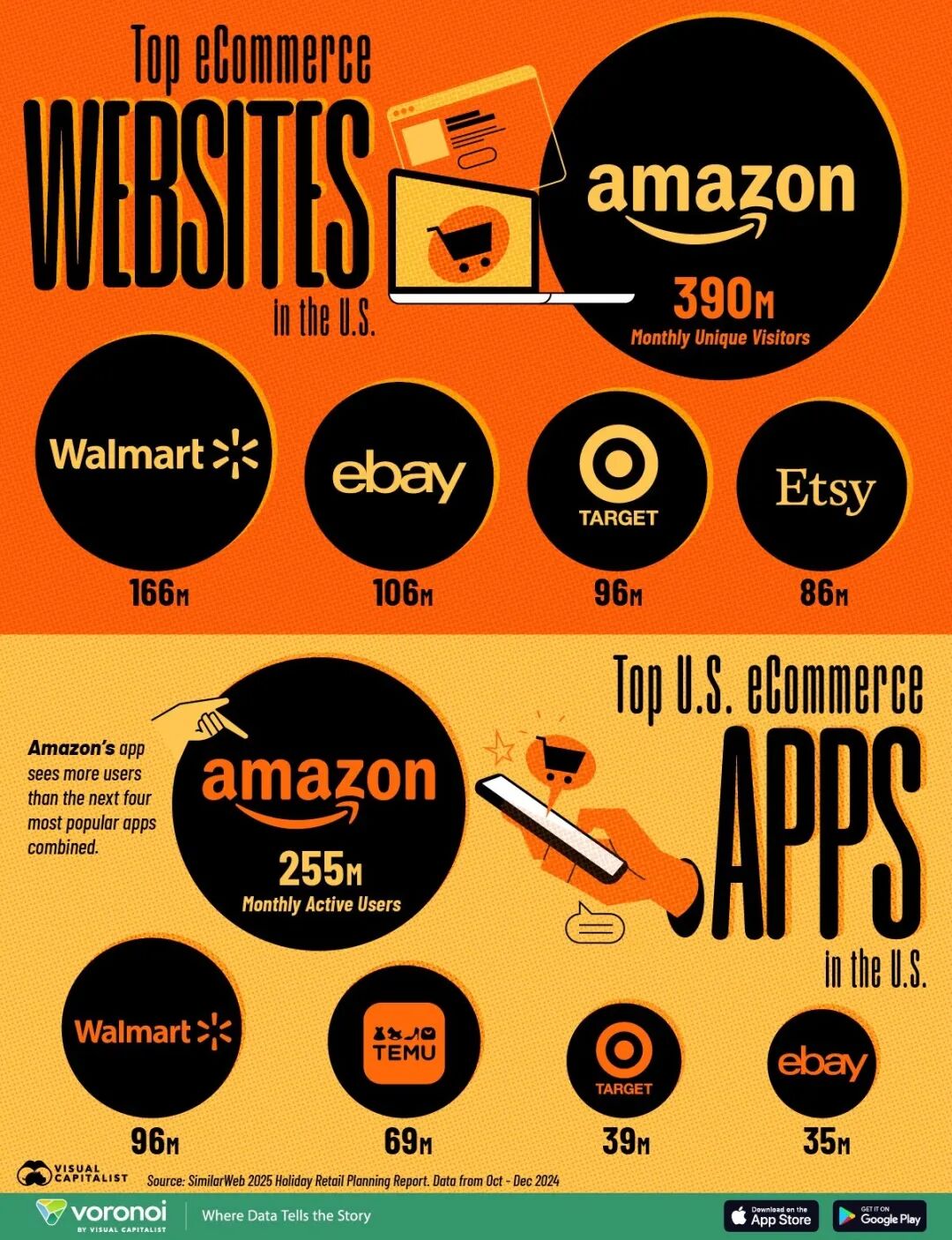
Monthly user traffic for mainstream U.S. e-commerce websites and apps from October–December 2024. Source: Voronoi
Though a bit late, Walmart has finally carved out a place in e-commerce.
More importantly, this veteran retailer has let go of its obsession with traditional 'access points.' Walmart found that customers who shop both in-store and online typically spend twice as much as pure in-store shoppers and visit more frequently.
This shows that online channels don't cannibalize offline customers but create incremental growth. In an omnichannel model, 'access point' sovereignty is no longer paramount. Walmart can connect with users through more flexible forms, bringing the competition back to user experience—or, as old Sam Walton once said:
The secret to success in retail is meeting customers' needs.
PART02 Connections in the AI Era
Consumers always want lower prices, faster speeds, and fewer hassles. This is a consensus validated by Walmart, 7-11, Amazon, and Chinese e-commerce companies.
Now, AI needs to convince users it can better deliver all this—and offer a superior user experience.
Agentic Commerce is emerging as the key. McKinsey predicts it could reach $3–5 trillion by 2030.
Unlike traditional AI shopping guides, the defining feature of this model is AI autonomy. In an ideal scenario, humans only set demands and budget rules, while AI, as an independent agent, autonomously completes the entire process: product selection, price comparison, ordering, payment, and after-sales. Overseas, ChatGPT Shopping and Gemini Shopping, as well as domestic platforms like Doubao and Qianwen, represent early explorations of such products.

Doubao and Qianwen have integrated with e-commerce platforms like Douyin Mall and Taobao
Walmart's new global CEO, Furner, stated this year: The shift from traditional web or app searches to agentic commerce represents the next major change in retail. We're not just observing this transformation—we're driving it.
Currently, Sparky is expected to deliver on this vision.
As a shopping assistant agent, Sparky can answer user questions about products, offer recommendations, track frequently purchased items, and remind users to restock. According to Walmart's Q1 FY2027 data, customers using Sparky have an average order value about 35% higher than non-users—not because Walmart deliberately raised prices, but because early adopters of AI shopping assistants are less price-sensitive and already have higher-frequency, efficiency-driven shopping habits.
Sparky still has vast potential. When Walmart described 'The Future of Shopping is Agentic,' it gave an example: a user asks what to eat for dinner, and Sparky generates a family menu, automatically adding ingredients to the cart. If a user asks how to fix a leaking faucet, Sparky provides steps, orders the right tools, and arranges same-day delivery.
Of course, this is just a lofty vision. In reality, agentic AI shopping is still in its infancy, with low penetration and many flaws.
Sparky has faced criticism on Reddit: inaccurate searches, robotic responses, misinterpreting user intent, and making simple product searches more cumbersome. Some say it's just a repackaged search engine, not truly useful AI.
This is par for the course with any new technology or product. E-commerce was once similarly dismissed. In 2021, Jeff Bezos, then the world's richest man, tweeted a 1999 cover of Barron's featuring his face on a burning bomb with its fuse lit, implying Amazon's imminent collapse. The article was blunt:
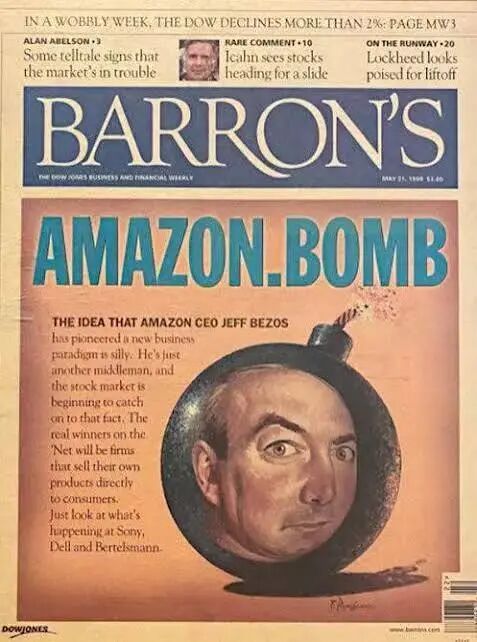
Jeff Bezos on the 1999 cover of Barron's
'The idea that Jeff Bezos has invented a new business model is foolish. He's just another middleman, and the stock market is starting to see that. The real winners on the internet will be companies that sell their own products directly to consumers. Look at what Sony, Dell, and Bertelsmann are doing.'
Walmart isn't trying to defy this pattern—pragmatism is in its DNA. So, before Sparky evolves into the AI shopping agent everyone envisions, Walmart has assigned it more practical tasks: guiding users who show purchase intent on ChatGPT or Gemini to complete their shopping within Walmart's ecosystem via Sparky.
Traditional access points are dissolving, but Walmart can use Sparky to connect with more new access points, forging new relationships with people actively or passively entering the AI world.
This is a path Amazon hasn't chosen. As an 'advertising company + cloud services company' in essence, Amazon must keep traffic access points in its grasp. Thus, its AI shopping assistants, like early Rufus or later Agent Alexa, operate only within Amazon's closed ecosystem. It lacks sufficient incentive to seek new AI access points.
Walmart, however, as a retail giant with over 2.1 million global employees, nearly 11,000 stores, and serving approximately 280 million customers weekly, remains focused on selling goods above all else.
Embracing AI is about continuing to sell well amid technological shifts. It doesn't need to aggressively label itself an 'AI company' but rather use AI to enhance user experience and efficiency.
Currently, it plans four types of super Agents for consumers, employees, suppliers/sellers/advertisers, and developers—leveraging relatively mature AI products like agents to improve user experience and refine its organizational ecosystem.
This time, it's clear about its strengths.
By transforming its decades-built store fulfillment, warehousing, inventory systems, pricing frameworks, membership programs, and data into AI-callable—even indispensable—infrastructure, Walmart can stay relevant. Maintaining its core business and staying in the game are prerequisites for discussing anything else.
PART03 At a Historical Turning Point
In the AI era, the consumer demand for 'saving money and time' remains unchanged, but decision-making processes will evolve. The more developed agentic AI shopping becomes, the more people trust AI, and the shorter the decision chain. This means Walmart must not only win over its customers but also gain AI's trust.
This new task falls on Furner.
Furner has worked at Walmart for over 30 years, starting as an hourly worker in 1993. After graduating from college, he began as a store manager, later serving as CEO of Sam's Club and Walmart U.S. before becoming global CEO in February this year. Walmart's official announcement noted: Under his leadership, the company is building a new era driven by innovation and AI. At the June shareholder meeting, Furner emphasized that Walmart is using AI to 'lead the next generation of retail.'

John Furner, President and CEO of Walmart Global
CEO transitions at major companies often align with significant technological or industry shifts.
When foundational technologies or competitive rules change, existing leaders risk path dependency, necessitating new strategists. Apple and Walmart exemplify this. While Tim Cook turned Apple into one of the world's most profitable hardware companies, the AI narrative falls to his successor, Williams. Doug McMillon built Walmart's retail, e-commerce, and advertising ecosystem while defining its AI direction—leaving deep AI integration as Furner's mandate.
McMillon highlighted two keywords in his assessment of Furner: curiosity and digital acumen.
According to media reports, Furner frequently uses AI, engaging with it daily and encouraging employees to leverage AI tools to enhance work outcomes. After becoming CEO, he swiftly consolidated Walmart's scattered technology and product departments under unified leadership, significantly boosting Walmart's AI integration: frontend Sparky continues to evolve; AI tools drive advertising and membership growth; backend AI improves inventory, fulfillment, and supply chain efficiency; internal tools like Code Puppy and AI training enhance productivity.
Take delivery efficiency, for example. During the Q1 FY2027 earnings call, Furner noted that AI applications in the supply chain are improving inventory placement, fulfillment decisions, and real-time service capabilities. That quarter, Walmart delivered over 3.5 billion items globally on the same or next day, with U.S. Walmart Delivery growing 45%.
Whether through Furner's background in Walmart's store systems or his post-appointment AI initiatives, one signal is clear: Walmart's AI isn't a Silicon Valley fantasy. It's about doubling down on its core business and remaining a global retail leader in the AI era.
However, the harsh reality is that large companies navigating technological shifts often endure more prolonged struggles than startups.
For now, Walmart has chosen a pragmatic, gradual approach to AI adoption, ensuring its current position. But as AI technologies and Agentic Commerce evolve, who knows where the 'next Amazon' might emerge?
This is an unavoidable challenge for Furner's CEO tenure. AI evolves far faster than e-commerce, bringing higher stakes and risks.
Even the value of "people," which Walmart has relied on for decades, may be reassessed in the AI era.
"People-oriented" is in the DNA of this veteran retail company. Over the years, it has firmly believed that frontline employees, who can talk to customers, are the only ones who truly understand what is happening outside. However, AI is changing the way people consume and also transforming human work. Silicon Valley's tech companies have already initiated waves of layoffs, and Liu Qiangdong recently mentioned that, in the long run, AI and unmanned robots will replace traditional express delivery positions.
Concerns about AI also loom over some Walmart employees.
A shareholder proposal demanding that Walmart disclose the impact of AI and automation on employee well-being appeared at the shareholder meeting in early June this year. Media reports revealed the background of this proposal: A Walmart night-shift employee believed that AI-driven work standards could lead to harm, burnout, and high turnover, and he also stated that employees were required to complete "impossible schedules."
The proposal was ultimately rejected due to a failed vote, but this minor controversy still stirred concerns about Walmart: With 2.1 million employees worldwide, are they an asset or a burden for this company undergoing AI transformation? When AI can handle more human jobs, how will these employees be accommodated?
"Since Sam Walton opened the first Walmart, business has changed a lot; since I worked as an hourly employee in the garden center, business has changed a lot too. But what hasn't changed is that our employees (people) make the difference."
Ferner responded to the concerns at the shareholder meeting with this statement. But everyone knows that a response is not an answer. This veteran Walmart employee still needs a more compelling new story about AI, retail, and people.
-
![]()
The Unstoppable Rise of 'Optical Progress and Copper Decline': Sunny Optical’s Strategic Vision for the Next Decade
-
![]()
AI + Going Global in the Second Half: No Intermission for Robot Vacuum Cleaners
-
![]()
The Suffering Endured in E-commerce, Walmart Doesn't Want to Repeat in AI
-
![]()
What Does the Doubling of New Energy Vehicle Exports Mean?
-
![]()
Ghosn: 'Only I Can Save Nissan'
-
![]()
Volkswagen Lays Off 100,000 Employees, The Elephant Sits Down
-
![]()
Expanding Production Capacity! Yutong Optics Acquires Approximately 1.5 Hectares of Industrial Land in Chang'an, Dongguan
-
![]()
Why Is Nokia Making a Comeback in the AI Era?