Why Is Nokia Making a Comeback in the AI Era?
 06/29 2026
 525
525
In the past, when Nokia was mentioned, the public's perception often swung between two extremes. On one hand, there were the iconic feature phones, affectionately dubbed "brick phones," like the Nokia 3310 and 3210, which epitomized a bygone era of dominance. On the other hand, there were the cautionary tales often cited in business textbooks, illustrating how a former titan that once ruled the global mobile phone market gradually lost its foothold amid the smartphone revolution.
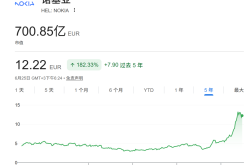
However, discussions about Nokia have taken a markedly different turn in recent times, even adopting a triumphant tone. Fueled by the AI boom, Nokia has once again found itself at the forefront of industry conversations, with its market value experiencing a significant upward trajectory. The market has re-evaluated its role in telecommunications infrastructure and the evolution of AI networks, with data indicating that Nokia's latest market value has surpassed $70 billion.
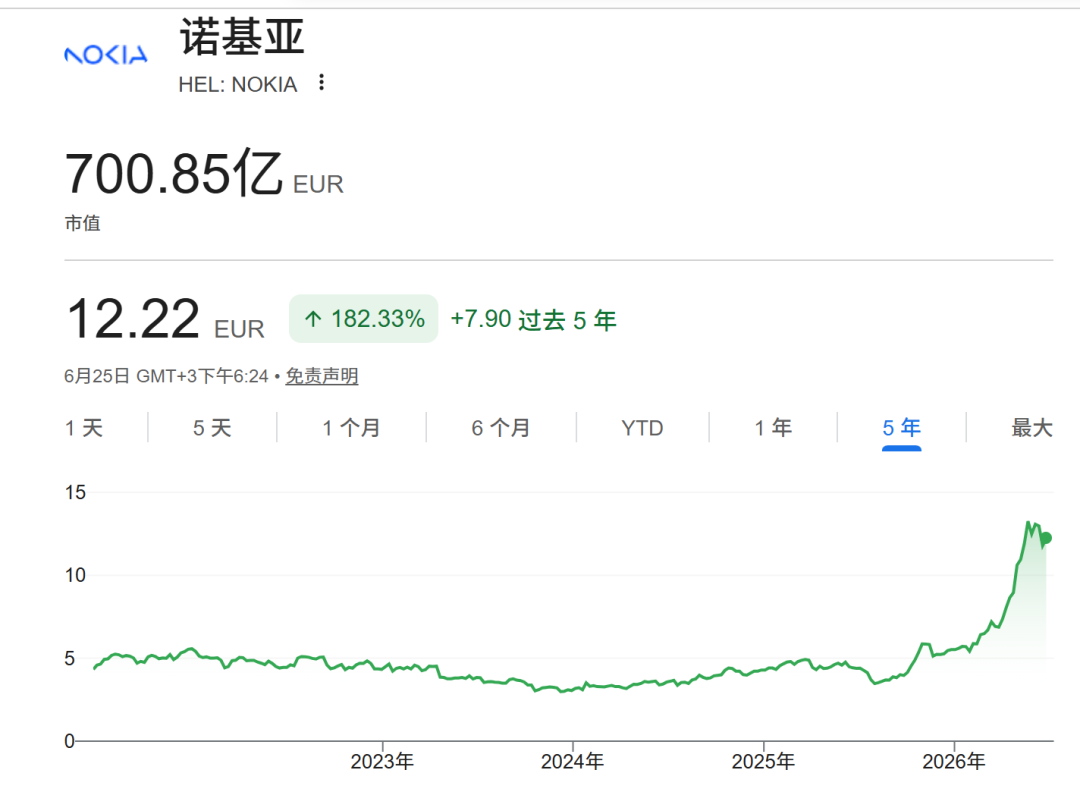
Rumors in the capital markets even once speculated about the possibility of SpaceX acquiring Nokia—though the authenticity remains unverified, such speculation itself underscores a reality: in this new technological cycle, telecommunications infrastructure is undergoing a transformation.
This raises the question: In an era where AI permeates every aspect of life and computing power reigns supreme, what has enabled Nokia to navigate through cycles and discover a new growth trajectory?
The Former King of the Mobile World Steps into the 'Light'
Pivoting Amid Adversity
Nokia was once the undisputed leader of the feature phone era. Starting in 1996, leveraging stable product iterations and a formidable supply chain, Nokia gradually outmaneuvered competitors like Motorola and Ericsson, securing the top spot in global mobile phone market share for 15 consecutive years. At its zenith, its global market share exceeded 40%, with a market value reaching approximately $162.3 billion. Classic models like the Nokia 1100 sold over 250 million units, with "durability, long battery life, and stable signal" becoming its hallmark brand attributes, while also embedding the philosophy of "Technology for Humanity" deeply in people's minds.
However, everything changed in 2007 with the advent of the iPhone, marking the beginning of the smartphone era. The competitive landscape in the telecommunications industry rapidly shifted from "hardware performance and supply chain efficiency" to systemic competition involving "operating systems + application ecosystems + platform capabilities." Nokia's strengths began to wane under the new rules. It clung to the outdated Symbian system, which suffered from bloated code and severe version fragmentation—in 2009, there were 57 incompatible versions, with an extremely weak application ecosystem (only 3,000 apps in the Symbian Store in 2010, compared to over 100,000 on Android). Meanwhile, it rejected Google's offer to collaborate on Android, opting instead to independently develop the MeeGo system, only to repeatedly miss transformation windows due to internal conflicts.
Later, former Microsoft executive Stephen Elop took over as CEO and spearheaded Nokia's strategic restructuring: abandoning the long-relied-upon Symbian system while halting the promising MeeGo system, which was seen as the next-generation platform, and betting all smartphone operations on the Windows Phone ecosystem. This decision was initially viewed as an attempt to "quickly shift tracks," but in hindsight, it became one of its most critical strategic missteps. Faced with the platformization wave of mobile internet, Nokia neither became part of the Android ecosystem nor built independent platform capabilities, ultimately losing momentum entirely in the entrance competition of the smartphone era. In 2013, Nokia sold its mobile phone business to Microsoft for approximately €5.44 billion, marking the formal end of its consumer electronics era.
However, from an industrial structure perspective, this "exit" did not signify decline but rather resembled a mandatory business repositioning. After shedding its mobile phone business, Nokia made a crucial strategic decision: it would no longer attempt to compete in the "terminal entrance" space but instead return to the more foundational yet long-term structural links within the telecommunications industry—network infrastructure.
During this phase, Nokia reorganized its organizational and asset structures, concentrating funds, R&D capabilities, and engineering systems into the telecommunications equipment sector (as exemplified by buying out Siemens' stake in the joint venture "Nokia Siemens Networks"), including mobile communication networks, core network systems, and private network capabilities for operators and enterprise markets, thus laying a solid foundation for its subsequent development.
Stepping into the Light
The primary driver behind Nokia's current market value surge is its precise alignment with one of the most critical industrial trends in the AI era: "light."
Over the past year, "optical communication" has ignited a frenzy in the capital markets, with related indices and stocks soaring. As a landmark event, on June 22, the A-share market witnessed a historic moment: Shandong-based optical module leader Zhongji Innolight saw its stock price break through 1,400 yuan during intraday trading, reaching a market value of 15.6 trillion yuan, surpassing Kweichow Moutai in both metrics.
Why has optical communication become so sought after? This is because, entering the AI era, computing power demand has grown exponentially, with large model training and inference imposing unprecedented bandwidth and latency requirements on data transmission. Traditional copper cable and electrical interconnection solutions have reached physical limits in bandwidth, power consumption, and transmission distance, unable to meet the transmission needs of petabyte-scale data. At this juncture, optical communication technology, utilizing optical fibers as carriers and light waves as media, has emerged as the cornerstone for building an AI computing power "highway" due to its overwhelming advantages in high bandwidth, low latency, and low loss.
Against this backdrop, Nokia's long-term investments in optical networks, IP transmission, and data center interconnectivity began to pay off. What truly propelled Nokia into the core ranks of optical communication was its 2015 acquisition of Alcatel-Lucent. Records show that this deal brought Nokia core patents and technological accumulations from Bell Labs, filling gaps in IP and cloud network domains. It not only catapulted Nokia into the global first tier in the optical network equipment market but, more importantly, incorporated Bell Labs' decades-long first-mover advantages in lasers, fiber amplifiers, and coherent transmission into Nokia's portfolio. In 2024, Nokia invested $2.3 billion to further acquire U.S. optical communication equipment manufacturer Infinera, and upon completion in 2025, Nokia will become the second-largest supplier in the optical network market, holding a 20% market share.
By October 2025, NVIDIA announced a strategic investment of approximately $1 billion in Nokia, with the two sides launching in-depth collaboration around AI-RAN (Artificial Intelligence Radio Access Network), attempting to upgrade traditional communication base stations into intelligent nodes capable of edge computing power scheduling. This collaboration is seen as an important signal of the integration between communication networks and AI computing power systems.
From optical communication to data center interconnectivity, from 5G-A to AI-RAN, from operator networks to edge computing nodes, Nokia is re-embedding itself into a grander industrial system. This time, it is no longer a company buffeted by technological waves but one of the architects of the "highway" behind those waves.
The Weight of the Computing Power Era
Besides securing its position in optical communication, the rumored SpaceX acquisition added to Nokia's allure.
Although the acquisition was false, the scenario is thought-provoking because it outlines a strategically near-perfect closed loop:
As SpaceX acquired U.S. nationwide mobile communication spectrum and made significant AI investments through acquiring xAI, its ambition to become a full-scenario communication operator has become evident. Starlink addresses space network coverage issues, while Nokia, as a leading supplier of wireless access network (RAN) equipment, can precisely fill gaps in its ground communication infrastructure, particularly in densely populated areas, forming a perfect "space-ground integration" closed loop.
The AI-RAN platform developed through Nokia's deep collaboration with NVIDIA can decentralize AI computing power to base stations, enabling real-time network optimization and edge-side inference. Traditional RAN systems primarily handle data transmission between base stations and mobile devices, while AI-RAN adds edge computing and intelligent processing functions. This allows base stations to apply AI algorithms to optimize spectrum utilization and energy efficiency, improving overall network performance while also leveraging idle RAN assets to host edge AI services, creating new revenue streams for operators. In an era of explosive AI application growth, AI-RAN enables faster responses for next-generation AI applications like intelligent agents and chatbots while preparing for integrated sensing and communication applications in the 6G era.
This advantage precisely complements SpaceX's computing power in space. The core logic behind this controversy is: in the AI-driven computing power era, any giant attempting to build a "full-stack empire" spanning chips, algorithms, space networks, and ground infrastructure will view companies like Nokia, which master key "connectivity" technologies, as strategic assets that must be acquired.
Moreover, today's Nokia is effectively an integration of Lucent, Motorola, Alcatel, Siemens (Communications), and Nokia itself, with core patent values that are difficult to overestimate, making it an unsurprising new favorite in the computing power era.
Epilogue
Looking back at Nokia's entire evolutionary path, its transformation is not merely a commercial cycle's rise and fall but a process of being continuously repositioned by technological paradigms. From the global hegemon of the feature phone era to strategic stagnation in the smartphone wave, and then to returning to the core of telecommunications infrastructure after shedding terminal operations, it has never truly left the industrial stage but merely shifted from the "center front" to the "systemic foundation."
In the AI era, this foundational position has been re-amplified. Nokia is no longer simply defined as an equipment vendor but reinterpreted as "part of the AI network foundation." Indeed, this is not unique to Nokia—the value positioning of traditional telecommunications companies is undergoing significant change. In this communication era rewritten by AI, what truly matters may no longer be who stands center stage but who still supports the entire stage's operation.
References: Why Has Nokia, Not Yet Bankrupt, Risen Again? How Did It Become Popular Without Mobile Phones? - 21st Century Business Herald; Why Has Nokia Become a Hot Commodity in the Computing Power Era? - Xianzao Classroom; Fate Has Once Again Favored Nokia - Wu Xiaobo Channel; Nokia's Century-Long Rise and Fall - Xianzao Classroom; In-Depth Revelation: Nokia's Century-Long Vicissitudes - Xianzao Classroom; Why Has Nokia Become a Hot Commodity in the Computing Power Era? - Xianzao Classroom; Giving Nokia $1 Billion, Jensen Huang Aims to Earn $200 Billion - Zimu AI; EU Approves Nokia's $2.3 Billion Acquisition of Infinera - Global Times; Nokia's 'Revival': This 'Light' Illuminates Its Path - IT Times
-
![]()
The Unstoppable Rise of 'Optical Progress and Copper Decline': Sunny Optical’s Strategic Vision for the Next Decade
-
![]()
AI + Going Global in the Second Half: No Intermission for Robot Vacuum Cleaners
-
![]()
The Suffering Endured in E-commerce, Walmart Doesn't Want to Repeat in AI
-
![]()
What Does the Doubling of New Energy Vehicle Exports Mean?
-
![]()
Ghosn: 'Only I Can Save Nissan'
-
![]()
Volkswagen Lays Off 100,000 Employees, The Elephant Sits Down
-
![]()
Expanding Production Capacity! Yutong Optics Acquires Approximately 1.5 Hectares of Industrial Land in Chang'an, Dongguan
-
![]()
Why Is Nokia Making a Comeback in the AI Era?