AI Office Enters the Paid Era: Alibaba, Tencent, and ByteDance Engage in a 'Three-Way Showdown'
 08/18 2026
 479
479
By Duo Le
On August 10, the Qianwen App openly displayed its pricing. The three tiers of continuous monthly subscriptions—Advanced, Elite, and Flagship—are priced at 19 RMB, 49 RMB, and 128 RMB, respectively, with additional charges for video generation quotas.
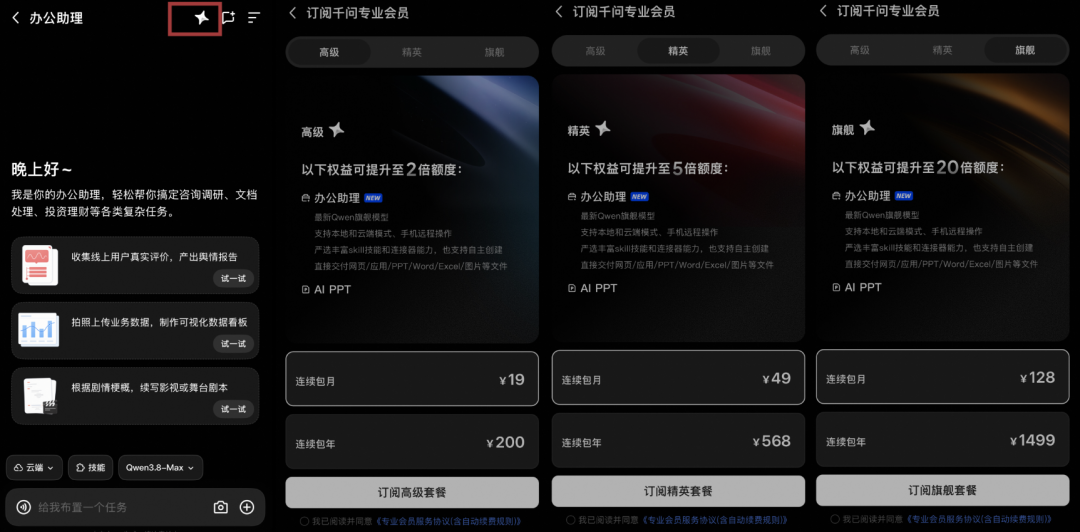
(Image from the Qianwen office page)
Two days later, Tencent highlighted in its Q2 financial report that WorkBuddy users demonstrated strong willingness to pay for Tokens through subscriptions and top-ups.
On August 13, Feishu renamed Feishu Daily to Doubao Work Partner, shifting from a development platform-oriented name to one that more closely resembles an enterprise employment relationship.
Taken together, these three announcements carry more significance than another product launch. Office AI agents are moving beyond showcasing capabilities and entering a phase focused on calculating revenue, costs, and delivery responsibilities. While users still assign tasks through chatboxes, manufacturers are now considering a different set of questions: How many model and tool calls are consumed for a single PPT? How many points should be charged for a cross-system task? Can a digital assistant justify a monthly corporate budget of several hundred RMB or more?
In the previous half-month, Tencent consolidated resources related to QClaw and WorkBuddy, ByteDance adjusted the product and commercial teams for Feishu, Doubao, and Volcano Engine, Alibaba merged QoderWork, MuleRun, and Wukong into Qianwen Office, and Baidu integrated the research and development resources of its internal AI agent, Dodo, into Baidu Dazi. This organizational consolidation addressed redundant development, and the subsequent emergence of pricing tables began to answer a more challenging question: What exactly are these major companies preparing to sell to their clients?

Traditional office software sells usage rights. Employees acquire a set of tools, with work output primarily depending on the individual. Office AI agents, however, offer something closer to on-demand work capabilities, with vendors providing not only models but also handling planning, retrieval, tool invocation, and execution environments.
AI office is attempting to capture corporate budgets for digital labor.
01 From Free Acquisition to Tiered Pricing: Office AI Enters the Paid Phase
Rewind to early 2026, and the market looked entirely different.
Tencent was simultaneously promoting WorkBuddy and QClaw, Alibaba was developing the local desktop tool QoderWork while nurturing Wukong within DingTalk, Baidu had both GenFlow within its document and cloud storage services and the standalone office AI agent Baidu Dazi, and ByteDance was placing bets across multiple entry points, including Doubao, Feishu Daily, and TRAE.
Running four or five office AI agents simultaneously within a single company, with teams competing for resources, entry points, and budgets, was seen as a standard approach for rapid trial and error at the time.

However, real-world office tasks never accept fragmented delivery. For example, an industry research task requires searching public information, accessing personal files, generating editable charts, and drafting a final report based on a template. If any step lacks permissions, context, or operable tools, the AI agent will stall, leaving the user to re-upload files, re-authorize access, and re-explain their preferences.
A deeper issue lies in the cost structure. During the free period, no one closely calculated these expenses—it was the company's money being spent to drive user growth. Once revenue became a serious consideration, the financial picture changed entirely. An office AI agent capable of continuously executing tasks relies not just on large models but also on cloud computing, storage, and third-party application interfaces. The cost of running some tasks once can equal dozens of user queries about casual topics.
Qianwen and Doubao have moved PPT generation, data analysis, and video production into paid zones while keeping basic Q&A free, a choice that highlights which functions are the most resource-intensive.

Thus, the consolidation and monetization of office AI agents are two sides of the same coin. Consolidation aims to focus limited computing, R&D, and sales resources on the product most likely to succeed, while charging fees tests whether that product deserves to survive.
When comparing monthly fees, China's AI office market has formed a clear hierarchy.
Qianwen App starts at 19 RMB, Baidu Dazi's Personal Pro and Max versions cost 59 RMB and 129 RMB, respectively, and Doubao Professional costs 68 RMB, 200 RMB, and 500 RMB across its tiers.
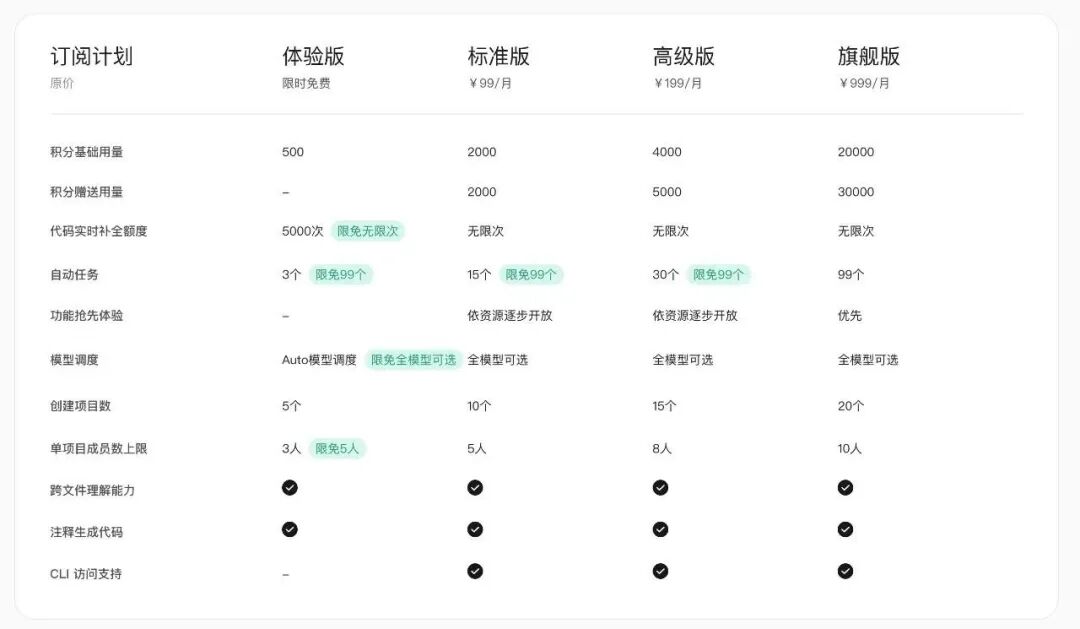
Tencent's WorkBuddy offers an enterprise SaaS version at 198 RMB per user per month and a private cloud version at 316 RMB per user per month. Feishu's enterprise-grade Doubao Work Partner starts at 990 RMB per month or 9,900 RMB annually. While prices range from the cost of a work meal to a corporate procurement, the target buyers and cost structures differ entirely.
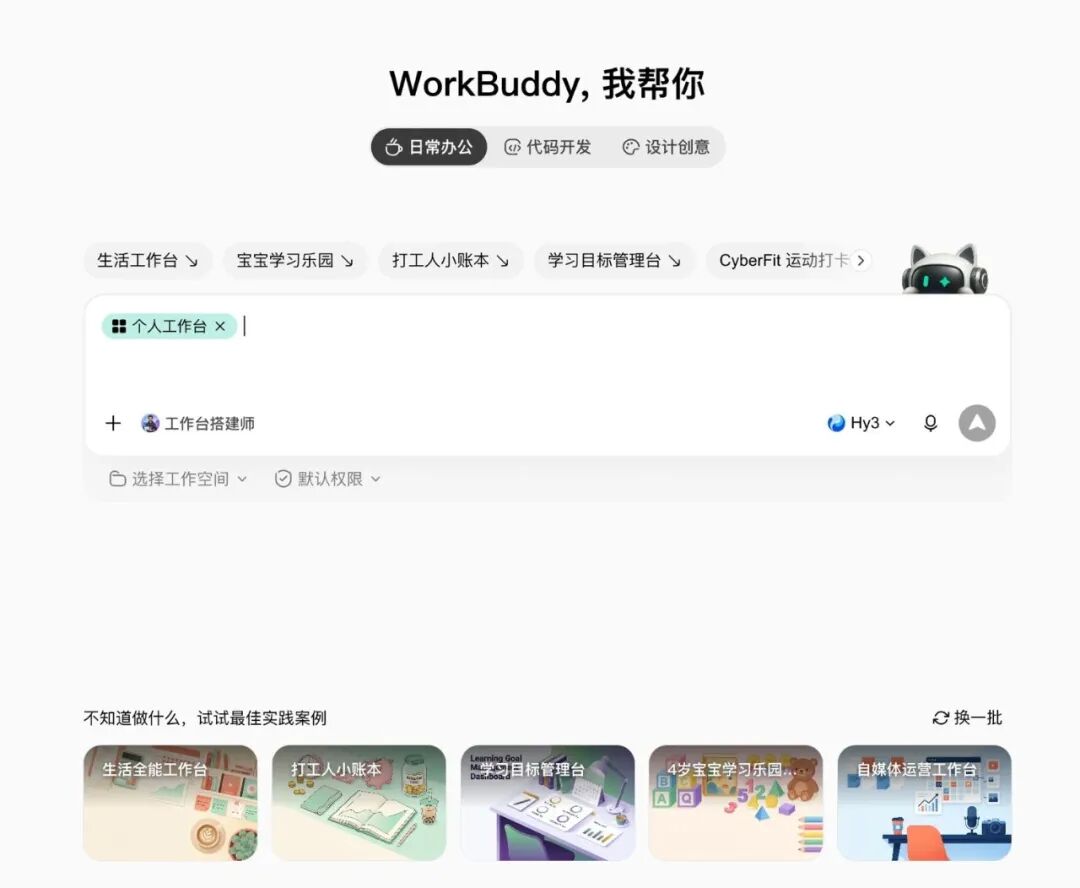
(Image from a WorkBuddy interface screenshot)
In Yunqi Business's view, Qianwen and Doubao's personal memberships primarily target frequent users, with low-tier plans lowering the barrier to first-time payments and high-tier plans offering more invocation opportunities. Tencent's WorkBuddy uses a seat-based system plus Credits.
Feishu's pricing is even more granular: Generating one effective answer for enterprise knowledge consumes 20 points, meeting minutes typically cost 0.5 points per minute, producing a document costs 2 points, a PPT costs 10 points, and a short video costs 20 points. Additionally, model and tool invocation fees apply when the AI agent executes tasks.
At this stage, pricing tables function more as tests: Companies observe which tasks users are willing to pay for while containing cost risks from unlimited usage through point systems.
02 Efficiency Calculations: Tencent, Baidu, ByteDance, and Alibaba Each Have Their Own Approach
From an enterprise perspective, Tencent focuses on corporate IT and collaboration budgets. WorkBuddy executes tasks from the desktop and can receive instructions through WeChat, Enterprise WeChat, and other entry points, while the enterprise version connects to Tencent Docs, Tencent Lexiang, and meeting content.
High-frequency communication entry points reduce the learning curve for employees to initiate tasks, and the seat-based model aligns with existing corporate procurement habits. The alignment of QClaw-related teams with WorkBuddy's department also helps reduce redundant investments between personal remote instructions and corporate execution environments.
Baidu targets the time costs of knowledge work. GenFlow operates within Baidu's document and cloud storage services, while Baidu Dazi integrates search, files, maps, and cross-application execution. Dodo previously handled meetings, documents, and emails within Baidu and could also access knowledge bases and R&D platforms for tasks like demand management. By merging this team into Baidu Dazi, Baidu is exporting a work methodology proven within a real organization to external products.
Baidu's strength lies at the task's starting point. Research, education, consulting, and content roles spend significant time searching for, reading, and organizing materials, and search and file assets can shorten the AI agent's path to contextual understanding. Its commercial challenge lies in the latter half of tasks. Personal files can be priced through 59 RMB or 129 RMB memberships, but enterprise knowledge involves identity, permissions, system access, and auditing—costs that standard memberships struggle to cover.
ByteDance is closer to integrating AI consumption into business revenue streams. The July 30 organizational adjustment merged Feishu's product team with Doubao's team, while Feishu's commercial team joined Volcano Engine. On August 13, Feishu Daily was renamed Doubao Work Partner, aligning the product brand with the new organizational structure. Behind this name change lies a key shift: Doubao now directly integrates into Feishu's messages, documents, meetings, and multi-dimensional table (multidimensional tables), placing consumer-grade model entry points, enterprise collaboration data, and cloud services on a single revenue chain.
ByteDance faces specific challenges: Doubao Personal Professional, Feishu Personal AI Membership, Enterprise AI Version, and Volcano Engine usage form multiple pricing tiers, requiring clients to understand what services each tier provides.

Alibaba's reach is the broadest, extending from personal efficiency to enterprise operations. Qianwen App targets individual office needs, while Qianwen Office combines local desktop, cloud execution, and DingTalk collaboration into a single product.
This represents Alibaba's larger commercial space beyond low-priced personal memberships. Once Qianwen Office connects to DingTalk identities, enterprise databases, and workflows, revenue can come from seats, computing power, deployment, and services. If tasks continue into procurement, marketing, and transaction processes covered by 1688, Taobao, Tmall, Alipay, and Alibaba Cloud, Alibaba may also earn returns from subsequent commercial activities.
However, the boundaries, user rights, and team goals among Qianwen App, Qianwen Office, and DingTalk require time to align.
All four companies are ultimately competing for the same efficiency gains, but their revenue entry points differ. Whoever can access higher-value, more reusable tasks will have greater pricing flexibility.
03 Task Completion Determines the Market's Size
After office AI agents enter the paid phase, monthly active users and task volume remain important.
However, enterprises bear at least four layers of costs: software subscriptions and points, system access and permission management, employee review and rework, and potential business losses from erroneous execution. Vendors' published pricing tables typically cover only the first layer, leaving the other three to be managed internally by clients.
Future corporate procurement will increasingly focus on hard metrics: end-to-end task success rates and manual takeover rates. These figures determine whether AI agents can access core functions like contracts, finance, customers, and supply chains—and whether vendors can charge membership fees, seat fees, or qualify for task-based pricing.
From this perspective, the introduction of fees for domestic AI assistants does not signify the complete end of the free era. Basic Q&A will likely remain free or low-cost long-term, as it serves to acquire users and cultivate habits.
Pricing is more likely to bifurcate: Personal products will use lower monthly fees and quota packages to filter heavy users, while enterprise products will charge higher fees around knowledge, permissions, execution, and accountability. Tools that only generate content and lack unique data will face pressure.
The recent product consolidations by the four major companies have set up shelves for this transition, and the pricing tables rolled out by Qianwen, Tencent, Baidu, and Feishu are clarifying product outlines for the first time.
Whoever can deliver these capabilities stably, cost-effectively, and with accountability will likely secure the largest share of digital workforce budgets.
-
![]()
[In-depth Report] Building a Solid Foundation of Quality to Lead the New Development of the New Energy Vehicle Industry
-
![]()
VOYAH Pursuit S Seeks to Outshine YU7? VOYAH Aims for Top 3 in BEV Market with Spiral Growth Strategy | Mingjingpro
-
![]()
6 Years, 7 Models, 2 Generations, 3 Major Categories: VOYAH Is Not Missing Any Battle
-
![]()
Will Gasoline Vehicle Owners Opt for Electric Vehicles with a 1,000-Kilometer Range?
-
![]()
Musk’s Ex-Chinese Executive Spends $500 Million on Silicon Valley Mansion: Is AI Fueling a New Era of Wealth Creation?
-
![]()
How Can the Charging Industry Overcome the Challenge of Inefficient Competition in the Era of Vehicle-Energy Integration?
-
![]()
The First Person in the World to Be 'Fired by AI' Has Appeared, but This AI Boss Made Me Laugh
-
![]()
What’s the Cost of Remaking ‘Cow Comes’ Using MiniMax Design?