What Does 6GHz Mean for Wi-Fi 8? A Global Struggle for Future Spectrum
 12/09 2025
 724
724
Over the past decade, Wi-Fi technology has witnessed remarkable enhancements in peak data rates. From Wi-Fi 4 to Wi-Fi 6E, theoretical peak speeds have soared to several Gbps or even higher, fully catering to the bandwidth demands of most applications, such as high-definition video streaming, cloud services, and AR/VR. In the majority of home and enterprise settings, Wi-Fi transmission rates now surpass practical needs. However, real-world connection experiences are seldom dictated by theoretical speeds alone. Signal obstructions, interference from multiple devices, complex indoor layouts, and delays during device roaming and handoffs can significantly degrade the perceived connection quality—this is precisely the context in which Wi-Fi 8 emerges.
Earlier, in the article "Wi-Fi 8 Is Coming Before We Even Use Wi-Fi 7! This Will Reshape Key IoT Scenarios," I introduced that unlike previous Wi-Fi generations, which solely pursued peak speeds, Wi-Fi 8 is designed to deliver stable, low-latency, and nearly lossless connections in high-congestion, interference-prone, and highly mobile environments.
In this pursuit, the 6GHz band has emerged as a critical cornerstone for Wi-Fi 8 to achieve its design goals. With its wide bandwidth and minimal interference, the 6GHz band supports continuous, wide-channel transmissions, providing the necessary conditions for Wi-Fi 8's advanced features. Without continuous, clean 6GHz spectrum, Wi-Fi 8's core capabilities cannot be fully realized, thereby limiting device adoption and user experience. Building on this, this article will discuss the key Wi-Fi 8 features reliant on 6GHz and how global spectrum policies impact the future development of the Wi-Fi 8 industry ecosystem.
Three Key Wi-Fi 8 Features Reliant on 6GHz
The 6GHz band (5925–7125 MHz) has become a critical spectrum layer for next-generation Wi-Fi, delivering the performance, reliability, and intelligence required for AI-driven and low-latency applications. Its significance was first recognized in April 2020 when the U.S. Federal Communications Commission (FCC) fully opened the entire 6GHz band for Wi-Fi use. This move unlocked a clean, high-capacity spectrum, powering Wi-Fi 6E and laying the foundation for wider channels, lower latency, and gigabit-level throughput.
Wi-Fi 7 further expanded on this foundation by introducing 320 MHz channels (double the bandwidth of Wi-Fi 6E) and Multi-Link Operation (MLO), enabling devices to connect simultaneously across multiple bands. These advancements deliver multi-gigabit speeds and more resilient mesh networks, particularly suited for high-density enterprise and residential environments.
Wi-Fi 8 takes this a step further by redesigning how the 6GHz band is utilized, shifting the focus from peak speed to enhancing reliability, determinism, and intelligent coordination. With the emergence of AI-driven computing devices, Wi-Fi 8 introduces several new features that rely on wideband, low-interference spectrum to function as designed:
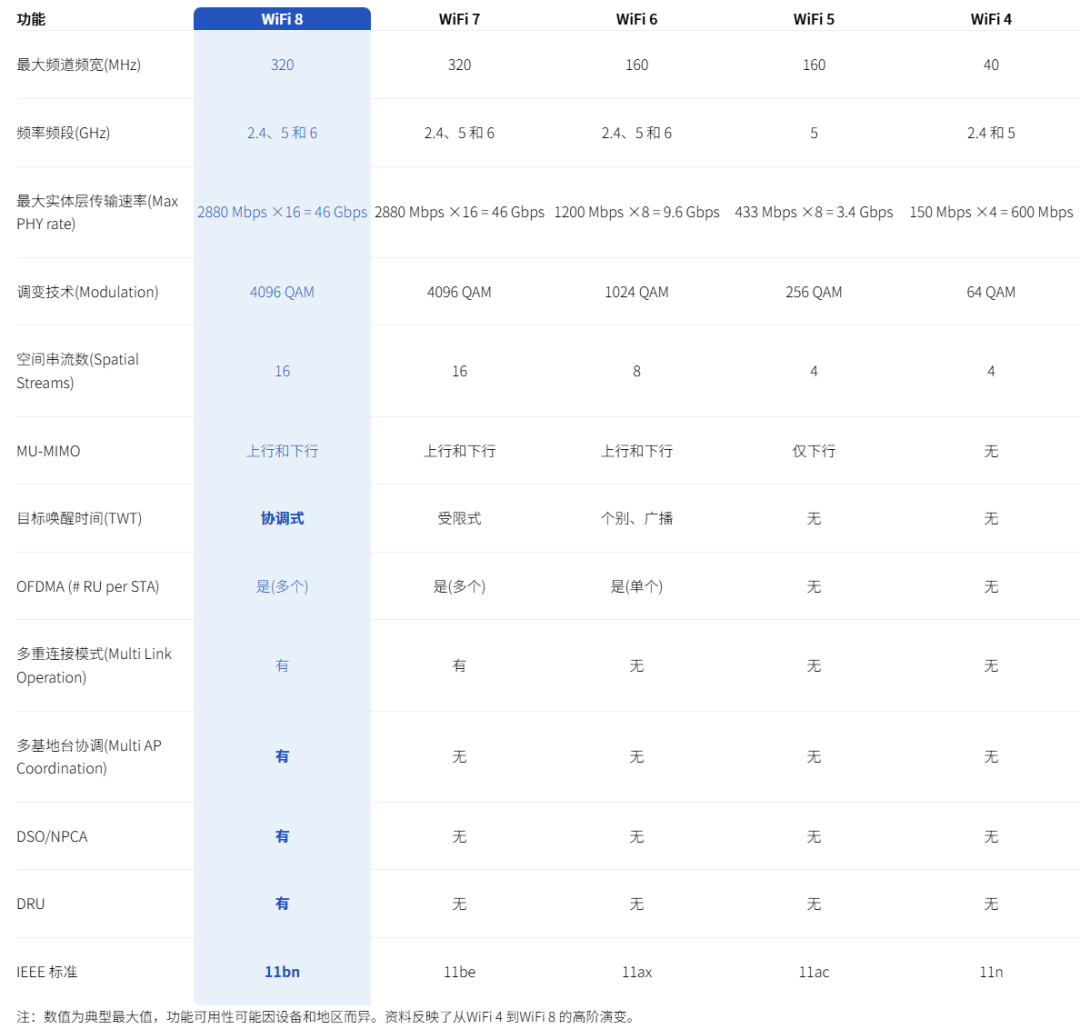 Image Source: TP-LINK
① Multi-AP Coordination (MAPC)
One of Wi-Fi 8's most transformative capabilities introduces cellular network technology—Coordinated Multi-Point (CoMP)—into the Wi-Fi domain. It moves beyond the traditional one-to-one relationship between a device and a single access point (AP), allowing multiple APs to simultaneously transmit and receive to the same device.
Multi-AP Coordination (MAPC) builds upon previous Wi-Fi network management capabilities, enabling multiple APs to operate as a unified system through the following mechanisms:
Coordinated Time-Division Multiple Access (c-TDMA): APs can share transmission opportunities by prioritizing and rotating non-overlapping signals. This reduces interference and congestion, ensuring more stable speeds, lower latency, and reliable connections even in busy homes.
Coordinated Spatial Reuse (c-SR): APs communicate with each other and use dynamic power adjustments to avoid overlapping coverage areas, preventing interference for clients in overlapping zones. This improves speeds near APs, reduces speed degradation, and enhances call and streaming smoothness.
Adaptive Power Control and Frequency Selection: Dynamically adjusts power and channels based on environmental interference and terminal distribution.
Cross-AP Cluster Load Balancing: Optimizes traffic distribution between users and APs, improving overall network throughput and stability.
These technologies require clean, spacious 6GHz channels to avoid interference from legacy devices. Analyst Dean Bubley emphasizes: "To have neighboring APs simultaneously use multiple 160/320 MHz channels without interference, sufficient total spectrum is essential... In other words, adequate spectrum is fundamental for these emerging applications in home and enterprise scenarios, and the full 6 GHz band will play a central role, as it supports 3 x 320 MHz or 7 x 160 MHz channels."
In the future, MAPC will support industrial automation, robotics, AR/VR, and other loads requiring deterministic low latency, becoming a key driver of Wi-Fi 8 performance improvements.
② Uplink Enhancement (ELR and DRU)
Wi-Fi 8 significantly boosts uplink performance, aligning the standard more closely with AI devices' "transmit more than receive" characteristics.
Enhanced Long Range (ELR): Wi-Fi 8 adopts more robust packet structures and encoding methods, greatly improving coverage in edge areas of the home. Devices can maintain stable connections with routers over longer distances, making it ideal for attics, garages, or outdoor spaces. This enhances uplink coverage for edge devices like cameras and outdoor sensors.
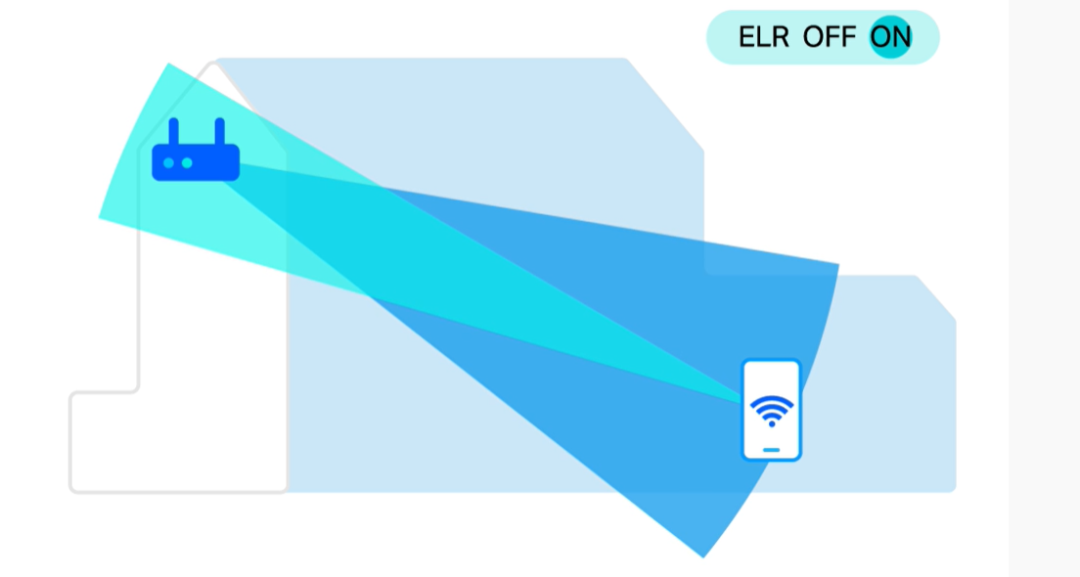 Image Source: TP-LINK
Distributed Resource Units (DRU): DRU helps low-power or distant devices be clearly received by routers, making uploads (e.g., video calls or cameras) more stable. This provides low-power indoor devices (LPI) with more flexible tone and subcarrier allocation capabilities.
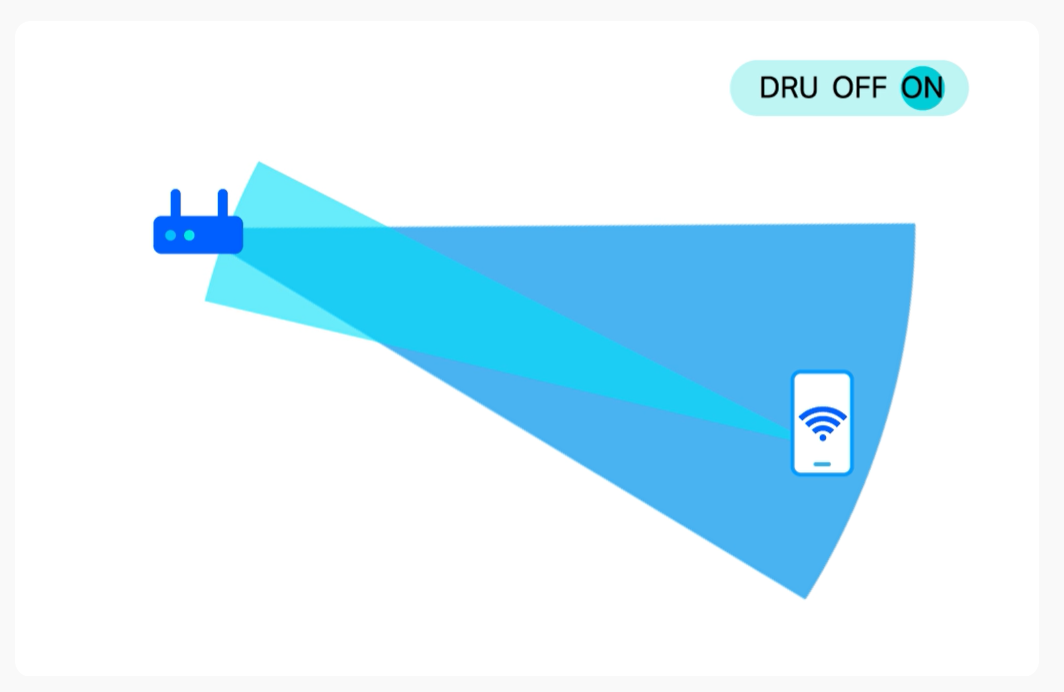 Image Source: TP-LINK
These enhancements rely on the continuity and low noise floor of the 6GHz band, ensuring network stability in coverage and uplink determinism—critical for wearables, smart glasses, laptops, robots, and real-time sensors.
③ Low-Latency Roaming
Drawing from cellular network mobility models, Wi-Fi 8 introduces seamless roaming mechanisms, drastically reducing re-association times between APs. There is no need to renegotiate with each move; AP clusters maintain a Unified Mobility List (UML) to track connected devices, enabling nearly instantaneous handoffs.
This mechanism relies on coordinated AP clusters operating on clean 6GHz channels, making roaming predictable and low-competition to meet the demands of AR/VR, autonomous systems, and uninterrupted critical communications.
Impact of Fragmented 6GHz Policies on Wi-Fi 8 Adoption
While some key Wi-Fi 8 features rely on 6GHz, global 6GHz policies remain inconsistent, significantly affecting Wi-Fi 8 deployment and adoption.
In April 2020, the U.S. Federal Communications Commission (FCC) announced the authorization of unlicensed access to the 6GHz spectrum, allocating its entire 1200 MHz bandwidth to wireless local area networks (WLANs) to drive next-generation Wi-Fi development and maintain its leadership in Wi-Fi chips and technical standards. In contrast, China's Ministry of Industry and Information Technology (MIIT) released the updated "Regulations on the Division of Radio Frequency in the People's Republic of China" in June 2023, designating the entire or partial 6GHz band (6425-7125 MHz) for 5G/6G systems.
Subsequently, at the 2023 World Radiocommunication Conference (WRC-23), delegates reached a consensus on allocating the 6GHz band for International Mobile Telecommunications (IMT, including 5G/6G) systems, forming a new resolution: Region 1 (Europe, Africa, Russia, and Arab countries) allocated the entire 6425-7125 MHz band for IMT; Region 2 (Americas) allocated the entire 6425-7125 MHz band for IMT in some countries; Region 3 (Asia-Pacific) allocated the entire 7025-7125 MHz band for IMT, with some countries in the region allocating the 6425-7025 MHz band for IMT. Additionally, the conference indicated in the WRC-27 (2027 World Radiocommunication Conference) IMT new agenda resolution that other Asia-Pacific countries could directly join the 6425-7025 MHz band allocation footnote without requiring additional technical and regulatory studies by the International Telecommunication Union (ITU).
According to publicly available information, current 6GHz band allocations by country are as follows:
United States/South Korea/Canada: Fully opened the entire 6GHz band (5925-7125 MHz) for unlicensed Wi-Fi use.
European Union/Japan/India/Australia: Only opened 5925–6425 MHz (500 MHz) for Wi-Fi, reserving 6425–7125 MHz for 5G/6G or maintaining a wait-and-see approach.
China: Explicitly allocated 6425–7125 MHz for 5G/6G, with 5925–6425 MHz still undecided.
As of now, China remains the only major economy globally that has not yet opened the lower 6GHz band (5925-6425 MHz) for Wi-Fi, hindering Wi-Fi industry upgrades. Consequently, many industry insiders have published commentary articles urging the swift opening of the lower 6GHz band (5925-6425 MHz) for unlicensed Wi-Fi to accelerate the large-scale deployment of Wi-Fi 6E/7.
Overall, fragmented 6GHz policies not only affect user experiences but also influence enterprise deployment decisions. Siân Morgan, Research Director at Dell’Oro Group, mentioned a vendor strategy: using software-defined radios (SDRs) to allow the same radio device to operate in 6GHz or as an additional 5GHz radio. In tri-band access points, for example, configurations could include 2.4GHz + two 5GHz bands or 2.4GHz + 5GHz + 6GHz—all controlled via software. Another strategy is offering access points without 6GHz support to reduce costs, as each additional radio increases hardware expenses. For customers who do not need, understand, or cannot use 6GHz, vendors may prioritize these low-cost models to lower material costs.
However, for enterprises and other end-users, this could mean higher costs: "The more SKUs vendors need to support, the higher the overall costs, which are ultimately passed on to enterprises," notes Dell’Oro. They also observed another trend with Wi-Fi 7: even in markets where 6GHz is available, some vendors continue promoting dual-band access points without 6GHz support. Enterprises may not realize this—they see "Wi-Fi 7" and assume it is better than Wi-Fi 6. Morgan explains that if enterprises are unaware of 6GHz's importance, low-cost access points without 6GHz support may seem perfectly adequate, and they might not even notice they are missing out on 6GHz's full capabilities. This issue will persist throughout Wi-Fi 8's adoption cycle.
Conclusion
The development of the mobile communications industry relies on the scientific planning and rational allocation of spectrum resources. From the leapfrog development of mobile communications, spectrum preparation generally precedes mobile communication generation shifts by about 5 to 10 years. The emergence of Wi-Fi 8 marks a transition in wireless connectivity technology from purely pursuing speed to focusing on reliability, determinism, and intelligent coordination. In this process, the 6GHz band is not only foundational for performance but also critical for enabling advanced features. However, inconsistent global policies will directly impact Wi-Fi 8's adoption speed and user experience.
For the industry and enterprises, understanding the strategic significance of 6GHz, monitoring regional policy developments, and fully considering spectrum characteristics in device selection and network planning will be key to unlocking Wi-Fi 8's full potential.
References: "Wi-Fi 6E introduced the 6 GHz band; Wi-Fi 7 maximized it; now Wi-Fi 8 will rearchitect how it’s used" (rcrwireless), "Wi-Fi 8 is taking shape, but the lack of universal 6 GHz access threatens to limit performance and distort regional rollouts" (rcrwireless), "How Will Fragmented 6GHz Band Policies Affect Wi-Fi 8 Adoption?" (Qianjia Network), "What Is Wi-Fi 8: Entering a New Era of Ultimate Stability" (TP-LINK), "It’s Official! MIIT Allocates 6GHz Spectrum—Will Wi-Fi 7 Still Have a Chance?" (IoT Intelligence Network), "WRC-23 Observations | An Irresistible Trend, A Unified Direction—The Global Regulatory Basis for 6GHz Band Allocation to 5G/6G Has Been Established" (Radio Regulatory Bureau), "The 6GHz Spectrum 'Battle': Global Telecom Industry's Struggle and Negotiation" (Telecom World), "Why Has China’s 6GHz Spectrum Allocation Remained Undecided?" (Focus Optical Communication)
-
![]()
Chevrolet and Skoda Exit China Before Mazda and Peugeot-Citroen
-
![]()
Zuckerberg's Concerns About Superintelligence: Who Holds the Power When the Technology Arrives?
-
![]()
Auto Scene Competition in Full Swing
-
![]()
Samsung Z Fold 8 Ultra Review: A $2,100 Foldable Flagship—What Justifies the Price?
-
![]()
Rocket Lab: Neutron Launch May Be Postponed. How Can RKLB Compete with SpaceX?
-
![]()
The Wealthiest Individual Critiques E-commerce: 'Championing the People' or 'Falling Prey to Business Theft?'
-
![]()
The 10-Trillion-Parameter Behemoth is Still Elusive, but ByteDance is Leading the Charge with a New Top-Tier Department
-
Who Will Be the Talent for the Commercial Space Industry?