WPS Polishing AI Semi-finished Product
 12/11 2025
 784
784
Has formatting become an insurmountable hurdle for AI-generated content?
Author | Wang Tiemei Editor | Gu Nian
Five years ago, WPS released a self-narrative article titled 'The WPS You're Using Now: 9,999 Updates Over 32 Years.'
This translates to roughly 26 updates per month. With this product rhythm, WPS has carved out a survival path for office software that better suits China's context, despite operating under Microsoft's shadow.
The most notable example is offering free office software while monetizing through pop-up ads. Though criticized, this approach aligns with China's internet business model, providing differentiation from Microsoft and achieving 60% coverage in Microsoft's Windows stronghold.
That is until AI emerged.
By late 2023, one year after ChatGPT sparked the large model wave, Kingsoft Office CEO Zhang Qingyuan announced that WPS Personal Edition would fully eliminate commercial ads and focus on AI. He stated, 'Why dare we invest after stopping ads? We believe users will pay for AI.'
Previously, Zhang mentioned in interviews his desire for a more elegant business model and plans to gradually phase out ads. He cited three main reasons: rising consumer wealth, the proliferation of mobile payments, and growing subscription willingness. Compared to these, AI presents a more compelling case for Kingsoft Office's product payment transformation.
From a product perspective, after fully pivoting to AI, WPS has iterated its consumer product to LingXi 3.0 and upgraded WPS 365 for businesses, positioning it as a one-stop AI collaborative office platform.
However, WPS has not adopted an all-in AI approach for monetization.
According to 'Shixiang,' WPS currently has around 40-50 million AI users. Among its three consumer membership tiers, Super Members have the highest count, followed by Grand Members, with AI Members having the fewest. This is primarily due to the limited value-added benefits (value-added benefits) of AI Members. Grand Members include AI capabilities along with traditional features, priced only around 100 yuan higher.
From a pricing strategy perspective, AI Members appear to be a 'price benchmark' to highlight the value proposition of Grand Members.
In other words, few users are paying solely for AI. WPS does not treat AI as a core paid product but as a value-added capability within its membership system to boost overall subscription rates and renewal willingness. Thus, Kingsoft Office adopts a global monthly subscription pricing model rather than the token-based system commonly used by Agent office software.
Industry insiders believe WPS's AI is primarily applied to text editing and modifications, which consume limited tokens, making it more suitable for a familiar monthly subscription model compared to Agent office software's token-heavy, one-sentence generation approach.
Currently, WPS offers limited text-to-video capabilities, with potential future additions like minor video storage and simple editing functions. For example, a PPT-to-video conversion feature may be introduced later.
Kingsoft Office, with 647 million monthly active users, is attempting to integrate AI seamlessly into users' existing workflows rather than creating entirely new usage habits. This approach differentiates WPS's AI strategy from many AI office software competitors, which often seek to refactor (reconstruct) usage paths with AI.
In the view of Kingsoft Office's President Assistant, 'Users don't want flashy; they want useful.' Under this logic, WPS aims not to rebuild user workflows but to make AI a new tool within familiar processes.
Compared to AI office newcomers rewriting workflows from scratch, WPS's veteran editor-style AI evolution makes it unique in this round of AI office reconstruction.
01 QianWen and Others Target Microsoft Office Suite
Within 30 days, Alibaba launched two consecutive To C AI applications:
First, in late November, the Quark browser, deeply integrated with QianWen AI assistant, received an upgrade, introducing six QianWen AI suites.
Though targeting Chrome, Quark leverages screen-sharing to collaborate with WPS and other office software, assisting users in writing Word documents, creating Excel sheets, and even generating tables, PPTs, or extracting content from Word documents within the browser itself.
Next, in early December, Alibaba's other AI product, QianWen, continued its upgrade. Following a week of launch, it surpassed 10 million downloads and now targets Microsoft Office Suite.
On December 4th, it introduced new capabilities for office and collaboration scenarios, integrating document generation, intelligent formatting, online editing, and multi-format conversion into a one-stop operation. Additionally, a new PPT generation feature allows QianWen to accurately refine and intelligently match templates based on various inputs like images, documents, and voice.
These capabilities are freely available to all users.

Compared to Quark, QianWen's upgrade directly targets Microsoft Office Suite. Shuyao, QianWen's product manager, revealed, 'QianWen's capabilities are further enhancing. We hope it not only inspires users but also delivers complete documents.' By integrating Office capabilities into conversations, the AI assistant evolves from content generation to task completion.
Task-solving ability is key to native AI application stickiness. 'Some apps have low engagement because they're strongly tied to demand frequency, simplicity, and criticality,' Shuyao noted.
'Launching office capabilities aims to address genuine, simple yet daily high-frequency needs. Results show it guarantees engagement, reflecting natural user demand.'
Notably, from Alibaba's management to product teams, efforts are underway to establish new AI-era standards. During a recent speech at the University of Hong Kong, Alibaba Group co-founder and Chairman Joe Tsai attempted to define Alibaba's AI competition rules.
'The U.S.-defined AI competition rules are flawed. How do Americans determine winners? By whose large language model is stronger. Today it's OpenAI, tomorrow Anthropic, and maybe someone else later,' Tsai said, criticizing the scoring method. 'The real winner isn't who has the best model but who utilizes it best.'
Not just Alibaba, but under the AI competition defined by task-solving capabilities, office suites have become a top choice for large model enterprises and AI startups.
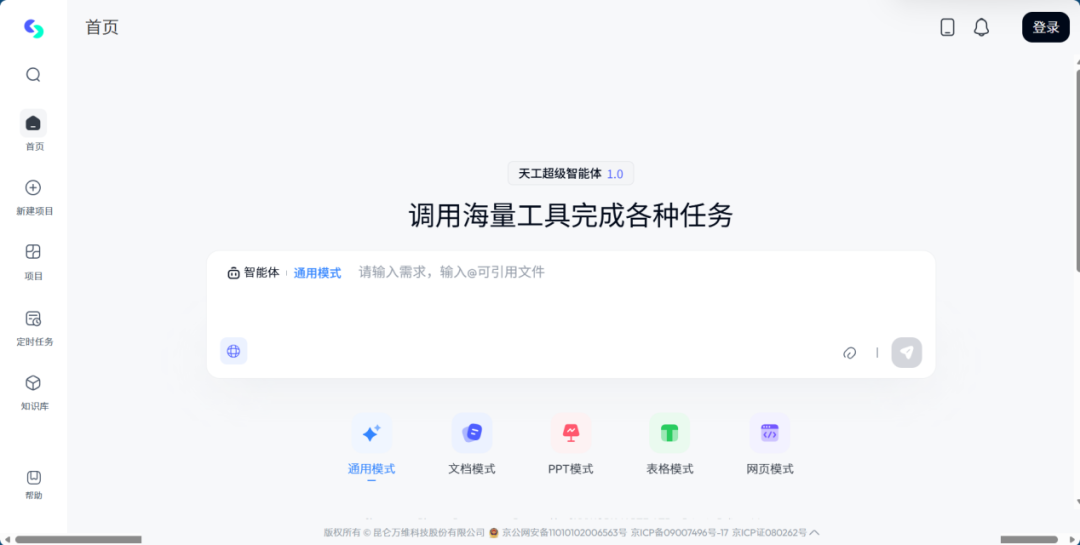
Before Alibaba, Kunlun Wanwei released the Tiangong Super Intelligence Agent, branded as 'AI Office,' with built-in expert agents capable of generating professional documents, PPTs, and tables with one click.
While large model companies target comprehensive office suites, more startups focus on niche AI office scenarios.
Take the fiercely competitive PPT field: Gamma, an overseas startup with annual revenue exceeding $100 million, validated AI office's commercial viability. Domestically, AiPPT acquired 20 million users in 20 months, with over 60% of traffic originating from large model platforms like Kimi and Zhipu.
These figures reveal a trend: though the office software market seems saturated, AI is transforming each component of Microsoft Office Suite into potential standalone battlegrounds.
Document writing, spreadsheet processing, and PPT presentations—functions traditionally within office suites—are now decoupled by AI and outsourced to vertical applications. Each scenario could spawn new unicorns valued at $3 billion.
AI office startups leverage AI's generational dividends to outflank traditional office tools. As AI office tools divert users from conventional software, traditional giants like Microsoft and WPS must address: what truly constitutes office software's moat?
02 A Distinct AI Path from Microsoft
Microsoft was an early adopter in the AI era.
Investing in OpenAI secured it a scarce resource in large model infrastructure. Though Copilot didn't become an AI office benchmark, Microsoft's growth engine has shifted from Office to AI infrastructure behind Azure and Copilot.
Office now primarily serves as an entry point and ecosystem role. In contrast, Kingsoft Office's foundation remains purer. During a media interview, Kingsoft Office VP Tian Ran was asked if WPS would become a 'super entry point' in the AI era.
His response was sobering: 'I don't see WPS as a super entry point. If it were, how tragic would that be? Future entry points include glasses, earphones, and speakers, but Office should be a core capability for every intelligent agent.'
WPS, eschewing the 'super entry point' label, aspires to be a 'must-have module' for all AI assistants, establishing standard capabilities that every AI agent must invoke for document generation.
This differentiates WPS from Microsoft: while Microsoft uses Copilot to refactor (reconstruct) the Office experience with an ultimate goal of binding enterprises to Azure's cloud, WPS uses LingXi to refactor (reconstruct) office interactions while safeguarding document infrastructure like formats, interfaces, and compatibility.
During a July WAIC group interview after LingXi 3.0's launch, WPS revealed its AI market advantage: multiple AI startups specializing in PPT generation actively seek collaboration with Kingsoft Office to resolve deep compatibility issues between generated content and real Office environments.

Currently, so-called one-click PPT generators essentially produce HTML or image-based files resembling PPTs. Ensuring seamless secondary editing in familiar environments and cross-device presentations remains challenging.
Lu Weijun, WPS's PPT product lead, noted that while many AIPPT tools exist, their effectiveness depends entirely on large models, precluding secondary modifications. Enabling AI to accurately grasp real-time user demands and swiftly adjust content per instructions is a critical pain point for the 2025 AI office industry.
Thus, WPS identifies the true barrier in AI office as the ability to modify, adjust, and edit post-generation. LingXi's core philosophy isn't one-sentence generation but an AI-era editing mode—'generate while modifying.'
For example, in WPS's AIPPT, users can adjust content structure via natural language in real-time: 'Expand the second page with three points,' 'Change this page's layout to dark theme,' or 'Add a financial chart.' LingXi instantly comprehends and executes, with all modifications occurring within the familiar PPT editing environment.
This isn't prompt-to-image AI but prompt-to-slide continuous dialogue, reminiscent of a veteran editor's workflow.
LingXi's 'chat while editing' capability relies on WPS's decades-long accumulation of Office format expertise.
Over 30 years, Kingsoft Office has honed 'CRUD (Create, Read, Update, Delete) capabilities' for Office documents, accurately reading format information and translating it into an 'intermediate file layer' understandable by large models. This is the fundamental prerequisite for PPTs to be interpreted, rewritten, and regenerated by AI.
In contrast, most AI startups lack format accumulation, merely extracting text during format conversion and relying on models to generate visuals. In formal office scenarios, where PPT and Word document formats are highly stringent, many AI-generated contents—though substantial—fail to meet standard usage requirements.
03 What Lies Ahead for AI Office Software?
Over the past three years, AI office has evolved through three stages:
2023's Plugin Enhancement Stage: Microsoft Copilot pioneered embedding AI into Office but limited to 'semantic enhancement' without refactor (reconstructing) office logic.
2024's Lightweight Generation Stage: AI platforms like Manus and Genspark supported one-sentence content generation but suffered from weak collaboration and poor editor experiences, struggling to integrate into workflows.
2025's Native Delivery Stage: AI assistants like QianWen and Quark began generating structured office outputs directly from voice/document/image inputs, achieving task closure.
In this third stage, large model companies are also challenging AI office format standards. For instance, QianWen not only makes new features user-friendly and content more professional but also refines usage details.
Unlike most AI products that generate text only, requiring users to copy-paste into other Office software for formatting—a subpar experience—QianWen now generates and formats simultaneously.
Additionally, QianWen's intelligent editor supports more granular operations. Users can request paragraph-specific refinements, expansions, or style adjustments.
Facing large model disruptions, WPS opted for a pragmatic defensive AI strategy: not developing proprietary large models but internalizing AI to strengthen its professional office standing.
At the model capability level, WPS implemented a 'multi-model adaptation' mechanism, selecting different large models per task to balance effectiveness and cost. Currently, WPS integrates multiple mainstream models like DeepSeek, MiniMax, Zhipu AI, Wenxin Yiyan, Tongyi, and SenseTime.
Zhang Qingyuan emphasized avoiding proprietary foundation model development, focusing instead on model applications. 'We self-identify as application developers, not model vendors, though we develop small models for vertical scenarios.' This strategy, set during the 2023 'Hundred Models War,' has proven correct.
With DeepSeek's emergence this year, foundation model costs declined. As an application provider, WPS can flexibly select optimal models. Its AI core capabilities remain open, but scenario entry points, content delivery, and format processing remain firmly under its control.
The technological paths of QianWen and WPS may seem different in direction, but in reality, both are vying for the ultimate delivery rights.
The difference is that large model manufacturers represented by QianWen start from AI assistants and attempt to cover the entire process from 'basic model → content generation → delivery of results'. WPS, on the other hand, starts from the end of file standards and format processing, deeply integrating AI into document entry points, editing processes, and formatting, without building models but upholding standards.
This positions WPS as a neutral connector between platforms and model manufacturers, offering greater room for collaboration amidst the rapid democratization of large models.
Lu Weijun once used a metaphor to describe the current state of the industry: 'The entire office industry is like digging two tunnels that have not yet connected. One end is dazzling AI interaction capabilities, and the other end is a profound understanding of office rules. Only when both ends are truly connected can fundamental problems be solved.'
Now, it appears that the direction chosen by WPS is to occupy the main tunnel of 'understanding office rules.' Meanwhile, the tunnel leading to AI-native interaction is being rapidly excavated by large model companies like QianWen. This shift in roles is also catalyzing a subtle restructuring of the office ecosystem.
Five years ago, when online collaboration platforms began to rise, emerging players like Feishu and DingTalk did not build their own foundations at the document level but generally chose to cooperate with Kingsoft Office, integrating its mature editing and formatting capabilities. Now, whether a similar cooperative structure will recur in AI office scenarios will also determine the depth of WPS's editing moat.
-
![]()
Chevrolet and Skoda Exit China Before Mazda and Peugeot-Citroen
-
![]()
Zuckerberg's Concerns About Superintelligence: Who Holds the Power When the Technology Arrives?
-
![]()
Auto Scene Competition in Full Swing
-
![]()
Samsung Z Fold 8 Ultra Review: A $2,100 Foldable Flagship—What Justifies the Price?
-
![]()
Rocket Lab: Neutron Launch May Be Postponed. How Can RKLB Compete with SpaceX?
-
![]()
The Wealthiest Individual Critiques E-commerce: 'Championing the People' or 'Falling Prey to Business Theft?'
-
![]()
The 10-Trillion-Parameter Behemoth is Still Elusive, but ByteDance is Leading the Charge with a New Top-Tier Department
-
Who Will Be the Talent for the Commercial Space Industry?