Hesai Unveils 3D Camera KOSMO: Positioned to Rival DJI and Target a Hundred-Billion Market Cap!
 04/20 2026
 722
722
On April 17th, Beijing time, Hesai hosted its 2026 Technology Open Day, announcing a strategic shift from 'Spatial Perception' to 'Spatial Intelligence'.
An unseen product featured on the invitation letter emerged as the centerpiece of this strategic evolution. This product holds the potential to propel Hesai from its current market valuation in the tens of billions to the hundreds of billions.
This product is KOSMO, one of four new products spanning different domains that Hesai announced on the same day, specifically tailored for spatial intelligence.
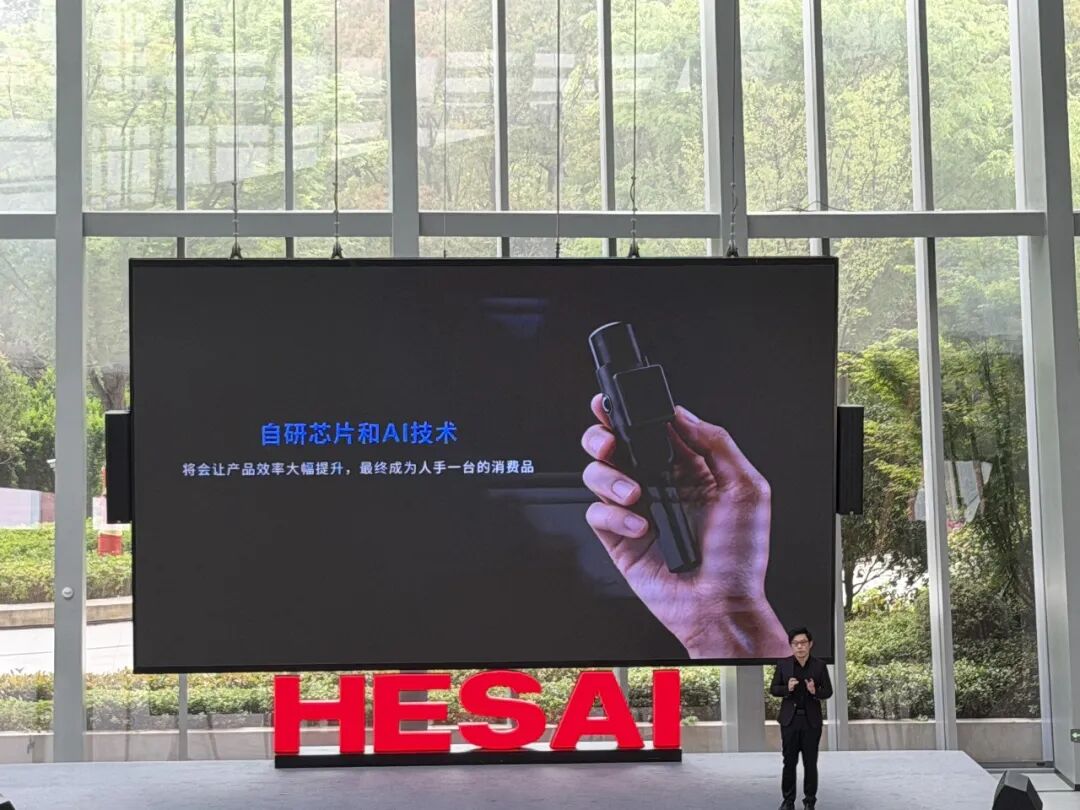
Judging by the name, it's evident that Hesai is aiming to compete with DJI. Given the significance of OSMO to DJI, adding a 'K' prefix is quite telling, isn't it?
The entry point is the relatively untapped 3D camera market, an area where DJI has yet to make significant strides.
Moreover, Hesai explicitly stated in its presentation that it aims to create 'a consumer product for everyone'. During the launch event, Hesai's CTO, Xiang Shaoqing, also clearly articulated: The ultimate vision for KOSMO is to become a camera that fits in everyone's pocket.
Additionally, Hesai introduced new products in three other domains:
A 6D full-color chip named 'Picasso';
A high-resolution 4320-line LiDAR, a domain where Hesai has its roots;
A power module customized for robotic applications.
While upgraded foundational chips like Picasso and the 4320-line LiDAR represent enhancements to Hesai's core business, the truly exciting prospects undoubtedly lie with the new products, KOSMO and the robot power module. Especially KOSMO—keep an eye on this name; it will be a focal point moving forward.
This product bears the responsibility of propelling Hesai's revenue to the next level within the next 5-10 years.
Upgraded Foundational Chips and LiDAR
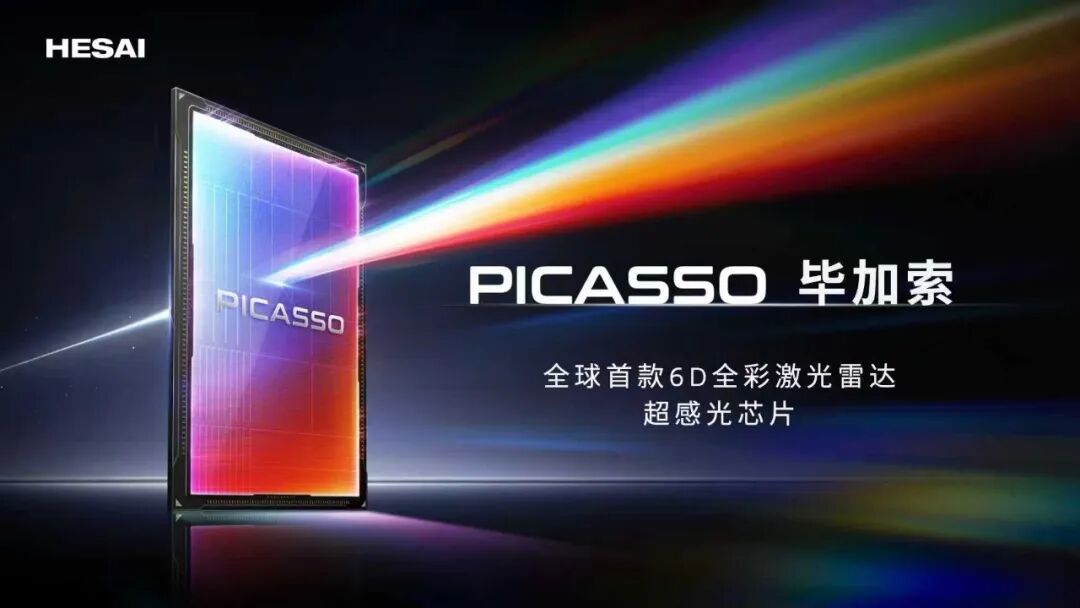
For all intelligent products today, chips are undoubtedly the cornerstone. The 'Picasso' chip is Hesai's flagship.
The '6D' in the 'Picasso' 6D full-color chip is a clever play on words, representing the three spatial dimensions: XYZ, and the three RGB color parameters—Red, Green, and Blue. Combined, these make up six parameters, hence '6D'.
Hesai states that the 'Picasso' 6D full-color chip can simultaneously measure spatial XYZ and color RGB, enabling LiDAR to possess both spatial understanding and the world-perception capabilities of a camera.
Hesai's Chief Scientist, Sun Kai, envisioned the following at the launch event:
The final complete machine (complete machine) volume of such a chip could be as compact as your thumb and could be applied to all intelligent terminals, not limited to phones and glasses—these are some of its potential future applications.
It is believed that this full-color chip is the foundation of all of Hesai's ambitions, including KOSMO, except for the power module. After all, perception and power are two entirely different realms.
With this chip, Hesai has developed a LiDAR supporting up to 4320 lines, capable of identifying a 15cm-tall wooden block 150 meters away and featuring 'full-color' functionality.
With such advancements in chips and LiDAR, Hesai introduced its masterpiece—KOSMO.
Sun Kai stated that LiDAR is essentially a 3D spatial camera. In the future, most scenarios currently utilizing cameras could potentially adopt LiDAR. Beyond the automotive market, this opens up several times more market space, enabling Hesai's revenue to grow by at least an order of magnitude in the next 5-10 years.
If Hesai's revenue can grow by at least an order of magnitude, then a corresponding increase in its market cap from the tens of billions to the hundreds of billions would be quite plausible.
3D Camera KOSMO and Power Module
Hesai dispatched its CTO, Xiang Shaoqing, who had never appeared on camera before, to launch KOSMO, underscoring the company's emphasis on this new product. Of course, it could also be because Xiang Shaoqing was the main advocate for its development and, like a proud parent, wanted to be present for its unveiling.
Humans have always sought ways to represent the 3D world. Apple, a benchmark company globally, released the 'Apple Vision Pro' as such a product. However, the equipment previously used for capturing 3D content was extremely bulky and costly.
Hesai's KOSMO aims to make capturing 3D content more convenient and cost-effective for humans.
KOSMO features a specially developed LiDAR combined with several cameras, achieving 3D effects that would otherwise require hundreds of cameras surrounding an object. Because LiDAR possesses spatial structure perception capabilities that a single camera lacks, combined with the texture and color perception capabilities of cameras, using Hesai's spatial perception algorithms and AIGC algorithms, it can capture the 3D world as seen by the human eye in its true form.
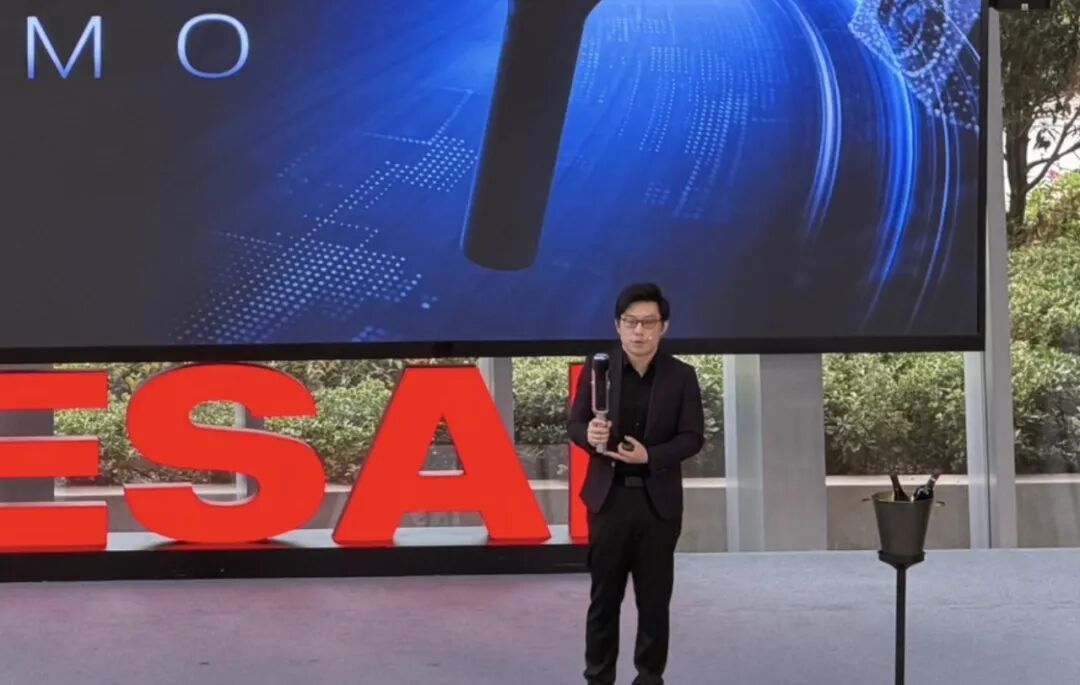
Currently, KOSMO is about the size of a champagne or wine bottle (as shown in the image below, held by Xiang Shaoqing). It primarily serves as a data collection device for world models, a product developed by Hesai as an infrastructure provider.
However, Hesai's poster shows a size that can be held in one hand, very similar to DJI's Pocket3 or the newly released Pocket4 product forms. This reveals Hesai's ambition—to 'ultimately become a consumer product for everyone'.
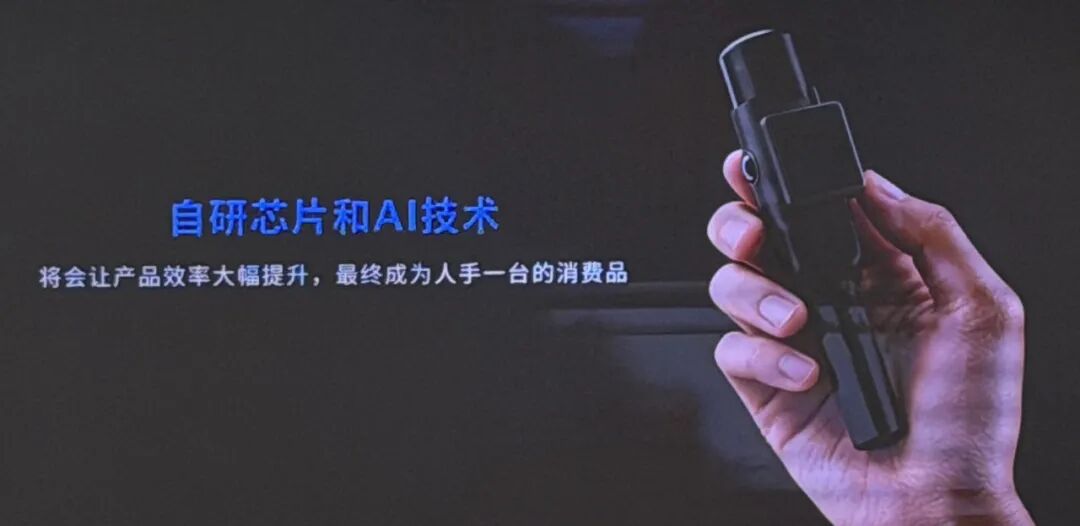
Although Li Yifan, when asked by the media about similar handheld camera products from DJI and Insta360, stated that they are not in the same market due to significant differences in size and price.
Of course, they are not in the same market. After all, both DJI's Pocket series and Insta360's Luna currently capture 2D images. Hesai's KOSMO captures 3D images.
Xiang Shaoqing also stated at the launch event that through continuous iteration and advancement in chip technology, KOSMO can be made smaller and smaller. The handheld state shown in the poster is Hesai's ultimate goal, which might take 3-5 years, as Hesai aims for its revenue to grow by an order of magnitude in the next 5-10 years. Once this state is achieved, it can enter the consumer market, and the goal of 'a consumer product for everyone' will have a chance to be realized.
Below is a sample video captured by KOSMO:
However, those familiar with the imaging market know that DJI's OSMO series is a strategic pivot for DJI, transforming from an 'aerial dominator' with drones to a 'ground imaging empire,' marking a crucial leap from 'flying' to 'filming'.
The most important product in DJI's OSMO lineup is the Pocket series, especially the Pocket3. This single product reportedly generates over 20 billion in annual revenue, with astonishing gross and net profit margins. Since DJI is not a publicly traded company and does not disclose specific data, according to third-party reports, the hardware gross profit margin of the Pocket3 is around 65%, with a net profit margin of 35%-40%.
For Hesai, launching KOSMO is also aimed at creating a second growth curve, and this naming is not without significance.
The product form of KOSMO is similar to that of the Pocket series. Hesai's ambition is glaringly obvious.
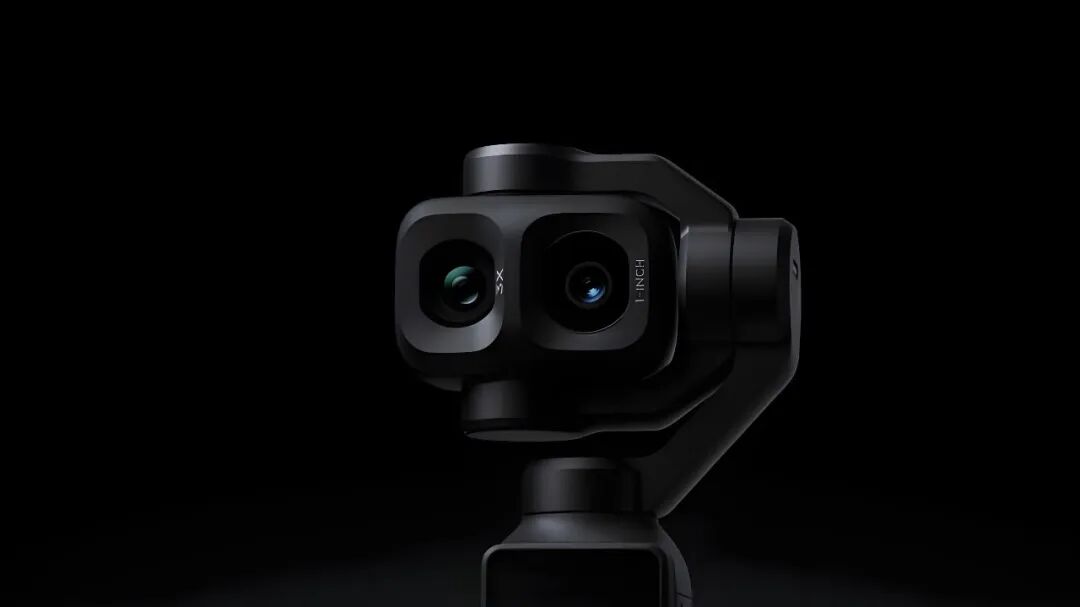
DJI's latest Pocket4 has been rumored to release a dual-camera version, which has not been officially announced yet.
According to Sun Kai, Hesai's revenue needs to grow by another order of magnitude in the next 5-10 years, with Hesai's 2025 revenue at 3.028 billion.
Just one Pocket 3 from DJI generates over 20 billion in annual sales, with some sources saying it's 35 billion+. This is exactly one order of magnitude more, and it's very reasonable for Hesai to target and attempt to enter the personal handheld camera market with its own interpretation (3D video). After all, as a 2B world model data collection device, the market size is extremely limited.
However, there are many challenges. The approach for 2C is entirely different from 2B. Independent operation might be the best approach.
For DJI, it needs to compete with Insta360 and also guard against Hesai.
It's worth mentioning that DJI also internally incubated and ultimately launched an independent LiDAR brand, Livox, starting in 2016 and officially releasing it in 2019. This shows that DJI also has the capability to launch a product similar to Hesai's KOSMO. In a recent interview after a decade, Wang Tao explicitly stated that several new products would be released soon.
In reality, DJI's products for 3D modeling and surveying, such as the Zenmuse series' L1, P1, and H20N, are not consumer-grade products. The L1 is a drone-mounted LiDAR with visible light and thermal imaging lenses, the P1 is a drone-mounted five-lens full-frame oblique photography camera, and the H20N is a spherical gimbal camera with a gimbal, thermal imaging, zoom, and laser.
These are not consumer-grade products. In the future, that might change.
Perhaps, since DJI internally incubated LiDAR in 2016, Hesai has been thinking about how to attack DJI's market, even though Hesai, founded in 2014, was still small at the time.
Just as Insta360 began incubating InstaLing five years ago and ultimately launched the InstaLing A1 panoramic drone last year, attempting to challenge DJI's aerial dominance in the consumer drone market, DJI also launched a panoramic camera to compete in Insta360's market.
Perhaps, DJI and Insta360 are also preparing products similar to KOSMO.
Wang Tao explicitly stated in a media interview that DJI's revenue would exceed 100 billion in 2026, while Insta360's revenue reached 9.858 billion in 2025, a year-on-year increase of 76.85%, also approaching the 10 billion mark.
This market size is highly attractive to Hesai. With KOSMO, Hesai also aims to make a strong entry into the larger imaging market. Hesai has also stated that if it does something, it aims to be the best in the world.
While KOSMO represents Hesai's second growth curve market, the robot power module represents Hesai's desired third growth curve, still positioning itself as a supplier similar to LiDAR. Hesai has provided relatively little information about this business, so here is an image for display. More information will be shared and interpreted as it becomes available.

As shown in the image, Hesai's robot power module covers the limb joints and dexterous hand joints of humanoid robots, meaning it comes in various sizes.
-
![]()
Proposed to Raise 955 Million Yuan through Private Placement! Huicheng Vacuum Boosts Localization of Ultra-Precision Optical Coating Equipment
-
![]()
Cash Flow Soars 13-Fold! What Major Strategic Move is Wuhan Five Square Optoelectronics Planning?
-
![]()
Leaked Design of vivo X500: Reverts to Circular Camera Module in Top-Left Corner, Pays Homage to Classic X90 Aesthetic
-
![]()
DeepSeek Shows Signs of Foraying into Code Agents, Launches WeChat Official Account Focused on Harness
-
![]()
Auto Companies Deny Claims That ‘Cooperation with Huawei Is Non-Essential’, as Huawei Transforms into a ‘Public Platform’
-
![]()
Starship to Independently 'Return to the Launch Tower': SpaceX's Ambitions Extend Beyond Rocket Building to Dominating Space Transportation
-
![]()
Starship Set to Independently 'Return to the Launch Tower': SpaceX is Revolutionizing Space Transportation, Not Just Building Rockets
-
![]()
Anthropic and OpenAI Face Off Against Deepseek