When the Entire Internet Is Criticizing iQIYI, I Believe Gong Yu Is Partly Right
 04/24 2026
 628
628
By Liang Tian
Source / Node Finance
If you're well-versed in navigating the internet, you've likely noticed phrases like "iQIYI has gone wild" popping up on trending search lists.
Yes, you've read that correctly. iQIYI is at the epicenter of a controversy.
The controversy erupted when iQIYI CEO Gong Yu announced the launch of the "Nadou Pro" AI Artist Library at the 2026 iQIYI World Conference, stating that 117 artists had signed consent forms to participate. He also made a somewhat bold claim: in the future, 100% live-action filming might be considered intangible cultural heritage.
As an enthusiast of AI tools, I was somewhat intrigued, but the announcement sparked a significant backlash. Zhang Ruoyun, Yu Hewei, Wang Churan, and several other artists swiftly issued statements denying that they had signed any AI-related authorizations. iQIYI quickly backtracked, clarifying that participation only indicated an interest in engaging with AI projects, not a full authorization.
At first glance, it appears that no one is enthusiastic about AI's involvement in content creation. However, when we delve deeper, is iQIYI truly "crazy"? What kind of content do we genuinely need?
Let me offer a "different" perspective: I fully comprehend iQIYI's strategy.
For iQIYI, the "AI Artist Library" is a measure to cut costs and boost efficiency amid performance pressures. Long-form video platforms have long grappled with profitability.
Financial reports indicate that iQIYI's 2025 annual revenue was 27.29 billion yuan, a 7% year-on-year decrease, with a net loss of 206 million yuan. All three major business segments—membership, advertising, and content distribution—experienced negative growth.
One contributing factor to the losses is the high cost of content production—elements such as actor salaries, schedules, scene arrangements, filming durations, and production cycles all require substantial investment, leading to persistent issues of high costs and low efficiency in traditional film and television production.
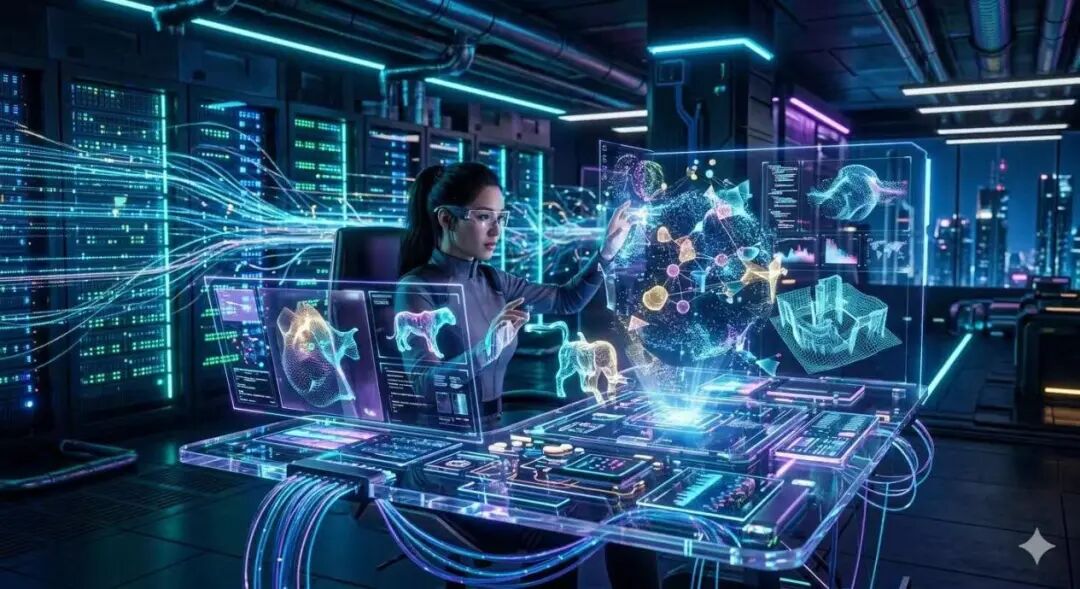
AI, on the other hand, can generate highly realistic scenes in minutes, seemingly providing an ideal solution.
For instance, AI-generated short dramas can cost 70%–95% less than live-action dramas, potentially reducing costs to 1/10 or even 1/100 of the original.
Given these circumstances, we can reinterpret Gong Yu's statement: he is not attempting to eliminate live actors but rather to address the industry's long-standing issues of "unaffordability and slow production."
In his subsequent response, he clarified that live-action filming will always have a place, much like stage plays. His concern is that without technological innovation, 100% physically filmed works might one day be designated as "intangible cultural heritage" due to their rarity.
Gong Yu envisions a future where actors won't need to spend four to five months on set, managing only two projects a year. Through AI technology and licensing, actors can digitally "appear" in more works, gaining more rest time or taking on additional projects.
I believe many will now understand Gong Yu's well-intentioned vision, which aligns with what many envision for the future of the film and television industry. However, I also want to highlight that what audiences fear may not be AI-driven films and TV shows but something entirely different.
The online backlash has been vocal, but when dissected, what are audiences truly resisting? Definitely not AI technology itself.
AI-generated shorts on Bilibili regularly amass millions of views. When Sora was first released, excitement abounded. Seedance even led many overseas viewers to seek Chinese phone numbers. Clearly, audience acceptance of AI content is much higher than many assume.
So, what do audiences fear? It's the influx of soulless industrial waste flooding content platforms.
This concern is legitimate but shouldn't cause undue alarm. Let's consider more examples.
Recently, short video platforms have seen a trend of revisiting old dramas, with shows like "Kangxi Dynasty," "The Smiling, Proud Wanderer," and "My Own Swordsman"—all nearly two decades old—being analyzed frame by frame by content creators. Isn't this ironic? Before AI has even significantly impacted film and TV production, why are people ignoring new live-action dramas in favor of nostalgia? This suggests that content quality is independent of AI—live-action shows can still be subpar. Audiences have discernment and know what they dislike.
What determines aesthetic appeal?
"My Own Swordsman" resonates with modern audiences not because Yan Ni and Yao Chen acted with their real faces but because the dialogue, emotions, and pacing in every scene were of high quality. If "My Own Swordsman" were remade with AI-generated virtual characters, it would likely still be a hit.
Thus, the real issue isn't whether AI can act but who controls the story, pacing, and emotional value provided to users. Emotional value is something only sentient beings can deliver—something AI can never replicate.
Among generative AI, text was the first to gain prominence. But as a writer, I can attest that emotional writing is still easily recognizable, let alone film and TV creation, which requires emotional nuance and human complexity.
Returning to iQIYI, Gong Yu merely stated a fact—AI will reshape the cost structure and efficiency of film and television production. This isn't a radical prediction but something already in progress.
The capabilities of video large models like Seedance, Kling, and HappyHorse are pushing boundaries every three months. iQIYI isn't the only one leveraging AI in film and TV; Hollywood studios have been using it for years, just without the fanfare.
Rather than saying iQIYI has gone wild, this seems more like a necessary clash during industry transformation. Gong Yu's intent is to return the content industry to its creative roots—letting technology handle technology, emotions handle emotions, and content handle content. After all, a truly great content creator can tell compelling stories whether using a film camera or AI tools.
A production team that merely piles on resources will produce the same results regardless of whether they use live actors or AI. Instead of worrying about whether AI will destroy the film and television industry, we should ask a more fundamental question: How many people in this industry are still seriously telling stories? The answer to that question will truly determine whether audiences are willing to pay for content.
*Featured image generated by AI
-
![]()
Proposed to Raise 955 Million Yuan through Private Placement! Huicheng Vacuum Boosts Localization of Ultra-Precision Optical Coating Equipment
-
![]()
Cash Flow Soars 13-Fold! What Major Strategic Move is Wuhan Five Square Optoelectronics Planning?
-
![]()
Leaked Design of vivo X500: Reverts to Circular Camera Module in Top-Left Corner, Pays Homage to Classic X90 Aesthetic
-
![]()
DeepSeek Shows Signs of Foraying into Code Agents, Launches WeChat Official Account Focused on Harness
-
![]()
Auto Companies Deny Claims That ‘Cooperation with Huawei Is Non-Essential’, as Huawei Transforms into a ‘Public Platform’
-
![]()
Starship to Independently 'Return to the Launch Tower': SpaceX's Ambitions Extend Beyond Rocket Building to Dominating Space Transportation
-
![]()
Starship Set to Independently 'Return to the Launch Tower': SpaceX is Revolutionizing Space Transportation, Not Just Building Rockets
-
![]()
Anthropic and OpenAI Face Off Against Deepseek