Alibaba Equips QianWen with 'Dimples' to Capture the Consumer Market
 04/23 2026
 458
458
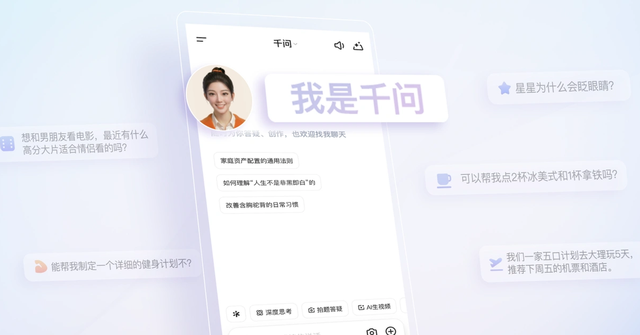
To gain a foothold in the consumer market, Alibaba has bestowed a pair of 'dimples' upon QianWen.
Alibaba Unveils Its 'Dimpled' Innovation
On April 22, after a period of anticipation (pre-heating), Alibaba's 'new weapon,' QianWen Xiaojiuwo, finally made its grand entrance.
Xiaojiuwo is a newly crafted 'QianWen AI Unified Digital Human Avatar' and serves as an 'ecosystem-level AI assistant.' The naming rationale is straightforward: its virtual avatar sports two endearing dimples when it smiles, enhancing the product's memorability while subtly fostering a connection between the digital human and users, thereby boosting the product IP's appeal.

As an ecosystem-level AI assistant, Alibaba emphasizes that Xiaojiuwo's primary distinction from traditional 'chatbots' lies in its proactive execution capabilities. Similar to the widely popular OpenClaw, leveraging Alibaba's robust product ecosystem, users can simply issue tasks in the chatbox, and the AI can autonomously carry out the entire process from 'demand understanding' to 'transaction payment' and 'fulfillment delivery.'
This mirrors Alibaba's previous endeavors to integrate QianWen into business modules such as Taobao Flash Sales, Gaode Maps, Alipay, and even Damai. As the ecosystem matures and user habits evolve, Xiaojiuwo is poised to become Alibaba's AI communication hub for consumer-end users, capitalizing on its efficiency advantages.
However, Xiaojiuwo's actual user experience remains to be validated by the market. Full-chain task execution places higher demands on the AI's comprehension, recognition accuracy, and adaptability in complex scenarios. Balancing personalized user needs while mitigating payment and order risks stemming from operational errors remains a significant challenge for Alibaba in intricate scenarios.
Yet, it is undeniable that
Xiaojiuwo's debut signifies a significant exploration of Alibaba's large model capabilities within consumer ecosystems. Its emergence also offers fresh perspectives for competitors in the 'B2C' and 'AI productization/commercialization' realms.
AI Competition Heats Up
Data from QuestMobile reveals that as of March 2026, China's AI-native apps boasted 440 million monthly active users (MAUs).
In terms of product rankings, the top three are Doubao, QianWen, and DeepSeek, with user bases of 345 million, 166 million, and 127 million, respectively. Q1 2026 average engagement data indicates active rates of 33.5%, 17.1%, and 21% for these three AI products, highlighting their strong user retention.
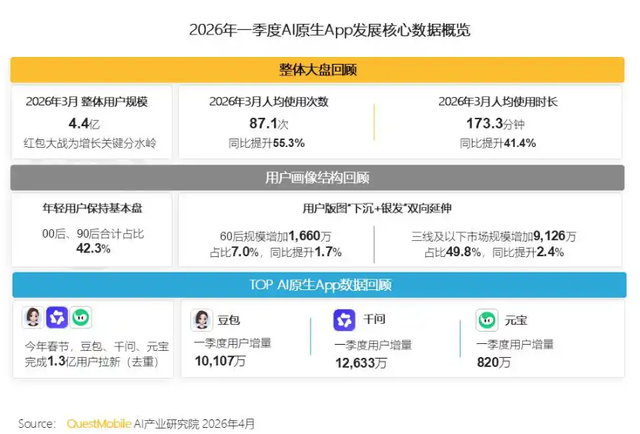
Data-wise, as of December 2025, China's internet user base reached 1.125 billion. Considering the 440 million AI users in Q1 2026, it is evident that after events like 'Red Packet Wars,' 'Lobster Craze,' and 'Token-to-WordPiece shifts,' AI has transitioned from a niche tool for tech enthusiasts to a mainstream presence in nearly 40% of netizens' smartphones, seamlessly integrating into their daily lives.
Notably, a breakdown of incremental user demographics reveals that in March, users aged 60-70 increased by 2.8%, while users from third-tier and lower cities rose by 2.4%. In terms of usage frequency, Doubao, DeepSeek, and QianWen averaged 54.8, 41.7, and 19.8 uses per person per month in Q1.
From corporate and user perspectives,
Why does QianWen trail behind Doubao and DeepSeek in monthly per-user usage?
Beyond Douyin's promotional boost for Doubao and DeepSeek's first-mover advantage in deep thinking features, QianWen's history reflects a persistent 'B-end' or 'tech-centric' image. In a market where generative AI dialog experiences were highly homogenized, QianWen's models gained traction through open-source initiatives, workflow applications, and image editing capabilities.

These features are impressive, and QianWen's project ratings are high. However, for average consumer-end users, these scenarios do not align closely with daily needs. Most users turn to AI for life queries, information organization, or casual venting. Without a demand for advanced professional functions or custom workflows, high-frequency usage habits are unlikely to develop.
This professional-oriented positioning left early versions of QianWen with limited mainstream recognition, while also laying the groundwork for Alibaba's later product synergies and the emergence of lifestyle agent concepts.
The Future Belongs to Data Custodians
Returning to Alibaba's launch of Xiaojiuwo,
Beyond bridging the gap between QianWen and users and boosting consumer-end engagement, increased consumer-end exposure and usage also accelerate model iteration efficiency for manufacturers.
Turing Award winner Richard Sutton once stated: 'Most machine learning aims to transfer existing human knowledge to static, non-autonomous AI. However, as human data nears exhaustion, AI cannot generate new knowledge or sustain learning.'
To enable continuous AI evolution, new data must be continuously fed.

But where does this new data come from?
For manufacturers, leveraging user dialog and task data for AI iteration is among the most practical solutions. Hence, Meta's collection of employee mouse-keyboard data to enhance model efficiency and vendors' open-sourcing to boost token consumption and API calls.
For Alibaba, which announced a ¥380 billion investment in cloud and AI hardware infrastructure, ensuring long-term model evolution through rapid data acquisition becomes a top priority as computational upgrades and model commercialization take shape.
Xiaojiuwo effectively addresses this need.
Through consumer-end interactions, Alibaba gains real-time user demands, conversational corpora, and task feedback data from authentic scenarios. These firsthand user insights are far more practical than laboratory-derived resource packages.
Thus, for Alibaba, Xiaojiuwo is not merely a consumer-end AI product or avatar but a 'fueling station' for QianWen's continuous evolution. Its true value lies in providing a data foundation for long-term model iteration, enabling the model to address capability gaps and adapt to user habits through real-world interactions.
References:
Wall Street See: QianWen Xiaojiuwo Makes Its Debut; Alibaba's QianWen App Climbs to Top 2 MAU
National Business Daily: Nearly 40% of Chinese Netizens Have AI on Their Phones; Doubao Nears 350M MAU as Yuanbao Falls Out of Top 3; Why Kimi and Zhipu Lag? | Q1 2026 AI App Value Rankings
Financial Sector: QuestMobile: Q1 MAUs for Doubao, QianWen, DeepSeek at 340M, 170M, 130M; User Growth Extends to 'Silver-Haired + Lower-Tier' Demographics
-
![]()
Wang Huiwen, Former Meituan Executive, Achieves 20-Fold ROI, Supports 24 AI Startups
-
![]()
Another AI Computing Power Unicorn Launches IPO! Founded by a Changjiang Scholar
-
![]()
OFILM Holdings Secures Zhongke Daojing, Marking a Significant Leap in the Optical Communication Industry!
-
What Will Be the Next Key Battleground for Large Models After AI Coding?
-
![]()
Leapmotor's Sales Soar, Yet Hidden Concerns Loom
-
![]()
China’s Action Camera Market Soars: 3.12 Million Units Sold in Six Months, DJI Secures 74% Dominance
-
![]()
Zhang Yiming: Strategic Retreat as a Path Forward
-
![]()
Exploring Charging for Some Features of QianWen App: Can It Follow the Path of Doubao?