On the Brink of the Smart Glasses Era, A 30-Year Optical Veteran Exits in Disappointment!
 04/23 2026
 654
654
As of 9:00 a.m. on April 23, Elegance Optical, a company with a 30-year history on the stock market, was officially suspended from trading by the Stock Exchange. The Listing Review Committee maintained its prior decision, citing the company's failure to sustain sufficient operational capacity and assets of adequate value to underpin its business operations.
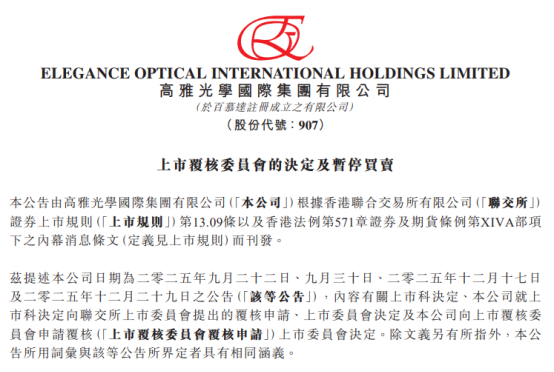
For a seasoned enterprise once hailed as a 'publicly traded optical company,' this outcome did not materialize suddenly. From establishing production bases in Shenzhen and Dongguan to diversifying into liquor trading, film investment, energy ventures, and gold and jewelry sectors, Elegance Optical persistently chased 'trends' over three decades, only to bow out just as the smart glasses industry is poised for takeoff.
In fact, Elegance Optical had a robust start. Its origins trace back to 1975, specializing in the design, manufacturing, and sale of optical frames and sunglasses, encompassing a range of materials such as metal, acetate plastic, and titanium. On April 11, 1996, Elegance Optical made its debut on the Main Board of the Hong Kong Stock Exchange, coinciding with the heyday of 'Made in China' in the global eyewear supply chain.
However, the company's business scope kept expanding, branching out into property investment, debt and securities investment, film investment and distribution, energy business, liquor trading, and more recently, gold and jewelry, as well as food seasonings. The seemingly diversified structure of five business segments actually underscored the predicament of its core optical business's persistent underperformance.
The most glaring signal emerged from the contraction of its manufacturing operations. The company transitioned its original eyeglass frame and sunglasses manufacturing business into a procurement and trading model, positioning itself as a one-stop solution provider targeting the upstream and midstream eyewear product market. This signifies that the optical manufacturer, which once boasted production facilities in Shenzhen and Dongguan, has largely withdrawn from the manufacturing sector. According to the latest disclosure, the company's workforce has dwindled to a few dozen or even fewer employees—a scale that borders on being a 'shell company' for a listed entity.
The shift in business focus is glaringly evident in the latest financial results. For the six months ending September 2025, revenue from the eyewear business stood at approximately HK$21.4 million, while the newly launched liquor trading business contributed about HK$24.5 million—marking the first instance where liquor revenue eclipsed that of the core eyewear business.
This 'scattershot' strategic approach seems particularly out of sync amid the rapid evolution of the optical industry. As the sector transitions from traditional frames to functional lenses and smart wearables, Elegance Optical not only failed to ascend the value chain but also gradually exited manufacturing, repositioning itself as a procurement intermediary.
The Stock Exchange's verdict on Elegance Optical essentially highlights a fundamental issue: when a listed company's core business cannot demonstrate sustainable operational value and industry competitiveness, the capital market's patience will eventually wane.
For the optical industry, Elegance Optical's experience offers three crucial lessons: First, diversification should not come at the cost of diluting the core business, as each cross-industry move further scatters management focus and limited resources.
Second, manufacturing capabilities should not be readily relinquished. The strategic decision to pivot from a manufacturing-centric to a trading-centric model, while seemingly cost-effective, essentially abandons the technological barriers built over four decades in optical manufacturing.
Third, the window for technological innovation waits for no one. While the smart glasses industry is on the cusp of full-scale growth, Elegance Optical was still issuing announcements about being selected for gas station supplier lists—a clear indication that its business focus had strayed.
From its modest beginnings as an eyewear manufacturer in 1975 to its listing as an optical company on the Stock Exchange in 1996, and ultimately to its suspension in 2026 for 'insufficient operational levels,' Elegance Optical's 30-year odyssey mirrors the broader transition of China's optical manufacturing industry from traditional to modern. Companies that lose their way amid industrial transformation often succumb not to competition but to strategic vacillation.
Overall, Elegance Optical's suspension underscores the profound restructuring underway in the industry. The survivors will be those with genuine technological advantages and strategic fortitude.
-
On the Eve of Its IPO, Avatr Finds Itself Embroiled in a 'Farce of Controversy and Belittlement'
-
![]()
Yutong Optics' Japanese Subsidiary Unveiled in Tokyo, Shifting Strategic Focus to Technology-Driven Growth
-
![]()
Half-Year Revenue Outstrips Last Year’s Total! Zhongrun Optics Forecasts 80.2% H1 Revenue Growth
-
![]()
Why Does AI Competition Start with Computing Power?
-
![]()
Apple AI Finally Makes Its Debut in China, Yet iPhone's 'AI Autonomy' Faces Uncertainty
-
![]()
Apple AI and QianWen Make Up Lessons: Alibaba Has Its Own 'Doubao Phone'
-
![]()
QianWen Joins Apple, Signal for Large Models to ‘Fade into the Background’
-
![]()
The ‘Anchor’ Strategy of Google Hidden Behind the Bleeding Financial Report