AI Hardware: Stop Extending Senses Like 'Next-Gen Smartphones'
 04/23 2026
 706
706
Author|Peng Kunfang
Editor|Lv Xinyi
Produced by|AI Chaos
For a long time, the history of technology has resembled the 'evolution of human prosthetics.'
From newspapers, railways, telephones, radio, and television to computers and smartphones, all technological logic has focused on one thing: 'external extension.' Extending vision, extending hearing, extending reach, extending connectivity, and extending how humans interact with the world.
This is why Marshall McLuhan's concept of 'the medium is the extension of man' has endured. It is concise and highly explanatory. Almost every wave of media technology can find its place within this framework.
However, with AI hardware, this narrative feels somewhat stale for the first time.
Over the past two years, some 'screen-equipped' smart glasses or 'screenless' wearables like Pin have been swept up in a grand narrative: they will become the 'next-gen smartphones,' succeeding or even revolutionizing them.
The problem lies in the fact that when the industry enthusiastically labels AI hardware as the 'next-gen smartphone,' many products do not truly reduce the distance between humans and information or services. Instead, they merely split a single operation originally completed on a smartphone into a longer chain. Devices may appear lighter, but interactions are not necessarily simpler; they may seem freer, yet they often rely more heavily on smartphones behind the scenes.
Thus, the most worthy question about AI hardware today may not be 'who can replace smartphones' but a more fundamental one: is it extending smartphones or redefining our understanding of humans?
If the former question still pertains to terminal competition, entry-point contention, and platform imagination, the latter truly touches on the underlying philosophy of this technological wave. Technology is no longer just extending humans outward but is now turning inward, getting closer to the body, and attempting to embed intelligence back into the physical self.
In this sense, terms like 'ambient intelligence' and 'on-body intelligence,' which have not yet been fully articulated by the industry, may deserve more attention than 'next-gen smartphones.'
They represent not just a new product category but potentially a new human-machine relationship.

Let's acknowledge one thing: smartphones have indeed been the most successful 'extension of humans' in the past few decades.
They have folded communication, photography, social media, navigation, payment, recording, entertainment, and office functions into a pocket-sized device. They are light, close, and used frequently, almost always attached to the body. In a sense, the smartphone's success lies not just in its power but in how seamlessly it extends humans: you don't constantly realize you're 'using a medium'; you naturally see, hear, speak, remember, pay, arrive, and communicate through it. It not only extends humans but also, to some extent, integrates with them.
This is why almost all AI hardware today instinctively looks up to smartphones. Everyone wants to become the next central terminal, inheriting the proven narrative of a super entry point. Thus, smart glasses are repeatedly described as the 'next-gen smartphone,' AI earphones are imagined as new voice entry points, and AI pendants, recording beans, brooches, and pendants are packaged as 'screenless' on-body assistants.
Yet the reality is that many products have not truly become smartphone replacements but have instead become extensions—or even peripherals—of smartphones.
A typical example is Humane's AI Pin. It was packaged as a representative product of the 'post-smartphone era,' attempting to reconstruct personal computing entry points through screenless, voice-based, projection, and AI-driven interactions. However, this narrative quickly hit a wall: less than a year after its launch, Humane announced the sale of its core assets to HP, and AI Pin-related cloud services were terminated in February 2025.
Humane's failure exposes the most awkward aspect of this type of AI hardware: when a device cannot complete tasks independently nor perform them faster, more smoothly, or at a lower cost than a smartphone, it struggles to become a true next-gen terminal. It may seem revolutionary but is actually just adding another layer of complexity that requires learning, maintenance, and tolerance for instability.
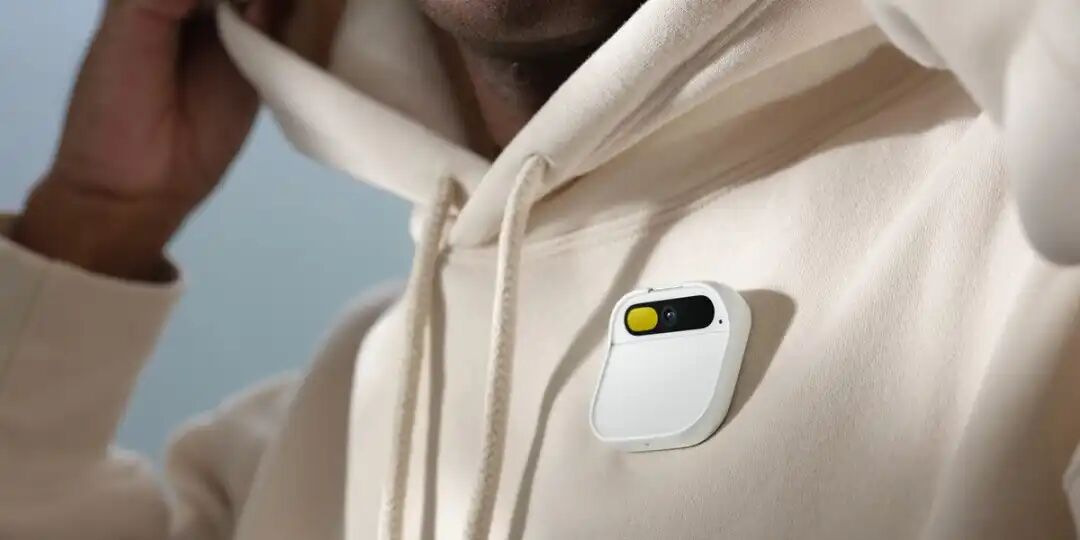
Image Source: Humane
This is why many AI hardware products today leave users feeling not 'more liberated' but 'more convoluted.'
This does not mean such products lack value. On the contrary, they may become important secondary entry points in the future. However, an entry point is not an endpoint, and peripherals are not the next platform. The industry's common mistake is prematurely equating 'novelty' with 'superiority.'
Today, the biggest issue with many AI hardware products is not insufficiently advanced technology but overly hasty narratives. They have not yet solved fundamental problems like 'shorter chains, lighter usage, and more stable tasks' but are eager to assume the mantle of 'next-gen smartphones.' However, smartphones became successful not just by aggregating functions but by hiding complexity. Conversely, any AI hardware that reimposes usage costs on users will struggle to succeed smartphones.
This is what AI hardware must truly guard against: becoming a burden rather than an extension of humans.

But the deeper issue is not just that 'they failed to replace smartphones.' Importantly, hardware in the AI era may not be reducible to a simple 'extension of humans.'
Old media lent themselves to the 'extension' narrative because they genuinely amplified human capabilities outward. They all did the same thing: projecting human abilities outward to reach the world more distantly.
However, many AI hardware products today are not solely focused on this.
At this stage, some products in the industry still adhere to the technological philosophy of 'human extension.' For example, many smart glasses emphasize 'ask whatever you see' or 'answer based on what's in front of you'; many AI earphones and voice devices still stress 'one command to orchestrate smartphone, car, home, or physical device functions.' This logic has not disappeared; it remains a strongly present product route.
But simultaneously, more and more new hardware is quietly shifting direction: they no longer just extend human senses outward but instead seek data from the body itself.

Image Source: Oura
Take the Oura Ring, for example. Its core capability is not 'seeing more for you' but using sensors to collect 24-hour physiological data like heart rate, body temperature trends, blood oxygen, activity, and sleep, then converting this continuous data into recovery, stress, sleep, and health recommendations. Oura officially describes this capability as individualized understanding based on continuous data.
The characteristic of such products is that they no longer just 'let humans see' or 'let humans hear' but instead continuously, intimately, and long-term understand humans. They comprehend your rhythms, your states, what you're doing and saying now, your context, and even your physiological changes and behavioral trajectories over time. They do not simply extend a sense outward but build a long-term online perception and computing system at the body's edge.
Thus, while it is not entirely wrong to explain them using 'human extension,' it is no longer sufficient.
Because 'extension' implies that the device is grafted onto the body as an external medium. Today, however, more and more AI hardware is no longer satisfied with being an external medium; they aim to become an infrastructure layer at the body's edge. This is why, in the AI era, the 'extension' framework in technological philosophy feels less reliable for the first time. It cannot adequately explain why today's hardware increasingly relies on continuous human reading rather than external world connectivity.
In this sense, the truly worthy technological philosophical foundation for AI hardware today is not whether it can still fit into 'human extension' but whether it is redefining 'humans' as its data source, object of understanding, and endpoint of interaction.

If 'next-gen smartphones' are still an inertial narrative inherited from the previous consumer electronics era, then 'ambient intelligence' and 'on-body intelligence' seem more like new terms emerging in the AI era.
For the new generation of AI hardware, they are no longer just 'intermediaries' but are becoming 'subjects'—they are where interactions occur, where tasks are completed, and where models understand, respond to, accompany, and shape your behavior.
'Ambient intelligence' is not just an alias for wearable devices but closer to a new type of intelligent relationship: 'It continuously takes human real-world data as input, enabling sustained understanding, proactive responsiveness, and constant evolution, while embedding into daily life with minimal disruption and presence.' This is the definition given by Jasper, who unsuccessfully pitched ideas to the Oura Ring team, left to start String Tech, and developed the Wilo smart ring. In his view, this always-on, continuously collecting unique contextual data from each individual and forming the basis for human-machine interaction is what he aims to achieve with hardware.
Another similar term, 'on-body intelligence,' follows the same logic. Whether it's AI pendants hanging around the neck or potentially even smaller, more invisible devices in the future, their common direction is to resemble a layer of intelligence running close to the body. They prioritize acquiring and feeding back information about your body and surrounding environment.
Thus, the real question we should ask is how the next generation of human-machine relationships should embed into the physical self.
From an industry perspective, this may be the true directional divergence for AI hardware.
One category of products will continue to cling to the narrative of 'revolutionizing smartphones,' attempting to compete for entry points, replace screens, take over App ecosystems, and become the next central terminal. This path will still be pursued and will undoubtedly yield phase achievement (phased results). However, its difficulty is evident: manufacturers must not only create new forms but also rewin user habits that have nearly become instinctive.
Another category of products will more pragmatically turn toward the body, context, and continuous data. They may not immediately shout about disruption but are more likely to take root in certain real-world scenarios: health management, meeting recording, cognitive assistance, contextual reminders, personal knowledge archiving, emotion and stress recognition, long-term habit companionship, and even further development of bodily intelligence.
This path may seem less 'sexy' than 'next-gen smartphones' but appears more aligned with AI's true strengths. Because AI's greatest advantage lies not in replacing all functions of a mature terminal but in transforming vast amounts of continuous, fragmented, and implicit personal data into long-term, dynamic, and individualized understanding capabilities.
In this sense, the future of AI hardware lies in how well it understands individuals. It does not necessarily amplify human abilities into the external world but is more likely to reorganize the human body, behavior, and state into a data mine. It may no longer continue the traditional media role of 'outward dissemination' but increasingly assumes a function of 'internal interpretation.' Media no longer just lets humans see the world but also lets intelligent systems see humans themselves.
Thus, the next generation of AI hardware may be the thing that gradually makes users forget its identity as a device. It quietly resides at the body's edge, within life, in places almost unnoticed, yet continuously understands, responds to, and shapes you.
At this point, AI hardware is no longer just another footnote to 'the medium is the extension of man.' It is proposing a new proposition: technology is not just extending humans outward but is also returning intelligence to the human self.
And this, perhaps, is closer to the true future of AI hardware than 'next-gen smartphones.'
Finally, we must remain vigilant: could AI hardware that turns inward, closing off its own senses and lacking interaction with the external world, truly fall into the warning Luo Zhengyu mentioned in his video—that AI is dismantling human collaboration? Perhaps the best AI hardware of the future will, on the one hand, retain the ability to extend the body and interact fully with the world, while on the other hand, turn inward and reflect upon itself.
-
![]()
Wang Huiwen, Former Meituan Executive, Achieves 20-Fold ROI, Supports 24 AI Startups
-
![]()
Another AI Computing Power Unicorn Launches IPO! Founded by a Changjiang Scholar
-
![]()
OFILM Holdings Secures Zhongke Daojing, Marking a Significant Leap in the Optical Communication Industry!
-
What Will Be the Next Key Battleground for Large Models After AI Coding?
-
![]()
Leapmotor's Sales Soar, Yet Hidden Concerns Loom
-
![]()
China’s Action Camera Market Soars: 3.12 Million Units Sold in Six Months, DJI Secures 74% Dominance
-
![]()
Zhang Yiming: Strategic Retreat as a Path Forward
-
![]()
Exploring Charging for Some Features of QianWen App: Can It Follow the Path of Doubao?