From OEM manufacturing to becoming a bestseller in North America, Chinese manufacturing is capturing global attention with the help of TikTok Shop
 04/24 2026
 633
633

One conclusion that is not hard to draw is that what Chinese manufacturing lacks today is not technical capability or cost-effectiveness, but opportunities to be discovered by global consumers.
For today’s Chinese manufacturing, with its complete ecosystem, efficient production capabilities are just one part of value creation. To capture greater value and mitigate the inherent risks of industrial cycles, it is essential to leverage the network of cross-border e-commerce to continuously reach global consumers.
Among the many Chinese cross-border e-commerce platforms driving Chinese manufacturing overseas, TikTok Shop is a relatively low-key player:
Quietly but steadily, TikTok Shop has become a major driver of ByteDance's overseas revenue growth. According to previous media reports, its GMV (Gross Merchandise Value) grew nearly 70% year-on-year in 2025, reaching 400 million active consumers and nearing $100 billion in GMV, making it the fastest-growing mainstream e-commerce platform overseas.
In choosing its path to global expansion, TikTok Shop’s rapid growth provides Chinese manufacturers with a unique and efficient channel to capture global consumer attention. The rise of interest-based e-commerce, represented by short videos and livestreaming, offers merchants a stage vastly different from traditional shelf-based e-commerce platforms.
In the Shenzhen government’s official WeChat account article “A Shenzhen Hair Curler ‘Rolls’ Its Way to $200 Million in the U.S.,” we see a vivid demonstration of TikTok Shop’s role in elevating China’s manufacturing value chain.

The story is familiar: Wavytalk, a Shenzhen-based hair curler company, successfully expanded into North America through TikTok Shop, capturing the attention of North American consumers, creating a global bestseller, and accumulating $200 million in sales.
However, in my view, the reason this story was featured on Shenzhen’s official WeChat account as a case study lies in its deeper significance:
Today, Chinese manufacturing can leverage TikTok Shop’s global network and brand-building capabilities to gradually upgrade into Chinese brand enterprises that can directly engage and communicate with North American consumers on an equal footing.
Let’s revisit Wavytalk’s journey to completing its brand closed loop (closed loop) and explore what insights it offers for China’s consumer manufacturing going global.
For founder Hugh, his story is a typical example of Shenzhen’s manufacturing scene:
Before starting Wavytalk, he and his team spent many years doing OEM manufacturing in Shenzhen, achieving strong sales. Their products left the factory, bore clients’ logos, and entered overseas stores and websites.
But Hugh was not satisfied with growth as a white-label brand. He also realized that Wavytalk already had the capabilities—what it needed was an opportunity to be seen.

Wavytalk’s subsequent actions can be summarized in four steps:
First, Wavytalk initially built its brand identity by posting short videos on TikTok, continuously establishing its presence.
Second, after joining TikTok Shop in 2023, it integrated content and e-commerce into a closed loop. The brand’s earlier accumulate (accumulated efforts) paid off, triggering a major sales boom: a 6-second hair-curling video sold 1,000 units in its first post, going viral.
Next, after recognizing TikTok Shop as the right platform, Wavytalk adopted a “pyramid” influencer strategy: UGC testing + steady output from mid-tier influencers + endorsements from top-tier influencers. The most visible result was that influencer videos contributed nearly 70% of sales.
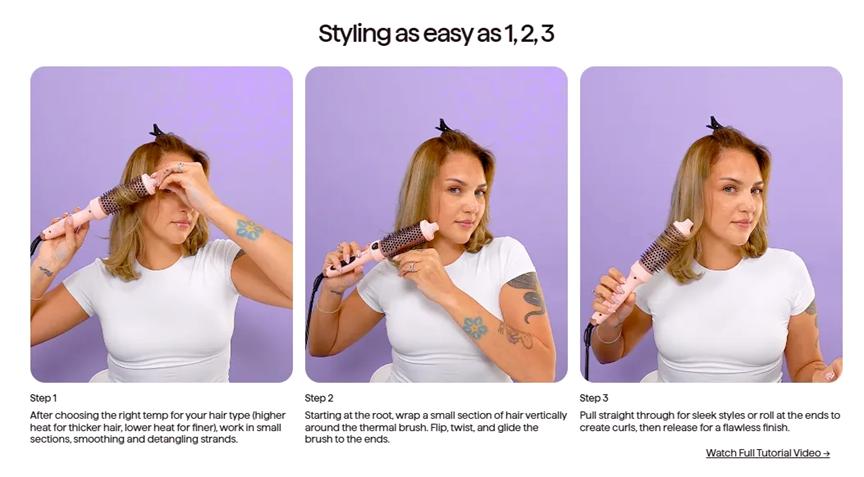
Then, Wavytalk launched hashtag challenges like “10-Minute Full Glam Look,” attracting user-generated content (UGC) participation with over 100 million exposures and sales exceeding expectations by 110%. Wavytalk achieved a brand upgrade from “being seen” to “being participated in,” using livestream data and feedback to drive product iterations.
Ultimately, TikTok Shop became the core tool for Wavytalk’s brand building: shifting from pure sales to building brand recognition, driving product iterations, and extending to offline channels (Target, Fashion Week, etc.). The team expanded from 4 to nearly 100 people, with cumulative sales nearing $200 million.
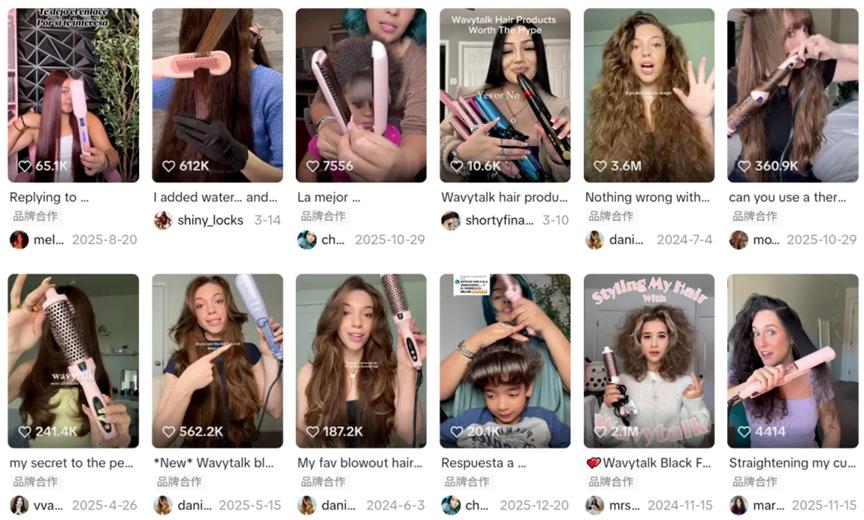
Through these four steps, Wavytalk reached North American consumers, established a direct dialogue channel, and completed the closed loop (closed loop), providing a new co-growth platform for other consumer brands exploring overseas markets.
Wavytalk’s success story is set against the broader backdrop of TikTok’s e-commerce business thriving overseas:
According to research and analytics firm eMarketer, after entering the U.S. market in September 2023, TikTok Shop’s sales in the U.S. grew 400% in 2024 and 108% in 2025.
TikTok Shop announced that during the “Black Friday to Cyber Monday” period from November 28 to December 1, 2025, GMV in the U.S. market exceeded $500 million, with nearly 50% more U.S. consumers purchasing through TikTok Shop.
Moreover, TikTok Shop is thriving in other markets beyond the U.S.
Momentum Works data shows that in Southeast Asia, a rapidly growing emerging e-commerce market, TikTok Shop became the second-largest player after Shopee in just four years and is closing the gap with significant above-industry growth. According to TikTok Shop, its Southeast Asian “Double 12” cross-border e-commerce GMV grew 2.7 times year-on-year in 2025.
In Europe, TikTok Shop has launched in the UK, Ireland, Germany, Spain, France, Italy, and other countries, with the European market growing over 100% in 2025. Market rumors suggest TikTok Shop will expand into more European markets in 2026.
Latin America and Japan are new markets TikTok Shop entered in 2025, also showing strong performance.
Momentum Works data reveals that in Brazil, TikTok Shop’s GMV grew 25 times in its first three months. Sources cited by Nikkei Asia reported that in Japan, GMV grew 20 times within four months of launch.
In my view, TikTok Shop’s global expansion is rooted in the unique brand-building advantages of content e-commerce, which differs from traditional shelf-based e-commerce.
Let’s still take Wavytalk’s rise to fame as an example to examine the irreplaceable role of TikTok’s content e-commerce in brand building:
First, short videos and livestreaming bring product selling points to life.
In traditional shelf-based e-commerce, many core selling points are hidden in static images and text, making them hard for overseas consumers to perceive intuitively.
On TikTok Shop, however, short videos and livestreaming can vividly and intuitively showcase product features instantly.
For beauty tool brands like Wavytalk, TikTok Shop’s branding value is particularly prominent—exposure opportunities are significantly amplified, and users can see immediate results, making it easier to create bestsellers.
It’s clear that beauty tools inherently have strong content attributes. Concepts like “one-second straight hair” or “goodbye to frizz” can be instantly understood by users through a few seconds of video, making content seeding far more efficient than static displays.
Second, TikTok Shop opens a “discovery” channel for new brands like Wavytalk.
Unlike traditional shelf-based e-commerce platforms like Amazon and eBay, which follow a “people find products” logic, TikTok Shop relies on an information feed recommendation mechanism that allows users to actively “discover” products and brands they’ve never seen or considered buying.
Once video content precisely matches users’ latent needs, conversion often follows naturally.
For new Chinese brands and categories like Wavytalk, this is precisely the critical first step in entering overseas markets; on other shelf-based platforms, Chinese newcomers often need to pay a higher price to break through.
Third, TikTok itself is the world’s largest traffic pool and trendsetter.
Today, TikTok has over 1 billion active users globally, with strong purchasing power among the 18-35 age group—a core demographic that trendy brands most desire (eagerly seek) to reach.
Chinese merchants can leverage TikTok’s hashtag mechanisms to quickly amplify their voice, creating an asymmetric yet highly efficient branding leverage.
For example, Wavytalk in our case precisely replicated strategies from the beauty sector, launching challenges like “15-Minute Everyday Hairstyle” while initiating hashtags that addressed pain points like “difficulty managing frizzy, fine, or flat hair,” allowing users to naturally perceive the ease of change brought by the product while sharing content.
Finally, merchants on TikTok Shop can directly access authentic consumer feedback to drive rapid product iterations.
It must be said that for many Chinese merchants, design and production still occur domestically, making it a pain point to accurately capture overseas demand.
TikTok Shop provides an efficient bridge: comments under short videos, real-time interactions in livestreams, and user reviews on product pages all offer direct firsthand market insights, enabling merchants to make targeted improvements and micro-innovations.
Additionally, deep collaborations with local influencers can yield valuable insights—they better understand local consumers’ real pain points and preferences: influencer feedback is itself firsthand consumer feedback.
Meanwhile, many merchants actively browse TikTok to gauge market feedback on similar products, timely grasping overseas trends to ensure their offerings truly meet market demands. These capabilities are difficult to achieve on traditional shelf-based e-commerce platforms.
Wavytalk is not an isolated case; many similar entrepreneurial stories exist on TikTok Shop:
For example, Chen Xing, a Zhejiang University graduate who went to the U.S. for a Ph.D., took a leave of absence to start a business in Yiwu, founding the brand hatteker, which specializes in personal care small appliances like hair removal devices and hair clippers.
After 13 years of deep cultivation, his company leveraged TikTok Shop in 2024, achieving $5 million in annual sales on a single platform with a bestselling waterproof hair removal device. A small team of four directly engaged overseas consumers, completing the transition from supply chain to direct brand reach.
Another example: Gan Chuanwei, a Hubei native born in the 1990s who worked in Shenzhen 11 years ago, and his Shaanxi partner Zhang Chao founded Suzhuanpu in 2018, pivoting to cross-border e-commerce after the pandemic.
After joining TikTok Shop in 2023, their team focused on the painting niche, launching creative stationery like tattoo pens that became party essentials in Europe and America. Through content seeding, they sold over 500,000 units annually on TikTok Shop, with over 12,000 units sold on Black Friday alone, completing their brand closed loop (closed loop) on the platform.
There are many more stories, like the plus-size women’s wear brand Finjani, expected to reach $40 million in annual sales on TikTok Shop, or the automatic cat litter box brand PetPivot, founded by two Shenzhen girls, which surpassed $200 million in GMV. These stories deeply moved me.
It’s clear that for over 100 million manufacturing industry entrepreneurs, TikTok Shop’s global growth represents overseas opportunities that are keeping Chinese manufacturing workers busier in livestreaming studios—a busyness that itself signifies value, demand, and hard-won opportunities.
Chinese manufacturing does not lack capability; what it lacks is opportunities to be discovered. TikTok Shop’s global expansion over the past year has synchronized with the global brand-building efforts of Chinese manufacturing.
The famous quote by General Motors’ CEO goes: “What’s good for General Motors is good for America.”
This statement’s context was that General Motors employed over a million workers at the time—a single company was like a city (Detroit), and the entire U.S. manufacturing ecosystem relied on General Motors. General Motors’ success was America’s success.
For today’s TikTok, this sentiment applies equally.
TikTok Shop’s rapid global growth is driven partly by the strong product capabilities of Chinese manufacturing like Wavytalk, which offers global consumers better choices, and partly by TikTok Shop’s own ability to reach and shape global consumer perceptions, making it the top platform for Chinese merchants to reach 8 billion people worldwide.
TikTok’s success is not just a continuation of China’s globalization narrative but the best proof of China’s thriving tech sector and what benefits China.
This article is based on publicly available information and serves solely for informational exchange, not as any investment advice.
-
![]()
Proposed to Raise 955 Million Yuan through Private Placement! Huicheng Vacuum Boosts Localization of Ultra-Precision Optical Coating Equipment
-
![]()
Cash Flow Soars 13-Fold! What Major Strategic Move is Wuhan Five Square Optoelectronics Planning?
-
![]()
Leaked Design of vivo X500: Reverts to Circular Camera Module in Top-Left Corner, Pays Homage to Classic X90 Aesthetic
-
![]()
DeepSeek Shows Signs of Foraying into Code Agents, Launches WeChat Official Account Focused on Harness
-
![]()
Auto Companies Deny Claims That ‘Cooperation with Huawei Is Non-Essential’, as Huawei Transforms into a ‘Public Platform’
-
![]()
Starship to Independently 'Return to the Launch Tower': SpaceX's Ambitions Extend Beyond Rocket Building to Dominating Space Transportation
-
![]()
Starship Set to Independently 'Return to the Launch Tower': SpaceX is Revolutionizing Space Transportation, Not Just Building Rockets
-
![]()
Anthropic and OpenAI Face Off Against Deepseek