Behind Oracle's Global Layoff of 30,000: AI Bubble or AI Replacement?
 04/24 2026
 558
558
Introduction: What's Happening with Oracle's Global Layoff of 30,000?
By Li Ping / Lishang Business Review
1
30,000 Employees Globally 'Terminated via Email'
Recently, U.S. tech giant Oracle initiated a surprise large-scale layoff globally, with a total of 20,000-30,000 employees expected to be affected, accounting for nearly 18% of Oracle's 162,000 global workforce. This marks one of the largest layoffs in the global tech industry since the start of 2026.
According to feedback from multiple Oracle employees on social media, their access to the company's internal systems was suddenly cut off around 3 a.m. on the day of the layoff, and they received termination notices via email. The layoffs affected multiple core departments of Oracle, including health, sales, and cloud services, covering major global markets such as the United States, India, and Europe. Notably, 12,000 employees were laid off in India alone, making it the hardest-hit region in this round of layoffs.
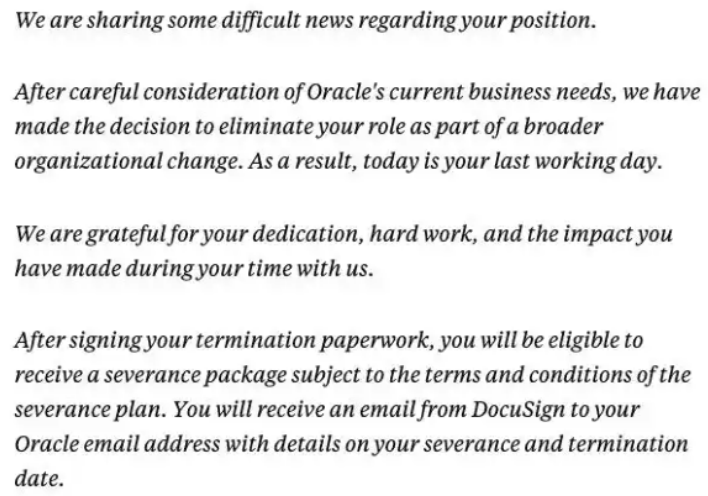
For a long time, Oracle has been widely regarded as a "retirement home" in Silicon Valley due to its job stability, slow pace, no overtime, and good benefits. However, this global layoff has completely shattered that image. Oracle's official explanation for the layoffs was brief, stating in the notice: "After careful consideration of current business needs, we have decided to eliminate your position as part of a broader organizational restructuring. Therefore, today will be your last working day."
Simultaneously with the mass emailing of layoff notices, the affected employees' company emails, internal systems, and access permissions were immediately cut off, with no prior communication, one-on-one discussions, or work handover periods. In terms of severance pay, Oracle offered four weeks of base salary plus an additional week of salary for each year of service, up to a maximum of 26 weeks.
As of now, Oracle has not issued any comments on the layoffs or disclosed the exact number of employees affected. However, public opinion generally believes that since Oracle is heavily investing in AI data center construction, the layoffs are primarily aimed at cost-cutting and efficiency improvements, freeing up cash flow for its AI business by strictly controlling operational costs.

Additionally, as large language models (LLMs) increasingly demonstrate exceptional capabilities in understanding scientific literature and generating high-quality code, the latest models such as Claude Opus 4.5 and GPT-5.2-Codex can already generate code of relatively high quality. Many software companies have begun using these models to generate program frameworks and simple logic, reducing the number of mid-to-low-level programmers.
According to public reports, on February 27 (Beijing Time), fintech company Block suddenly announced the layoff of about half of its workforce. In response, Block's co-founder and CEO, Jack Dorsey, stated that with the efficiency improvements brought by "intelligent tools," most companies will be forced to make similar structural adjustments within the next year. He chose to "take this step openly and on our own terms, rather than being forced into a passive response later."
Some analysts also believe that Oracle, in order to concentrate resources on training smarter AI, is willing to lay off standardized engineers who have been in high demand for the past decade, which can be seen as a disguised form of "robot replacement." In other words, the first wave of impact from the AI trend did not attack traditional industries but instead targeted the IT sector, represented by asset-light businesses, even including those who once helped build the industry.
2
Business Growth and Cost Pressures
Judging from the company's latest financial report, Oracle is far from reaching a "desperate" stage. On the contrary, due to the rapid growth of its cloud infrastructure and other businesses, Oracle's financial performance in the third fiscal quarter was quite impressive, with a strong backlog of orders and fiscal 2027 guidance exceeding market expectations.
According to Oracle's financial report released on March 11, in the third fiscal quarter of fiscal 2026 (ending February 28, 2026), Oracle achieved total revenue of $17.19 billion, up 22% year-over-year, higher than the market expectation of $16.91 billion; net profit was $3.721 billion, up 26.5% year-over-year. This marked the first quarter in 15 years where Oracle achieved simultaneous revenue and adjusted profit growth exceeding 20%.
As the world's largest enterprise software company, Oracle's traditional strengths lie mainly in databases, tools, and application software. In recent years, Oracle has continued to increase its investment in AI infrastructure, accelerating its transformation into a cloud services giant to compete with Amazon AWS, Microsoft Azure, and Google Cloud GCP.
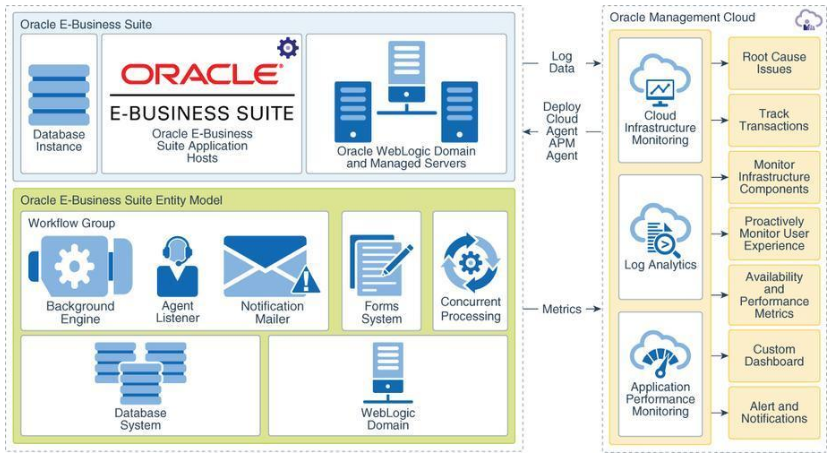
In terms of revenue composition, Oracle's main businesses are divided into four segments: cloud business (Cloud), software business (Software), hardware business (Hardware), and services business (Services). Among them, the cloud business includes IaaS (Infrastructure as a Service) and SaaS (Software as a Service), which are currently Oracle's fastest-growing business segments.
IaaS is primarily provided through Oracle Cloud Infrastructure (OCI), including the company's signature database cloud services and computing power leasing business. SaaS is mainly provided through Oracle Cloud Applications (OCA), including SaaS-based enterprise resource planning (ERP), customer relationship management (CRM), and other general management tools, as well as some vertical industry-specific tools.
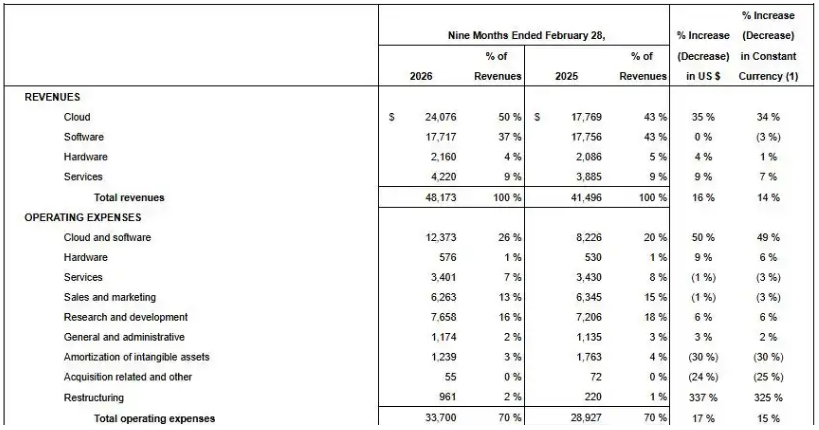
In the third fiscal quarter of fiscal 2026, Oracle's cloud business achieved sales revenue of $8.9 billion, up 44% year-over-year, accounting for 52% of total revenue. Among them, cloud infrastructure (IaaS) achieved sales revenue of $4.9 billion, up 84% year-over-year, becoming the key driver of rapid growth in cloud business revenue; SaaS business achieved sales revenue of $4 billion, up 13% year-over-year.
In addition to the cloud business, Oracle's other three business segments also achieved positive growth. Software revenue reached $6.119 billion, up 3% year-over-year, accounting for 36% of total revenue; hardware revenue reached $714 million, up 2% year-over-year; services revenue reached $1.443 billion, up 12% year-over-year.
Oracle's software (Software) business refers to traditional software businesses deployed and managed by customers themselves, mainly consisting of software license sales (software license) and software support services (software support). This segment was once the largest contributor to the company's revenue, accounting for over 60% at one point.
Since fiscal 2025, the cloud business has gradually replaced traditional software as Oracle's largest revenue source. Judging from the latest financial report data, the cloud business now accounts for over 50% of Oracle's revenue, marking Oracle's successful transformation into a cloud-centric technology company.
It is worth mentioning that Oracle's future performance remains promising based on its remaining performance obligations (RPO). According to the financial report, in the third fiscal quarter of fiscal 2026, Oracle signed new contracts worth over $29 billion, and the company's remaining performance obligations (RPO) reached $553 billion, up 325% year-over-year.
In terms of future performance guidance, Oracle expects total revenue in the fourth fiscal quarter of fiscal 2026 to grow by 19%-21% year-over-year in U.S. dollars, with cloud services revenue growing by 46%-50% year-over-year in U.S. dollars. Meanwhile, Oracle maintained its fiscal 2026 total revenue guidance of $67 billion and full-year capital expenditure guidance of $50 billion, while raising its fiscal 2027 total revenue guidance to $90 billion, higher than the market consensus of $86.6 billion-$86.7 billion.
Due to the financial report results, remaining performance obligations, and performance guidance all exceeding market expectations, Oracle's stock price surged over 9% the day after the financial report was released but has since been in a downtrend. As of April 7, Oracle's latest market capitalization was approximately $506.9 billion, down nearly $500 billion from its historical high.
So, why are investors not optimistic about Oracle, which holds $550 billion in orders?
3
Concerns Arise Over Revolving Financing
In September 2015, Oracle released its financial report for the first quarter of fiscal 2026, showing that as of the end of August 2025, the company's remaining performance obligations surged by 359% to $455 billion, far exceeding the market consensus of $178 billion. This means Oracle's backlog of orders has been scheduled for the next decade.
Stimulated by this news, Oracle's stock price rose more than 40% during the session, with its peak market capitalization once approaching the $1 trillion mark. Company founder Larry Ellison also briefly surpassed Elon Musk to become the world's richest person.
However, investors soon discovered that the surge in Oracle's orders was almost entirely contributed by one company, OpenAI. According to reports, OpenAI signed a five-year computing power procurement agreement with Oracle, valued at $300 billion, accounting for 94.6% of Oracle's new RPO ($317 billion) in the first quarter of fiscal 2026.
It should be noted that for OpenAI, the computing power purchaser, the five-year, $300 billion order requires annual spending of $60 billion. However, OpenAI's annualized revenue is only $10 billion, with losses as high as $5 billion. Clearly, OpenAI's current revenue-generating capacity is far from sufficient to cover the annual $60 billion spending under the agreement.
For Oracle, relying too heavily on future revenue from this unprofitable star startup seems unwise. According to the agreement, Oracle needs to provide OpenAI with up to 4.5 gigawatts of power capacity, equivalent to the total power generation of two Hoover Dams, or enough to meet the annual electricity needs of about 4 million U.S. households.
In addition, Oracle needs to borrow to purchase AI chips, with the hidden risks being self-evident. Some analysts believe that Oracle is expected to borrow $100 billion to complete the AI infrastructure investments required for the $300 billion order. Clearly, once OpenAI's operations or external financing progress fall short of expectations, the risks involved are self-evident.
Therefore, the focus of secondary market attention has shifted from the previous massive orders to OpenAI's true ability to fulfill the contract, as well as Oracle's capital expenditure pressures and cash flow performance. Against this backdrop, Oracle's stock price began to decline from its rise.
Subsequently, the second-quarter financial report (corresponding to September-November 2025) showed that as of the end of November 2025, Oracle's backlog of orders had reached $523 billion, an increase of $68 billion year-over-year. However, in terms of operating cash flow, Oracle's free cash flow for the quarter was negative $10 billion, with capital expenditures (CapEx) reaching $12 billion, significantly exceeding the market expectation of $3.7 billion.
It is clear that from the perspective of free cash flow, Oracle is already in a state of "living beyond its means," indicating that the concerns of the secondary market are becoming a reality. Therefore, after the release of the second-quarter financial report, Oracle's stock price plunged 11%, with a maximum intraday decline exceeding 15%.
Judging from the latest third-quarter financial report data, Oracle's free cash flow for the quarter was negative $11 billion, an increase from the negative $10 billion in the second fiscal quarter. Capital expenditures for the quarter reached $18.6 billion, far exceeding analysts' expectations of $14 billion. Clearly, this indicates that the concerns of the secondary market still exist, which is also a major reason for Oracle's stock price to resume its decline after the release of the third-quarter financial report. Behind the exodus of investors, concerns over an "AI bubble" in the secondary market have become a major negative factor suppressing Oracle's stock price.
-
![]()
Tesla Restructures Its Balance Sheet
-
![]()
Accelerating the High-Speed Interconnection Upgrade of AI Computing Clusters! JONHON Releases ELSFP External Light Source Optical Connectors
-
![]()
Breaking the overseas blockade of volumetric holographic materials, this optical enterprise secures nearly 100 million yuan in financing!
-
![]()
Why Does Jensen Huang So Openly Praise China’s AI?
-
![]()
"Wudang" Unveiled: Arm China's Next-Gen AI VPU Redefines Video Encoding
-
![]()
From Energy Conservation and Carbon Reduction to AI Decision-Making: GECON East Intelligence and Chery Group Explore a New Green and Smart Paradigm for Automobile Manufacturing
-
![]()
WAIC 2026 Observation | AI Accelerates Towards the Core of Industries, Industrial AI Enters a Critical Phase
-
![]()
Volkswagen China Fires the First Shot in Foreign-Funded 'White Box Delivery'!