A Premier Optical Module Company’s Dual Odyssey: Seeking Fortune Abroad, Crafting a Legend at Home
 04/24 2026
 781
781

With a stock price that has soared tenfold in a year and 90% of its revenue stemming from overseas markets, this company has become the cornerstone of the 'New Stock King's' income, contributing over half.
Source | Silicon-Based Quadrant
Yuanjie Technology, a company whose stock price once eclipsed that of Kweichow Moutai to claim the 'New Stock King' crown, boasts a major client that accounted for over half of its revenue in 2025.
In its prospectus filed with the Hong Kong Stock Exchange, Yuanjie Technology disclosed that this key customer is headquartered in Shandong and listed on the Shenzhen Stock Exchange, primarily engaged in the optical interconnect optical module sector.
The Shandong-based optical module powerhouse is undoubtedly Coherent (Innolight).
Coherent (Innolight), a company steeped in legend, was born from the 2016 merger of Zhongji Equipment and Suzhou Innovight, with its headquarters in Longkou City, Shandong Province. Its stock price has skyrocketed over tenfold in the past year.
As of the market close on April 21 (the report date), Coherent (Innolight)'s market capitalization had reached RMB 963.109 billion, with a share price of RMB 862.59. Just a year ago, its share price was a mere RMB 80.
Coherent (Innolight)'s mainstay is optical modules, crucial components for interconnecting computing power data centers. Over 90% of its income hails from overseas, with major clients being cloud service giants like Google, Amazon, Meta, and Microsoft.
In 2025, Coherent (Innolight) witnessed remarkable growth. Financial data revealed a revenue of RMB 38.240 billion, up 60.25% year-on-year; net profit attributable to shareholders soared to RMB 10.797 billion, a 108.78% increase.
The first quarter of 2026 saw continued growth: revenue hit RMB 19.496 billion, up 192.12% year-on-year; net profit attributable to shareholders reached RMB 5.735 billion, a 262.28% surge.
How has Coherent (Innolight) secured a plethora of overseas orders and propelled the 'New Stock King' to prominence? How long can this rapid growth trajectory be sustained?
Sources indicate that 'with yield enhancements and economies of scale, the price of Coherent (Innolight)'s flagship 1.6T optical module is expected to decline this year.' Will this impact the future of this optical module leader?
01 How Does It Fuel the 'New Stock King'?
The optical chip, the core component of an optical module and the largest cost contributor, is pivotal.
Optical modules primarily convert electrical signals to optical signals.
While our computers and servers process electrical signals (represented by the on/off states of current as 0s and 1s), these signals suffer significant losses over long distances and are speed-limited.
In 1966, Dr. Charles Kao posited that if ultra-pure glass fibers could be manufactured, optical signals could travel hundreds of kilometers without attenuation, leading to the birth of optical fibers. Dubbed the 'Father of Fiber Optics,' Dr. Kao was awarded the Nobel Prize in 2009.
Optical signals ensure long-distance, low-loss transmission at faster speeds. For instance, in home broadband, fiber-to-the-home (FTTH) utilizes optical fibers for long-distance signal transmission.
Converting optical and electrical signals necessitates a converter. At the transmitting end, electrical signals from the server are converted into optical signals and emitted into the fiber; at the receiving end, optical signals transmitted through the fiber are converted back into electrical signals recognizable by the server.
The compact boxes responsible for these 'electrical-to-optical' and 'optical-to-electrical' conversions are optical modules.
The capability disparities among optical modules are mainly reflected in their transmission rates, which denote the theoretically achievable maximum data transmission per second, measured in bps (bits per second).
Based on transmission rates, optical modules can be categorized into low-speed modules (e.g., 10G, 25G, 100G) for enterprise networks and internal data center connections; high-speed modules (e.g., 400G, 800G), currently mainstream for AI data centers; and ultra-high-speed 1.6T modules.
Coherent (Innolight)'s core business revolves around high-end optical communication transceiver modules, with transmission rates primarily at 100G, 200G, 400G, 800G, and 1.6T.
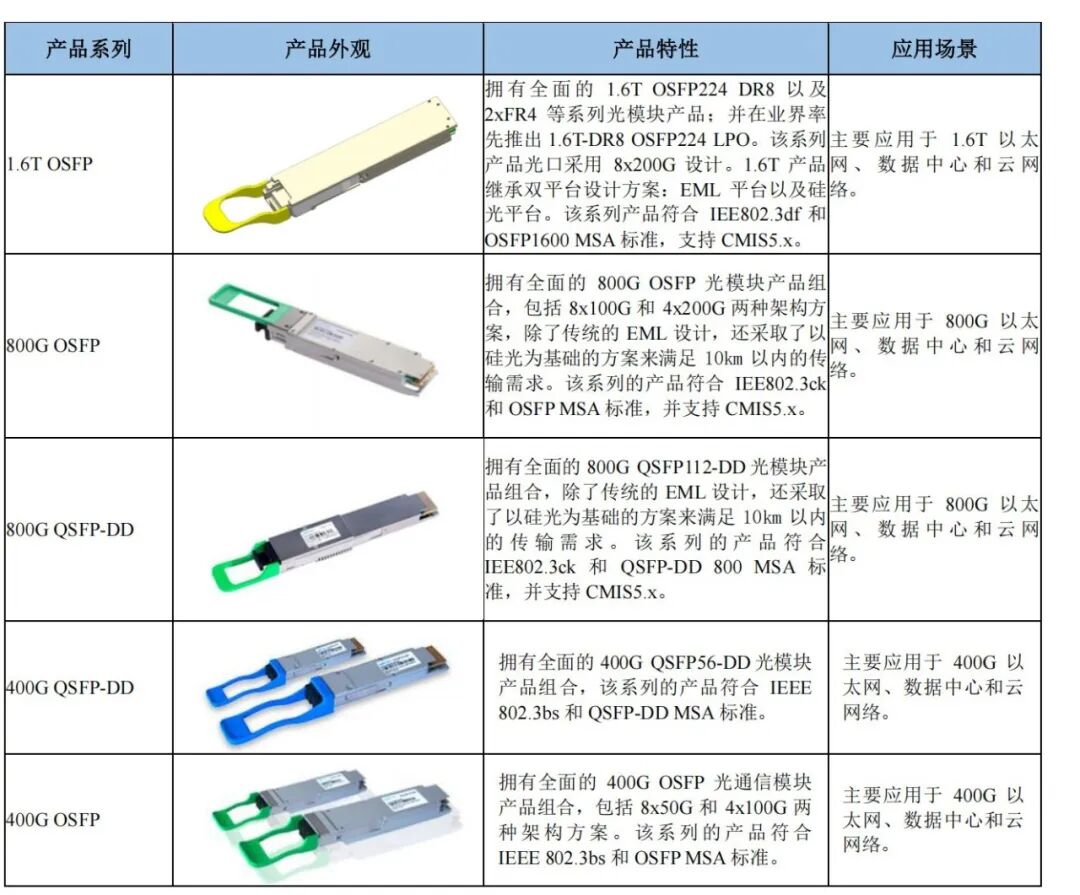
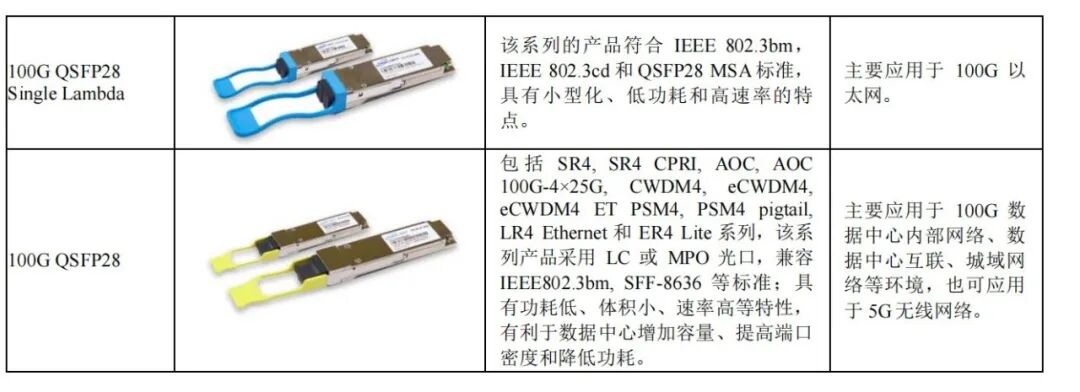
Optical modules comprise a transmitter optical subassembly (TOSA), a receiver optical subassembly (ROSA), a printed circuit board assembly (PCBA), and fiber optic transceiver interfaces.
The TOSA's core is a laser, converting electrical signals into optical signals. Common lasers include VCSELs (for short distances), DFBs (for medium to long distances), and EMLs (for high-performance long distances); the ROSA converts optical signals into electrical signals, featuring ordinary PIN receivers and high-sensitivity APD receivers.
Yuanjie Technology's main business includes DFB/EML laser chips. DFB chips, capable of rates up to 2.5G/10G/25G/50G, are used in fiber-to-the-home (PON), 5G base stations, and medium to short-distance data centers; EML laser chips, reaching rates of 50G/100G, are crucial for medium to long-distance high-speed optical communications and form the core of 800G/1.6T optical modules.
Currently, Coherent (Innolight) can procure 50G/100G laser chips from Yuanjie Technology for its optical modules below 800G. However, manufacturing high-end optical modules above 1.6T requires EML lasers with rates of 200G and above, still imported from overseas.
02 Ascent from 'Deep Capital and Industrial Restructuring'
Coherent (Innolight) wasn't always at the industry's pinnacle. Its success stems from a profound capital and industrial restructuring.
Coherent (Innolight)'s history traces back to the Huadian Special Equipment Factory established in Longkou City, Shandong Province, in 1987, later renamed Longkou Zhongji Electrical Equipment Co., Ltd. (Zhongji Equipment).
Zhongji Equipment's founder, Wang Weixiu, born in 1950 with a mechanical manufacturing background, worked at machine tool and auto parts factories. With an initial capital of RMB 230,000, he established the company, primarily manufacturing mechanical products like washing machine motors.
In 2012, Wang Weixiu led Zhongji Equipment to list on the ChiNext board of the Shenzhen Stock Exchange, becoming China's first listed company in the motor winding equipment field.
However, post-listing, Zhongji Equipment's performance growth stagnated, facing delisting risks.
In 2016, Wang Weixiu, at 66, made a pivotal decision to acquire 100% of Suzhou Innovight's equity for RMB 2.8 billion, renaming the company Coherent (Innolight).
Suzhou Innovight, founded by Liu Sheng in 2008, benefited from Liu's stellar academic background (Bachelor's from Tsinghua University, Master's from the Chinese Academy of Sciences, and Ph.D. from the Georgia Institute of Technology) and his R&D experience at North American optical communication companies like Lucent and Opnext.
Post-merger, Coherent (Innolight)'s 'core leader' shifted to Liu Sheng, steering the company from traditional manufacturing to the optical module business.
This merger yielded dual benefits: Suzhou Innovight completed capital restructuring and successfully 'backdoor listed,' while Zhongji Equipment, stagnated in business development, 'changed lanes and moved forward.'
From August 2017 to August 2023, Liu Sheng served as Coherent (Innolight)'s president and director, overseeing technology and strategic direction, while Wang Weixiu 'retired to the second line' as chairman.
Coherent (Innolight) began upgrading to high-end optical module products, releasing the industry's first 400G optical module in 2018 and becoming Nvidia's core 800G optical module supplier in 2023. Currently, the company operates multiple factories in Suzhou, Chengdu, Tongling, Thailand, Malaysia, and the United States, with an annual production capacity exceeding 28 million units.
In August 2023, Wang Weixiu stepped down as chairman, with his son, Wang Xiaowei, continuing as director and executive vice president, while Liu Sheng assumed the roles of chairman and president, fully taking charge.
Under Liu Sheng's leadership, Coherent (Innolight) has secured the 1.6T optical module market with its production capacity and technological edge, such as silicon photonics.
03 How Long Will the AI Computing Power Expansion Last?
In 2023, Coherent (Innolight) ascended to the pinnacle of global optical module manufacturers.
According to Lightcounting data, the top ten global optical module market share companies in 2024 are Coherent (Innolight), Coherent (formerly II-VI), Eoptolink, Huawei (Huawei/HiSilicon), Cisco (Cisco/Acacia), Accelink, Hisense Broadband, HGGenuine, Marvell, and Source Photonics.
The company is reaping the dual benefits of industry prosperity and customer loyalty.
Firstly, global cloud providers' capital expenditures are on the rise. The expansion of AI training cluster sizes, the surge in GPU quantities, and the exponential growth in network bandwidth demand will directly drive the explosion in demand for optical modules, especially the upgrade from 800G to 1.6T and the emergence of new architectures like silicon photonics + CPO.
According to Lightcounting's forecast, the global data communication optical module market size is expected to reach USD 22.8 billion in 2026 and grow to USD 41.4 billion by 2030, corresponding to a compound annual growth rate of 20% from 2025 to 2030.
Secondly, Coherent (Innolight)'s core competitiveness lies in its deep binding with global leading cloud providers. It holds a dominant share in Google's 800G optical modules and about 30%-40% market share in Amazon. Additionally, the company collaborates on R&D with core AI industry chain enterprises like Nvidia, forming a highly binding relationship.
This means its technological roadmap is synchronized with customers, orders are highly certain, and switching costs are extremely high.
However, Coherent (Innolight) cannot rest on its laurels. On one hand, technological iteration poses pressure. From 800G to 1.6T and then to 3.2T, new technologies like silicon photonics and CPO are reshaping the industry chain. The optical module industry has a clear cycle, with supply falling short of demand during upswings and prices plummeting during downturns. On the other hand, it faces international competition and geopolitical risks, as its high proportion of revenue from overseas markets may be affected by policies.
Furthermore, the essential role of optical modules is to transmit data at high speeds between servers, and Coherent (Innolight)'s current core growth source is AI data centers. Currently, AI training and inference require massive GPUs to work collaboratively, and communication between GPUs necessitates optical modules and fiber optic connections.
How long will the AI computing power cycle last? This will become a pivotal factor affecting Coherent (Innolight)'s performance.
-
![]()
Proposed to Raise 955 Million Yuan through Private Placement! Huicheng Vacuum Boosts Localization of Ultra-Precision Optical Coating Equipment
-
![]()
Cash Flow Soars 13-Fold! What Major Strategic Move is Wuhan Five Square Optoelectronics Planning?
-
![]()
Leaked Design of vivo X500: Reverts to Circular Camera Module in Top-Left Corner, Pays Homage to Classic X90 Aesthetic
-
![]()
DeepSeek Shows Signs of Foraying into Code Agents, Launches WeChat Official Account Focused on Harness
-
![]()
Auto Companies Deny Claims That ‘Cooperation with Huawei Is Non-Essential’, as Huawei Transforms into a ‘Public Platform’
-
![]()
Starship to Independently 'Return to the Launch Tower': SpaceX's Ambitions Extend Beyond Rocket Building to Dominating Space Transportation
-
![]()
Starship Set to Independently 'Return to the Launch Tower': SpaceX is Revolutionizing Space Transportation, Not Just Building Rockets
-
![]()
Anthropic and OpenAI Face Off Against Deepseek