OPPO's 'Insensitive' Misstep
 05/09 2026
 500
500
By Jing Jing
Establishing a brand can sometimes feel like walking a tightrope. Take a step too far, and you risk appearing frivolous; take a step too small, and you risk being forgotten. OPPO found itself teetering on this fine line this Mother's Day. An attempt at creative copywriting, meant to 'break stereotypes,' backfired due to poor phrasing, transforming a well-intentioned holiday message into an unplanned PR crisis.
On May 8, OPPO's official Weibo account posted Mother's Day content suggesting that 'moms have their own celebrity fan circles.' However, the copy referred to moms' celebrity crushes as 'another 'husband',' drawing a comparison to their interactions with their actual spouses. The post quickly sparked controversy, prompting OPPO to delete it and issue an apology, explaining that their creative intent was to 'present a more diverse and nuanced image of contemporary mothers.'
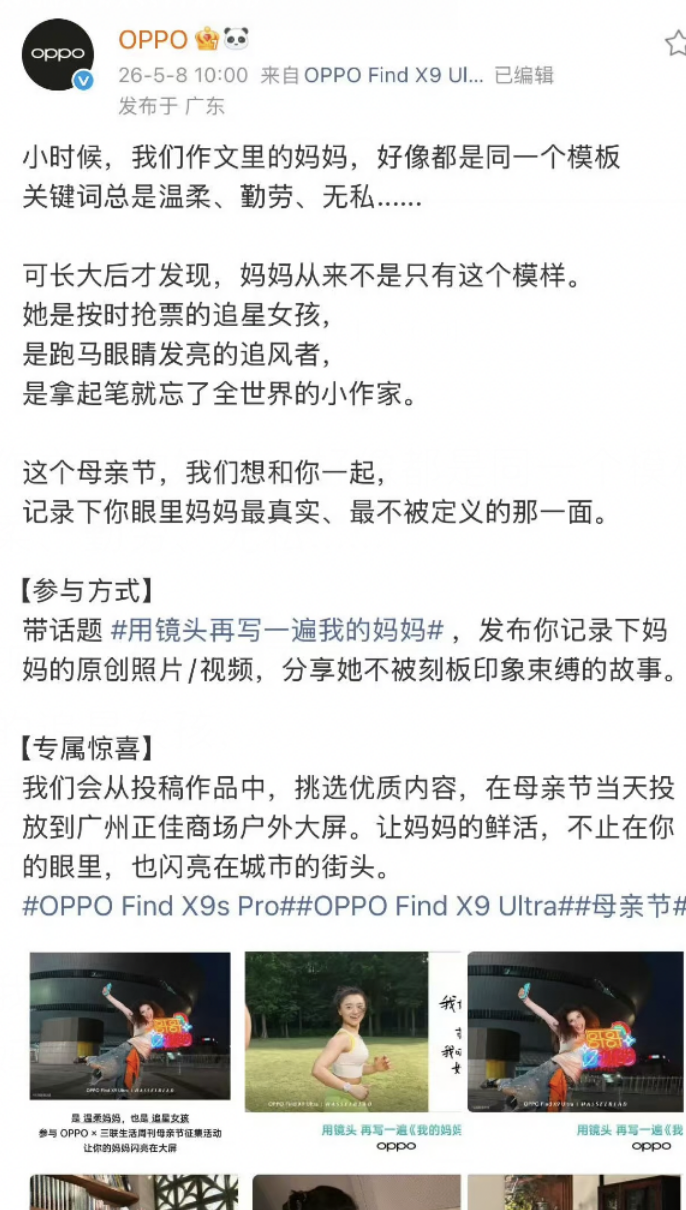
(Image from OPPO's official Weibo account)
The incident itself was relatively minor and would soon be eclipsed by newer, hotter topics. However, when viewed in the context of OPPO's situation over the past two years, it provides an interesting starting point—why is a company striving to move upmarket and tell a 'richer' brand story struggling more with expression? The issues here may run deeper than a single copywriting error.
My assessment: OPPO hasn't made any unforgivable mistakes, but it is revealing a kind of 'brand insensitivity.' This insensitivity isn't about being slow-witted but rather a diminished ability to perceive external emotions, control product timing, and master brand storytelling—all under pressure from the broader environment and internal path dependencies.
01
Copywriting Misstep: A Lack of 'Finesse'
Let's first examine the copywriting itself.
Honestly, I don't believe OPPO's creative team had malicious intent. On the contrary, they were eager to create something different. Amid a sea of Mother's Day content filled with 'mom, you've worked hard' and 'mom, I love you' narratives, OPPO wanted to take a different path by telling a story about 'moms having their own passions and identities.' This direction was valid and even clever—'undefinable women' and 'diverse mother images' have been mainstream sentiments in public discourse in recent years.
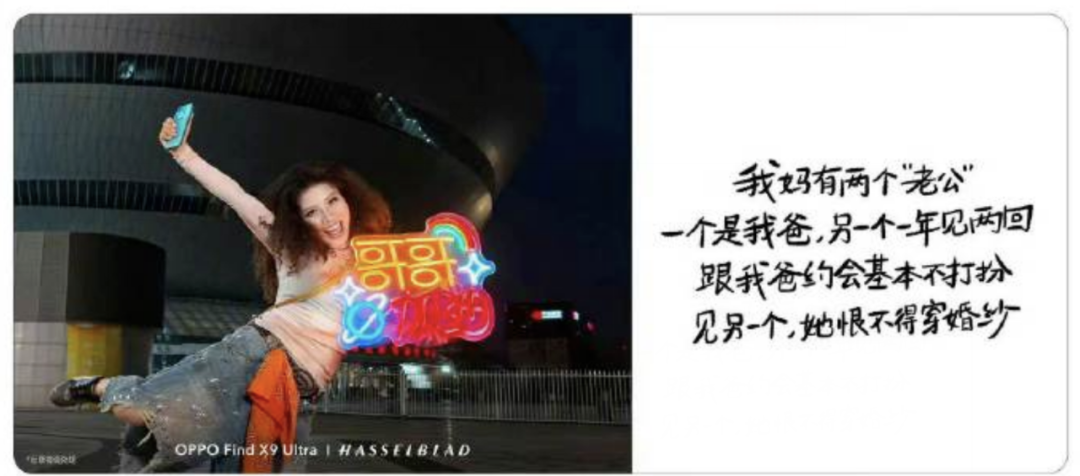
(Image from OPPO's official Weibo account)
The problem lay in execution.
The phrase 'another 'husband'' might be acceptable in casual banter among friends, but on an official account with millions of followers, its implications and potential interpretations are entirely different.
A brand is not a personal WeChat Moments feed, and an official account is not a personal blog. When you use an ambiguous term with marital connotations to describe 'fandom' and apply it to 'mothers,' ordinary users without context or explanation are more likely to react with confusion ('What is this trying to say?') than amusement ('How interesting!').
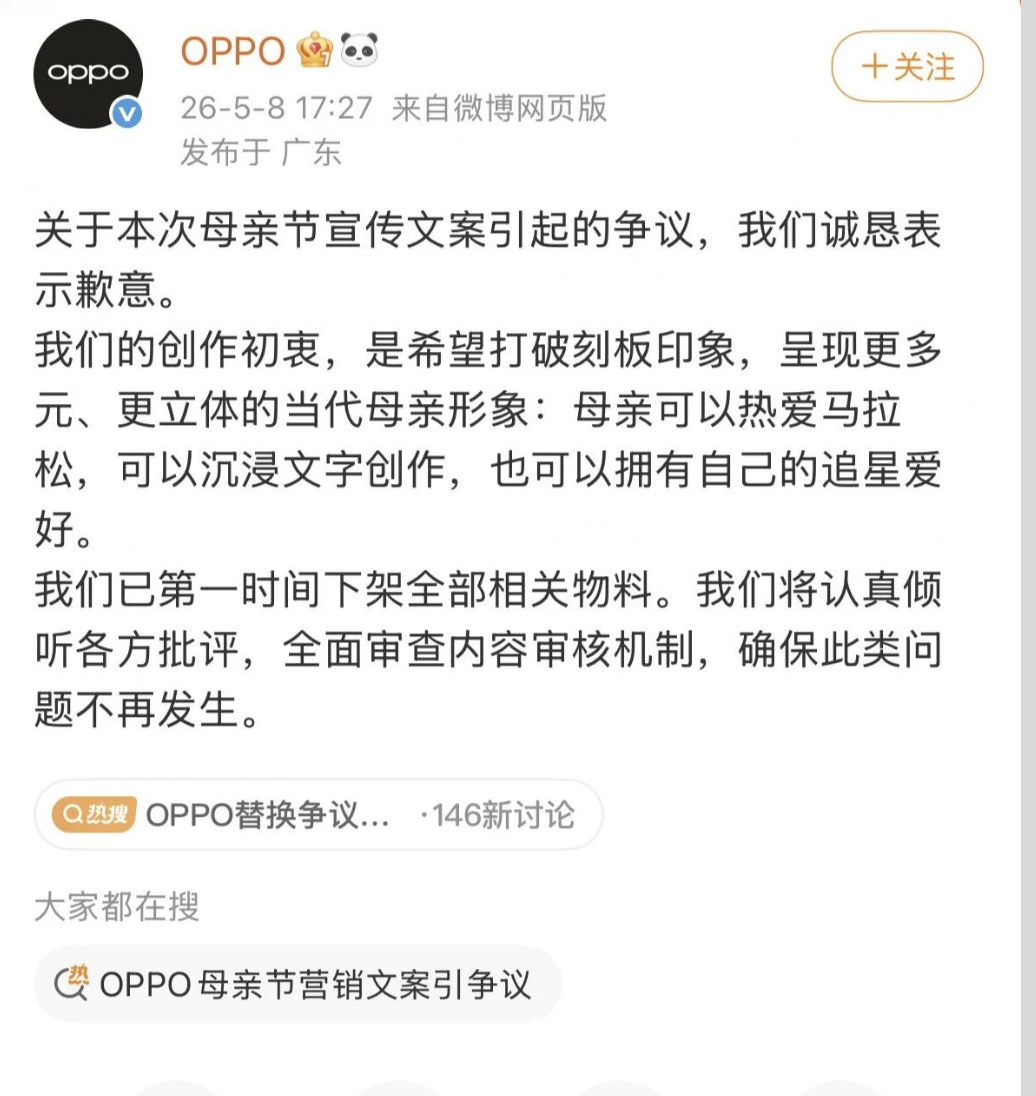
(Image from OPPO's official Weibo account)
This is what we call a 'lack of finesse.' Brand expression, especially when dealing with social issues and family relationships, is never about how 'bold' your creativity is but rather about a precise perception of public sentiment. You need to know what can be said, what should be phrased differently, and whether something might offend others. This isn't conservatism—it's a fundamental skill.
OPPO's mistake this time was precisely that: it wanted to appear 'young' and 'relaxed' but ended up coming across as reckless.
An interesting detail is that this content likely underwent multiple layers of internal review before publication, meaning it wasn't the impromptu idea of a single editor but the product of a decision-making chain. This makes it even more noteworthy—when an organization's decision-making chain fails to perceive risks, the issue lies not in an individual's aesthetic sense but in the entire brand judgment system.
If we zoom out a bit, signs of this 'brand insensitivity' have been evident for some time.
During the 2025 'Green Line' incident, where OPPO handled screen warranty policies differently for domestic and Indian users, the underlying issue was the same kind of insensitivity. OPPO failed to anticipate how sensitive local consumers would be to 'differential treatment' and didn't realize how damaging it could be for a brand built on a reputation for 'durability and peace of mind' to have 'inconsistent' after-sales policies.
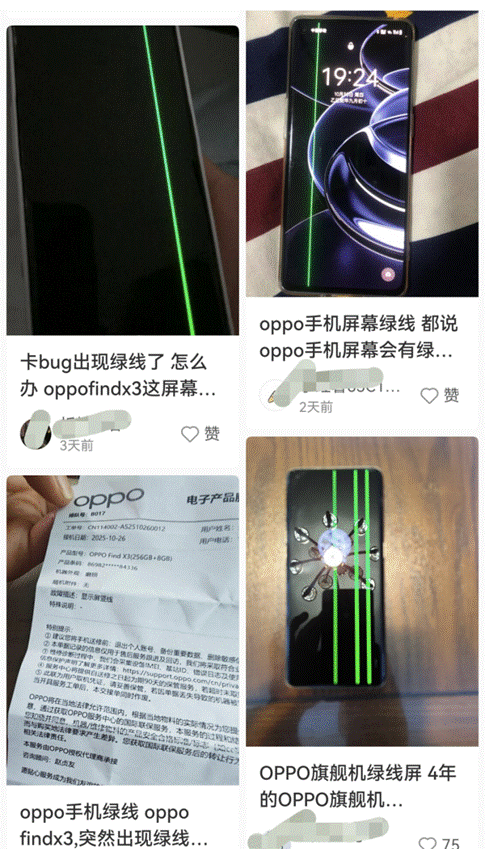
(Image from Xiaohongshu)
When these two incidents are viewed together, a conclusion emerges: OPPO's current problem isn't an inability to market itself but a loss of the sharpness it once relied on to determine 'what matters and what shouldn't be touched.'
02
More Challenging Than Copywriting: OPPO Is Becoming 'Heavier'
The copywriting can be deleted, and the apology issued. What truly deserves attention is the more structural challenge OPPO is facing behind this misstep.
First issue: Too many product lines, too few memorable points.
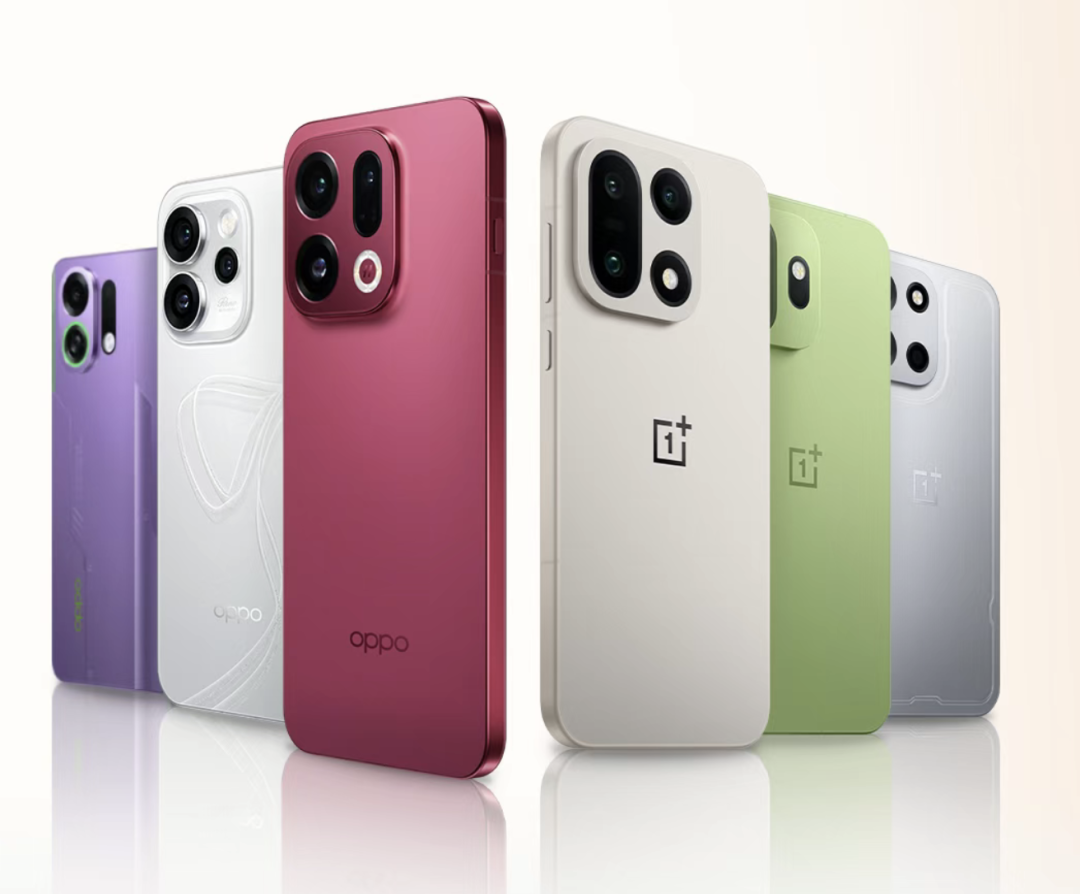
Over the past year, if you didn't follow the smartphone industry closely, watching OPPO group (OPPO + OnePlus + Realme) product launches would likely leave you with 'model recognition fatigue.'
The Find series, Reno series, K series, A series, plus OnePlus flagships and Realme performance phones—dozens of models span prices from a few hundred to over six thousand yuan. This is a classic scale-driven approach: flood the channels, and something will reach you.
(Image from OPPO's official WeChat account)
But the cost of this approach is brand focus dilution. Consumers can't remember which model is 'the best buy' because there are too many choices, and OPPO's own products overlap in features and pricing—the differences between OnePlus flagships and Find flagships are blurring, while Reno mid-to-high-end models compete with OnePlus mid-range phones at similar price points. It's hard to summarize 'what OPPO phones are known for' with a clear label, which is a problem for a brand aiming for the high end. The premium market doesn't rely on 'something for everyone' but on 'I am what you're looking for.'
Second issue: Shifting market share rankings reflect 'defensive' pressure.
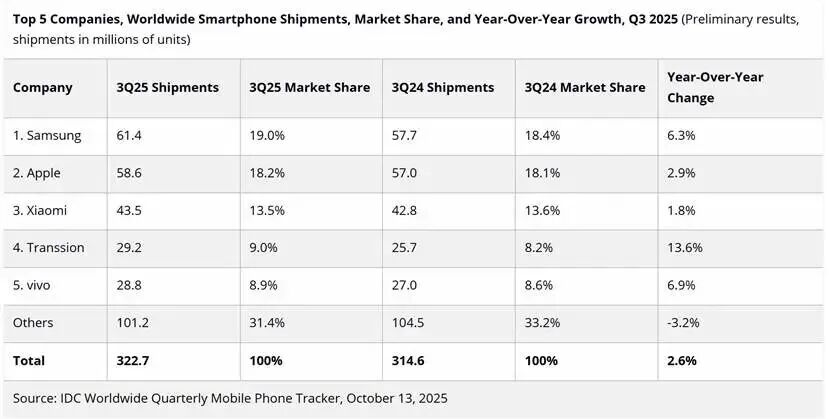
Here's a factual data point: According to IDC and Counterpoint data from 2025, OPPO's global shipments have indeed contracted over the past year or two, with its top-five global position ceded to Transsion or other vendors in some quarters. Annually, it remains in China's top five but with minimal gaps to Huawei, Apple, vivo, and Xiaomi—any fluctuation could trigger ranking changes.
(Image from IDC report)
This isn't a 'crisis'—the smartphone market has always been a zero-sum game.
What's noteworthy is the trend: OPPO is pursuing a 'sacrifice share for average selling price (ASP)' strategy—no longer chasing significant shipment growth but aiming to sell more expensive phones.
2025 data shows OPPO's global ASP now exceeds Samsung's, second only to Apple. This strategy isn't flawed; it's even a necessary path for Chinese brands to go premium.
The issue is that as ASP rises, so do user expectations. When you sell phones for 2,000 yuan, tolerance levels are high; when you sell them for 6,000–7,000 yuan, an inappropriate copywriting choice or a restrictive after-sales policy becomes a 'why should I?' moment. Premium pricing is a double-edged sword—once you charge it, you must deliver matching experience and trust.
(Image from OPPO's official WeChat account)
Third issue: Premium storytelling still lacks a 'must-have' reason.
OPPO hasn't spared effort in technological investment. The Find X9 Ultra's 20x optical zoom and the Find N6's TÜV-certified fold flatness demonstrate its engineering capabilities. VOOC flash charging was once OPPO's most distinctive tech tagline, with 'charge for five minutes, talk for two hours' becoming ubiquitous. But now fast charging is an industry standard, and that tagline has faded. The termination of the MariSilicon chip project was also a pity—it showed OPPO's determination to pursue 'foundational breakthroughs.'
The current situation: Foldables are dominated by Huawei and Samsung, imaging has barriers from Xiaomi and vivo's joint R&D, and ecosystems are walled off by HarmonyOS and Apple. OPPO delivers excellent products but hasn't yet given consumers a 'must-choose-you' reason.
This reason could be exclusive technology, a brand belief, or even a unique aesthetic system—Apple's success has never been just about specs. OPPO has nearly caught up in product strength but needs a clearer, more compelling answer to 'why does this brand exist?'
Returning to the Mother's Day copywriting incident, I actually think this misstep isn't entirely bad for OPPO. A brand's growth journey inevitably reaches moments like this: when past experiences no longer suffice, past messaging loses its resonance, and the old path of 'winning through aggressive advertising' starts to fail.
This failure isn't a disaster but a reminder. It reminds OPPO that its products now cost more, and user expectations are higher—not just about product quality but also about brand tone, crisis response, and fairness toward users in different markets.
OPPO doesn't need more apology statements but a from-the-ground-up recalibration: On the road to premiumization, beyond perfecting specs and raising prices, it must establish a more mature, stable, and trustworthy brand ethos. This is harder than making a foldable screen but far more worthwhile.
-
![]()
Proposed to Raise 955 Million Yuan through Private Placement! Huicheng Vacuum Boosts Localization of Ultra-Precision Optical Coating Equipment
-
![]()
Cash Flow Soars 13-Fold! What Major Strategic Move is Wuhan Five Square Optoelectronics Planning?
-
![]()
Leaked Design of vivo X500: Reverts to Circular Camera Module in Top-Left Corner, Pays Homage to Classic X90 Aesthetic
-
![]()
DeepSeek Shows Signs of Foraying into Code Agents, Launches WeChat Official Account Focused on Harness
-
![]()
Auto Companies Deny Claims That ‘Cooperation with Huawei Is Non-Essential’, as Huawei Transforms into a ‘Public Platform’
-
![]()
Starship to Independently 'Return to the Launch Tower': SpaceX's Ambitions Extend Beyond Rocket Building to Dominating Space Transportation
-
![]()
Starship Set to Independently 'Return to the Launch Tower': SpaceX is Revolutionizing Space Transportation, Not Just Building Rockets
-
![]()
Anthropic and OpenAI Face Off Against Deepseek