Tencent Hides Its 'Tigers', WeChat Conceals Its 'Dragons'
 07/17 2026
 446
446

Tencent's AI journey has more than one path.
Written by | Zhao Weeiwei
Tencent hides its 'tigers,' WeChat conceals its 'dragons.'
On one side, there is the top-level will of Tencent Group. Yao Shunyu, a 'newcomer' born in 1997, parachuted into Tencent, recruited top industry talent, and has been transforming the Hunyuan Large Model for half a year. The latest official version of Hunyuan Hy3, integrated into internal Tencent products like WorkBuddy and Yuanbao, is narrowing the gap with leading models. They aim to prove a proposition: although Tencent was slow, it still maintains its rhythm.
On the other side, there is the AI transformation within the WeChat ecosystem. A veteran who has been with Tencent for over 20 years leads a team of WeChat AI members with local backgrounds, including Zhou Jie. Since 2022, they have been developing the self-researched WeLM large language model, frequently updating their technical blog this year to support WeChat's AI assistant 'Xiaowei,' currently in beta testing and planned for a third-quarter launch. They aim to demonstrate that a self-developed, cost-effective, and efficiency-first model is better suited for WeChat's ecosystem scenarios.
'No wonder it's Tencent; even LLMs (large language models) can support two teams competing,' a user commented on WeLM's technical team's social media.
'We are committed to exploring the boundaries of intelligence under extreme resource efficiency,' wrote the WeChat AI team in their blog. This statement also reflects Yao Shunyu's approach after joining the Hunyuan team. He pushed Hunyuan to abandon benchmark-chasing, not pursuing trillion-parameter models or ultra-long contexts, but steadily improving model capabilities with medium-sized parameters and optimized inference engineering.
The difference lies in stability: after three generations of technical leaders, the Hunyuan Large Model team has finally stabilized, from Zhang Zhengyou to Jiang Jie and now Yao Shunyu. Hunyuan belongs to the Technology Engineering Group (TEG), with Yao Shunyu reporting directly to Martin Lau.
In contrast, WeLM of the WeChat AI team belongs to the WeChat Group (WXG). The team, grown internally and remaining stable, is led by a founding member of WeChat.
WeChat's AI transformation is led by a group of product-savvy local 'veterans,' telling the story of how a product with 1.4 billion users maintains a low-key, restrained approach while delving deep into AI scenarios.
Meanwhile, Hunyuan's leader, the more prominent 'newcomer' Yao Shunyu, represents a narrative of building a powerful foundational model to drive growth in Tencent Cloud and gaming businesses.
Tencent holds more than one 'AI ticket.' The Hunyuan and WeLM paths—one pursuing scale breakthroughs, the other deep scenario cultivation—both indicate that Tencent will enter a period of sustained investment.
Both the WeChat AI team and the Hunyuan team are building core foundational models. Will Tencent's management converge the strategies of external AI newcomers and WeChat's local veterans, or will Hunyuan become Tencent's unified AI foundation?
This remains a true proposition for Tencent's management.
1. WeChat AI: A Low-Key Veteran Team
Compared to the significant attention Yao Shunyu has received for the Hunyuan Large Model, the leader of the WeChat AI team remains very low-key, rarely appearing publicly in recent years.
He is currently the technical architecture leader of the WeChat Group, leading the development of WeChat's first native AI assistant, 'Xiaowei,' currently in beta testing and planned for a wider rollout in the third quarter of this year.
His most well-known public appearance was a decade ago in a talk titled 'The Architectural Secrets Behind 100 Million User Growth.' The architectural principles he proposed—'building large systems in small steps, making everything scalable, having essential foundational components, and enabling easy deployment'—have since become the 'four magic weapons' repeatedly cited in discussions about WeChat's high-concurrency systems within the internet technology industry.
Less widely known is that WeChat WeLM's first technical paper, 'WeLM: A Well-Pre-Trained Chinese Language Model,' published in September 2022, predates ChatGPT's official release in November 2022, making it one of the earliest domestic teams to follow the general pre-trained large model route.
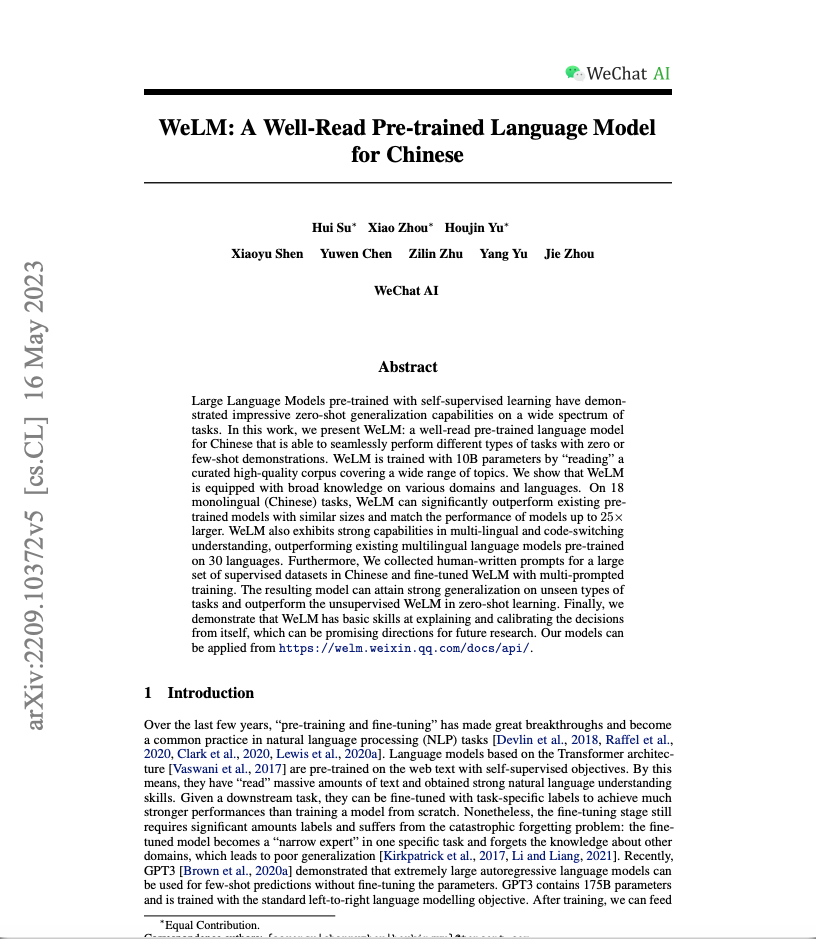
The WeChat AI team trained the model with 10 billion parameters, significantly outperforming other pre-trained models of the same scale and rivaling models 25 times larger.
The paper listed eight authors, including Su Hui, Zhou Xiao, Hou Jinyu, Shen Xiaoyu, Chen Yuwen, Zhu Zilin, Yang Yu, and Zhou Jie.
Currently, except for two individuals confirmed to have left through public records, the original WeChat AI large model team has remained largely stable over four years.
Su Hui, one of the first authors of the paper, joined Meituan in 2023 and contributed to developing Meituan's LongCat-Flash. Zhu Zilin joined Zhipu AI in 2025 and is now an RL Infra engineer, leading the open-source framework 'slime,' dedicated to post-training reinforcement learning for LLMs.
The latest July 2026 paper shows that the WeLM foundational large model team has grown to 48 members, a sixfold increase, with Chinese names dominating and only one author, Donald He, suspected of having an overseas background.
The last author of a model paper typically indicates the research direction's leader.
Zhou Jie, the head of WeChat's Pattern Recognition Center and WeLM's technical leader, appears most frequently in WeLM's technical papers. He led the team through a full range of technical iterations from 10B dense models to MoE architectures, serving as the top technical supervisor for research and development.
Zhou Jie joined Tencent in 2017. Previously, he earned a Ph.D. from the Institute of Theoretical Physics, Chinese Academy of Sciences, before shifting to research in computer deep learning and AI, focusing on natural language understanding. He is also very low-key, with his most recent public appearance being a general education lecture at Hunan University in June 2024.
It is clear that from the WeChat AI leader to WeLM's technical leader and the stable large model team members since 2022, the WeChat AI team is primarily dominated by long-time Tencent 'veterans.'
Compared to Yao Shunyu's leadership of the Hunyuan Large Model, which brought in a wave of 'newcomers,' the WeChat AI team follows an internally grown, stable iteration route, with deeper team roots, lower personnel turnover, and a technical approach more closely tied to WeChat's business scenarios.
2. 'Frugality' Ingrained in the Bone Marrow
'We are committed to exploring the boundaries of intelligence under extreme resource efficiency.' This statement means that while others stack parameters with computational power, WeChat AI conserves computational resources with ingenuity.
WeChat AI inevitably faces internal competition. Caixin reported that Tencent's computational resources are concentrated on the large model Hunyuan and the Yuanbao App, with GPU resources in short supply, constraining WeLM's training speed. The WeChat Group had to repeatedly apply to the corporation for new card resources, 'taking months to complete.'
Meanwhile, Tencent President Martin Lau believes that developing intelligent agents within WeChat first requires ensuring user privacy and security. Some scenario-specific functions cannot be easily achieved with general models. For WeChat's massive user base, the model needs further improved reasoning capabilities.
Additionally, a Tencent insider interviewed by LatePost said that while Hunyuan aims to break through intelligence limits, WeChat seeks a more cost-effective computational model to adapt to large-user-volume scenarios.
WeChat AI's choice of 'frugality' is essentially a commercial necessity.
WeChat is a national-level application with over 1.4 billion monthly active users. The computational cost of large models is a core constraint for ultra-large-scale products. Even a difference of 0.0001 yuan per thousand tokens, multiplied by a user base of 1 billion, becomes a staggering figure. This is why WeChat places extreme importance on cost optimization and insists on self-developing foundational models.
Doubao has already provided a cautionary tale, with rising computational costs forcing it to start charging. According to a May research report by Guosen Minsheng Securities, using the cheapest Doubao model as a baseline, Doubao's daily cost for providing free AI services ranges from 132 million to 240 million yuan.
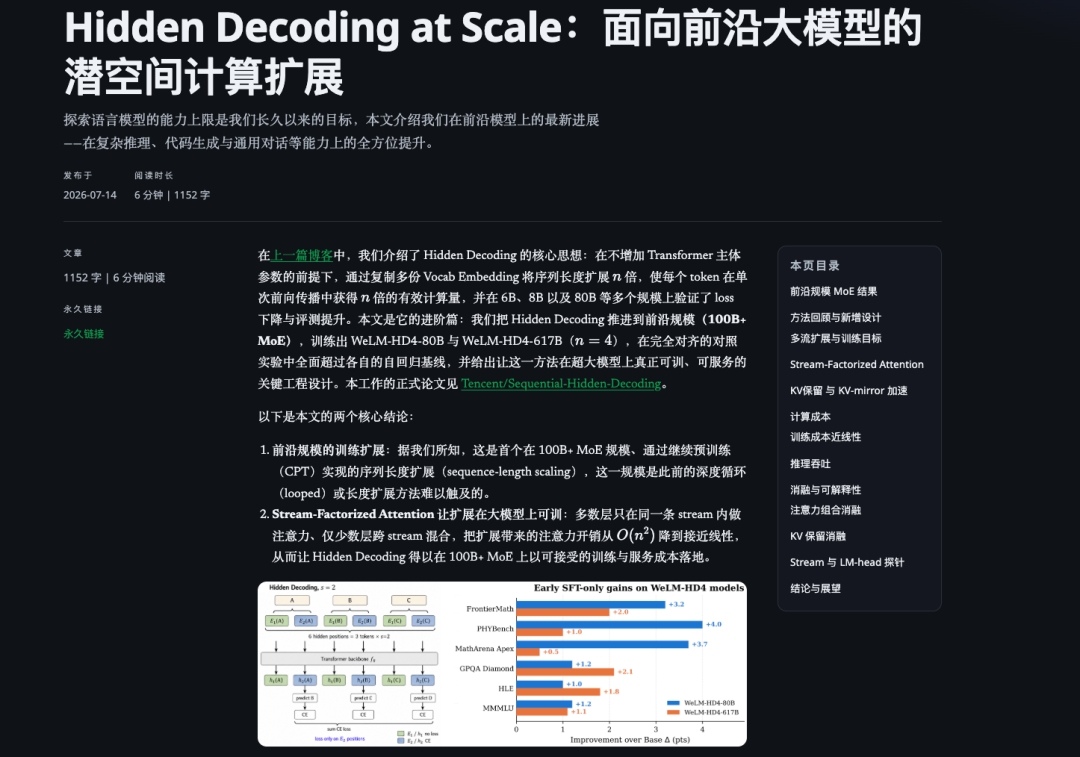
What is WeChat AI's solution? The technical report 'Hidden Decoding at Scale,' officially released on July 14, provides one answer.
When a foundational model's training converges, how can its capabilities be further pushed? The industry's standard answer has become a path dependency: expand parameters, add layers, increase width, and mobilize a ten-thousand-card cluster to rerun a complete pre-training, using linear computational Input to achieve sub-linear performance gains.
WeLM's approach is to split each token into four 'hidden computation streams,' allocating more internal computation per token, thereby continuing to enhance model capabilities while keeping the backbone network largely unchanged. As a result, the training cost for the 80B model increases only 5.1 times, and for the 617B model, only 4.4 times, far below the theoretical 16-fold increase under naive implementation.
Another technical blog post, 'Building Efficient Sparse MoE Models with Moderate Resources,' describes an 80B total parameter MoE model with 3B activated parameters per step, trained on less than 14T tokens of corpus, yet achieving performance on par with or even surpassing general models of the same scale or larger.
The blog concludes bluntly: 'These methods provide a practical roadmap for developing efficient and powerful models without relying on extreme-scale resources.'
This has been WeLM's consistent approach over four years: in 2022, it matched a model 25 times larger with 10B parameters; in 2026, it supports 1.4 billion users with 3B activated parameters. The series of engineering details listed in the technical blogs, while seemingly minor optimizations individually, form a complete 'extreme efficiency improvement' system when combined—all manifesting the art of 'frugality.'
The problem's magnitude has changed, but the underlying logic of the solution remains the same: solving scheduling problems for billion-user products with even more extreme resource efficiency.
From current evaluations of WeChat's AI assistant 'Xiaowei' in beta testing, Moments and private chat data can only access records from the last two days, avoiding high computational costs for full historical data. Mini-program controls are based on official Skill programmatic interfaces rather than visual recognition simulated clicks. The Contacts Skill explicitly prohibits calling multiple tools in one round or parallel tool calls.
These reflect WeChat AI's methodology for full-link cost control: not pursuing extreme usability but ensuring stable availability.
3. What Happens After Taking a Seat at the Table?
From the current Tencent AI strategy, a four-layer layout has been completed:
- The foundational Hunyuan Large Model provides reasoning, coding, and agent capabilities, aiming to enter the industry's first tier.
- Yuanbao serves as a general-purpose application, validating C-end demand and content consumption capabilities.
- WorkBuddy and CodeBuddy create closed loops for office scenarios and enterprise consumption.
- WeChat AI Xiaowei acts as a platform AI gateway, completing closed loops for WeChat content, advertising, and commercialization capabilities, raising the ceiling for AI narratives.
Hunyuan Hy3 has been released, and WeChat AI Xiaowei is in beta testing. Both newcomers and veterans are taking their seats.
The question is whether Hunyuan and WeLM, both building foundational large models, will lead to internal product coordination issues. Goldman Sachs analysts straightforward in a research report, 'This means Tencent is maintaining two independent large model R&D systems in parallel within the corporation. Whether they can achieve synergy and whether training costs can ultimately be integrated remains uncertain. The market worries this represents redundant resource investment.'
Goldman Sachs estimates that this investment may equate to 5% to 17% of Tencent's adjusted operating profit in the fourth quarter of 2026. Nevertheless, Goldman maintains a 'buy' rating, believing long-term ecological dividends will sufficiently cover short-term redundant construction costs.
This argument about redundant resource investment views the issue through past experiences. Google's 2023 voluntary merger of DeepMind and Google Brain provides the most valuable industry parallel for observing Tencent's dual-model system, validating a pattern: when large models become a company's core strategy, redundant foundational technology construction will eventually be consolidated by scale effects.
However, for Tencent at present, this is not an either-or choice. While dual-track parallel operation incurs efficiency losses, it also preserves business-side flexibility. The only catalyst that might force a true merger is cost—profit margins during the investment period.
After all, the AI competition has entered the 'capital finals' stage.
Across the ocean, Anthropic's valuation has surpassed OpenAI's, reaching $965 billion, with a potential Nasdaq listing as early as October. OpenAI's listing plans have been delayed from this autumn to 2027. On this side of the Pacific, Tencent-invested DeepSeek is also preparing for an IPO, currently valued at approximately $71 billion, with a potential listing in 2027.
The large model race is a financially draining contest where those who slow down in R&D investment risk falling behind in the next generation of model competition.
Reviewed by | Chen Qiulin
END
-
The Moment to Evaluate Montage Technology Has Arrived
-
![]()
StepOn Has Solved the Monetization Challenge of Large Models with Just a Smartphone
-
![]()
Is a Camera the New AI Safety Guardian? Hikvision Introduces Active Vision Operation Monitoring Gun-Ball Camera at WAIC 2026
-
The Second Half of AI: Cost-Effectiveness Takes Center Stage
-
![]()
Location, Concentration, and Trajectory Tracking: Hikvision’s TDLAS Gas Cloud Imaging Telemetry System Debuts at WAIC 2026
-
The 'AI Study Tour' Under the Original Equipment Manufacturer Model is Set to Create a New Wave of Internet-Famous Science and Innovation Cities
-
![]()
Now, There's a 'Basis' to Curb 'Price Wars': Future Reports of Automakers Setting Low Prices Will Be Probed Under New Rules
-
![]()
WAIC 2026: Farewell to Parameter Races, Full-Chain AI Commercialization