SpaceX's 13th Starship Test Flight Takes Off Tonight: Packed with 20 Genuine Starlink Satellites, How Many Hurdles Remain Before Orbital Insertion?
 07/20 2026
 548
548
The 13th full-scale Starship test flight takes off tonight, packing 20 operational Starlink V3 satellites into the cargo bay for the first time—yet the Raptor engine restart and reusable thermal shield remain the two toughest hurdles before orbital insertion.
Tonight (starting at 5:45 PM Central US Time, early Friday morning Beijing Time), SpaceX's Starship will undergo its 13th full-scale test flight, the second using the latest Starship V3. Unlike May's test, this cargo bay won't carry simulated weights but 20 genuine Starlink V3 broadband satellites—deployed one by one through a side opening via a pulley-cable 'deployer'.
These satellites won't merge into SpaceX's operational network, but the engineering team will attempt laser communication links with ground stations and other spacecraft in low Earth orbit to verify V3's interoperability with previous-gen Starlink. For a rocket still 'getting its driver's license', this marks the first step from PPT payload missions to real space.
What's 'New' This Time: 20 Genuine Starlink Satellites in Orbit
The most critical increment (increment) in this V3 flight is the 'real satellites'. Last year's test used simulated weights matching Starlink's mass/dimensions; now technicians loaded 20 V3 satellites into the deployer. As planned, the spacecraft's time in space will just allow these satellites to unfold solar panels and antennas, attempting ground station links while passing over South Africa.
More intriguingly, some V3 satellites carry cameras to scan Starship's thermal shield and transmit footage back—last flight had 2 simulated units with cameras; this time 6 satellites do it, with imaging windows at night. SpaceX claims these visuals help 'continuously test the thermal shield's readiness before returning to the launch site'. When fully loaded, Starship could deploy 60 V3 satellites per mission, adding ~60 Tbps capacity to the constellation, while a Falcon 9 with V2 adds just 2.6 Tbps.
One Hurdle Remains Before Orbit: 'Raptor Restart' 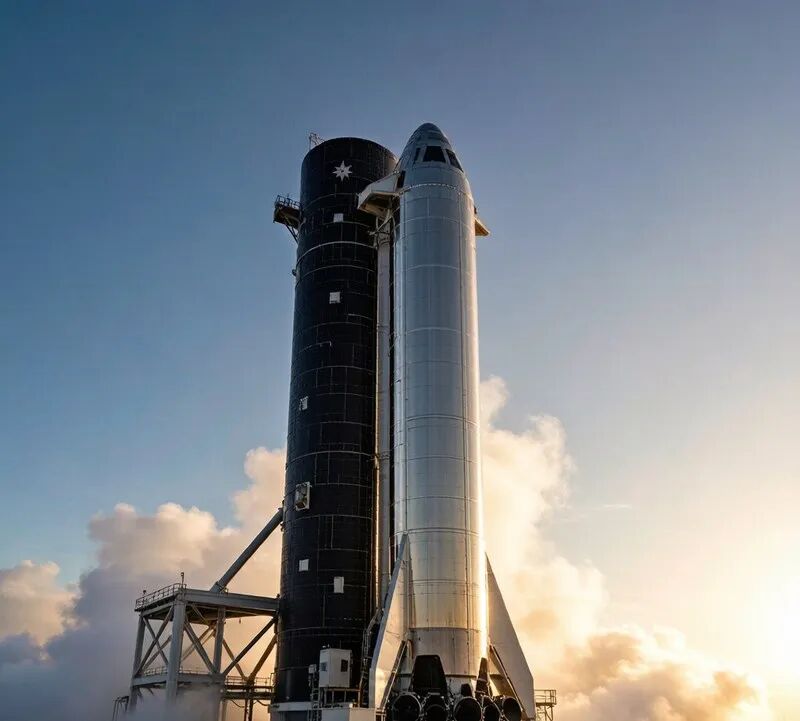
Image Source: AI-Generated
Why Not Attempt Orbital Insertion This Week? The Root Cause Lies in Last Flight's Unfinished Maneuver: The spacecraft should have ignited one of six Raptors for a brief burn in space but skipped it due to one engine shutting down prematurely during liftoff. Though the rest of the sequence completed as planned with a precise splashdown in the Indian Ocean, SpaceX must regain confidence in 'Raptor's reliable restart in vacuum without atmosphere' for the new V3's maiden flight—otherwise, engine restart failure could strand Starship in orbit, risking an uncontrolled re-entry and public safety.
This flight's checklist includes that unfinished Raptor restart. SpaceX's weekend update didn't clarify why Flight 12 shut down early, only stating 'the spacecraft demonstrated endurance with a single-engine failure and reached the intended suborbital trajectory', with multiple hardware and operational modifications made. The Super Heavy booster also needs fixes: after separation in Flight 12, it lost control instantly; subtle engine startup differences at the spacecraft end caused the booster to flip ~90 degrees off course, while its retro-burn saw 5 of 33 engines restart improperly and end early. This flight introduces hardware replacements and updated engine alarm/abort logic.
The Toughest Challenge: Reusable Thermal Shield
What keeps Musk awake at night more than engines is the thermal shield. He stated in a February podcast: 'The biggest single challenge left for Starship is making the thermal shield reusable. No one's ever built a reusable orbital thermal shield—it must shed no tiles during ascent, lose none on return, and not burn through the main structure.' Every one of the thousands of ceramic tiles must survive intact per flight for 'rapid reuse' to be possible.
This flight will test improved tiles and fixation mechanisms, plus 'load-sensing tiles' to collect data under higher dynamic pressure than ever. If successful, Starship will reach the orbital threshold: satellite launches, on-orbit refueling demos, and its first return to Texas' Starbase for reuse. Its actual inaugural operational mission likely won't be a moon landing but deploying the third-gen Starlink constellation—NASA's Artemis moon missions come later.
Today's Golden Quote
'The maturity of a rocket isn't judged by how high it flies, but by whether it can return unscathed and refuel for a second flight.'
Follow 【Degaoxing Zhiqinglang】 for three daily hardcore tech articles showing you how technology reshapes the world.
-
![]()
Some New Thoughts on ModelBest
-
![]()
After Three Attempts to List on the Hong Kong Stock Exchange, Has Yonyou Finally Broken Free from Its Painful Transition?
-
![]()
Qianwen Powers Apple’s AI: Alibaba Secures Its ‘Doubao Moment’ with iPhone Integration
-
![]()
JD Marches West, Pinduoduo Ventures East: The Clandestine Struggle for China’s Supply Chain Dominance
-
![]()
GAC Honda Secures 10-Year Contract Renewal: Debunks Merger Rumors, Unites for Market Breakthrough | Mirror Pro
-
![]()
Analysis of BBA Service Reputation Index in the First Half of 2026: Terminal Services Under Pressure
-
Observation of AI Business Models: From Token-Based Payment to Outcome-Based Payment
-
Observations on AI Business Models: From Token-Based Payment to Outcome-Based Payment