Why has OPPO's strategy been adjusted again in less than three months?
 07/22 2026
 445
445
Smartphone giant OPPO has undergone a new round of strategic adjustments.
On July 17, OPPO issued two consecutive announcements: Xu Qi, Vice President of realme, announced the suspension of new smartphone product launches in the Chinese market to focus on overseas markets.
OnePlus, on the other hand, decided to end product promotion in Europe and North America.
According to Sina Technology, OnePlus will primarily focus on developing the Chinese market, while maintaining product updates in the Indian market.
Viewed alone, this strategic adjustment can be seen as a significant internal restructuring, but when viewed over a longer period, it is also a continuation of the previous round of strategic adjustments.
In January of this year, realme returned to the OPPO system, and at the end of April, OPPO established a sub-series business unit.
Coupled with OnePlus, which returned in 2021, OPPO's sub-brands have all moved away from operating independently and have become part of a unified system.
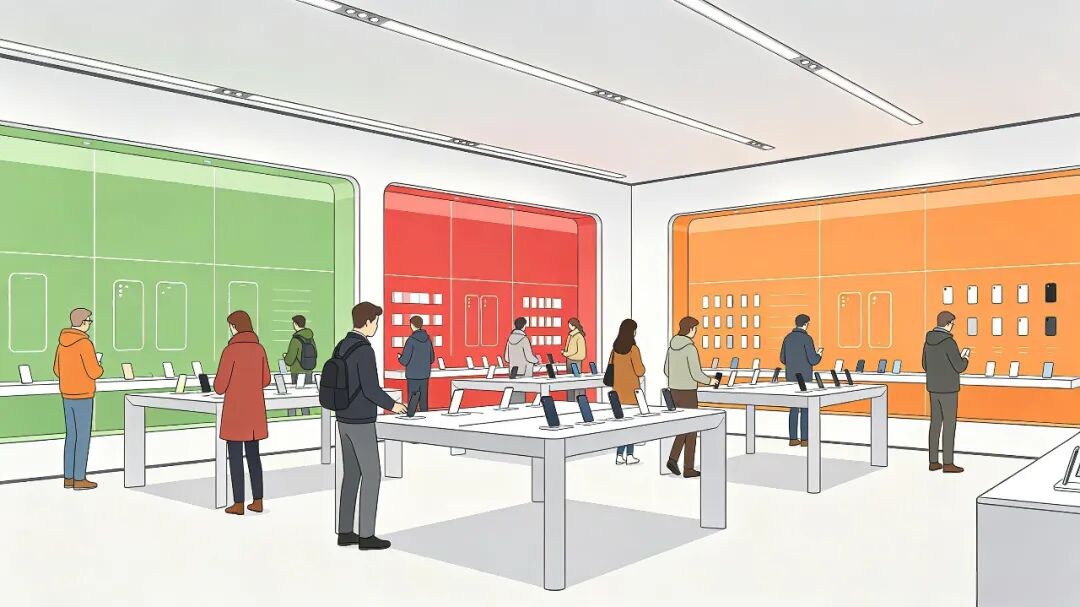
Image source: AI
In the future, all three brands will enjoy updates to the ColorOS system, with OnePlus and realme products focusing on the gaming and performance sectors.
As the saying goes, there is no absolutely correct strategic template, only strategic layouts suitable for the present.
Can such a major strategic adjustment, with one core and two wings, solve OPPO's brand management challenges?
01
Clearly Define Brand Roles
From OPPO's current announcements and previous adjustments, the internal brand landscape is as follows:
Firstly, in terms of internal structure, realme and OnePlus are both sub-brand business units of OPPO.
Secondly, in terms of supply chain costs, the three brands share systems, hardware, and after-sales services.
Then, in terms of product direction and market, OPPO covers all price segments, while OnePlus and realme's future products will focus on gaming and performance, with OnePlus responsible for the domestic market and realme for overseas markets.
After this adjustment, the roles of the three brands, especially the two sub-brands, have become clearer.
This time, the brand with the most significant changes should be realme, as it has ceded the domestic market. What is the logic behind OnePlus focusing on the domestic market and realme on the overseas market?
realme's historical performance is not bad.
In August 2025, realme announced that its cumulative global product sales had exceeded 300 million units.
However, the difference between realme and OnePlus lies in the fact that realme's domestic market share has consistently struggled to rise.
According to Counterpoint data, realme's domestic market share reached 3% in 2021, but according to RD observations, it was only 1.3% in 2025; OnePlus, on the other hand, surpassed 3.3% for the first time at the end of last year.
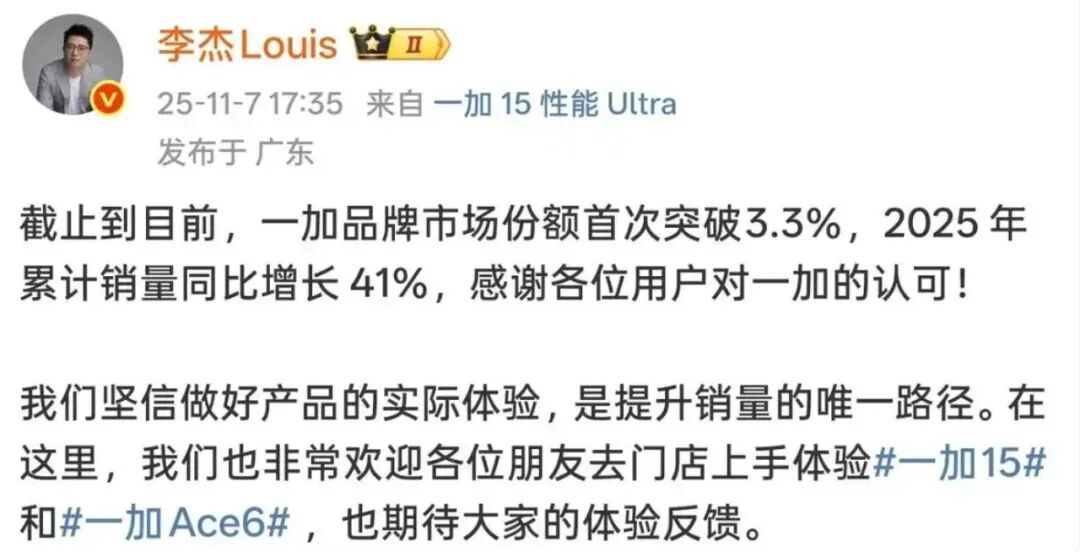
Image source: Weibo screenshot
At the same time, realme and OnePlus sometimes have overlapping target user bases for their products.
More critically, this year's smartphone market is different from the past, which will amplify the issue of internal brand competition.
02
Market Contraction and Rising Storage Costs
Why does the market environment amplify internal brand competition?
From the perspective of the global and domestic smartphone markets, this year has been challenging.
On July 14, IDC released relevant data showing that global smartphone shipments in the second quarter of 2026 were 277.5 million units, a year-on-year decrease of 6.7%, marking the second consecutive quarter of year-on-year decline.
China's smartphone market shipments were approximately 66.01 million units, a year-on-year decrease of 4.3%, marking the fifth consecutive quarter of year-on-year decline.
Market analysis suggests that the rising costs of core storage components have forced manufacturers to adjust terminal prices, further suppressing consumers' willingness to upgrade their devices.
In today's smartphone market, which is characterized by inventory competition, the demand for upgrades determines the sales lifeblood of smartphone manufacturers.
Performance excess and a lack of functional updates have led many young people to delay their upgrade plans.
Recently, media reports have indicated that agency survey data shows a continuous extension of the average user upgrade cycle.
Counterpoint shows that the average global smartphone user upgrade cycle exceeded 47 months in 2026.
Data from the China Academy of Information and Communications Technology shows that the average domestic smartphone user upgrade cycle reached 40.2 months in 2026.
In the second half of 2025, due to the surge in demand for AI servers, Samsung, Micron, and SK Hynix shifted production capacity to manufacture HBM chips while raising prices for consumer-end DRAM and NAND by nearly double.
Even Apple's products could not withstand the price increases, and domestic smartphone manufacturers also raised prices collectively. New models even featured a retro 6+128GB configuration, with significantly lower cost-effectiveness compared to last year.
Of course, under such market conditions, manufacturers have also diverged.
IDC reported that in the second quarter of 2026, Apple and Samsung both saw year-on-year increases in global market shipments, at 3.8% and 3.2%, respectively.
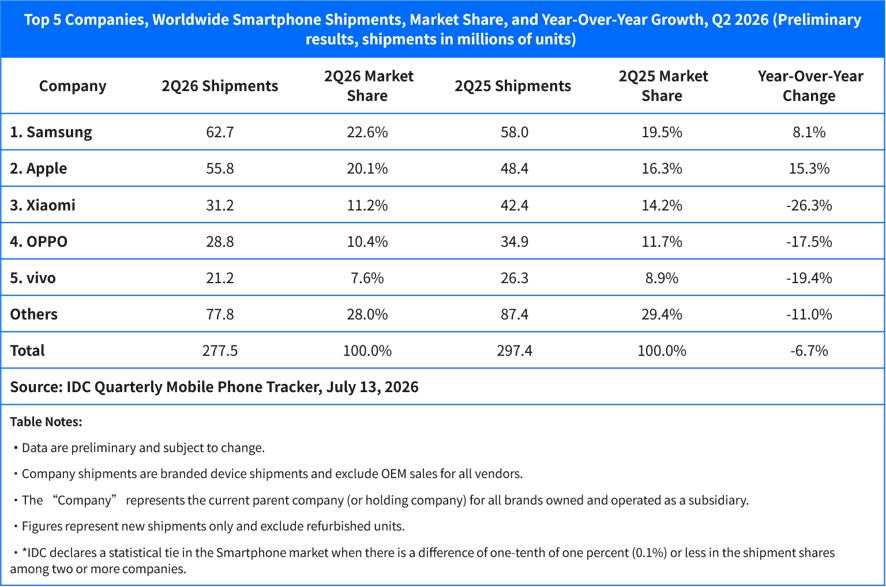
Image source: IDC
According to media reports, in the domestic market, Huawei and Apple also dominate the high-end segment.
This means that competition in the mid-to-low-end market will be even more fierce.
For example, if OnePlus and realme have overlapping products in the domestic market, they may end up competing against themselves.
The strategy of multiple brands vying for market share is no longer realistic. Reducing costs for sub-brands and waiting for future recovery is a more rational choice.
Therefore, OPPO's further adjustments to OnePlus and realme are imperative.
With OPPO as the flagship, and OnePlus and realme focusing on cost-effectiveness and market segmentation, the transition from independent operations to a one-core-two-wings structure has largely resolved internal competition issues.
03
OPPO's Six-Year Strategic Adjustment
Viewed over a longer period, OPPO's sub-brand strategic adjustments have spanned six years.
In 2019, the smartphone industry gradually reached the ceiling of its dividends, facing an uncertain future market.
It was in this environment that in 2020, Liu Zuohu returned to OPPO as Senior Vice President and Head of the Company's Product Line.
At the time, many media outlets speculated that changes in senior management would trigger changes in the two brands, and indeed they did:
In June 2021, OnePlus announced its full integration with OPPO, becoming an independent brand under OPPO, sharing R&D resources and supply chain advantages.
Subsequently, HydrogenOS, which was oriented towards the domestic market, was discontinued, leading many netizens to comment that HydrogenOS was dead. Overseas, OnePlus also adopted OxygenOS, which is deeply customized based on ColorOS.
In December 2022, Liu Zuohu announced that OPPO was officially entering a dual-brand era, with OnePlus settle in (setting up in) over 5,000 OPPO offline stores nationwide. OPPO planned to invest 10 billion yuan in OnePlus alone over the next three years, hoping to make it the leader in the online smartphone market for devices priced above 2,000 yuan.
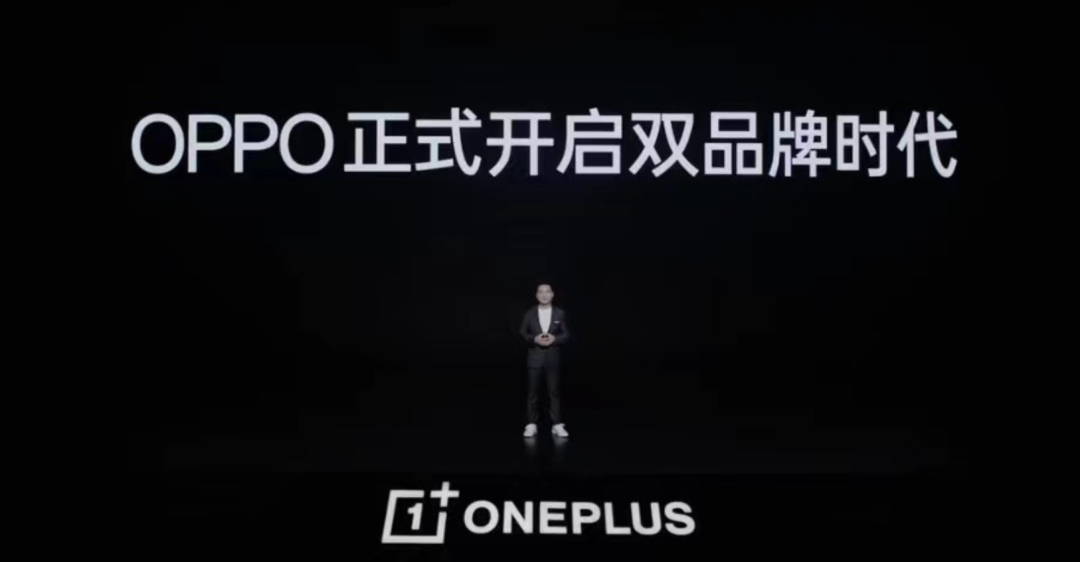
Image source: Screenshot from a product launch event video
Three years on, without mentioning OnePlus's performance, realme, which has cumulative sales exceeding 300 million units, has instead been integrated and adjusted.
In January 2026, realme also returned to OPPO, with Li Bingzhong serving as Senior Vice President of OPPO.
In April, OPPO merged OnePlus and realme to form a new sub-series business unit, with Li Bingzhong still overseeing the operations of the two sub-brands.
With the recent adjustments, the product positioning and sales scope of OPPO's three brands have become clearer, and they can also share R&D resources, supply chains, and after-sales services.
However, some loyal realme users will have to rely on overseas purchases for new devices in the future.
-
![]()
Following the Explosive Success of Kimi k3, Moonshot AI is Reportedly in Final IPO Financing Discussions
-
![]()
Baidu Dazi's Ambitious Overtaking with 'Product-Centric' Upgrades
-
![]()
AI PC Is Becoming Obsolete! The Rise of AC: Do Agents Really Need Their Own Computer?
-
![]()
Times Are Changing: Domestic New Energy Vehicles Are Driving Traditional Luxury Brands to the Wall, Prompting BBA to Slash Prices En Masse for Survival
-
![]()
The Myth of Musk
-
![]()
Which Type of Talents Do Automakers Prefer to Promote: Science or Liberal Arts Graduates?
-
![]()
Why has OPPO's strategy been readjusted in less than three months?
-
![]()
New Models Falter: Over 700 New Cars in the First Half of the Year Struggle, Only 4 New Models Surpass 10,000 Units in Sales, Achieving Hot Sales | Mingjing Pro