Meta Made the Biggest Promise, Invested the Most Money, but Ended Up with Nothing
 07/31 2026
 345
345
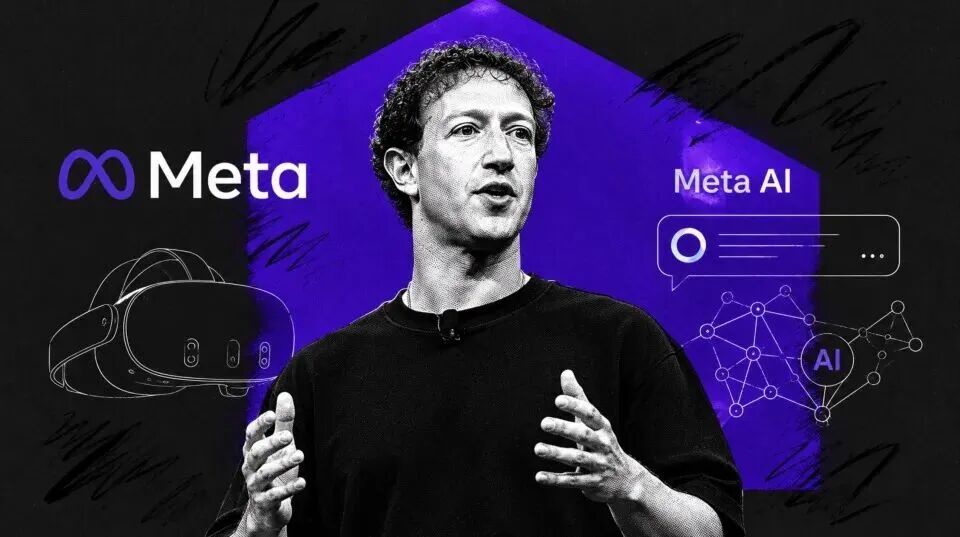
▲All images in this article are sourced from the internet. Please contact us for removal if there is any infringement.
The Boss Who Makes the Biggest Promises

This article was first published in Shadow Memo by Mo Yingsheng.
On July 29, 2026, Meta released its Q2 2026 financial report. This report acted like a mirror, revealing the true embarrassment behind Zuckerberg's grand AI vision.
Revenue reached $60.8 billion, up 28% year-over-year, hitting a record high. However, net profit fell 14% year-over-year to $15.8 billion, far below market expectations of $18.5 billion. Free cash flow plummeted 91% from $8.55 billion in the same period last year to just $784 million, marking the lowest level in nearly four years.
What's even more disheartening is that the company's revenue guidance for Q3 was a median of $62.5 billion, lower than analysts' average expectation of $63.2 billion. Following the release of the financial report, Meta's after-hours stock price briefly plunged by over 10%.
Revenue is rising, profits are falling, cash flow is drying up, and the stock price is collapsing. This is the current state of what Zuckerberg calls 'AI accelerating our core business.'
On one hand, there's the ever-expanding AI promise; on the other, a deepening capital black hole. Is Meta's multi-billion-dollar gamble betting on the future, or is it repeating the mistakes of the metaverse?

The Speed of Making Money Can Never Catch Up with the Speed of Burning Money
Let's first examine what this financial report actually says.
The good side: The advertising engine is still roaring. Meta's advertising business remains an undisputed cash cow. Q2 ad revenue reached $59.363 billion, up 27% year-over-year, with ad impressions growing 14% and average prices rising 12%.
Zuckerberg even stated bluntly on the earnings call, 'In terms of dollars, our advertising business reported faster year-over-year revenue growth than any other company's advertising business.'
Currently, 9 million small businesses on Meta's platform are using at least one AI-powered ad creative tool, and the annual revenue run rate for AI-driven Advantage Plus end-to-end solutions has exceeded $75 billion.
The ugly side: The speed of making money can never catch up with the speed of burning money.
Q2 total costs and expenses reached $42.026 billion, up 55% year-over-year. Among them, R&D spending hit $21.7 billion, up 67% year-over-year, accounting for more than one-third of revenue.
The bigger issue is capital expenditures. Q2 capital expenditures soared to $31.08 billion, up 83% year-over-year.
The company raised the lower end of its full-year 2026 capital expenditure guidance from $125 billion to $130 billion, with the upper end remaining at $145 billion. This is still one of the most aggressive capital expenditure plans in the global tech industry.
This led to the shocking figure: operating cash flow of $31.86 billion, minus $31.08 billion in capital expenditures, left just $784 million in free cash flow.
In other words, nearly every dollar Meta earns is being swallowed up by AI infrastructure.
One analyst put it bluntly, 'Nearly all the cash generated is being consumed by AI infrastructure spending.' Bloomberg's commentary was even more direct: 'The company's Q3 revenue forecast disappointed. Investors remain skeptical about how Meta will recoup its massive investments in artificial intelligence.'
Even more concerning is the trend. Some analysts point out that, at the current rate, Meta's free cash flow is almost certain to turn negative in the current quarter. A tech giant with annual revenue exceeding $240 billion is facing the risk of negative cash flow—this itself is a warning signal.
Meta's AI layout (strategic layout can be translated as 'strategic layout ' but for fluency, we'll use 'strategy') can be summarized in four words: 'early starter, late finisher.'
Zuckerberg doesn't underestimate AI. As early as 2013, Meta established FAIR (Facebook AI Research) and brought in Yann LeCun, one of the three pioneers of deep learning. In terms of foundational AI research, Meta's accumulations are not much inferior to Google's or Microsoft's.
But the problem lies in strategic focus.
First Missed Opportunity: Misjudging the direction of large models. When OpenAI released GPT-1 in 2018 and GPT-2 in 2019, Meta was still preoccupied with optimizing recommendation algorithms. When ChatGPT exploded globally at the end of 2022, Meta only then woke up.
It wasn't until 2023 that Meta hurriedly launched the Llama series of models, attempting to carve out a space in the open-source large model arena.
Second Missed Opportunity: The 'fiasco' of Llama 4 was textbook-worthy. According to media reports, when developing Llama 3, Meta exhausted all its technical reserves to ensure the success of that version.
This directly led to a technical gap when developing Llama 4. In today's most critical areas of reasoning and Mixture of Experts (MoE) models, Meta had to start from scratch.
Worse still, there were reports that Meta's AI team manipulated some of the benchmark test results for Llama 4, using different model versions to optimize different test items. This incident directly caused Zuckerberg to lose confidence in the existing AI team.
Ultimately, Meta announced that it would replace Llama 4 with its self-developed Muse Spark, effectively abandoning its most recognizable open-source brand in the large model race.
Third Missed Opportunity: AI Agent progress has fallen far short of expectations. On July 2, 2026, during an internal all-hands meeting, Zuckerberg sent a rare signal—he admitted he had miscalculated. According to a recording of the meeting obtained by the media, Zuckerberg acknowledged that Meta's development progress in the AI Agent field had 'not accelerated as we expected' over the past four months.
He further stated that the company's large-scale organizational restructuring around AI 'could have been cleaner' and that there had been misjudgments among senior leadership regarding the timing of the changes.
From missing the large model wave to the Llama 4 fiasco, and now to AI Agent progress falling short, Meta always seems to be 'chasing' and 'a step behind' in the AI race.
There's a deeper reason behind this: Zuckerberg's investment logic has never been 'think clearly before acting,' but rather 'go all-in first and figure it out later.'
From the cryptocurrency Libra to the metaverse, and now to AI, Zuckerberg's investment style has been consistent—seeing a trend, going all-in, pivoting when it doesn't work, and then going all-in again when a new trend emerges.
This 'trend-chasing' investment style means he always rushes in after the wave has already risen, never able to be the one defining the race.


'Pie-in-the-Sky' Narratives
If Meta is 'a step behind' in technical execution, Zuckerberg is definitely 'far ahead' in narrative ability.
During the Q2 earnings call, Zuckerberg painted a grand and dizzying vision: 'Soon, we will have AI assistants that can work for you 24/7, helping you achieve your goals, improve your life, health, relationships, and financial situation—whatever you desire.'
He further predicted, 'Whether we set the timeframe at five years or any other period, I believe the likelihood of billions of people not using personal intelligent agents in the future is extremely low.'
'We are the only major tech company whose primary goal is to put superintelligence directly into people's hands.'
In an op-ed for The Wall Street Journal, Zuckerberg even proposed a grand 'AI philosophy,' with personal empowerment as the source of prosperity, invention as the primary purpose of superintelligence, and checks and balances as the foundation of safety.
Sounds wonderful, right?
But the reality is: Currently, about 98% of Meta's revenue still comes from traditional advertising. AI subscription services are expected to contribute up to $3 billion in revenue by 2027, a negligible amount compared to Meta's annual advertising revenue exceeding $240 billion.
In terms of enterprise AI assistants, while over 1 million businesses use Meta's commercial AI assistants on WhatsApp and Messenger, the overall revenue contribution remains limited. New businesses like compute rentals and large model APIs are still in their infancy.
The ability to paint grand visions is growing stronger, but the ability to deliver remains lacking.
Does this scene seem familiar?
Five years ago, Zuckerberg was equally certain that virtual reality was the future, even going so far as to rename the entire company from Facebook to Meta. That bet cost about $80 billion.
This year, Meta significantly downsized its metaverse division, laying off 10% of the team and quietly halting new development of Horizon Worlds.
Today, the Reality Labs division is still burning through over $4.6 billion every quarter. Since 2021, the division has accumulated approximately $85.6 billion in operating losses.
One user's online comment hit the nail on the head: 'Sorry, isn't this the same guy who bet $80 billion that people would wear VR goggles for meetings?'
Another was more direct: 'Everything Zuckerberg has bet on in the past few years has failed. Not sure his 'vision' is still trustworthy.'
From Libra to the metaverse to AI, Zuckerberg's narrative skills have never disappointed, but his ability to deliver has never inspired confidence.

Invested $130 Billion, but Seen No Results
Meta's AI investment has been substantial, with capital expenditures ranging from $130 billion to $145 billion in 2026, representing almost exponential growth compared to $28.1 billion in 2023, $39 billion in 2024, and $72.2 billion in 2025.
For comparison, Sweden's national GDP in 2024 was approximately $604 billion. Meta's annual capital expenditures alone are nearly a quarter of Sweden's entire economic output.
But why, after investing so much money, are there no tangible results?
Most of the money is being spent on 'infrastructure' rather than 'products.' The vast majority of Meta's capital expenditures go toward data centers, GPU clusters, and power infrastructure.
The company plans to double its overall computing capacity to 7 gigawatts in 2026 and double it again to 14 gigawatts in 2027. These infrastructure projects take years to go from construction to operation and are unlikely to generate any revenue in the short term.
Meta CFO Susan Li also admitted that the company is currently prioritizing computing capacity expansion for 2026-2027, with specific deployment plans to be considered only for 2028 and beyond.
In other words, the money being poured in now will only yield results—if at all—two or three years from now.
The boost AI provides to core businesses is 'invisible.' Zuckerberg repeatedly emphasizes that AI is improving ad recommendation efficiency and conversion rates, but this improvement is indirect, gradual, and difficult to quantify precisely.
Unlike launching a new product, which generates immediate market feedback, AI's impact seeps quietly into every detail of algorithmic optimization. For investors, this 'invisible return' does little to alleviate their anxiety about massive expenditures.
The path to monetizing new businesses is long and uncertain. Meta is exploring multiple AI monetization paths, including large model APIs, compute rentals, and enterprise AI agents.
However, these businesses are either still in their infancy or face fierce market competition. In cloud computing, Amazon AWS, Microsoft Azure, and Google Cloud have already formed a solid triopoly.
As a latecomer, Meta faces significant challenges in carving out a share of the compute rental market. While Zuckerberg stated on the earnings call that 'we've received a large number of compute rental inquiries at significantly higher prices than our acquisition costs,' he also emphasized that 'the profit margins from selling intelligence will continue to be significantly higher than from selling compute directly.' The problem is, 'selling intelligence' itself is far from scaling (scalable) at this point.
Internal mismanagement has hindered execution efficiency. In May, Meta underwent a massive restructuring affecting about 20% of its workforce—global layoffs of approximately 8,000 employees, with about 7,000 transferred to AI-related departments.
However, Zuckerberg himself admitted internally that the layoff process was chaotic and uneven, and the restructured AI-oriented organizational system failed to quickly deliver value. Multiple engineers transferred to the AI department revealed that the new AI teams are under immense pressure. Zuckerberg even acknowledged in an internal memo in June that the company's AI transformation was 'moving too fast.'
EMARKETER senior analyst Minda Smiley put it sharply: 'These continuous product launches increasingly give the impression that the company is shooting in the dark rather than following a sustainable path.'
From strategy to execution, from infrastructure to products, from organization to culture, Meta has problems at every level. No matter how much money is invested, if these fundamental issues are not resolved, the outcome is unlikely to be optimistic.

Will the History of Metaverse Repeat Itself?
To understand Meta's dilemma in AI, we cannot overlook the 'hard lesson' from the metaverse.
In 2021, Zuckerberg rebranded the company as Meta and announced an all-in commitment to the metaverse. At that time, he painted an equally grand vision: billions of people would work, socialize, and entertain in the virtual world.
What was the result? Five years have passed, and Reality Labs has accumulated losses of $85.6 billion, while the metaverse remains a distant concept for ordinary users.
Today, Meta's narrative logic in AI is almost identical to that of the metaverse back then:
Both start by painting an ultra-ambitious vision ('Billions will have personal AI assistants' vs. 'Billions will live in the metaverse');
Both involve astronomical initial investments ($130-145 billion in annual capital expenditures vs. cumulative losses of $85.6 billion);
Both go all-in before market demand is validated;
Both rush to roll out infrastructure before core products mature.
Mike Proulx, Research Director at Forrester, commented bluntly: 'This mirrors Meta's metaverse misstep. Meta is again spending recklessly before demand is proven. The difference is that AI adoption and value are real. The technology differs, but market patience is starting to look similar.'
This comment strikes at the heart of the issue: AI's value is real, but Meta's 'burn money first, figure out profits later' model is exhausting the market's remaining patience.
To be fair, Meta's AI layout (AI layout means AI strategy/layout, kept as is for context) is not entirely without bright spots.
AI's enhancement of the advertising business is tangible. With a 27% growth in ad revenue, 9 million small businesses using AI ad tools, and a $75 billion annual revenue run rate for Advantage Plus, these numbers show that AI is indeed strengthening Meta's core business.
Zuckerberg's statement on the earnings call that 'we are truly a full-stack tech company' is not empty rhetoric. From self-developed chips to Self built data center (meaning self-built data centers, kept as is), from self-developed large models to proprietary application scenarios, Meta's depth of layout (layout) in the AI supply chain is unmatched by few companies.
NVIDIA CEO Jensen Huang even commented: 'No company deploys AI at a scale larger than Meta.'
But the problem remains: scale does not equal returns, and investment does not equal output.
When a company's free cash flow plummets from $8.5 billion to $700 million, when its stock price falls for 10 consecutive trading days, losing 13% of its market cap, and when it admits 'progress is far below expectations' in AI Agent development, the market and investors have ample reason to feel anxious.
Zuckerberg said on the earnings call: 'I understand this is a huge investment and a massive bet. My personal wager is that those investing in this will be rewarded and feel very good over time.'
Meta's AI dilemma is essentially a dilemma of 'strategic pacing.'
Going all-in in the right direction is not wrong, but if the pacing is off—if infrastructure is overbuilt before products mature, if capacity is overexpanded before market demand is validated, if transformation is forced before organizational capabilities catch up—then even the right direction can lead to a dead end.
The core question Meta needs to answer has never been 'whether to invest in AI,' but rather 'how to invest, how much to invest, and when returns will be visible.'
So far, Zuckerberg's answer appears to be: keep investing, double down, and keep painting the vision.
On July 29, 2026, the same day as the earnings release, Meta announced a partnership with BlackRock to launch a $14 billion data center project in El Paso, Texas.
Earlier, the company also disclosed the 'Hyperion' data center project in Louisiana, with total investments exceeding $50 billion.
The vision keeps expanding, and the money keeps burning.
As for the fruits, they are probably still 'three to six months' down the road.
-
![]()
Apple: How Long Can the Tech Giant Sustain Its Pricing Power Amid Rising Costs?
-
![]()
Breaking News! Tesla Considers Divesting Its China Operations
-
![]()
Foreign Media Claims Tesla Considers Selling Chinese Business to Pave Way for Merger with SpaceX
-
![]()
Meta Made the Biggest Promise, Invested the Most Money, but Ended Up with Nothing
-
![]()
Lei Jun Disrupts the Market: Xiaomi Unveils N70/N90 Dual Models, Zeroing in on Two Leading Extended-Range Rivals
-
![]()
Sales Champion Leapmotor's Quest for Scale
-
![]()
SAIC-GM and SAIC Passenger Vehicles Announce Leadership Shifts on the Same Day: 'Technical Talents' Step Forward to Steer the Course
-
![]()
BMW's Turnaround Starts with the Easy Part