Lark, Boasting Over 3 Billion Yuan in Annualized Revenue, Emerges as the 'Junior Partner' of Doubao and Volcano Engine
 08/03 2026
 337
337

Produced by Leida Finance. Text by Ding Yu. Edited by Meng Shuai.
Facing 'relentless pressure' from competitors, ByteDance is stepping up reforms to adjust its AI business architecture.
As part of this adjustment, ByteDance has bifurcated Lark, its 'pride and joy' that just turned ten this year. Specifically, Lark's product team will merge with the Doubao product team, while the Lark GTM (Go-To-Market) team will integrate with the Volcano Engine team.
This marks ByteDance's most significant adjustment to its To B (business-to-business) operations since implementing business segmentation in 2021.
ByteDance emphasizes that post-integration, Lark's existing products and services will remain unchanged, with both teams focusing on deepening product integration within office productivity scenarios.
According to Caijing, Lark's ARR (Annual Recurring Revenue) surpassed 3 billion yuan in 2025, with a YoY (Year-over-Year) growth of over 100% in ARR for Q2 2026. However, considering costs such as computing power and marketing, Lark still faces a profitability gap.
As ByteDance enters the 'fierce competition' arena, within less than ten days, three internet giants—Tencent, Alibaba, and ByteDance—have completed or are rumored to have completed organizational restructuring of their AI office product lines.
Notably, in the '2026 Global Unicorn List' released by Hurun Research Institute this June, ByteDance's valuation soared to a staggering 3.26 trillion yuan, ranking third globally and first domestically.
ByteDance 'Splits' Lark: Half to Doubao, Half to Volcano Engine
On July 30th, multiple media outlets reported that ByteDance issued an internal email announcing a major organizational restructuring targeting its AI business.
In this adjustment, Lark will be divided into two and integrated into the Doubao product team and Volcano Engine team, respectively. ByteDance stated that this move aims to enhance product and service collaboration among Doubao, Lark, and Volcano Engine in enterprise productivity scenarios.
Specifically, on the product front, the Lark product team will merge with the Doubao product team to form a new Doubao product team, led by Doubao head Zhao Qi, with Lark head Xie Xin reporting to Zhao Qi.
ByteDance reiterated that post-integration, Lark's existing products and services will remain unchanged, with both teams focusing on deepening product integration within office productivity scenarios.
It is reported that the Doubao Enterprise Edition, developed with significant input from the Lark product team, has already commenced internal testing among select Lark customers.
Currently, the Doubao Enterprise Edition seamlessly integrates Lark's office scenarios, including documents, spreadsheets, meetings, and group chats, supporting Q&A and creation functions based on enterprises' proprietary knowledge bases. It is also equipped with enterprise-grade security features such as data isolation, permission control, and security auditing.
In terms of the commercialization system, the original Lark GTM (Marketing, Sales, Customer Service) team will merge with the corresponding team from Volcano Engine to form a To B GTM organization named 'Creativity Service Platform.'
This organization will oversee the marketing, sales, and customer service of ByteDance's cloud services, such as MaaS (Model as a Service) and SaaS (Software as a Service), led by Volcano Engine head Tan Dai, with Lark sales head Lin Chan and Lark strategy and marketing head Shi Zhijun reporting to Tan Dai.
Some view this organizational integration as a sign that ByteDance is further elevating the priority of its AI-to-B strategy.
According to Beijing Business Today, in Q2 2026, over 90% of Lark's new customers simultaneously purchased Lark's AI products. Based on July's average consumption, ByteDance's large model business ARR reached US$4 billion, surpassing the combined ARR of other domestic model companies.
According to data previously disclosed by Volcano Engine, as of June 2026, the daily average Token calls for the Doubao large model have exceeded 180 trillion, growing over 10 times in the past year.
Additionally, QuestMobile data shows that Doubao's monthly active users reached 382 million in June, surpassing the combined total of the second-ranked Tongyi Qianwen and third-ranked DeepSeek.
In IDC's ranking of China's public cloud MaaS service market, Volcano Engine also ranked first with a 49.5% market share.
With the support of China's largest 'C-end AI user base + public cloud MaaS service computing power platform,' Lark's office scenarios and customer resources are being more deeply integrated into ByteDance's AI ecosystem.
A Decade of Layout: From 'Self-Use' to Full Embrace of AI
Tianyancha shows that Beijing Lark Technology Co., Ltd. was registered and established in 2016 as a member company of Douyin Group. The inspiration for Lark's name comes from 'flying pigeon transmitting messages.'
Xie Xin, head of Lark, once stated that at the end of 2016, after trying various tools on the market, ByteDance decided to develop its own, starting with communication and creation tools, aiming to build a globally leading collaboration suite.
Lark was born under this backdrop, integrating functions such as instant messaging, shared calendars, online documents, audio and video conferencing, and cloud storage.
The core driving force behind ByteDance's self-developed Lark was the company's need to create a tool that could ensure seamless collaboration among its tens of thousands of global employees.
According to public information, ByteDance began using Lark internally in late 2017, with domestic beta testing and promotion starting in 2018.
After the outbreak of remote work demand due to the pandemic, ByteDance announced in early 2020 that it would provide all SMEs (Small and Medium-sized Enterprises) and anti-epidemic organizations with free access to Lark's commercial version for three years. Subsequently, ByteDance further increased its investment in Lark.
In November 2021, ByteDance CEO Liang Rubo released an internal letter announcing an organizational restructuring. At that time, Lark, EE, and EA merged to form the Lark business segment, becoming one of the company's six major business segments.
It is reported that this segment focuses on providing enterprise collaboration and management services, integrating office collaboration applications such as instant messaging, online documents, calendars, audio and video conferencing, and offering organizational operation and management products such as OKR (Objectives and Key Results), recruitment, performance, and contracts.
Now, several years later, amidst the rise of AI, Lark is once again undergoing significant organizational restructuring.
According to media reports, Doubao and Lark have already established a Doubao Office department internally, aiming to promote Doubao's deep integration into real office and collaboration processes.
Leida Finance noticed that job postings related to 'Doubao Office' can also be seen on ByteDance's official website.
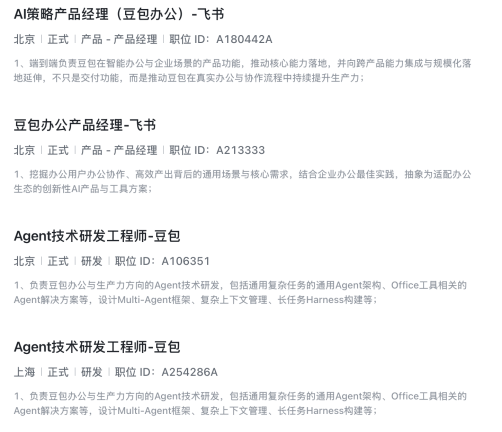
These job positions include Doubao Office's AI Strategy Product Manager, Agent Technology R&D Engineer, etc., primarily responsible for Doubao's product functions in intelligent office and enterprise scenarios, cross-product capability integration and scalable implementation, as well as Agent technology R&D for Doubao Office and productivity directions.
Additionally, according to Beijing Business Today, the collaboration between Lark and Doubao has already taken a step forward on the product front. When visiting Lark's official website, a popup window appears stating 'Doubao has entered Lark!'

According to the popup content, 'Get both Doubao Professional Edition + Lark Pilot Edition for as low as 99 yuan/month,' saving at least 89 yuan/month compared to purchasing Doubao Professional Edition (starting at 68 yuan/seat/month) and Lark Pilot Edition (starting at 120 yuan/seat/month) separately.
It is introduced that this product integrates an enterprise AI assistant, providing intelligent Q&A, meeting minutes, automatic replies, group chat summaries, and automated scheduled tasks, while equipped with Seed 2.1 Pro, Seedance 2.0 models, and Lark's office suite, including 15TB of storage, 50,000 rows of multi-dimensional table rows, and 500,000 automation times/month.
Combined with ByteDance's overall organizational adjustments, this popup is not a temporary promotion but a direct reflection of the organizational adjustments on the product front.
Tencent and Alibaba Successively 'Apply Pressure,' Internet Giants Consolidate Their Positions
In fact, with the rapid development of AI technology, an industry consensus has gradually formed: the emergence of emerging technologies such as AI large models and AI agents is compelling internet giants to dismantle the previously clear product boundaries between office and AI departments.
When agent capabilities surpass the productivity threshold, enterprise customers' focus shifts from whether models can generate content to whether AI can read enterprise knowledge, understand organizational permissions, invoke business tools, and complete real work in a closed loop.
Alibaba was one of the early pioneers, proposing 'Cloud + DingTalk Integration' as early as 2020, attempting to combine DingTalk's personnel, organizational, and application entry points with Alibaba Cloud's computing and digital infrastructure.
However, limited by the technological maturity at the time, this layout remained more at the level of mutual customer acquisition between cloud and collaboration office software, failing to form an irreplaceable deep product binding.
Some view that Tencent may be the first domestic vendor to successfully implement the 'AI + Office' landing path. After the explosion of OpenClaw earlier this year, Tencent quickly followed up, introducing a 'Lobster Family Bucket' encompassing self-developed Lobster, Local Lobster, Cloud Lobster, Enterprise Lobster, Cloud Desktop Lobster, etc.
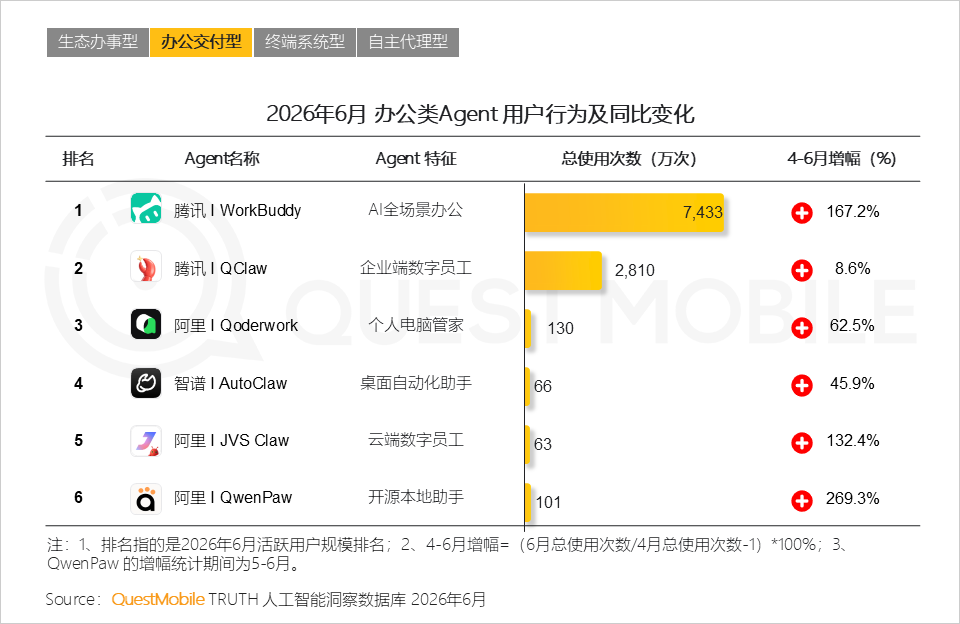
Among them, WorkBuddy, focusing on AI full-scenario office, relies on scenario demands and ecological traffic to dominate in user scale, demonstrating strong market explosiveness and expansion potential.
QuestMobile data shows that in June this year, WorkBuddy's total user usage reached 74.33 million times, with a 167.2% increase from April to June, significantly leading Tencent's own Qclaw and similar products from competitors such as Alibaba and Zhipu.
Recently, Tencent and Alibaba have tacitly accelerated their AI office business layouts, concentrating forces and consolidating their positions.
On July 20th, Tencent released an internal organizational adjustment notice, transferring relevant businesses and some teams from its QClaw product center to Cloud Product Division VI, placing WorkBuddy under the same management system to achieve deep collaboration.
The next day, news emerged that Alibaba would integrate three Agent products—QoderWork, Wukong, and MuleRun—into 'Qianwen Office,' led by DingTalk's new CEO Chen Yusen.
Now, just 10 days later, ByteDance has also joined this silent competition by integrating Lark into Doubao and Volcano Engine.
With the strong support of Doubao and Volcano Engine, can Lark make a late comeback? Leida Finance will continue to monitor.
-
![]()
Qwen Still Sees Value in Open Source Initiatives
-
![]()
Qwen Still Sees the Merits of Open Source
-
![]()
A Complete Retrospective of the Thailand Campaign: A Detailed Review of the First 'Complete Model' for Chinese Automobiles Going Global
-
![]()
Can Leapmotor's 'Budget-Friendly Choice' Strategy Support a 200 Billion Valuation?
-
![]()
The Codes in Two Sets of Data: AI Applications Start to Show Winners and Losers, and the Smartphone Market is Changing Protagonists
-
![]()
Can Xiaomi Pengcheng Succeed with Its 'Sincerity' Despite the 'Delayed' Sales Report?", "Xiaomi Pengcheng, extended-range SUV, pre-sale price, product strength, delivery capability", "Xiaomi Pengcheng
-
![]()
Will Traditional Algorithm Engineers Be Rendered Obsolete by VLA? Fact or Fiction?
-
![]()
Everyone is Talking About World Models, What Are the Technical Focuses of Different Companies?