Everyone is Talking About World Models, What Are the Technical Focuses of Different Companies?
 08/03 2026
 512
512
By 2026, world models have become a new hotspot in the field of autonomous driving. Almost every major player, including NIO, XPENG, Li Auto, Huawei, Tesla, and Waymo, is discussing world models and has introduced their respective technical solutions. However, upon closer inspection, while all are called world models, the technical approaches, implementation methods, and interpretations of the concept vary significantly among companies.
01 NIO: Letting the World Model Drive Directly
In June 2026, NIO rolled out the latest version of its world model to over 700,000 users, covering two brands (NIO and Leapmotor), four platforms, and two entirely different chip platforms.
The core feature of NIO's world model is end-to-end direct control. Traditional intelligent driving systems typically involve a model planning a trajectory first, which is then executed by a control module. NIO's approach allows the world model to directly output steering wheel, acceleration, and brake pedal signals, bypassing intermediate layers. This results in a shorter path and lower latency. NIO views this end-to-end kinematic modeling approach as the control foundation for the next generation of intelligent driving systems.
In terms of training methods, NIO employs a three-tier architecture of world model + supervised fine-tuning + closed-loop reinforcement learning. The January 2026 version was the first to apply complete closed-loop reinforcement learning to intelligent driving development. Simply put, this approach allows the algorithm to trial and train in simulated future scenarios generated by NIO's World Model (NWM), acquiring capabilities before deployment in vehicles. This method enables the model to experience numerous extreme scenarios in a virtual environment without risking real vehicles.
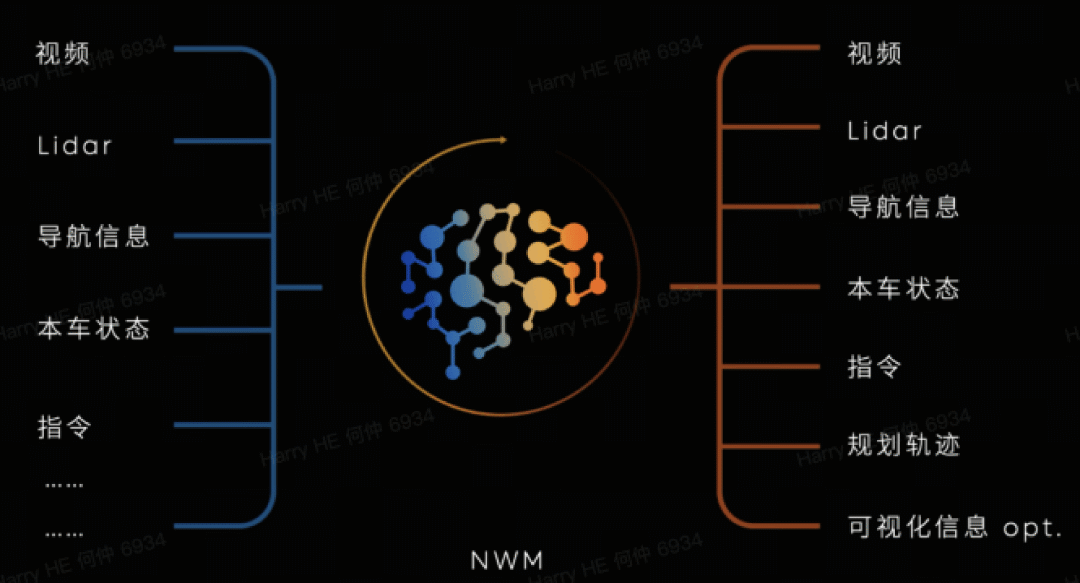
Image Source: Internet
NIO faces a challenge in deploying the same world model across more than a dozen vehicle models spanning four years. With coverage of two chip platforms, Orin-X and the self-developed Shenji NX9031, this requires not only algorithmic capabilities but also engineering prowess. Issues such as how to deploy the model, transmit data, update systems on older models, design testing processes, and close the loop on safety verification all need to be addressed one by one.
02 XPENG: Taking a Dual Approach with VLA and World Models
At CVPR 2026, XPENG unveiled its technical roadmap for world models for the first time. XPENG's approach differs from NIO's, as they chose to have their second-generation Vision-Language-Action (VLA) model and world model jointly form the foundational model for physical AI.
The XPENG team clearly outlined the division of labor between the two components. The second-generation VLA primarily learns from human driving behavior, unifying video streams, commands, and action outputs to enable the system to act reasonably in complex traffic environments. The world model, on the other hand, learns the operational rules of the physical world by predicting future states and scene evolution.
To distinguish the roles of the two, the former enables the model to learn how to act, while the latter helps the model understand how the world will change after actions are taken.
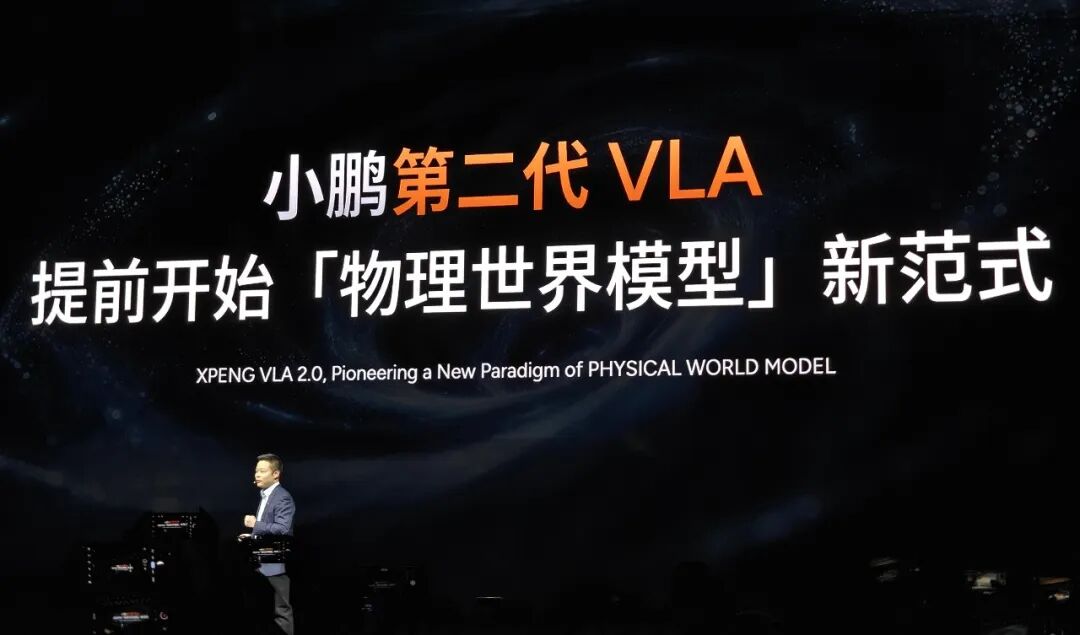
Image Source: Internet
Regarding the debate in the autonomous driving community over whether to prioritize VLA or world models, Liu Xianming, head of XPENG's General Intelligence Center, clarified in his CVPR speech that XPENG's foundational model for the physical world is both a second-generation VLA and a world model. The two are not substitutes but enhance the model's capabilities through different training signals.
Liu Xianming also elaborated on his understanding of world models at CVPR 2026. He believes that the core value of world models lies in providing far denser supervisory signals than human driving behavior. Human driving behavior offers sparse supervisory signals, only able to supervise the final behavioral outcome. In contrast, world models can predict every frame, every movement, and every interaction, providing much denser supervisory signals. XPENG's world model draws inspiration from the next-token prediction approach in large language models, gradually learning the rules of the physical world through dense predictions of the next frame or state on massive amounts of unlabeled video data.
Based on these principles, Liu proposed that an excellent world model should possess three core capabilities: proactive thinking, controllable generation, and long-term sequence reasoning. XPENG subsequently officially released the X-Mind technical framework, which enables vehicles to conduct mental simulations before taking action by embedding a predictive world model, transforming autonomous driving from passive reaction to proactive decision-making.
03 Li Auto: Building a Solid Foundation with Bottom-Up Technology
Li Auto's approach differs from the previous companies. At CVPR 2026, Li Auto had 12 papers selected, four of which focused on world models. These four papers correspond to three key links in the construction and application of world models, from accurately reconstructing the 3D physical world to understanding traffic rules and predicting dangerous consequences, forming a complete technical chain.
At the scene reconstruction level, InfiniDepth models depth as a neural implicit field, breaking through the resolution bottleneck of traditional discrete grids. Unposed-to-3D can directly generate high-precision 3D vehicles from real driving images, reducing the cost of simulation asset construction. In terms of understanding traffic rules, DriveCombo serves as an evaluation benchmark for reasoning about complex traffic rules, assessing the model's understanding of various rules in real traffic scenarios.
Li Auto's world model layout leans more toward bottom-up technological accumulation. Instead of releasing a world model product at a specific point in time, they are solidifying the key capabilities required for world models through continuous foundational research. The advantage of this approach is a deeper technological foundation, but the downside is that the perceived progress in productization is less intuitive (intuitive) than NIO's.
It should be noted that Li Auto is also advancing MindVLA-o1 and the Mach VLA driver model, following the VLA route.
04 Huawei: Cloud-Vehicle Collaboration with a Focus on Safety
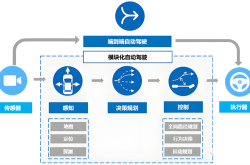
The core upgrade of Huawei's ADS 5 is the WEWA 2.0 World Behavior Model, which features a distinct characteristic: a clear division of labor between the cloud and the vehicle.
On the cloud side, Huawei's world model introduces a multi-agent game mechanism for the first time, increasing training intensity by 10 times. It also adopts online reinforcement learning, enabling simultaneous generation, learning, and validation, boosting training efficiency by 10 times. On the vehicle side, WEWA 2.0 introduces the Safety Risk Field theory, aiding decision-making by generating real-time risk heatmaps.
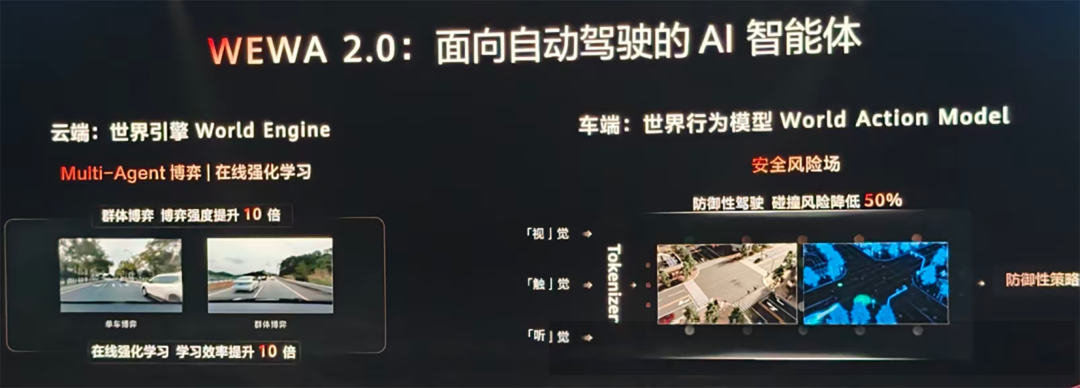
Image Source: Internet
Huawei explicitly stated that it has skipped the intermediate translation layer route of VLA and directly adopted a world model architecture to reduce latency and computational consumption. From a technical perspective, Huawei places greater emphasis on the efficiency advantages of world models in real-time decision-making rather than the interpretability offered by VLA.
05 Xiaomi: Combining Two Technical Routes
In May 2026, Xiaomi open-sourced Xiaomi OneVL, a framework that unifies three technical routes—Vision-Language-Action (VLA) models, world models, and latent space reasoning—into a single system. Previously, VLA and world models were relatively independent technical routes in autonomous driving, but Xiaomi's approach connects the two through latent space reasoning.
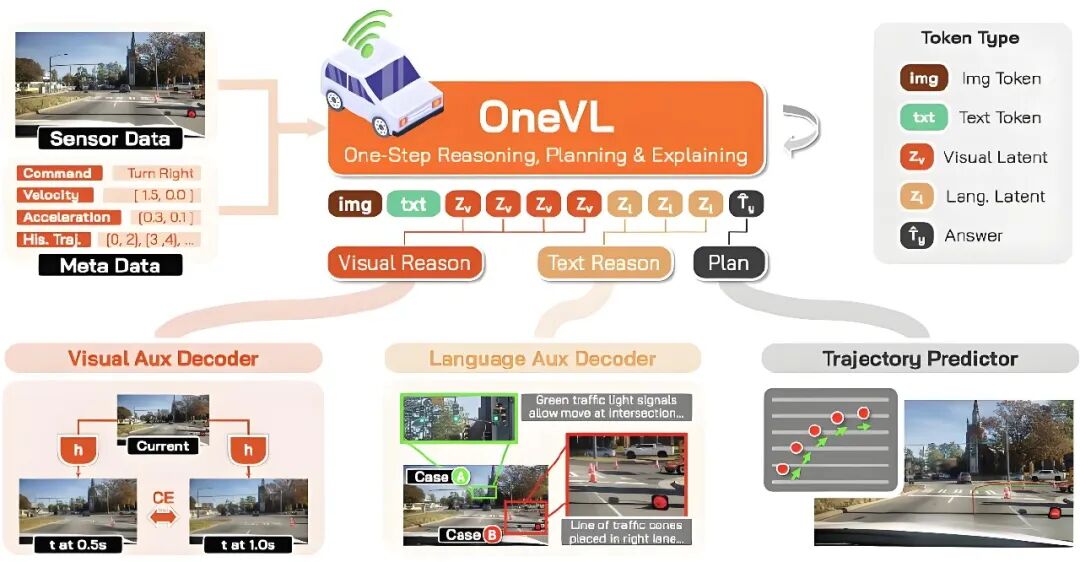
Image Source: Internet
OneVL employs a dual-modal latent variable token design, where visual latent variable tokens encode the physical causal structure of the scene, and language latent variable tokens encode the semantic expression of driving intentions. The training phase is equipped with dual auxiliary decoders—one for predicting future frames and the other for reconstructing the reasoning process. During inference, both decoders are removed to avoid additional overhead.
This design enables faster reasoning speeds. OneVL achieves a minimum reasoning latency of 0.24 seconds, approximately 5.4% of the traditional VLA autoregressive reasoning method. On the NAVSIM benchmark test, it achieved a PDM-score of 88.84, surpassing the explicit chain-of-thought score of 88.29 in the latent space reasoning domain for the first time. Xiaomi also open-sourced the model weights and code.
However, it should be noted that OneVL is currently in the academic verification stage, and there is still a considerable distance between model open-sourcing and actual engineering deployment in vehicles.
06 Momenta: A Supplier Solution with a Three-Tier Architecture
In April 2026, Momenta released the R7 world model. Unlike most world models, R7 is defined as a reinforcement learning world model, where world models and reinforcement learning jointly form the two pillars of physical AI.
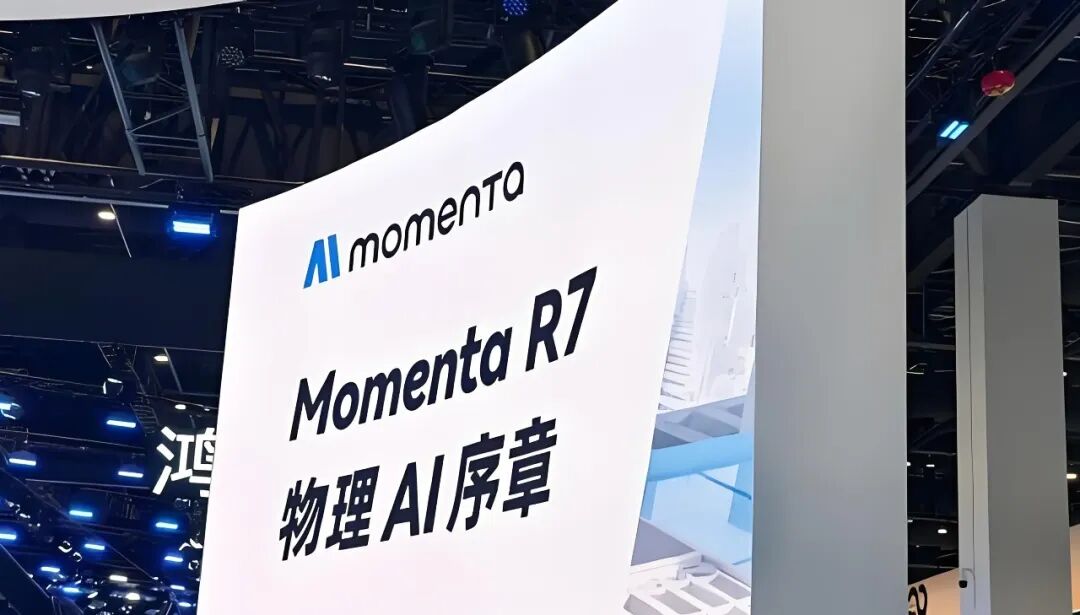
Image Source: Internet
The R7 architecture consists of three layers. The first layer is world model pre-training, which compresses physical laws, common sense, and causal relationships into the model through massive real driving data, enabling the system to form a foundational understanding of the physical world. The second layer is world model simulation, where the world model is used for closed-loop simulation in autonomous driving, allowing the system to predict how the environment will evolve when its behavior changes, while evaluating performance in long-tail scenarios. The third layer builds a highly realistic virtual training ground based on the first two layers, enabling the system to repeatedly explore and trial in an environment close to reality. Momenta believes this mechanism allows the model to outperform human drivers in rare extreme scenarios.
According to related reports, R7 has optimized misbraking indicators by more than three times and improved in-lane avoidance performance by nearly five times in predicting sudden events such as objects falling from vehicles ahead or small animals suddenly crossing the road. R7 achieved mass production deployment in April 2026, trained on over 12 billion kilometers of driving data and 100 million critical scenario segments. Cadillac announced that it would be the first to mass-produce vehicles equipped with the R7 world model, and SAIC Volkswagen's ID.ERA 9X will also be among the first to adopt it.
07 Tesla and Waymo: Two Different World Simulators
Tesla and Waymo represent another approach to world models, emphasizing cloud-based simulation.
In January 2026, Tesla disclosed a patent titled "Ground Truth Heuristic Engine," which outlines a technical solution for reconstructing real vehicle camera footage into 3D models and generating nearly unlimited training scenarios based on this. Ashok Elluswamy, Vice President of AI Software at Tesla, revealed at CVPR 2026 that its end-to-end large model operates at a frequency of 36 Hz, significantly higher than the industry standard of 10 Hz. Elluswamy also stated that Tesla aims to replace modular architectures with a single end-to-end neural network, achieving a unified foundation model for both autonomous vehicles and humanoid robot Optimus.
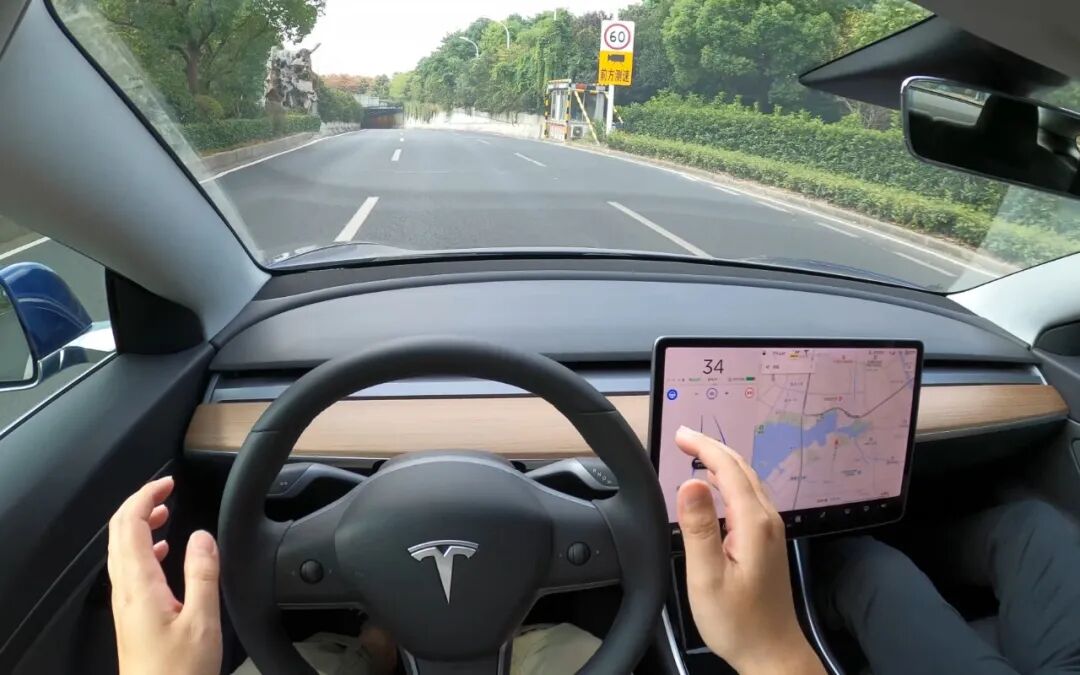
Image Source: Internet
Waymo's world model is built upon Google DeepMind's Genie 3. Genie 3 is no longer just a generative model but a world simulator capable of understanding the operational rules of the real world. Waymo's training framework consists of three stages: pre-training, mid-training, and post-training. The pre-training stage directly leverages Genie 3's general world understanding capabilities. The mid-training stage incorporates Waymo's proprietary sensor data (multi-camera, LiDAR, millimeter-wave radar, high-definition maps). The post-training stage fine-tunes and distills the model for specific driving tasks.
However, Tesla and Waymo share a commonality: they both use world models as powerful simulation engines to generate massive training scenarios and conduct closed-loop testing. This fundamentally differs from NIO and Huawei's approach of deploying world models directly on vehicles for real-time decision-making.
08 How to Interpret These Differences?
On the surface, everyone is working on world models, but a closer analysis reveals that each company's answer to what problems world models should solve varies.
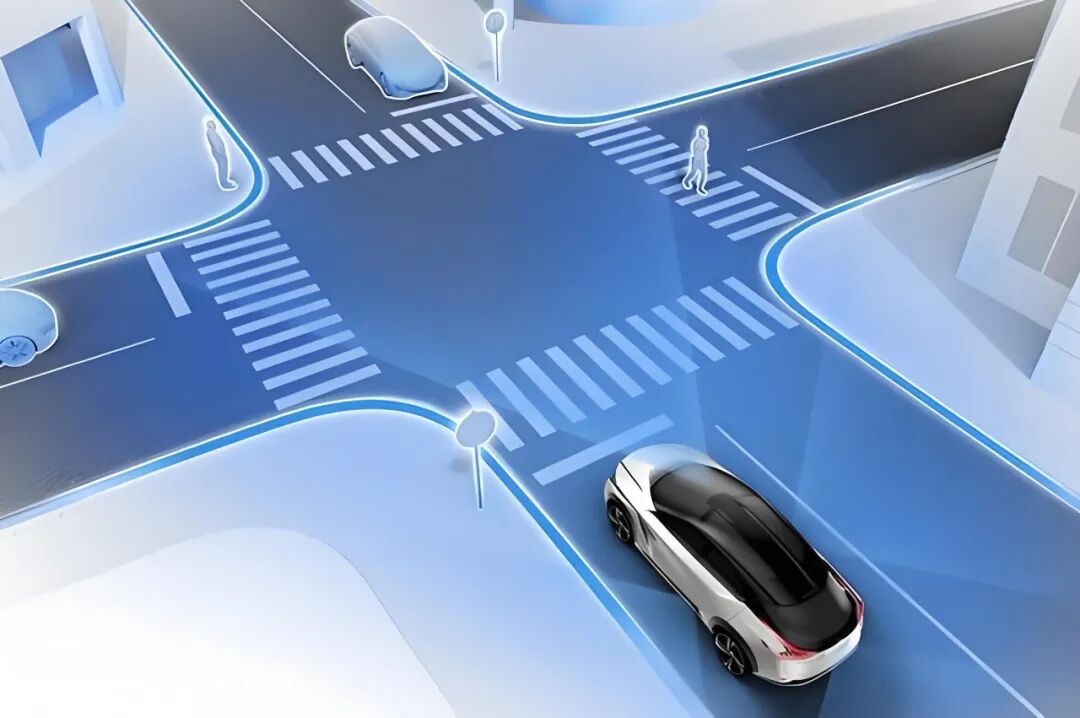
Image Source: Internet
NIO treats the world model as an execution system that can directly control vehicles, pursuing lower latency and finer control. XPENG considers the world model as part of a foundational model, working in tandem with VLA—one for understanding physical laws and the other for learning human driving behavior. Li Auto starts with foundational technologies, first solidifying capabilities like depth estimation and 3D reconstruction. Huawei emphasizes cloud-vehicle collaboration, using multi-agent games in the cloud to enhance training efficiency and safety risk fields in the vehicle to ensure safety. Tesla and Waymo use world models as simulation tools to generate training data and test extreme scenarios.
These differences stem from varying judgments on technological evolution paths and resource conditions. Automakers with self-developed chips and large fleets of existing vehicles are more inclined to deploy world models on vehicles, while companies with strong computational power and data accumulation focus more on cloud-based simulation. No single route is absolutely correct, but one thing is certain: world models are transforming from an academic concept into a real-world component of autonomous driving systems, and this process is accelerating.
#AutonomousDriving #WorldModels
-
![]()
Qwen Still Sees the Merits of Open Source
-
![]()
A Complete Retrospective of the Thailand Campaign: A Detailed Review of the First 'Complete Model' for Chinese Automobiles Going Global
-
![]()
Can Leapmotor's 'Budget-Friendly Choice' Strategy Support a 200 Billion Valuation?
-
![]()
The Codes in Two Sets of Data: AI Applications Start to Show Winners and Losers, and the Smartphone Market is Changing Protagonists
-
![]()
Can Xiaomi Pengcheng Succeed with Its 'Sincerity' Despite the 'Delayed' Sales Report?", "Xiaomi Pengcheng, extended-range SUV, pre-sale price, product strength, delivery capability", "Xiaomi Pengcheng
-
![]()
Will Traditional Algorithm Engineers Be Rendered Obsolete by VLA? Fact or Fiction?
-
![]()
Everyone is Talking About World Models, What Are the Technical Focuses of Different Companies?
-
![]()
The Final Verdict: Extended-Range Electric Vehicles Are Accelerating Toward Obsolescence