Qwen Still Sees the Merits of Open Source
 08/03 2026
 546
546
Yesterday, an official demo of Qwen-UI-Agent was released on its webpage.
The AI first opens Douyin, searches for the most-saved Graphic (graphic with text) on “beef in passion fruit sour soup,” saves it, and notes down the ingredients. Then, it jumps into Hema, adds all ingredients except seasonings to the cart, and schedules delivery for 6:45 PM the same day.
Previously, Doubao Mobile’s most viral demo was similar. A user says a sentence, and the phone autonomously opens different Apps, searches, compares, and places orders. The difference is that Doubao actually embedded this capability into a 3,499-yuan engineering phone, only to be blocked by risk controls from WeChat, banking, and payment Apps. Qwen, instead, showcased the same actions in papers and project repositories.
For cross-App operations, Doubao collided with product risk controls, while Qwen featured it in model demos.
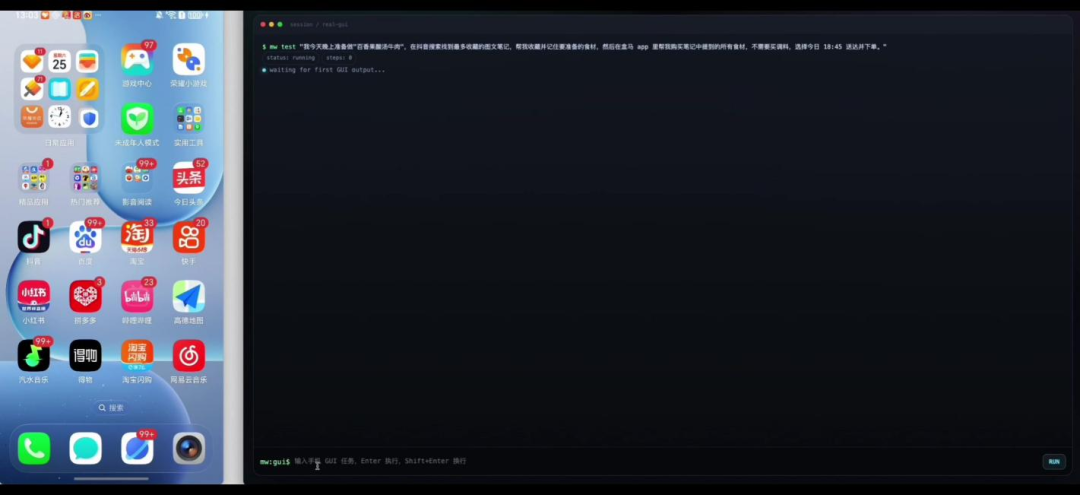
Figure 1 | First frame of Qwen-UI-Agent's official demo.
The right-side instructions require the Agent to first find a highly-saved recipe on Douyin, then purchase ingredients on Hema with delivery scheduled for 6:45 PM. It proves Alibaba demonstrated cross-App long tasks but does not solely confirm this capability has entered mass-produced phones. Source: Qwen-UI-Agent's official project page.
Additionally, Qwen-UI-Agent disclosed its technical report, project page, and demo, but as of today, its flagship model weights remain closed. The truly open-sourced model is its predecessor, MAI-UI, with 2B and 8B weights released under the Apache 2.0 license. Larger 32B and 235B weights have not been released.
Thus, this is not a strict open-source release. What Alibaba did was reframe the system-level Agent capability Doubao once embedded into an engineering phone into a standalone model capability: trainable, evaluable, adaptable to different devices, and not inherently tied to system-level UIs.
Open source here serves more as a foundation for Qwen's strategy. The previous MAI-UI lowered experimental barriers, while the latest Qwen-UI-Agent showcases capability limits. This step has also, to some extent, influenced the current development landscape of AI phones.
When AI control over phones can be embedded into small open-source models, is there still a need for entirely new AI phones?
Doubao Mobile's background needs no further elaboration; its collaboration launch and subsequent bans by multiple Apps are old news.
ByteDance doesn’t just want a voice entry point. It aims to position itself between user needs and all Apps.
The significance of this move is that Doubao, for the first time, pushed system-level Agents to real users and, on behalf of the entire industry, collided with the boundaries of super Apps.
On December 5, Doubao Mobile Assistant issued another statement, restricting score-brushing and incentive-brushing scenarios, temporarily disabling operations for banking and internet payment Apps, and limiting some competitive games. User authorization does not automatically resolve platform liability. If AI misclicks a button, reads a verification code, or turns a mistaken operation into a payment, post, or account risk, liability cannot be dismissed with a simple “the user agreed.”
Super Apps also have their own business interests.
A GUI Agent can bypass homepages, ads, and recommendation slots to directly complete searches and transactions. For users, this means fewer taps; for Apps, it could mean losing traffic entry points, ad inventory, and transaction allocation rights.
Recently, Doubao shifted its approach. LatePost reported that the new Doubao Mobile, when facing top apps, will no longer read screens or simulate clicks. It can only integrate if the counterpart voluntarily provides MCP services, opening relevant data and operation permissions.
MCP can be understood as a set of tools handed over by the App itself: which data can be read, which actions can be taken, and which steps require user confirmation are all clearly defined by the App. The Agent doesn’t need to access excessive underlying data, and users don’t have to worry about AI over-operation.
The new Doubao Mobile reportedly increased its stock from around 30,000 units in the previous generation to hundreds of thousands, with ByteDance still negotiating with phone manufacturers and top apps. In December 2025, Jiemian News reported that ByteDance was advancing AI phone collaborations with hardware manufacturers like Vivo, Lenovo, and Transsion; Lenovo later responded that both sides maintain close communication.
At this point, ByteDance’s most critical bargaining chip has shifted from “I have a large model” to “I’ve built a phone that can truly operate across Apps.” It has navigated system permissions, real-device adaptation, and app risk controls.
But it can no longer claim exclusivity.
Alibaba Disassembled a Phone into Models
Less than a month after Doubao Mobile encountered risk controls, on December 29, 2025, Alibaba’s Tongyi Lab released MAI-UI and open-sourced its 2B and 8B model weights.
What Qwen does is quite similar to Doubao: the model receives user instructions and the current screen, deciding whether to click, swipe, input, or call an interface. After executing an action, the model checks the new page to determine if the task has deviated.
The difference is that Doubao encapsulated this loop into a product relying on system permissions. Alibaba first disassembled the loop into downloadable, trainable, and deployable models.
In short, Alibaba open-sourced the GUI phone.
The newly released Qwen-UI-Agent takes this a step further. The paper states that the team built an operational environment comprising over 100 real devices and 150+ Apps, generating training trajectories across ~10,000 simulated environments and using online reinforcement learning to handle long tasks exceeding 100 steps. Its actions are no longer limited to screen taps: when encountering files, tables, and data processing, the model can switch to the command line. Several consecutive operations can also be generated in a single output.
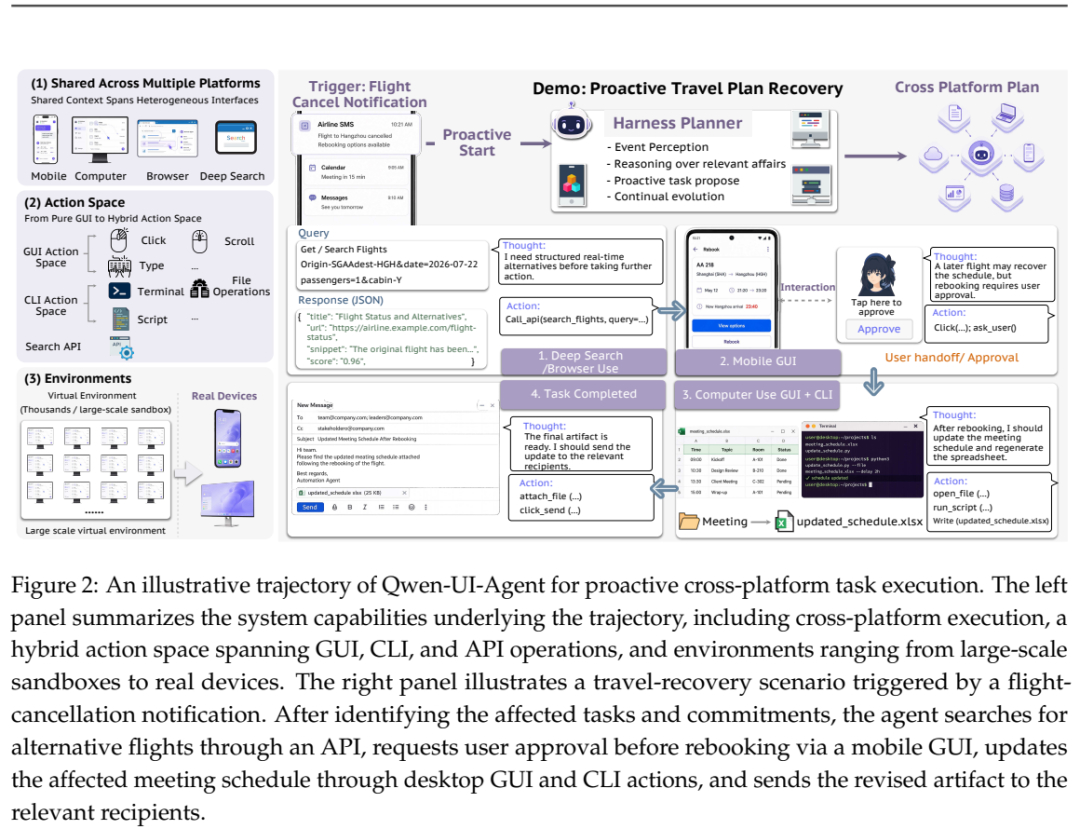
Figure 2 | Paper Figure 2.
A flight cancellation notice triggers the Agent to find alternative itineraries, and with user consent, modify meetings and spreadsheets on a computer. The left side lists mobile phones, computers, browsers, and action spaces like GUI, command line, and API. Source: Qwen-UI-Agent Technical Report, p. 5.
The value of this paper lies in expanding “phones tapping Apps for users” into a cross-device execution system. It taps the screen when needed, uses interfaces when appropriate, and turns to the command line for file processing. GUI is no longer the sole path, nor is it the only decision-making route.
Official results look impressive: Qwen-UI-Agent achieved success rates of 82.1%, 92.2%, and 97.5% on MobileWorld, MobileWorld-Real, and AndroidDaily, respectively, and scored 79.5% on OSWorld-Verified. The previous MAI-UI-235B had also achieved 76.7% on AndroidWorld, outperforming UI-TARS-2’s 73.3%.
But benchmarks alone don’t tell the full story.
The latest mobile scores primarily come from Alibaba’s self-built or operated evaluation environments. Some competitor scores in the table were also rerun by the team, not equivalent to all companies submitting results under the same public test. By the Qwen-UI-Agent generation, the official primary mobile benchmark shifted from AndroidWorld to MobileWorld, MobileWorld-Real, and AndroidDaily, which better reflect Alibaba’s desired real-device and long-task capabilities but make external verification harder.
The paper itself doesn’t overhype the results.
It showcases a task where the Agent is asked to add in-stock items under 10 yuan to the cart in a Pupu Supermarket livestream and then favorite the most expensive item. The model repeatedly clicks on bread, durian, and matcha cake without completing the task as required. Another task involves posting a WeChat Moments update and then changing its visibility to “Only Me”; the post succeeds, but the privacy setting fails.
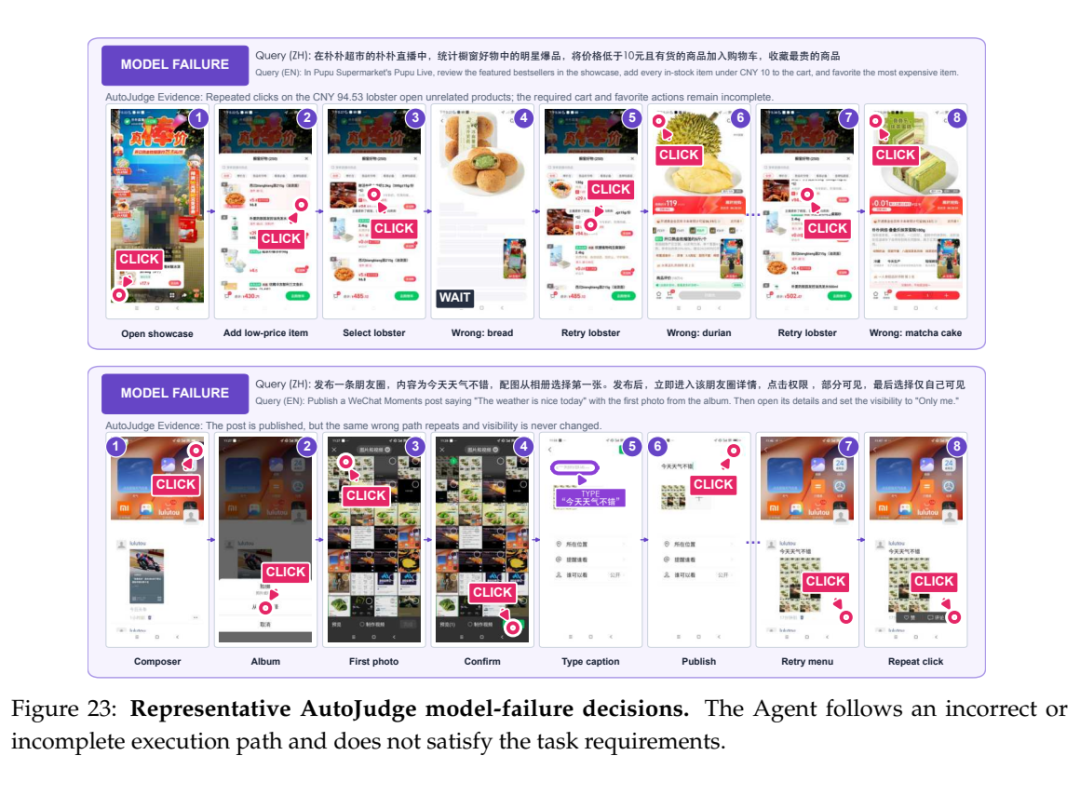
Figure 3 | Paper Figure 23.
The top half shows failed product selection in Pupu Supermarket; the bottom half shows a Moments post published but “Only Me” not set. Both cases are labeled MODEL FAILURE by the team. Source: Qwen-UI-Agent Technical Report, p. 53.
Compared to benchmarks alone, these failures feel more authentic. The longer the task, the more likely an early misjudgment snowballs into complete failure. Posting, paying, and modifying permissions are precisely the areas where users least want AI to err.
Qwen proves Alibaba has built a machine to collect failures, train models, and validate them on real devices. It hasn’t yet proven that a Qwen-equipped mass-produced phone can stably manage users’ lives, but this attempt is far from insignificant.
Open source must also be dissected.
MAI-UI only released the “small” 2B and 8B weights, while the 235B weight that achieved 76.7% on AndroidWorld remains closed. The latest Qwen-UI-Agent’s flagship weights also lack a download portal. Alibaba Cloud has integrated Qwen models and cloud-based Android containers into its Agentic Mobile product for Wuying Cloud Phones, charging by instance specifications and usage duration. While not the same product version as Qwen-UI-Agent, it clearly outlines the commercial path.
Open-source “small cups” drive traffic; cloud-based “large cups” monetize.
In March, when Qwen lead Lin Junyang departed, the primary concern was whether Qwen’s open-source strategy would end. Wu Yongming later clarified in an internal letter that Alibaba would continue its open-source approach, with Zhou Jingren continuing to lead Tongyi Lab. Zhou’s name also appears on MAI-UI’s technical report author list.
Though personnel changed and usage evolved, the open-source path remains.
Previously, Qwen open-sourced primarily to gather developers around its models. For mobile Agents, open source serves a more specific purpose: by offering a trialable, modifiable, and comparable version, Alibaba positions itself in negotiations with phone manufacturers for exclusive collaborations.
It doesn’t need to immediately outcompete rivals. Phone manufacturers now have a second technical reference.
This Is a Negotiation Tool
For phone manufacturers, MAI-UI’s 2B and 8B weights are far from equivalent to a Doubao Mobile.
Beyond models, they must address system permissions, real-device data, App adaptation, security policies, account systems, and after-sales liability. If AI misclicks a menu in a demo, it’s a model failure. If it misclicks a payment on millions of phones, manufacturers face customer service calls.
But user choices have evolved.
Previously, a manufacturer unwilling to train a GUI Agent from scratch could partner with ByteDance to integrate Doubao. Now, it can download MAI-UI for prototyping, accumulate data, adapt systems, and then decide which stronger capability to procure. It may not use Alibaba’s open-source model but gains a technical reference for price and condition comparisons.
Alibaba seeks to dilute exclusivity.
On July 13, Step AOS and prototype STEPX Neo were released by Jueyue Xingchen, along with initial ecosystem partners like Alipay, Meituan, Ctrip, and JD. While product names vary across companies, actions increasingly align: model firms aim to bypass individual Apps and become cross-brand, cross-service intermediaries.
Phone manufacturers hold system permissions, super Apps hold transactions, social graphs, and data, and model firms hold understanding and execution capabilities. All three want Agents to follow their lead but hesitate to cover others’ mistakes. The likely outcome is a hybrid approach: long-tail Apps let AI view screens, high-frequency and sensitive actions use MCP or A2A, and payments, posts, and permission changes return control to humans.
ByteDance won’t retreat. With experience co-developing systems with ZTE and user-product closures from Doubao and Douyin, no public evidence yet shows how Honor, OPPO, Vivo, or Xiaomi will decide. Still, the AI upstream environment for phone manufacturers has subtly shifted.
In the coming months, if Qwen releases its flagship weights or a mainstream manufacturer adopts MAI-UI publicly, Alibaba’s open-source strategy will move from GitHub into the phone business. Conversely, if Doubao secures structured interfaces from super Apps like WeChat, Taobao, and Alipay, turning its stock into a stable product, ByteDance’s early investments could become first-mover advantages.
-
![]()
Microsoft: Has the Tide Turned in Favor of the Old Guard?
-
![]()
Amazon: AWS Soars, Catching Up with Competitors at Last!
-
![]()
Acknowledging Task Incompletion: Neither Shameful Nor Daunting
-
![]()
How to Efficiently Manage and Control Street Lights in Industrial Parks? The Smart Street Light Control System Solution for Parks Offers Insights
-
![]()
Only One of Its Kind in the Country! Shenzhen's 'Five-Party Collaborative Operation' Pilot for Unmanned Delivery Takes Off, Steering Autonomous Driving Away from 'Money-Burning Competition' into the E
-
![]()
Qwen Still Sees Value in Open Source Initiatives
-
![]()
Qwen Still Sees the Merits of Open Source
-
![]()
A Complete Retrospective of the Thailand Campaign: A Detailed Review of the First 'Complete Model' for Chinese Automobiles Going Global