Didi's Compliance Paradox: Why Can't the Strongest Platform Manage the 'Three Certificates'?
 08/04 2026
 389
389
Why can't a ride-hailing giant that completes nearly 40 million transactions daily fully resolve the most basic issues of platform, driver, and vehicle certificates?
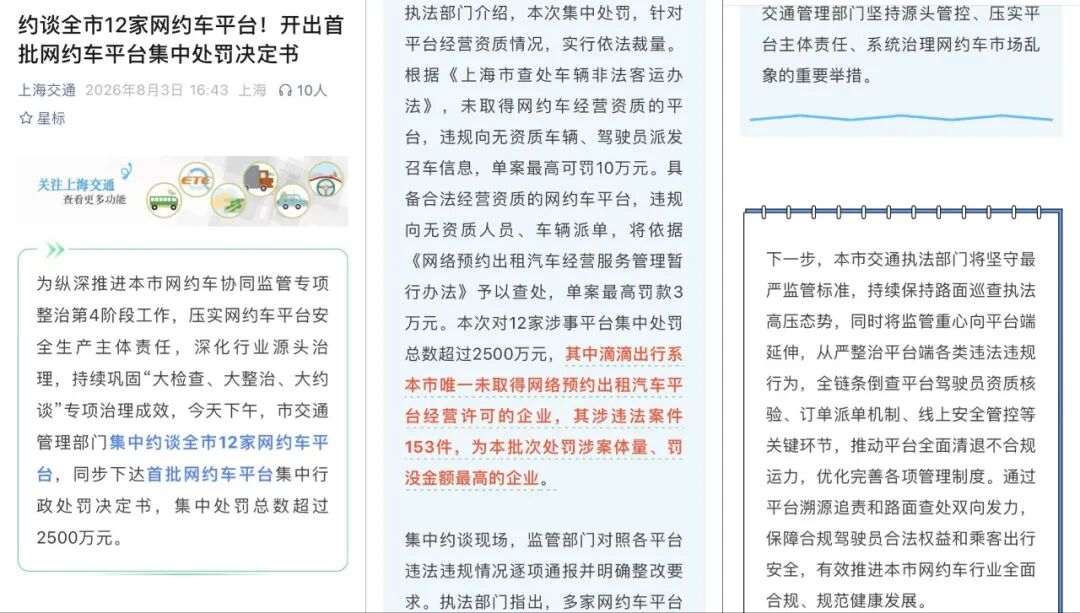
According to the Shanghai Municipal Transportation Commission, on August 3, Shanghai's transportation authorities collectively summoned 12 ride-hailing platforms across the city and simultaneously issued the first batch of centralized administrative penalty decisions to these platforms, with total fines exceeding 25 million yuan.
Among them, Didi Chuxing is the only enterprise in Shanghai that has not obtained an operating permit for online taxi-hailing services. It was involved in 153 illegal cases, making it the enterprise with the highest number of cases and fines in this batch of penalties.
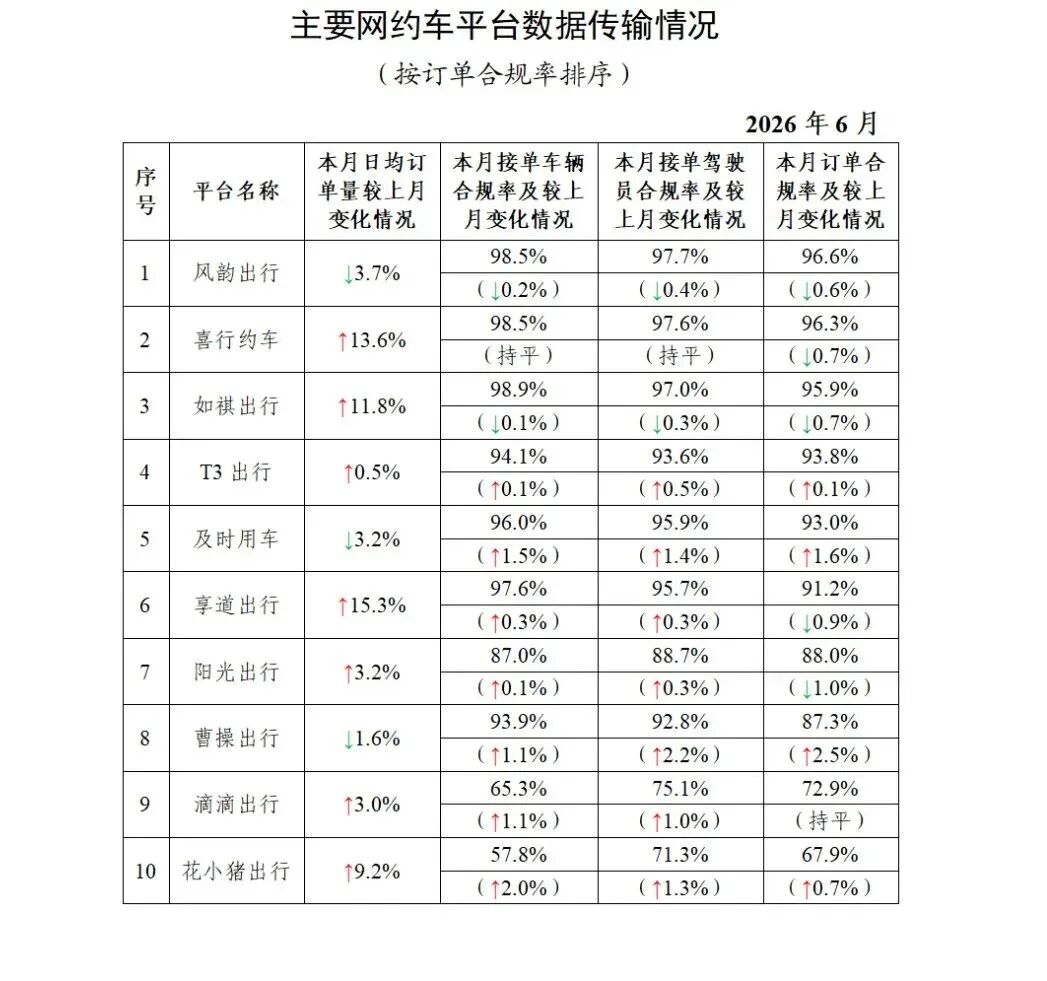
Previously, in the operational data of the ride-hailing industry for June 2026, released by the Ministry of Transport on July 14, Didi ranked 9th in compliance rate among the top 10 platforms in terms of order volume, only higher than Huaxiaozhu. The compliance rate refers to the proportion of orders where both the driver and vehicle are licensed.
According to the Interim Measures for the Administration of Online Taxi-Hailing Operations and Services, legal operation of ride-hailing services requires 'three certificates in order': platform license, driver's license, and vehicle license. However, Didi lacks a platform license, rendering the entire transaction process illegal at its source.

Didi Operates Without a License in Shanghai
According to the Shanghai Municipal Transportation Commission, since July 14 of this year, the city's transportation enforcement team has established a special task force to address ride-hailing platform violations, initiating a comprehensive investigation and prosecution of illegal activities. The first batch of penalty cases is based on illegal passenger transport cases filed between June 1 and June 30, 2026, with completion of penalty payments as a Filter criteria . A total of 479 non-compliant vehicles were identified, involving 12 ride-hailing platforms operating in Shanghai, including Didi, Shandao, Caocao, and T3.
Enforcement authorities stated that this round of centralized penalties targets platform operating qualifications and imposes legal discretion. According to the Shanghai Measures for Investigating and Handling Illegal Vehicle Passenger Transport, platforms without ride-hailing operating qualifications that dispatch orders to unqualified vehicles and drivers face a maximum fine of 100,000 yuan per case. Legally operating ride-hailing platforms that dispatch orders to unqualified personnel or vehicles will be punished under the Interim Measures for the Administration of Online Taxi-Hailing Operations and Services, with a maximum fine of 30,000 yuan per case.
The total fines for the 12 platforms in this batch exceeded 25 million yuan. Among them, Didi Chuxing is the only enterprise in Shanghai without an operating permit for online taxi-hailing services, with 153 illegal cases, making it the enterprise with the highest number of cases and fines in this batch.
During the collective summons, regulatory authorities Notification ed each platform's violations and specified rectification requirements. Enforcement authorities pointed out that multiple ride-hailing platforms have lax driver admission reviews and consistently assign orders to non-compliant drivers and vehicles, seriously infringing upon the legitimate rights and interests of compliant ride-hailing practitioners and posing safety risks to passengers' personal and property security. Last November, Shanghai's multiple departments jointly launched a major crackdown on ride-hailing services and had repeatedly summoned platform enterprises for rectification. However, several platforms continued to assign orders to non-compliant drivers and vehicles.
In simple terms, Didi's operational status in Shanghai is 'the platform itself lacks certification while assigning orders to some unlicensed vehicles and drivers.' This not only exposes Didi to higher legal risks and heavier financial penalties but also challenges fair competition in the industry and passenger safety.
Historically, Didi's temporary pilot qualification in Shanghai expired in 2016, and subsequent formal applications have not been approved. According to media reports, the core issue lies in Shanghai's regulatory requirements for hard indicators such as full-capacity management, data transparency, safety risk control, localized management, and withdrawal of non-compliant capacity, which Didi has failed to meet despite multiple years of rectification and summons. Previously, Didi has been fined the maximum amount multiple times for illegal passenger transport.
A platform operating permit is a localized administrative access qualification. Without it, even if drivers and vehicles hold compliant certificates, the platform's entire operational behavior in Shanghai—including order assignment and service fee collection—is legally considered unauthorized ride-hailing activity. Didi, the nation's largest ride-hailing platform, continues to operate in Shanghai without a formal operating license.
This action is part of Shanghai's transportation authorities' 'source control' and 'full-chain retrospective investigation.' Future regulatory focus will extend further to the platform side, strictly addressing various illegal activities at the platform level. This indicates that holding platform enterprises accountable for their principal responsibilities will be a key regulatory direction in the future.
Certification for Drivers and Vehicles Is No Easy Task
While Didi lacks a local platform operating permit in Shanghai, some drivers and vehicles on its platform hold Shanghai-issued driver and vehicle certificates. These 'fully certified' drivers accept orders in Shanghai through Didi, but the 'platform' assigning the orders lacks certification, creating a 'semi-compliant' status: the vehicles and drivers may be compliant, but the platform's lack of certification undermines the legal integrity of the entire transaction.
Didi should be one of the platforms most aware of its drivers' and vehicles' backgrounds. Information on whether drivers have professional qualifications, whether vehicles have transport permits, registration cities, and eligible operating areas is all stored in its system.
From a technical perspective, maintaining order compliance is not difficult—simply do not assign orders to drivers or vehicles lacking full certification, a task achievable with a single platform toggle. However, this represents a complex business reality.
Didi appears as a unified national mobility network: passengers in Beijing, Shanghai, Shenzhen, or Chengdu use the same app; drivers operate under the same order system, and orders are allocated by the same platform rules.
However, ride-hailing regulations are not uniformly applied nationwide. At the national level, the Interim Measures for the Administration of Online Taxi-Hailing Operations and Services only establish a basic framework for certification. Platforms must obtain permits based on their operating regions, vehicles must obtain Network Pre-booked Taxi Transport Permits, and drivers must obtain Network Pre-booked Taxi Driver Certificates.
Specific requirements such as vehicle axle base, energy type, age, license plates, and driver household registration or residency permits may be separately stipulated by local authorities. Platforms operating in different cities must meet local licensing conditions.
This means Didi faces not a single national compliance standard but hundreds of city-specific versions.
For example, under Shenzhen's current regulations, vehicles applying for ride-hailing transport permits must be registered in Shenzhen, have been registered for no more than two years at the time of application, and be pure electric vehicles with an axle base exceeding 2,650 millimeters. When individual vehicle owners apply for transport permits, they must first obtain driver certificates and commit to personally driving the vehicle.
However, these thresholds vary by city. These differences are reflected in compliance data. In June 2026, among the 36 central cities Statistics ed by the Ministry of Transport, Shenzhen ranked first in order compliance, while Beijing ranked last. Twenty-five cities had order compliance rates exceeding 80%.
This suggests that the same platform and technology may yield vastly different compliance results across cities. While Didi's scale advantage is national, compliant capacity is produced city by city.
For instance, Beijing cannot temporarily supplement compliant vehicles from Tianjin, nor can Shanghai borrow a fleet from Suzhou during sudden rainstorms and return them afterward. Ride-hailing platforms are not e-commerce warehouses; drivers and vehicles cannot be 'shipped' across cities.
Thus, improving Didi's national compliance rate fundamentally requires transforming hundreds of local transport capacity markets, not just modifying a single platform rule.
The Difficulty of Absorbing Compliance Costs
From a regulatory perspective, ride-hailing compliance is clear: platforms need permits, vehicles need transport permits, drivers need professional certificates, and orders must match licensed drivers and vehicles.
From drivers' perspective, obtaining 'dual certificates' involves more than passing an exam and submitting materials. After registering a vehicle as a pre-booked taxi, it must be operated under commercial vehicle rules. Current regulations mandate mandatory scrapping when a ride-hailing vehicle reaches 600,000 kilometers; if it has not reached 600,000 kilometers but has been in use for eight years, it must exit ride-hailing operations.
This means drivers must consider how long a vehicle can remain operational and whether order revenues can cover commercial insurance, vehicle depreciation, and exit costs.
However, the current ride-hailing market offers increasingly narrow profit margins for drivers.
As of April 2026, Shenzhen had approximately 142,000 compliant ride-hailing vehicles and 395,000 licensed drivers. With a permanent population of about 18 million, this averages one ride-hailing driver for every 46 people. The vehicle-to-driver ratio reached 1:2.8, meaning 2.8 drivers compete for orders from a single vehicle.
Nationwide, the number of licensed drivers surged from approximately 2.89 million in 2020 to 7.48 million by late October 2024. Multiple transportation authorities have issued industry saturation warnings, indicating that ride-hailing capacity growth outpaces order growth, reducing orders per vehicle.
This directly affects drivers' willingness to obtain certificates. For full-time drivers with steady order volumes, fixed costs from vehicle commercialization can be offset by high order volumes. However, for part-time drivers operating only during peak hours, weekends, or holidays, the same fixed costs must be covered by fewer orders. With Bicycle order and revenues already under pressure, converting a family vehicle into a commercial vehicle becomes a harder investment decision.
Stating these facts does not justify unlicensed operations but explains part of the reason for low platform compliance rates.
What Comes After Platform Identification?
Despite capacity saturation, ride-hailing demand is not constant. Scenarios like weekday rush hours, severe weather, holiday returns, concert dispersals, and concentrated flight arrivals create surges in orders within short periods.
Suppose a commercial district typically has 1,000 vehicles online, maintaining rough supply-demand balance. A sudden rainstorm could double orders within half an hour. Didi needs more vehicles online immediately, not 500 new drivers recruited next week.
Full-time drivers form Didi's base capacity, while part-time and casual drivers help fill demand gaps.
This flexible supply is valuable to Didi. Drivers need not be online full-time but can work during peaks, rainy days, holidays, or when rewards increase. Didi avoids maintaining an idle fleet while rapidly expanding capacity when needed.
However, the most flexible drivers are often the hardest to professionalize.
As a ride-hailing platform, Didi must simultaneously achieve several interconnected goals: increase the proportion of compliant capacity; prevent prolonged wait times during peaks; avoid significant fare hikes; and ensure driver earnings remain attractive.
If Didi immediately blocks all non-compliant capacity, compliance data would improve. But in cities and during peaks with insufficient compliant vehicles, wait times could lengthen, dynamic pricing could rise, and many drivers might reject low-fare orders.
From a supply-demand perspective, if non-compliant vehicles currently fulfill some orders, their complete withdrawal would require Didi to fill the gap with new compliant vehicles or other dispatch methods.
Didi can certainly identify unlicensed drivers. The real challenge lies in post-identification handling. Closing an account takes seconds, but onboarding a compliant driver willing to work during rush hours requires certification, vehicle reclassification, operational support, and ensuring run earnings cover these costs.
Algorithms can filter supply but cannot create it. This is the core of Didi's compliance dilemma: order compliance rates appear as mere percentages but connect to driver numbers, wait times, passenger fares, and platform transaction volumes.
Who Pays for Compliance?
Didi is not incapable of investing in compliance.
As of late March 2026, Didi held approximately 48.725 billion yuan in cash, cash equivalents, and financial investments. Meanwhile, its China mobility business reported an adjusted EBITA of 3.967 billion yuan in the first quarter. Although the group incurred a quarterly loss of 1.22 billion yuan, Didi is clearly not a small platform without room for investment.
However, the issue extends beyond Didi's financial capacity to how new compliance costs are allocated. If drivers bear the costs, some part-time drivers may exit, challenging platform capacity. If the platform subsidizes certification, insurance, vehicle inspections, and exit losses, its costs rise. If costs pass to passengers, fares increase, reducing price-sensitive demand.
Without voluntary absorption, costs do not disappear but manifest as unlicensed operations, safety risks, insurance disputes, and regulatory pressure, remaining off-platform books.
The platform model's appeal lies in avoiding vehicle ownership and traditional employment of all drivers. Vehicle, energy, depreciation, and many operational costs are borne by drivers or leasing companies, while the platform connects supply and demand, allocates orders, and earns revenue.
This model was once highly profitable, but regulations now explicitly require platforms to assume carrier responsibilities, ensuring legally compliant vehicles and drivers. This creates Didi's most contradictory core: desiring to maintain a light asset cost structure while bearing heavy operational management responsibilities.
Didi need not own vehicles but must verify their certification; it need not directly employ drivers but must check their qualifications; it can use algorithms for order allocation, but the results constitute platform operations. Thus, Didi must change not just admission reviews but also profit distribution.
If compliant drivers bear higher insurance, vehicle, and certification costs while competing with lower-cost non-compliant capacity for the same orders, compliance becomes a competitive disadvantage.
To improve compliance rates, Didi must make compliance economically attractive—e.g., prioritizing order allocation for compliant drivers under similar conditions, offering stable rewards and income guarantees for certified drivers, or supporting some operational costs.
These measures increase platform costs but address the root issue more effectively than repeatedly urging drivers to improve compliance awareness. Drivers understand the legality of certification; they need assurance that higher costs will yield more orders and stable income.
As the platform controlling driver admission, order allocation, fare display, and incentive rules, Didi cannot attribute problems to complex local policies or drivers' reluctance to obtain certificates.
Conclusion
Didi's first half proved technology could help passengers get rides faster. Its second half must answer a harder question: when low prices, efficiency, and compliance cannot all peak, which will it sacrifice first?
The answer does not lie in the rankings of regulatory interviews, penalties, and monthly reports, but in whether Didi is willing to pay a real price for compliance.
Risk Warning: The content of this article is compiled based on publicly available information and does not constitute any investment advice.
-
![]()
Dividend Flow Reversing? XPENG, NIO, and ZEEKR in Tight Race in July! Harmony Intelligent Mobility Sees Monthly Decline
-
![]()
realme hasn’t faltered; it’s merely on a hiatus
-
![]()
Is the Launch Speed of New Cars Faster Than That of Mobile Phones? Why Are Vehicle Development Cycles Shorter in the Era of Intelligent Driving?
-
![]()
Qianwen Office Makes Its Debut! China's AI Titans Alibaba, Tencent, and ByteDance Vie for Supremacy in the Office AI Arena
-
![]()
Xiaomi Shakes Up the Extended-Range Vehicle Market! Li Auto Fights Back with Proprietary Chips, While 'Budget Li Auto' Innovates to Stand Out
-
![]()
Didi's Compliance Paradox: Why Can't the Strongest Platform Manage the 'Three Certificates'?
-
Financing and IPO: Is Ant Group a Financial Giant or a Pioneer in Cutting-Edge Tech?
-
![]()
Revenue Soars Twofold in Three Years! Optical Firm Reignites Bid for Hong Kong Stock Exchange Listing