Qianwen Office Makes Its Debut! China's AI Titans Alibaba, Tencent, and ByteDance Vie for Supremacy in the Office AI Arena
 08/04 2026
 390
390
Striving for Dominance in the Next Generation of Office Solutions.
Recent advancements in AI products have seen them evolve far beyond mere chatbots.
Traditionally, interacting with an AI tool involved posing a question and awaiting a response. The quality of the response was somewhat secondary, as the brunt of actual work still rested with the user. Today, however, these products are no longer content with mere conversation; they're setting their sights on drafting your weekly reports, crafting PPTs, summarizing meeting minutes, and even directly operating your computer to accomplish entire tasks on your behalf.
On August 3, Alibaba unveiled the public beta of its enterprise-level AI agent product, "Qianwen Office," along with its latest flagship model, Qwen3.8-Max.
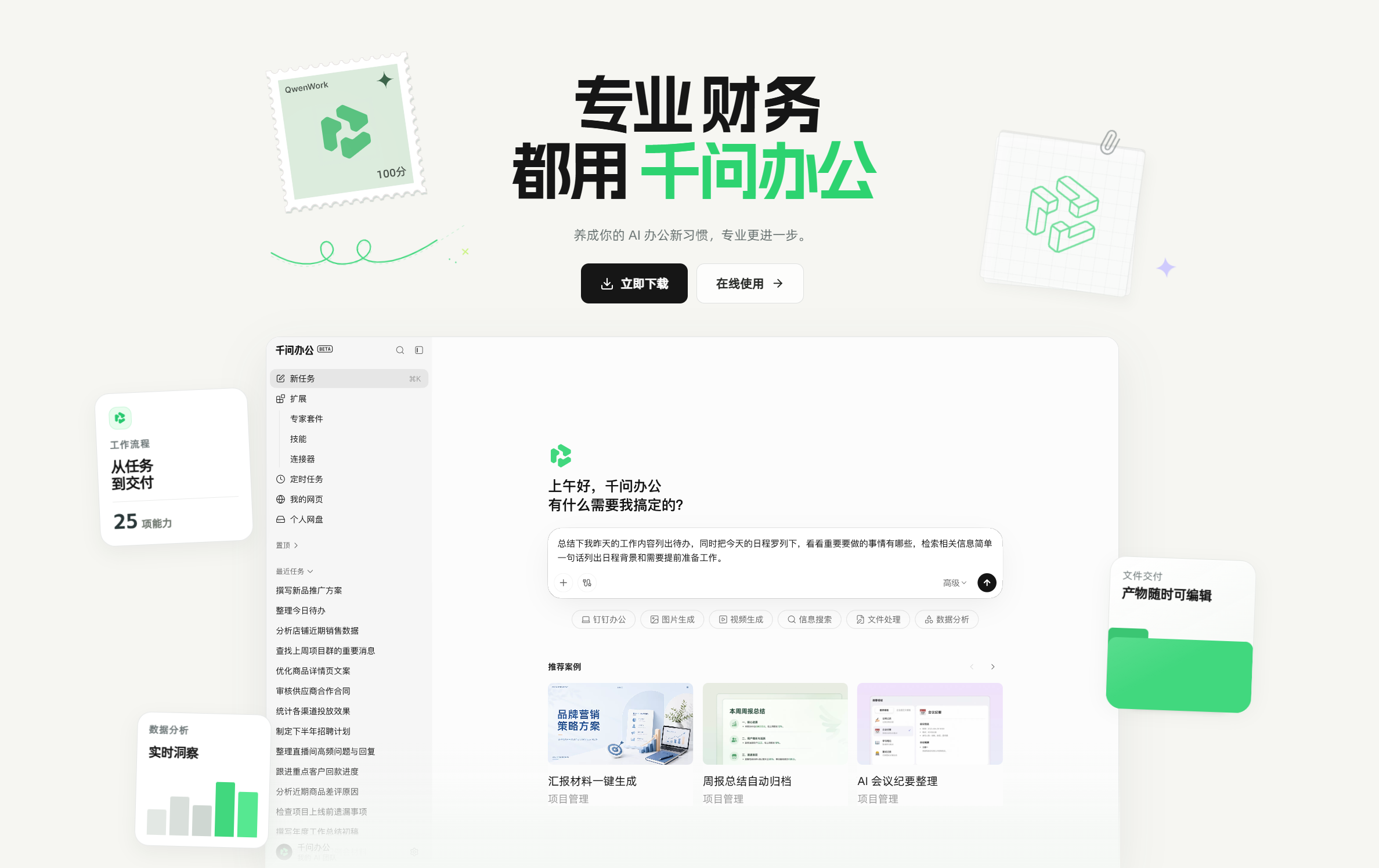
(Image source: Leikeji)
At first glance, Qianwen Office might seem like just another addition to the office software landscape. Yet, a closer look at recent moves by industry leaders reveals a pattern.
Tencent recently reassigned its QClaw business and certain teams to the department overseeing WorkBuddy. ByteDance upgraded TRAE SOLO to TRAE Work, while simultaneously implementing organizational changes across Doubao, Feishu, and Volcano Engine. Alibaba, meanwhile, consolidated its three AI agents—QoderWork, Wukong, and MuleRun—into the unified Qianwen Office platform.
Hmm... It appears that China's top three AI companies have, almost in unison, begun streamlining their products, realigning their teams, and focusing their efforts on the office sector.
It seems that after the intense competition over AI models, the major players have now recognized the office space as the next critical battleground.
In this domestic competition for office AI supremacy, Tencent was an early mover with its product.
Back in March, WorkBuddy launched its public beta. Many may recall seeing promotional ads on WeChat at the time, and some might have even joined during the "lobster craze" to gain free access to the HY3 model. Few, however, would have predicted that it would become the most renowned domestic office AI agent product.
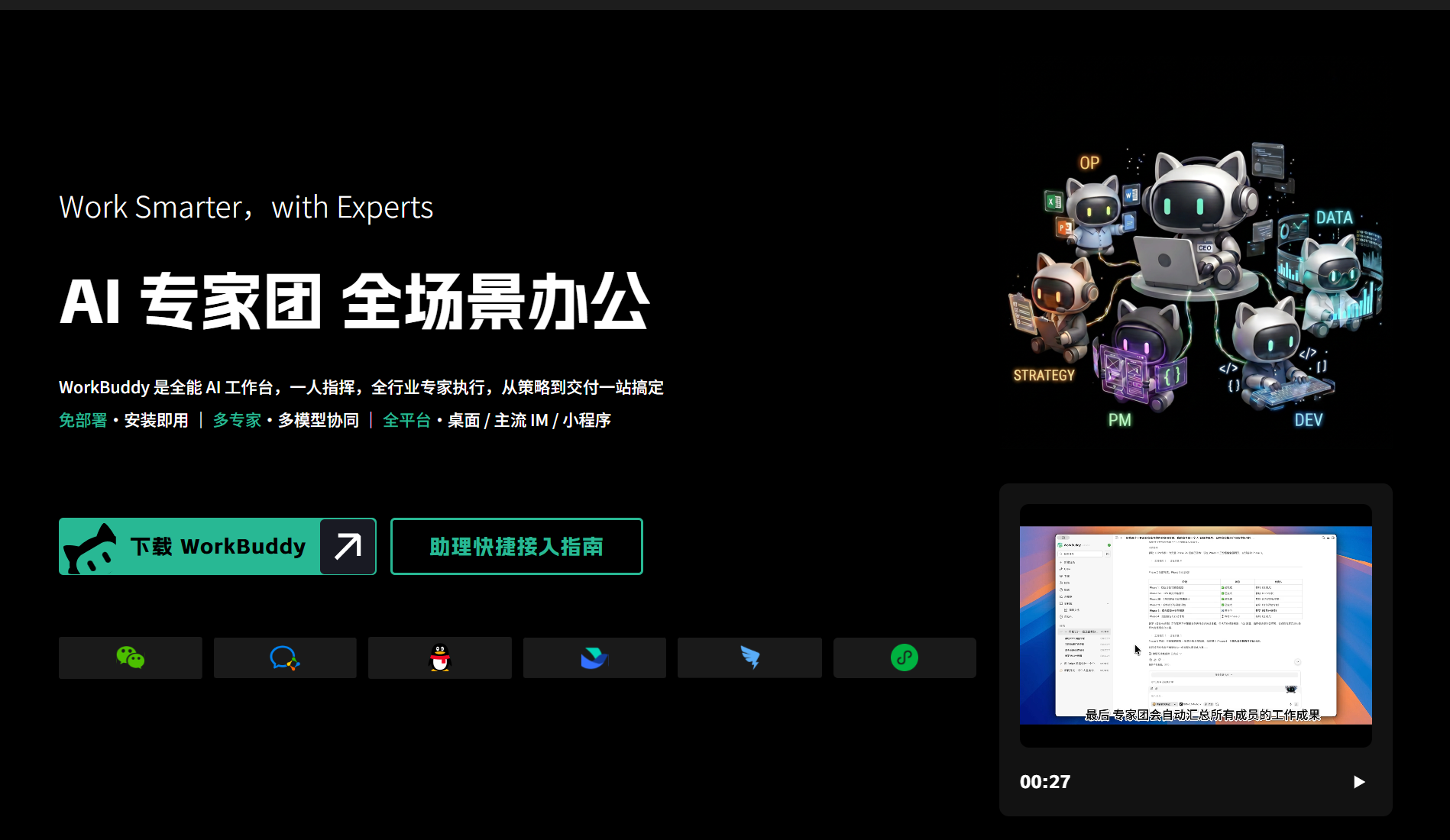
(Image source: WorkBuddy)
Indeed, according to Analysys data, in June this year, Tencent's WorkBuddy achieved 20 million monthly active users (MAU) across all platforms, with daily active users (DAU) surpassing 13 million.
In comparison, TRAE IDE boasts 12.97 million MAU, while Qoderwork has 7.88 million MAU.
This is intriguing. All these AI agent products offer similar selling points, emphasizing functionalities like operating Word and Excel, searching for information, and organizing local files. Even Tencent itself has two other AI agent products, QClaw and Marvis. So, what makes WorkBuddy so popular?
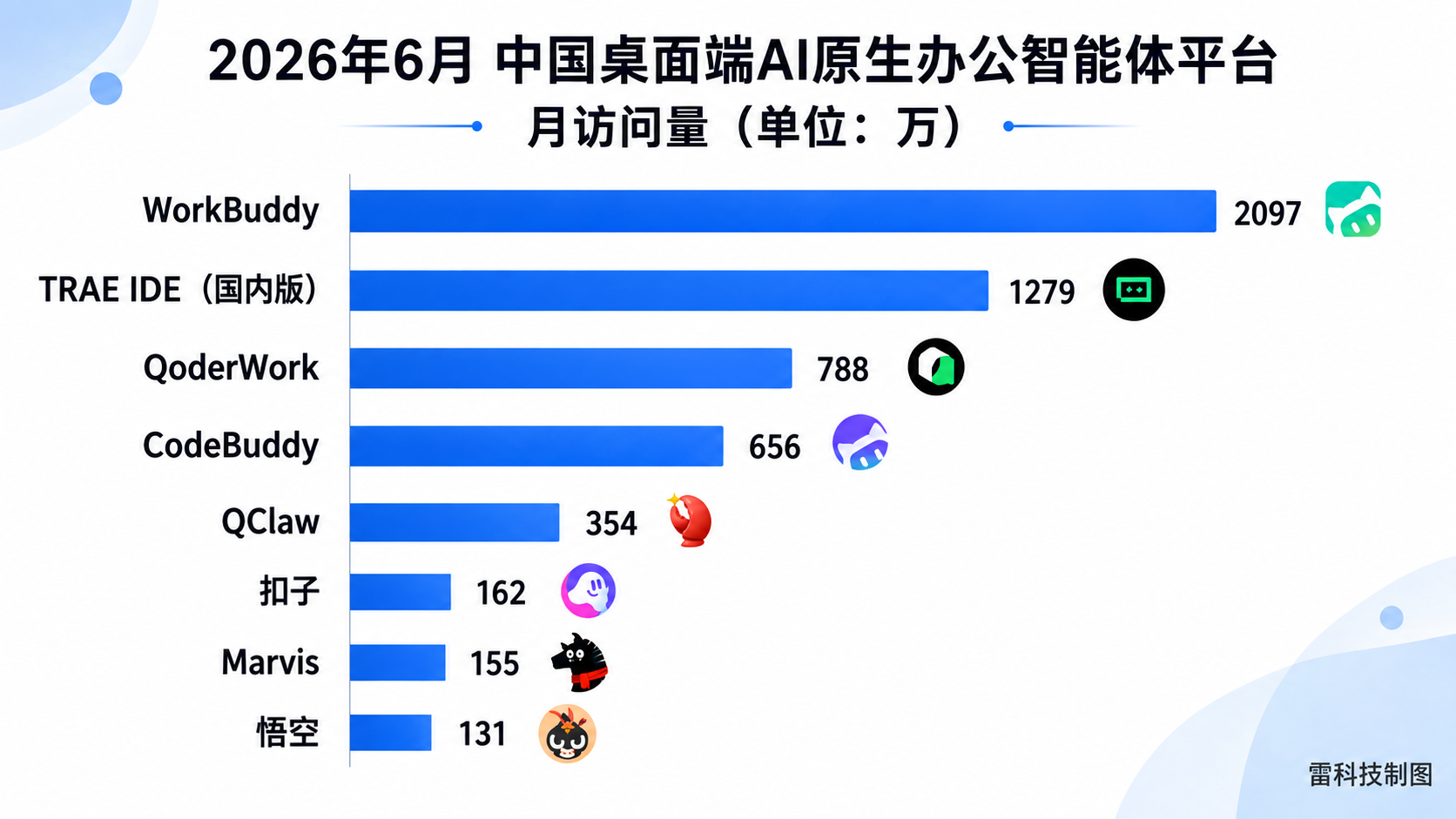
(Image source: Leikeji, Analysys)
On one hand, being first to market and having strong promotional efforts certainly provide an advantage.
WorkBuddy successfully packaged the proven execution capabilities of AI agents into office software that ordinary users could readily download and utilize. It also capitalized on the "lobster craze" popularized by OpenClaw, combined with Tencent Cloud's persistent promotion on WeChat, contributing to its current popularity.
On the other hand, from its inception, WorkBuddy has been tailored specifically for office scenarios.
Huang Guangmin, Tencent Cloud's AI Agent Product Director, stated that WorkBuddy targets "semi-developers" and the broader office workforce. Compared to development scenarios, the pan-office scenarios—encompassing knowledge workers in editing, operations, product management, and marketing—boast a much larger user base and higher usage frequency.
Moreover, in July this year, Tencent merged the QClaw business and certain teams into the department responsible for WorkBuddy.
Although the QClaw product will continue to operate post-integration, it's evident that Tencent will now focus more on WorkBuddy, which is currently performing exceptionally well. This adjustment is seen as a significant signal of Tencent's AI office strategy shifting from multi-line exploration to concentrated investment.
In my view, as Tencent's office AI agent, WorkBuddy's greatest strength lies in its connection to the Tencent ecosystem.
Tencent Cloud provides enterprise services and model capabilities, WeChat Enterprise manages organizational relationships and work communications, Tencent Meeting stores meeting content and minutes, and Tencent Docs contains a wealth of real data. WorkBuddy can leverage this daily context to assist users in organizing content, generating documents, and advancing tasks without starting from scratch.
In fact, Alibaba was not late to the AI agent game compared to Tencent.
Early this year, Alibaba's DingTalk team released the AI agent office unified portal—DingTalk Wukong. Our editors at Leikeji collectively tested it and found the results quite impressive, even hailing it as one of the first domestic office AI agent applications.
Unfortunately, Alibaba's subsequent AI agent products lacked focus and became increasingly fragmented.
First came DingTalk Wukong for enterprise office use, which made perfect sense. Then there was Tongyi Lingma for coding, which spawned a series of products like Qoder Desktop, QoderWork, QoderWake, Qoder CLI, and Cloud Agents. Later, a general-purpose AI agent platform called MuleRun emerged.
While each product seemed impressive in its description, after reading about them, one question lingered: Which one should I actually use?
The good news is, now you don't have to think about it—there's just this one!
(Image source: Qianwen Office)
In July this year, Alibaba decided to launch a new Qianwen Office based on QoderWork, incorporating technical insights from the three aforementioned products, and placed it under the leadership of DingTalk CEO Chen Yusen. Simultaneously, teams for Wukong, MuleRun, and others were reintegrated into the unified Qianwen Office system.
The result is the product now available for free with a click on Qianwen Office.
Qianwen Office currently offers a wide array of capabilities. It can read messages, schedules, meetings, and files from enterprise IM, generate Word, Excel, PPT, and web pages, operate computers, call on professional data sources, and support scheduled tasks and expert kits tailored for different roles.
The official description states that it handles tasks from receipt to final delivery.
It sounds promising, so I decided to test it with one of my most common work tasks—writing a weekly report.
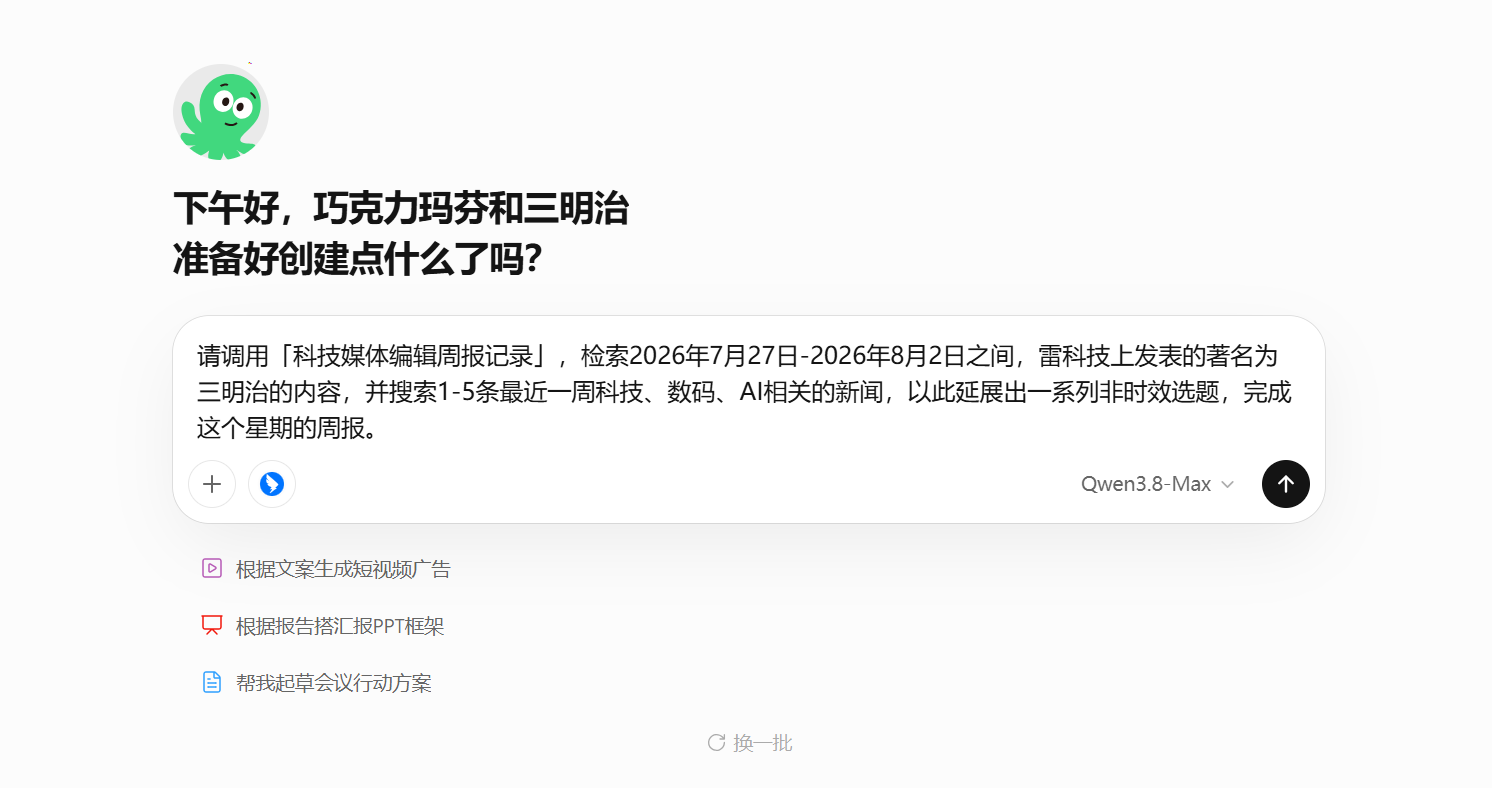
(Image source: Leikeji)
Anyone who has worked in an office understands the tedium of weekly reports.
When preparing a weekly report, I have to review topic lists, meeting minutes, article publication details, confirm completed tasks and pending topics, and even brainstorm upcoming non-time-sensitive topics. It's a real hassle.
If Qianwen Office could automatically collect topics from the official website and brainstorm several qualifying non-time-sensitive topics, it would save a significant amount of time.
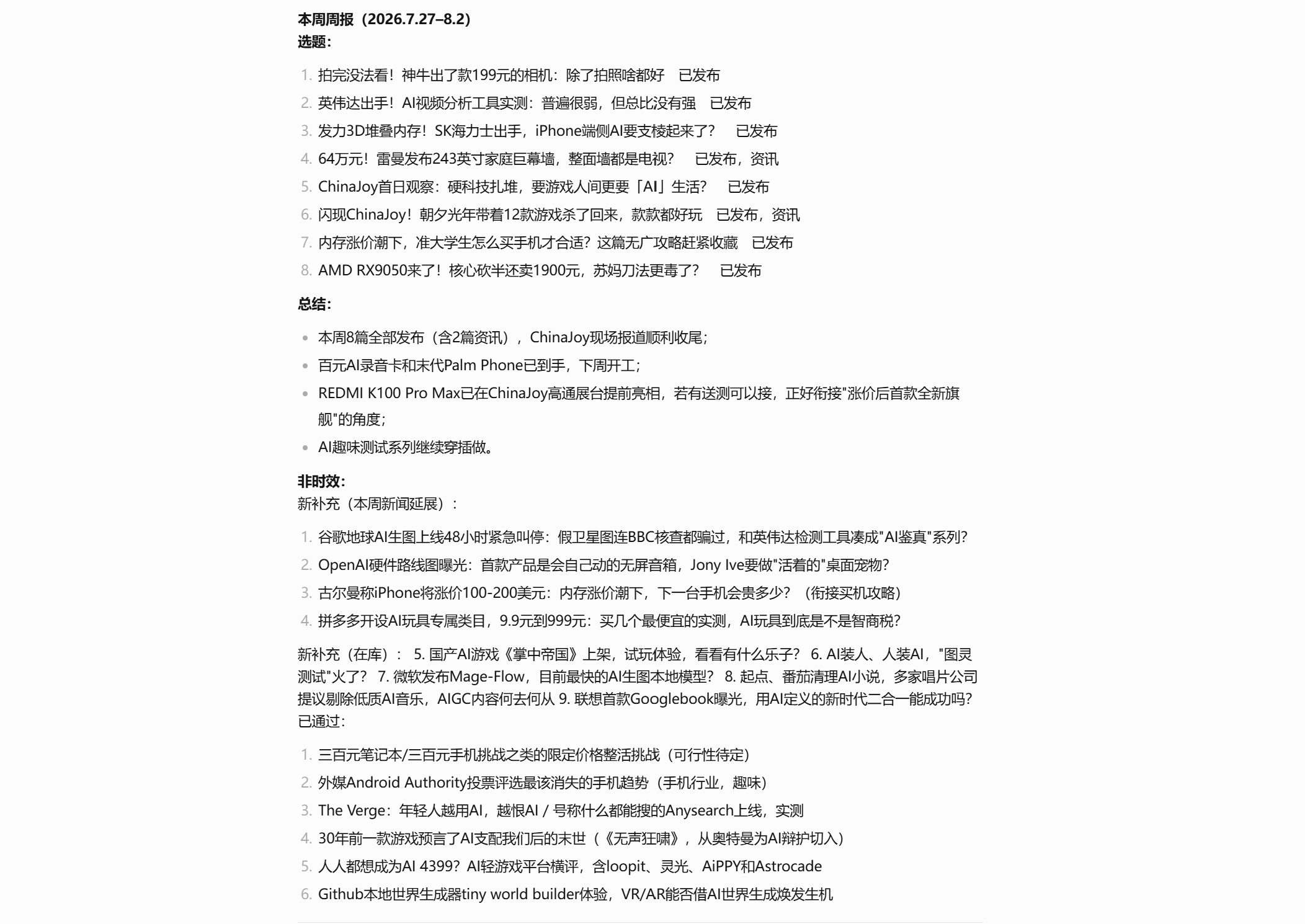
(Image source: Leikeji)
The result?... It took about fifteen minutes.
I must say, the final weekly report met my requirements perfectly. The summary was well-written, and it even generated four qualifying non-time-sensitive topics, sparing me the trouble of scouring external websites.
With something this useful, I naturally set it as a weekly scheduled task, so I don't have to worry about it every weekend.

(Image source: Leikeji)
Hmm... Let's try a different approach. How about having it create a PPT?
Nowadays, many AI tools that create PPTs don't struggle with ugly layouts—they can arrange content, find images, and automatically generate charts. Visually, they're often more polished than what many office workers create themselves. However, their final products often lack flexibility for later adjustments, and the images and text still have a strong template feel.
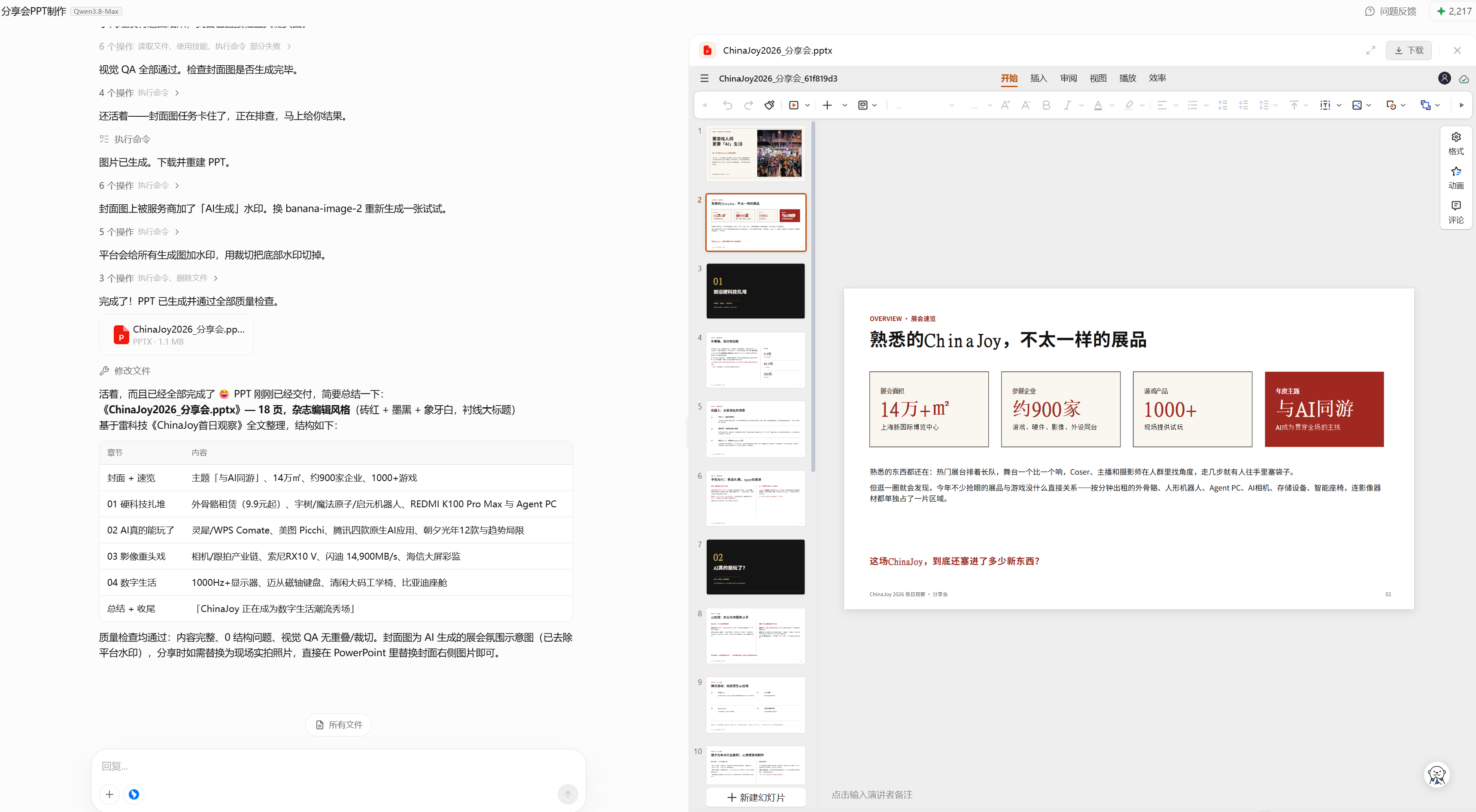
(Image source: Leikeji)
The result was quite satisfactory. It not only called on a text-to-image model to supplement the cover and content images but even provided an editable document for further optimization.
It might be because Qianwen Office just launched and many people are using it, but this task took us at least 45 minutes. I might retest it during off-peak hours later.
Of course, the key player here is DingTalk.
Currently, Qianwen Office has launched on the DingTalk connector, and built-in access points will soon be available on DingTalk's PC and mobile clients. This gives Qianwen Office the opportunity to understand more context and even utilize the information and data repositories genuinely produced by enterprises daily, ultimately achieving complete delivery of work products.
Undoubtedly, Qianwen Office will be Alibaba's core product in the AI office space. Alibaba believes that the combination of Qianwen Office and Qwen3.8-Max will enable its office AI agent to integrate seamlessly into more enterprises' workflows.
Compared to Tencent and Alibaba, ByteDance embarked on the general-purpose office AI agent path slightly later.
However, to say it hastily assembled a team after seeing competitors' success would be inaccurate. In fact, ByteDance had notable AI agent products even before the "lobster craze."
Strictly speaking, TRAE SOLO should be recognized as the earliest AI agent product within the domestic industry. It targeted development tools like Cursor and Claude Code, focusing on reshaping developers' workflows and offering disruptive experiences from code completion to AI agent-assisted tasks.

(Image source: Leikeji)
Believe it or not, while coding might seem far removed from general office work, the problems it needs to solve are quite similar: understanding complex tasks, reading large volumes of files, breaking work into steps, calling on different tools, and delivering final results.
TRAE has already honed these capabilities with programmers.
Unfortunately, it wasn't until June this year that ByteDance upgraded the SOLO mode to TRAE Work, expanding its focus to more general work scenarios like operations and marketing, including data organization, project advancement, and web operations. It can also connect to Feishu to read documents, spreadsheets, and meeting transcripts.
In short, TRAE Work has all the capabilities you'd expect from an office AI agent, and we at Leikeji are currently testing it—so stay tuned!
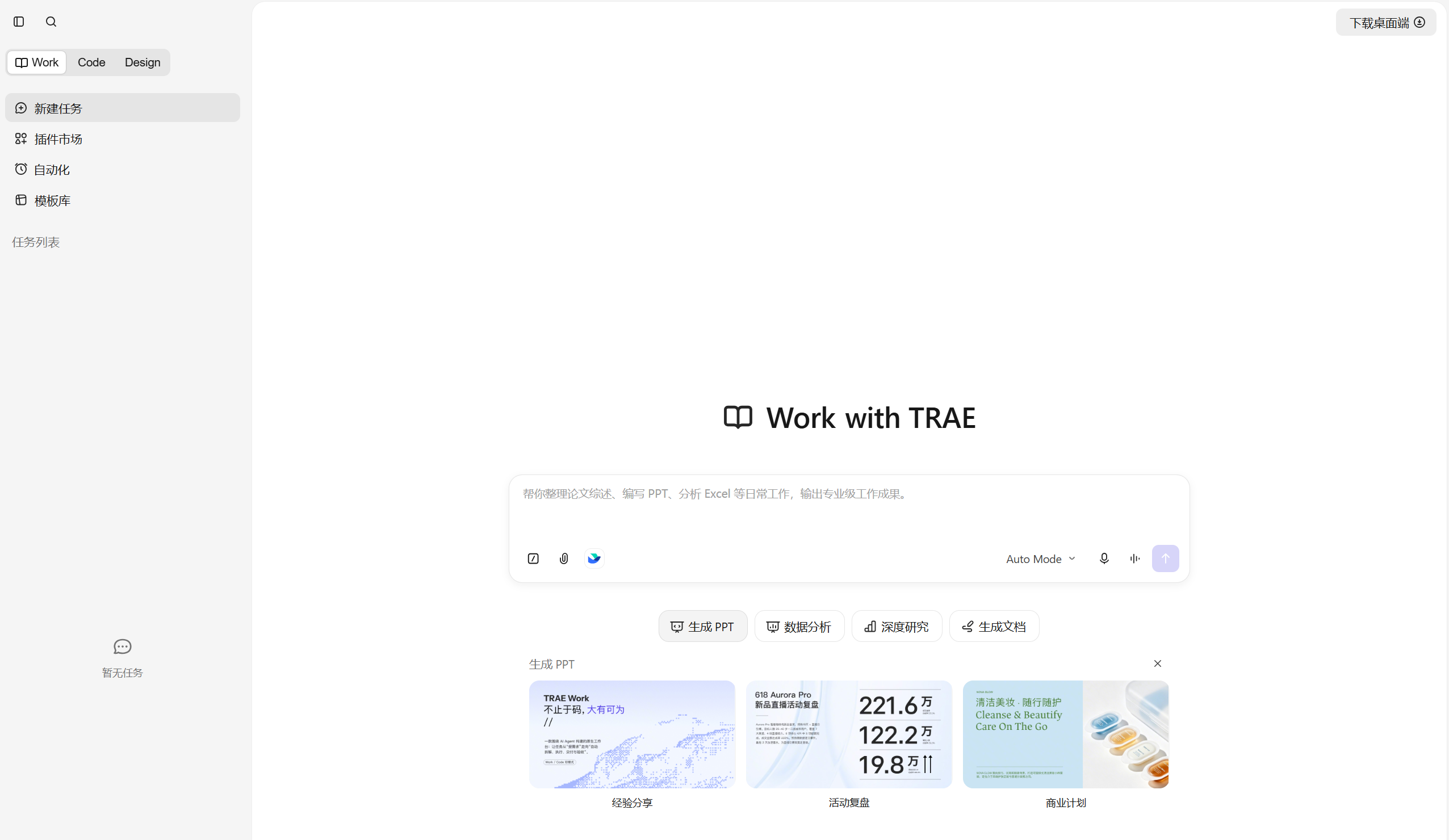
(Image source: Leikeji)
At the same time, ByteDance also launched Doubao Pro.
It can continue tasks across computers, mobile devices, browsers, and Feishu, calling on the Seed model to create documents, spreadsheets, images, and videos. It can also operate browsers and computers within authorized limits, with finished work directly sent back to Feishu for team editing.
This raises a question.
TRAE Work is developing as an office AI agent, Doubao Pro is also developing as an office AI agent, and Feishu itself has Aily and various AI functions. Users might wonder: With so many entry points, how do I know which one to use?
Fortunately, they've already considered this. On July 30, ByteDance sent an internal memo: The Feishu product team and Doubao product team will merge to form a new Doubao product team, led by Doubao head Zhao Qi, with Feishu head Xie Xin reporting to Zhao Qi.
Nowadays, Doubao enjoys high public recognition, while Feishu has accumulated enterprise knowledge, permissions, and collaboration processes. It's expected that Doubao Pro will deeply integrate with Feishu, forming a direct competition with WorkBuddy (integrated with WeChat Enterprise) and Qianwen Office (integrated with DingTalk).
As for TRAE Work, it has already developed relatively mature AI agent execution capabilities. With ByteDance's overall traffic, AI technology, and ecosystem advantages, it has a strong chance of replicating the success story of "the next Doubao."
When you put these products together, the outline of China's "top three" domestic office AI agents becomes clear.
Tencent's WorkBuddy, Alibaba's Qianwen Office, and ByteDance's TRAE Work and Doubao Pro—all three companies are drawing inspiration from Anthropic and OpenAI to develop local AI agents while actively integrating into the familiar office, communication, and file environments of domestic users through advantages tailored to local workflows.
Interestingly, Tencent, Alibaba, and ByteDance are all adjusting their organizational structures, teams, and products while actively integrating cloud-side models and AI agent teams with office-side entry points, data, and client systems. The reasons for this are straightforward:
First, office AI agent applications need to bridge models, data, permissions, and software to complete tasks. If the organization itself isn't integrated, the product certainly won't be.
Second, cloud-side teams can boost model and computing consumption through AI agents, while office-side teams can enhance seat prices and client stickiness through AI. The sales team can even package office suites, AI agents, and private deployments together for enterprises, like WorkBuddy Enterprise, which combines unified subscriptions, member usage, enterprise models, and private deployments into a single product.
In fact, OpenAI is also pursuing a similar strategy.
(Image source: Leikeji)
Just last month, OpenAI adjusted its product organization by integrating ChatGPT and Codex into a unified AI agent experience. The goal is to bring the execution capabilities already demonstrated by Codex to a broader range of individual and enterprise users. This approach shares similarities with those taken by domestic companies.
In my view, the primary reason for the initial popularity of Coding Agent lies in its easily verifiable effectiveness. Whether the code runs successfully can be readily assessed through testing, and programmers are inclined to pay for improved efficiency.
However, programmers represent just a subset of the broader office workforce. A larger number of individuals engage with documents, spreadsheets, meetings, emails, and various other processes on a daily basis. As long as office agents can consistently manage a portion of these tasks, the market they serve will be vastly larger than that of any single programming tool.
The entity that can more effectively integrate corporate data and workflows, and deliver results in a more efficient and timely manner, will stand a chance to dominate the gateway to the next generation of productivity tools.
This competition is only just getting started.
The most AI-focused and cutting-edge ChinaJoy in history has just wrapped up.
This year's exhibition was themed "Exploring with AI." Leikeji MCN, a company dedicated to AI hard technology, dispatched a specialized CJ exploration team to Shanghai for the first time, with results that surpassed expectations. By 2027, Leikeji plans to increase its investment in ChinaJoy.
In the meantime, Leikeji's WRC (World Robot Conference) 2026 exploration team has been formed, and preparations are underway for the largest and highest-caliber IFA 2026 reporting team in history. Stay tuned for more updates!
Qianwen Office, Tencent Workbuddy, Byte TRAE
Source: Leikeji
The images featured in this article are sourced from 123RF's licensed image library. Source: Leikeji
-
![]()
China Allocates 200 Billion Yuan in Subsidies to Bolster Car Purchases, Yet Auto Market Sees 20% Decline in First Half-Year
-
![]()
Old Cars’ Residual Value Plummets: What Are My Options for Upgrading?
-
![]()
Why Do ZQ-3 and LM-12A Continue to Compete After LM-10B’s Pioneering Success?
-
![]()
Dividend Flow Reversing? XPENG, NIO, and ZEEKR in Tight Race in July! Harmony Intelligent Mobility Sees Monthly Decline
-
![]()
realme hasn’t faltered; it’s merely on a hiatus
-
![]()
Is the Launch Speed of New Cars Faster Than That of Mobile Phones? Why Are Vehicle Development Cycles Shorter in the Era of Intelligent Driving?
-
![]()
Qianwen Office Makes Its Debut! China's AI Titans Alibaba, Tencent, and ByteDance Vie for Supremacy in the Office AI Arena
-
![]()
Xiaomi Shakes Up the Extended-Range Vehicle Market! Li Auto Fights Back with Proprietary Chips, While 'Budget Li Auto' Innovates to Stand Out