Ctrip Loosens Its Grip on Hotels, While Fliggy Remains Trapped Within Taobao
 08/06 2026
 509
509
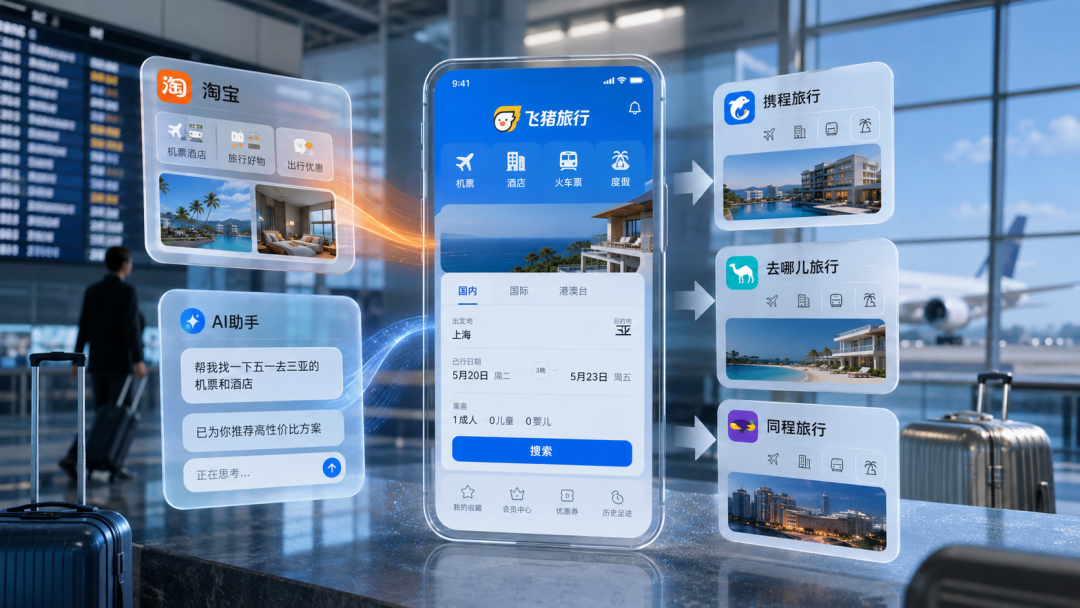
Reduced to a Back-End of Alibaba's AI Strategy, Does Fliggy Still Have a Future?
Author|Xinjian
Editor|Xiaobai
Illustrations|AI Generated
Produced by|QiangdiaoNext
In QuestMobile's latest report, Fliggy secured a not-so-flattering "first place."
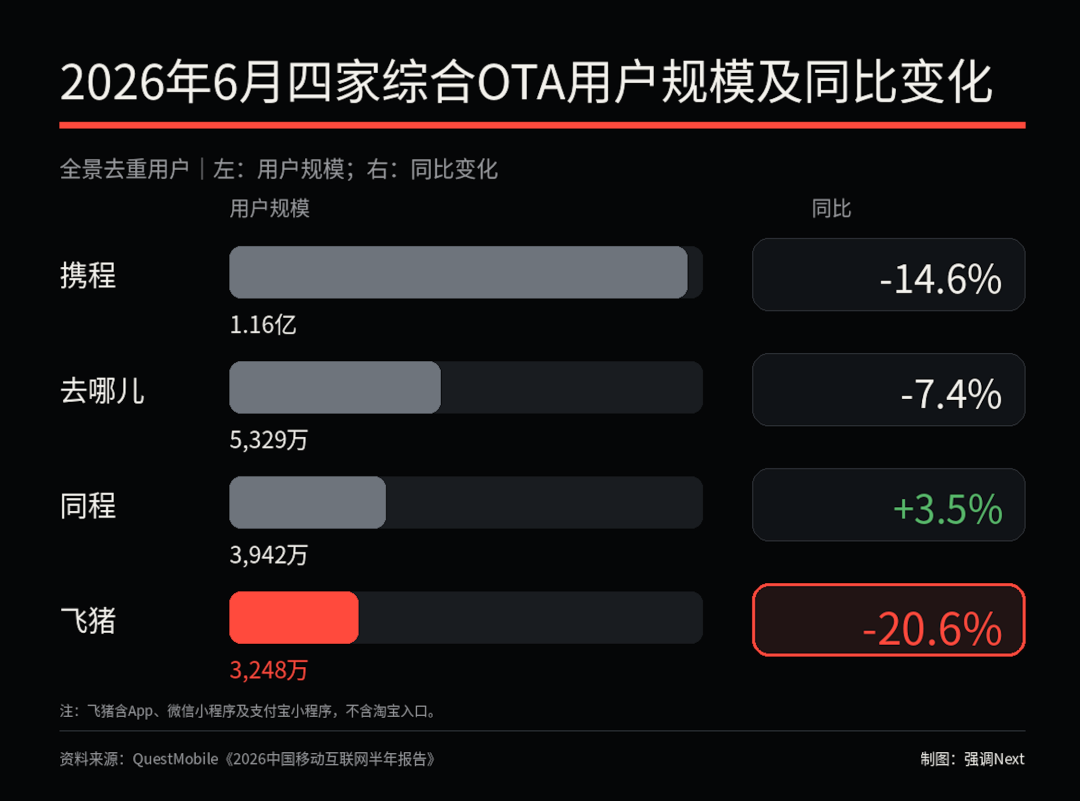
In June 2026, Fliggy's panoramic deduplicated user base stood at 32.48 million, a year-on-year decrease of 20.6%, marking the largest drop among the four comprehensive travel platforms: Tongcheng, Ctrip, Qunar, and Fliggy.
During the same period, Ctrip's user base was 116 million, down 14.6% year-on-year. Qunar's was 53.29 million, a 7.4% decrease. Tongcheng's user base was 39.42 million, up 3.5% year-on-year. While Ctrip is indeed losing users, Fliggy is losing them faster.
On July 25, the State Administration for Market Regulation imposed a fine of RMB 5.179 billion on Ctrip, targeting exclusive partnerships and the "lowest price guarantee" across platforms. This fine dismantled Ctrip's tools for restricting hotels from operating across platforms but did not redistribute travel demand.
A year earlier, Fliggy had already begun searching for new portals. In June 2025, Fliggy was integrated into Alibaba's China e-commerce business group, with CEO Zhuang Zhuoran reporting to Jiang Fan. Taobao subsequently added Fliggy portals and gradually connected Taobao's premium membership with Fliggy's membership.
By 2026, Qianwen had also integrated Fliggy's flight and hotel transaction capabilities. Continuous organizational and product adjustments all pointed to the same strategy: Fliggy would no longer rely solely on its standalone app to compete with Ctrip for users. Instead, it would leverage Taobao and AI portals to convert consumer demand within the Alibaba Group into travel orders.
However, having traffic within the group does not mean Fliggy already has customers.
01. Fliggy is Losing Not Just MAU, but Travel Mindshare
The gap between Fliggy and Ctrip goes beyond user base size.
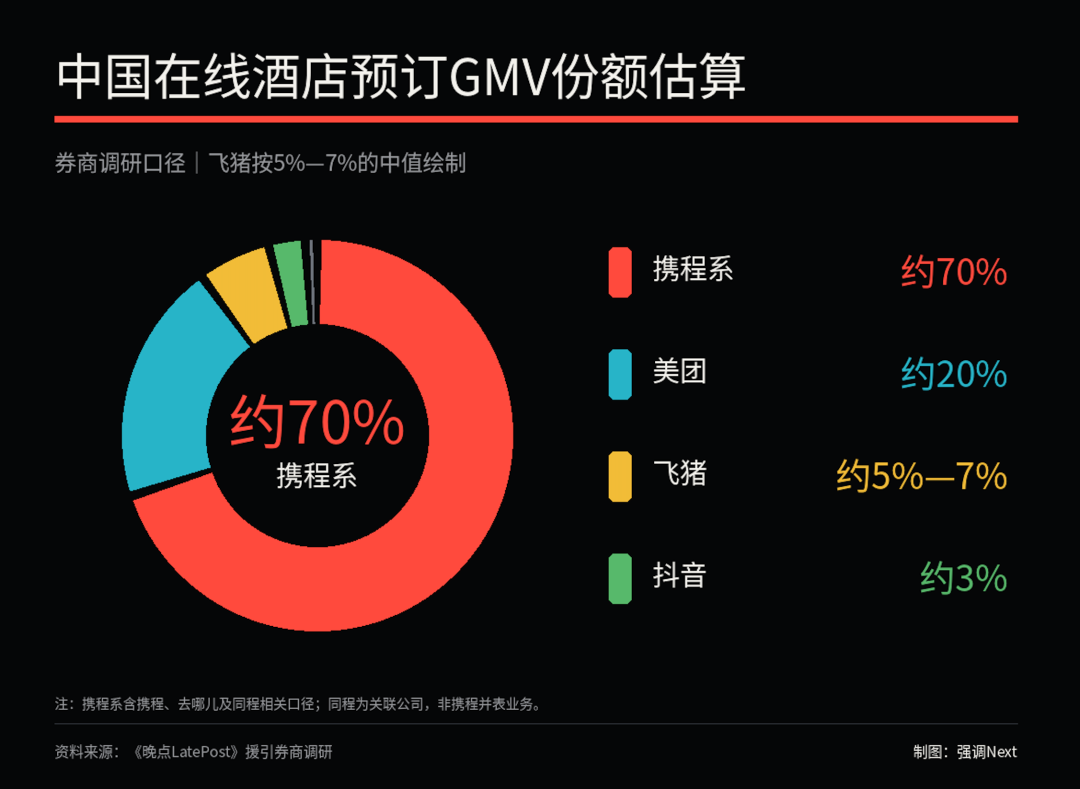
According to LatePost, citing brokerage research, Ctrip, along with Qunar and Tongcheng, accounts for approximately 70% of China's online hotel reservation market GMV. Meituan holds about 20%, Fliggy about 5% to 7%, and Douyin about 3%. This data underscores Ctrip's influence over online hotel demand.
More importantly, Ctrip dominates the more profitable price segments. Research shows that in the first half of 2025, Meituan led only in room sales under RMB 200; Ctrip led in all price segments above RMB 200. For luxury hotels priced over RMB 1,000, Ctrip's sales volume was nearly five times the combined total of Meituan, Fliggy, and Douyin.
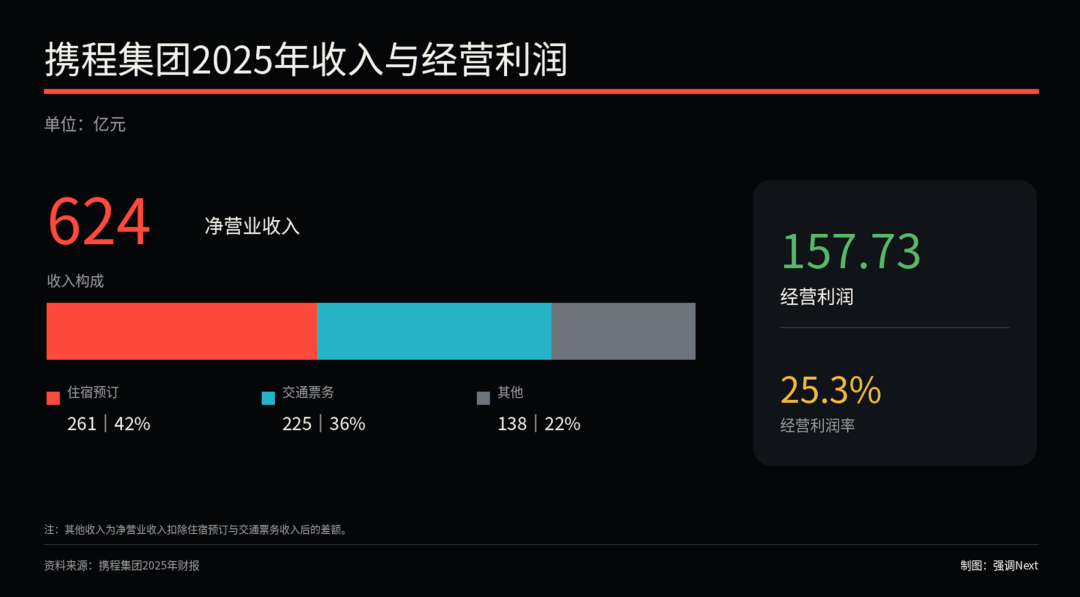
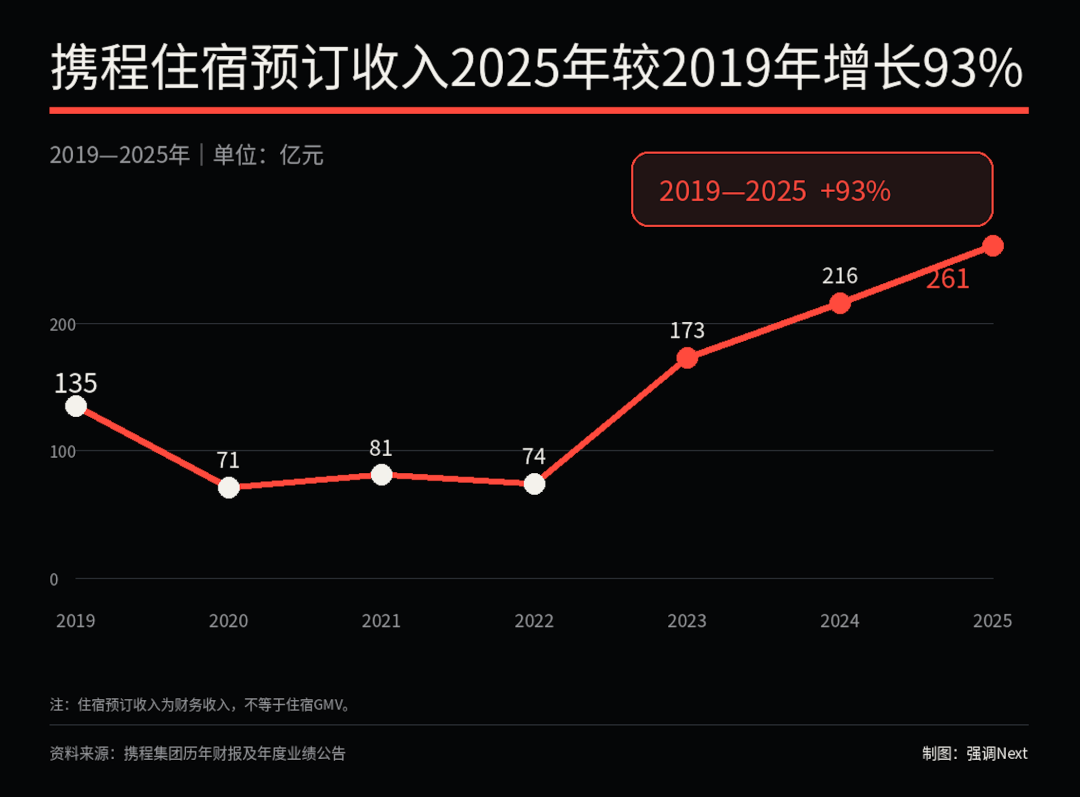
Ctrip's net revenue in 2025 was RMB 62.4 billion, with accommodation reservation revenue at RMB 26.1 billion, accounting for 42%. Transportation ticketing revenue was RMB 22.5 billion, making up 36%. Annual operating profit was RMB 15.773 billion, with an operating profit margin of approximately 25.3%.
While ticketing has a lower direct monetization rate than hotels, it consistently generates clear travel demand. Industry data compiled by BOC International shows that online transportation commission rates typically range from 1% to 2%, while online accommodation rates are around 10%. Train tickets themselves do not incur commissions. Ctrip uses low-margin ticketing to maintain its portal and then directs users to more profitable hotels.
This cycle is difficult to replicate by simply increasing the number of hotels. Budget rooms can be boosted through subsidies, but mid-to-high-end hotels require business travelers, membership systems, after-sales capabilities, and stable cross-city demand. A platform's bargaining power ultimately depends on its ability to consistently sell more expensive rooms.
02. Taobao and AI Provide New Portals for Fliggy
After Fliggy's standalone portal contracted, Taobao stepped in to create transactions.
Fliggy disclosed that during the 2025 National Day and Mid-Autumn Festival holiday, its fulfilled GMV increased by 48% year-on-year, with global hotel room nights growing by 78%. Among these, travel service orders booked through Taobao increased by 74%, and hotel orders brought by 88VIP users grew by 120%.
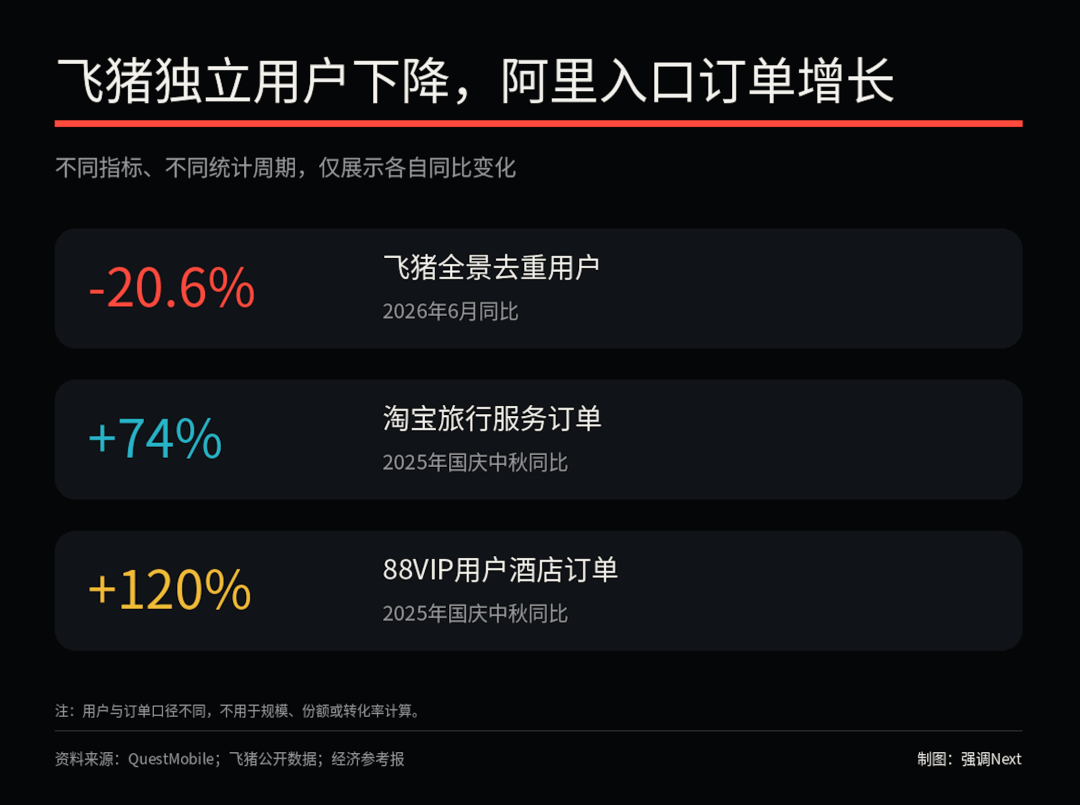
This data does not contradict Fliggy's declining user base. QuestMobile's statistics for the Fliggy app, WeChat mini-program, and Alipay mini-program do not account for internal Taobao portals. Alibaba is not driving more users to the Fliggy app but is instead keeping travel transactions directly on Taobao. This reduces Fliggy's customer acquisition costs but has yet to prove that Taobao can stably handle last-minute bookings, weekday business travel, cross-city rescheduling, and overseas fulfillment. Selling packages during promotions and operating as an OTA daily remain two different businesses.
Zhuang Zhuoran, returning to Jiang Fan's business system, must first continue this group synergy strategy. Both have previously participated in product transformations during Taobao's mobile transition phase. A decade later, with portals changing again, consumers may no longer open OTAs to search item by item but instead let AI directly complete planning, price comparison, and booking.
Alibaba has already pushed this vision into the transaction phase. In January 2026, the Qianwen app integrated Taobao, Taobao Deals, Gaode, Fliggy, and Alipay. By the end of February, Qianwen's consumer-facing applications had over 300 million monthly active users, with nearly 140 million users experiencing AI-powered shopping for the first time through smart agent functions, covering ticketing and travel reservations.
What Fliggy provides is something AI cannot generate on its own: real-time pricing, available inventory, cancellation policies, and after-sales fulfillment.
In April 2025, Fliggy launched the multi-agent product "Wen Yi Wen" and later transformed its search and booking capabilities for flights, hotels, tickets, and vacation packages into FlyAI, which is open for external smart agents to use.
This has added new demand portals for Fliggy and altered its role within the group. Users can propose demands on Qianwen, have Gaode plan routes, and pay via Alipay, with Fliggy completing transactions in the backend. It no longer needs to pull every user back to its own app but must secure default invocation, order attribution, and revenue distribution within the group. Otherwise, AI growth will benefit Qianwen and Taobao, while Fliggy will only gain more backend work.
Therefore, Zhuang Zhuoran's challenge is not to create another AI travel assistant but to convert group traffic into a sustainable hotel and travel business: whether non-promotional orders can be repurchased, whether AI portals can drive transactions for hotels priced above RMB 200, especially mid-to-high-end ones, and whether Fliggy can negotiate differentiated pricing and benefits from hotels accordingly. AI can shorten the path from planning to booking but cannot establish supply and fulfillment advantages for Fliggy.
03. Fines Open Up Supply, but Orders Must Still Be Competed For
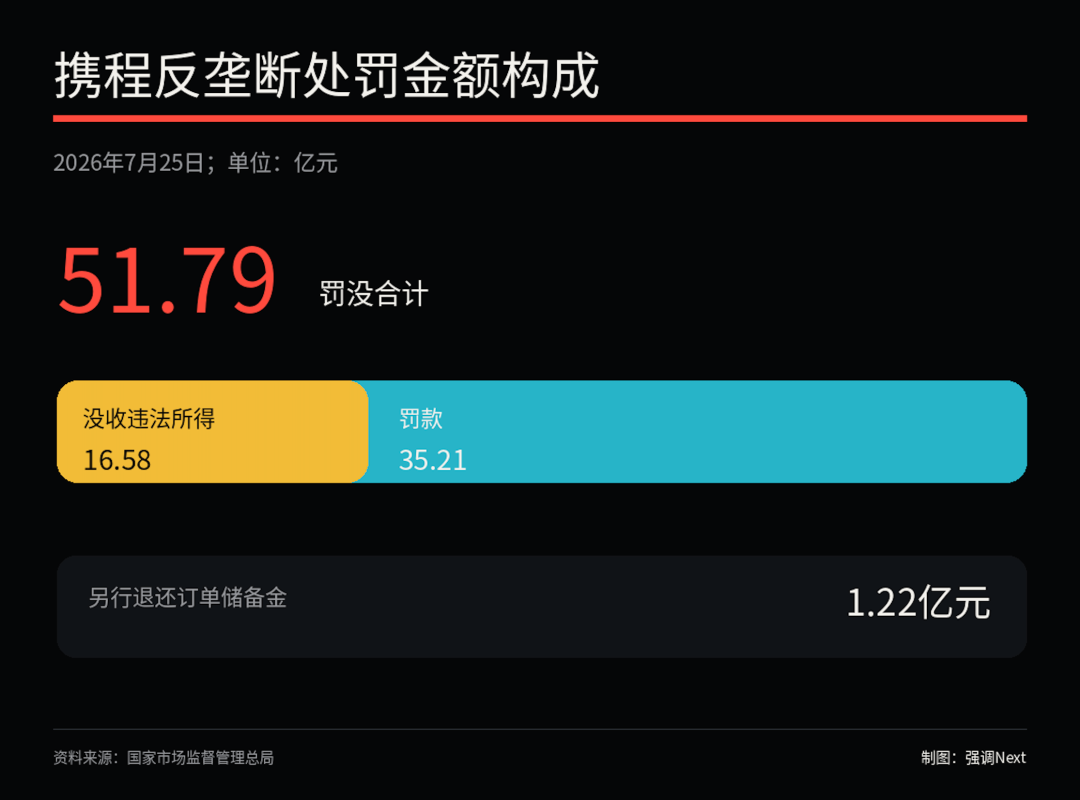
The State Administration for Market Regulation determined that since 2020, Ctrip had used traffic allocation, platform rules, and technical tools to require exclusive partnerships with some hotels and forced hotels operating across platforms to maintain the "lowest price guarantee" on Ctrip. The regulator confiscated illegal gains of RMB 1.658 billion, imposed a fine of RMB 3.521 billion, and required the return of RMB 122 million in order reserves. Ctrip stated it accepted the penalty and would implement rectifications.
After the penalty, hotels can offer differentiated pricing, room types, and membership benefits on Fliggy, Meituan, or Douyin. Inventory that Fliggy could not secure due to the "lowest price guarantee" is now available for renegotiation. However, while hotels can list on multiple platforms, consumers typically place orders on only one or two platforms. The cost for suppliers to open an additional store is limited, but consumer migration requires re-establishing search, payment, membership, and after-sales habits.
For years, Fliggy has emphasized direct hotel operations: brands open official flagship stores, autonomously manage pricing, inventory, and membership, while Fliggy provides traffic, transactions, and technology. The platform disclosed that as of the first 11 months of 2025, over 8 million new members were added across more than 30 hotel brands integrated with Fliggy's membership system, with average member repurchase rates for directly cooperating brands exceeding 50%.
This model is friendly to hotels but does not inherently create barriers for Fliggy. Hotels control pricing and membership, and consumers recognize hotel brands or promotional packages. Fliggy helps merchants manage users but does not necessarily retain those users as its own daily travel demand.
Regulation first improves hotels' bargaining power. If Fliggy merely waits for hotels to leave Ctrip, it will attract merchants listing on multiple platforms but may not secure exclusive pricing or stable orders. It must use new demand from Taobao, 88VIP, and Qianwen to negotiate better mid-to-high-end inventory and then leverage supply advantages to boost repurchase rates, thereby forming its own cycle.
The fine has opened hotels' doors, and AI has added another path to those doors for Fliggy. What matters next is not how many hotels Fliggy integrates or how many models it calls but whether non-promotional repurchase rates, daily room nights for mid-to-high-end hotels, and differentiated supply can all grow simultaneously. Ctrip's advantage is built on mutually reinforcing demand and supply, and Fliggy can only break through by completing the same closed loop (closed loop).
· Data Sources: QuestMobile's "2026 China Mobile Internet Half-Year Report"; State Administration for Market Regulation; Ctrip Group's 2025 Financial Report; Alibaba Group's Quarterly Results; LatePost; BOC International; Public data from Fliggy and Taobao.
- END -
-
![]()
Google No Longer Lets Top Scientists 'Call the Shots'
-
![]()
Ctrip Loosens Its Grip on Hotels, While Fliggy Remains Trapped Within Taobao
-
![]()
Four Visits to Lu Fang: The Vision of VOYAH in My Heart | Insight
-
![]()
Hot Stocks to Track | SpaceX: Releases First Quarterly Report After Listing, Revenues Soar by 92%, Capital Expenditure Reaches $18.4 Billion, Trillion-Dollar Target Advanced to 2030
-
![]()
Hot Stocks to Monitor | SpaceX: Releases Inaugural Quarterly Report Post-IPO, Revenue Soars 92%, Capital Expenditure Reaches $18.4 Billion, Trillion-Dollar Revenue Goal Moved Up to 2030
-
![]()
Porsche China Shifts Focus Amid Sales Struggles
-
![]()
Without a Web Celebrity CEO, It Still Achieved Over 100,000 Monthly Sales in Its Debut Month! Who Is Zero Run Motor Proving Wrong?
-
![]()
A New 20-Year Deal! SAIC and GM Renew Their 'Joint Venture': Are They Competitors or Allies?