Without a Web Celebrity CEO, It Still Achieved Over 100,000 Monthly Sales in Its Debut Month! Who Is Zero Run Motor Proving Wrong?
 08/06 2026
 411
411
Author|Chen Cong
Produced by|Shi Tianhao Observations
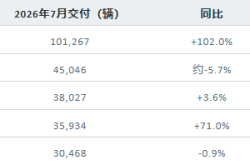
On August 1, 2026, Zero Run Motor announced its delivery data for July: a staggering 101,267 vehicles delivered in a single month, marking a 102% year-on-year increase. This achievement made Zero Run Motor the first Chinese new energy vehicle (NEV) startup brand to surpass 100,000 monthly deliveries. Among the leading new forces announcing data on the same day, Hongqi Smart Travel delivered 45,046 vehicles, XPENG 38,027, NIO 35,934, and Li Auto 30,468. Notably, Li Auto was the only brand experiencing both year-on-year and month-on-month declines, while Zero Run Motor was the sole brand achieving six-digit deliveries.
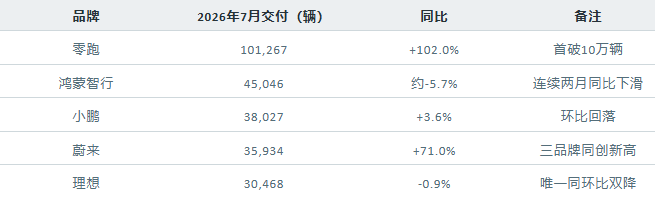
(Data Source: Official Company Announcements, Cailian Press Statistics)
The timing of this announcement amplified the dissemination intensity of the data. On July 31, Zhu Jiangming, Chairman of Zero Run Motor, stated on the podcast Luo Yonghao's Crossroads that Zero Run Motor "does not employ online trolls, does not attack competitors, and does not engage in unethical practices." This statement did not spark much discussion at the time but was widely cited after the delivery data was announced the next day. A company that had long maintained a low profile in public discourse suddenly surpassed rivals reliant on founder-driven hype in terms of sales—this contrast became the focal point of this round of attention.
This figure deserves closer scrutiny. Zero Run Motor's achievement not only challenges a single company but also three prevailing industry assumptions from the past three years: 1. Founder's personal brand (IP) equals sales volume; 2. The 100,000–200,000 yuan price range is unprofitable; 3. Low-priced brands cannot ascend to higher market segments.
It has proven some things, while others remain unanswered.
I. 100,000 Units Did Not Happen Overnight
Zhu Jiangming recalled in the aforementioned conversation: "From 879 monthly sales to 100,000, Zero Run Motor took six years." Key milestones disclosed by the company reveal staggered growth: first surpassing 10,000 units in March 2022 (10,059), breaking 20,000 in June 2024, 40,000 in November 2024, 50,000 in July 2025, then gradually rising to over 80,000 in May 2026, 93,376 in June, and capping at 101,267 in July.
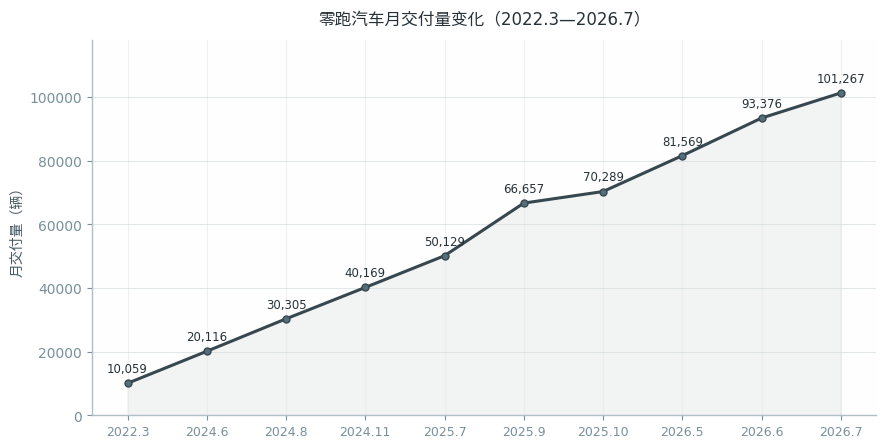
Figure 1: Zero Run Motor's Monthly Delivery Trends (Data Source: Zero Run Motor Official)
Two structural characteristics stand out. First, growth was not driven by a single blockbuster model in a sudden surge. Scaling from 10,000 to 20,000 units took over two years, and from 50,000 to 100,000 about a year, with extended plateaus at each level. Second, there were virtually no monthly declines throughout the process. This stair-step expansion typically corresponds to phased rollouts of production capacity, distribution networks, and product portfolios—rather than short-term marketing stunts. While sudden surges can be achieved with a hit model or price cuts, stair-step growth cannot; it offers greater predictability.
The industry context behind this trajectory should not be overlooked. When Zero Run Motor was founded in 2015, it lacked a celebrity founder IP and had only second-tier financing capabilities, sharing the second tier with WM Motor and Neta. Today, WM Motor and Neta have exited the market, while Zero Run Motor claims the annual sales crown. In 2025, it delivered 596,000 units, surpassing XPENG's 429,000 and Li Auto's 405,000.
Financial performance is equally noteworthy. In 2025, Zero Run Motor reported revenue of 64.73 billion yuan and net profit of 540 million yuan, achieving annual profitability for the first time after a 2.82 billion yuan loss in 2024.
No other new force has transitioned from a 2.8 billion yuan loss to a 500 million yuan profit in a single year.
II. How Did It Achieve 905 Yuan Profit Per Vehicle?
Why can Zero Run Motor achieve per-unit profitability when so many new forces struggle?
Zero Run Motor's cost control stems from a straightforward approach: in-house production wherever possible.
According to Zero Run Motor, over 65% of its vehicle components are self-developed, with 88% architecture standardization. It operates over 18 in-house parts factories covering battery systems, electric drives, electronic control, thermal management, lighting, AR-HUD, seating, and more. High self-development ratios reduce outsourcing costs, while high standardization amortizes R&D investments, together enabling a low-price, high-configuration strategy. Based on 596,000 deliveries, its 2025 per-unit net profit was approximately 905 yuan.
Though modest, this figure proves a proposition rarely validated before:
In the mainstream 100,000–200,000 yuan price range, profitability can be achieved through cost efficiency rather than brand premium.
This system has a counterpart. The industry often compares Zero Run Motor to "a mini BYD," and the two companies share similarities: 1. Both are led by engineer-founders; 2. Both insist on in-house powertrain development; 3. Both were among the few new energy automakers to achieve annual profitability in 2025 (BYD sold 4.6 million vehicles with 32.6 billion yuan net profit).
The difference lies in system openness. BYD prioritizes internal supply in its vertical integration—SNE Research shows 99.6% of BYD's battery installations were internal in the first five months of the year, with only a 0.4% year-on-year increase in global installations (67.6 GWh). Zero Run Motor, however, sells components to over 10 domestic and international automakers and has licensed its electronic architecture to FAW Group.
One closed-loop, one open—these two models define different industry relationships.
The two companies are also at different stages. BYD's 2025 revenue hit a record 804 billion yuan, but net profit declined 19% year-on-year. Its domestic sales fell nearly 40% in the first half of the year, with growth now driven by overseas markets—indicating that the peak benefits of vertical integration have passed. Zero Run Motor, meanwhile, is in the early stages of monetizing its cost advantages, with its steepest growth curve still ahead.
The "mini BYD" analogy is valuable for path validation, not scale comparison.
III. Who Is It Proving Wrong?
Zero Run Motor's 100,000+ monthly sales are impressive, but they also countered previous skepticism about the company.
First Slap: "Founder IP Equals Sales Volume."
For the past three years, the industry's most valuable traffic entry point has been the chairman's personal brand. Lei Jun's product launches could secure a year's worth of orders, while Yu Chengdong's remarks could trend three times on Weibo. Zero Run Motor provides a counterexample: a chairman who describes himself as socially anxious and views networking as a burden, alongside a company that explicitly avoids online trolls, achieved 100,000 monthly sales among new forces. This does not prove the failure of the traffic model—Xiaomi and Hongqi Smart Travel remain solid—but demonstrates that traffic is not the only solution. Systemic efficiency can also drive growth, even if it lacks the theatrics of product launches.
Second Slap: "The 100,000–200,000 Yuan Range Is Unprofitable."
This price range is a fiercely competitive market. The dominant narrative offered only two survival paths: either dominate through full-chain scale like BYD or burn cash at a loss while waiting for brand elevation. Zero Run Motor proposes a third path: push self-development ratios to 65%, standardize architectures to 88%, and scrape out 905 yuan in per-unit profit from the margins. The profit is thin, but the direction is validated.
Third Slap: "Low Price Equals Low End" (though only half-delivered).
Zero Run Motor's four series (A, B, C, D) cover 60,000–300,000 yuan. The A10 delivered nearly 30,000 units monthly, while the C series has accumulated over 850,000 global sales. The flagship D19, priced from 219,800 yuan, exceeded 10,000 deliveries in July. Its first MPV model, the D99, launched in late June with an average order price exceeding 300,000 yuan. The 300,000 yuan price tier's order structure suggests that some consumers value configuration density over low prices alone—two distinct competitive dimensions. However, with only one month of D19 deliveries exceeding 10,000 units and D99 deliveries just beginning, brand elevation remains an unfinished proof.
Epilogue
Returning to the opening conversation.
Zhu Jiangming's statement about "not engaging in unethical practices" gained traction after August 1 because the July sales rankings spoke loudly: the non-combatant won that month.
Zero Run Motor's six-year journey offers an industry benchmark: in an era where founder traffic is deemed a core asset, systemic efficiency can equally drive growth.
Six years, from 879 to 101,267 units—no miracles, just arithmetic.
But 100,000 units mark the beginning of validation, not the finale.
Whether the D series can stabilize in the 300,000 yuan price tier, whether European factories can ramp up smoothly, and whether new intelligent driving solutions can deliver—all lie ahead as hurdles.
Wang Chuanfu famously judged: "Any new technology's lead window lasts only 18 months."
This map, validated by BYD, is now being navigated by Zero Run Motor at its steepest segment.
Six years solved the first step of a complex equation. The remaining steps still depend on arithmetic.
-
![]()
Innovative ‘Large Family Box-Shaped’ Model, Great Wall H10, Officially Launches with Limited-Time Trade-In Price Starting at 201,800 Yuan
-
![]()
Google No Longer Lets Top Scientists 'Call the Shots'
-
![]()
Ctrip Loosens Its Grip on Hotels, While Fliggy Remains Trapped Within Taobao
-
![]()
Four Visits to Lu Fang: The Vision of VOYAH in My Heart | Insight
-
![]()
Hot Stocks to Track | SpaceX: Releases First Quarterly Report After Listing, Revenues Soar by 92%, Capital Expenditure Reaches $18.4 Billion, Trillion-Dollar Target Advanced to 2030
-
![]()
Hot Stocks to Monitor | SpaceX: Releases Inaugural Quarterly Report Post-IPO, Revenue Soars 92%, Capital Expenditure Reaches $18.4 Billion, Trillion-Dollar Revenue Goal Moved Up to 2030
-
![]()
Porsche China Shifts Focus Amid Sales Struggles
-
![]()
Without a Web Celebrity CEO, It Still Achieved Over 100,000 Monthly Sales in Its Debut Month! Who Is Zero Run Motor Proving Wrong?