Royalties Outstrip Licensing Fees for the First Time: Arm’s Leasing Business Thrives
 08/07 2026
 432
432
Produced by Zhineng Zhixin
In the semiconductor industry, the entity that commands data centers commands the global market. Data centers are swiftly transitioning to Arm, and Arm is shifting its focus from 'license sales' to 'CPU silicon sales.' Everyone is keen to observe how much of the market share Arm's royalty growth in the cloud sector can capture.
Part 1: Financial Report Analysis: Dual-End Revenue Growth
Arm's fiscal quarter is typically a period of modest activity.
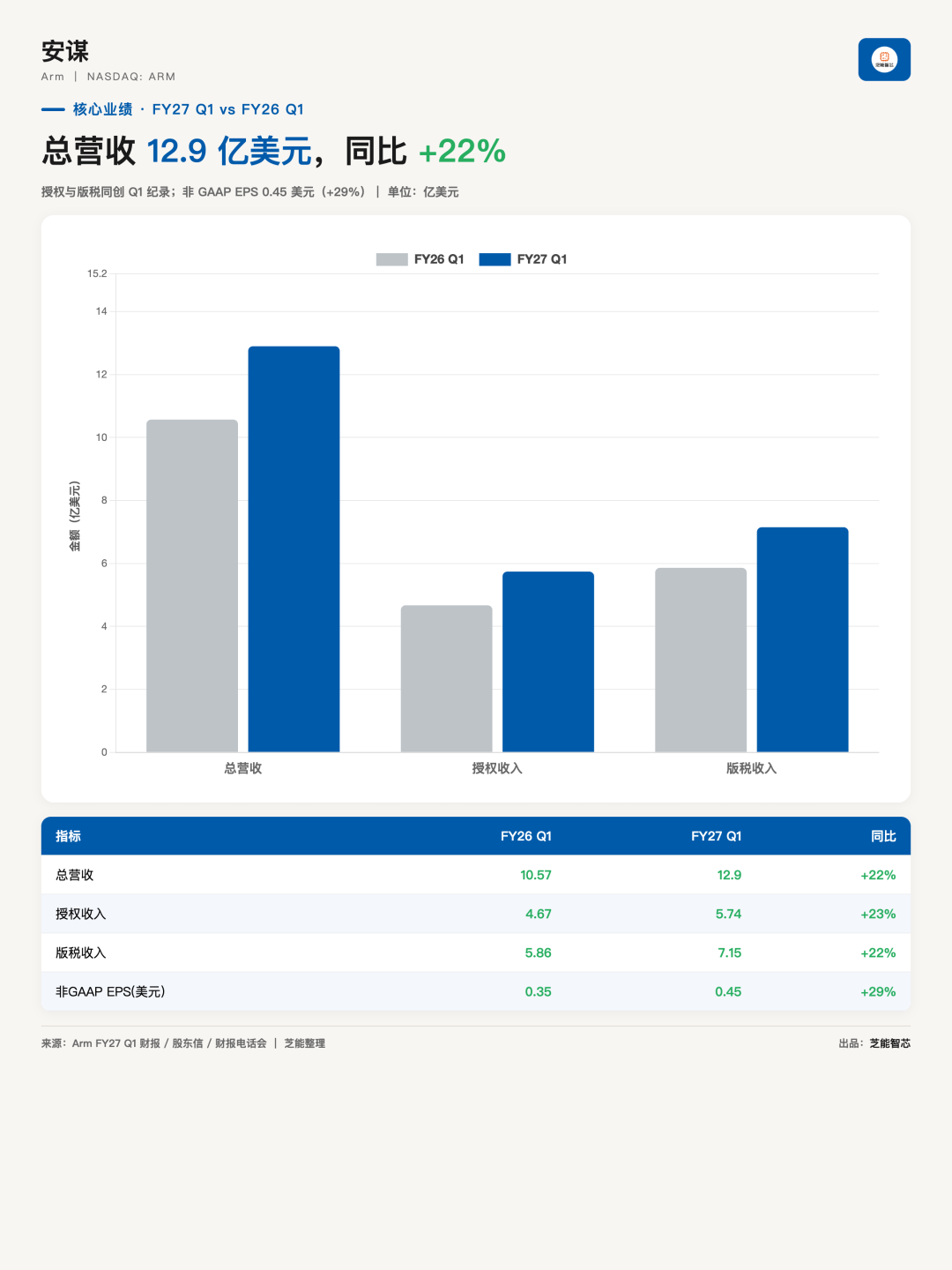
◎ Revenue reached $1.29 billion, surpassing expectations.
◎ Licensing revenue amounted to $574 million, a 23% year-over-year increase.
◎ Royalty revenue hit $715 million, up 22% year-over-year. Royalties now marginally exceed licensing fees, constituting just over 55% of total revenue.
Arm's 'existing portfolio' continues to yield returns: Licenses sold in previous years are now being realized as chips are taped out and shipped, continuously feeding royalty revenue. Who wouldn't appreciate such a compounding business model?
Data centers are pivotal in doubling royalty revenue. Historically, Arm's royalty revenue primarily stemmed from mobile phones, with a few cents earned per chip—high volume but low unit price.
Now, a single CPU in data centers sells for thousands of dollars, with royalties extracted proportionally—a few dollars or more per chip. The scale has shifted dramatically. From 'a few cents' to 'a few dollars,' the value of royalty extraction has transformed significantly.
Observing Qualcomm and MediaTek's financials in the mobile market, it's evident that the gap is being filled by the data center business.
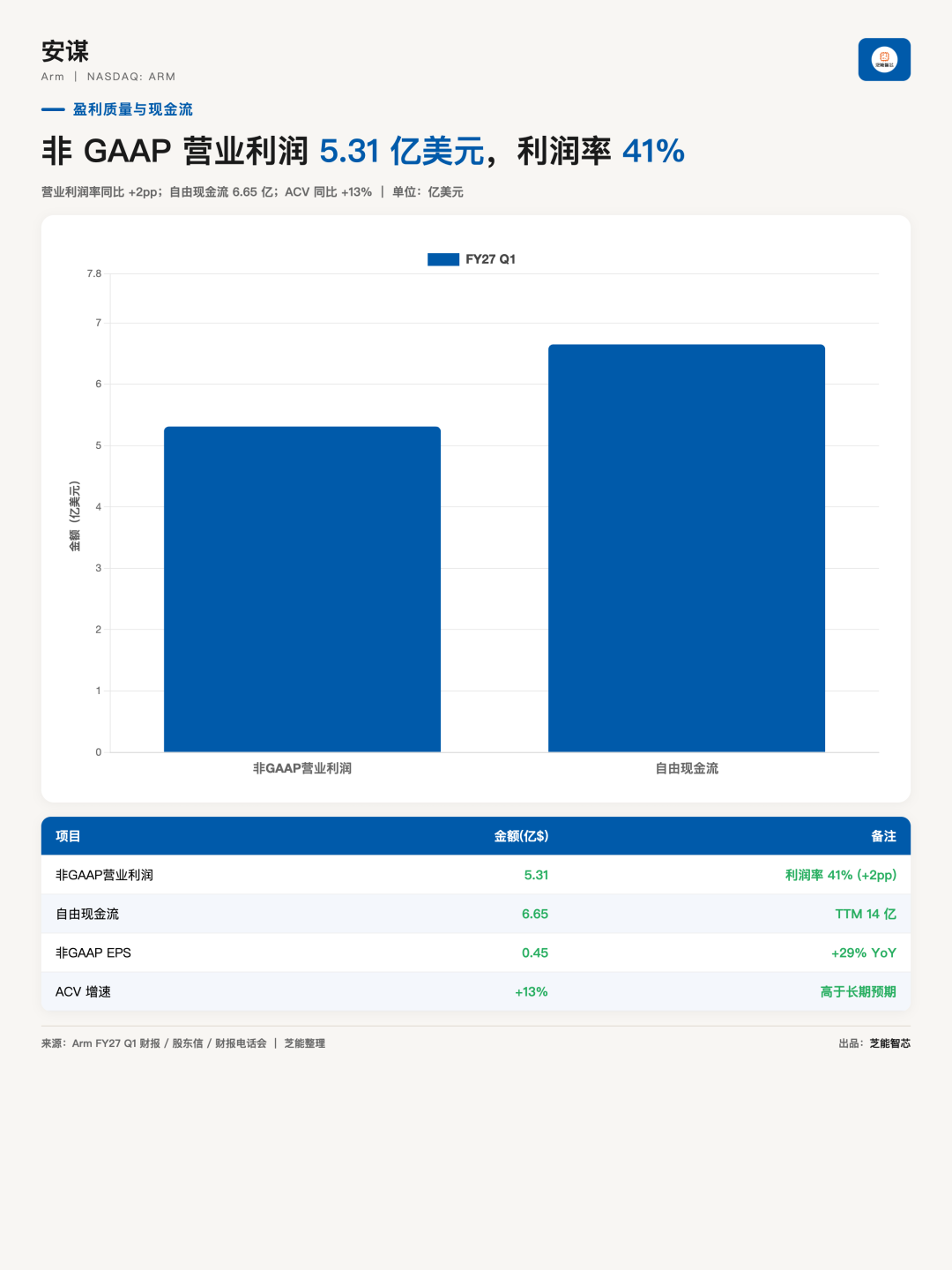
◎ Non-GAAP operating profit stood at $531 million, with an operating margin of approximately 41%, up 2 percentage points year-over-year.
◎ Quarterly free cash flow reached $665 million, with a trailing twelve-month (TTM) cumulative total of $1.4 billion.
◎ With revenue of $1.29 billion, free cash flow hit $665 million—nearly half of revenue converted into net cash.
This cash cow attribute is the most enticing aspect of the IP business: asset-light, high conversion, and virtually no need for capital expenditure to expand production.
ACV (Annual Contract Value) increased by 13% year-over-year (indicating customer stickiness). Licensing customers are willing to sign larger long-term agreements, demonstrating confidence in using Arm for future products. Long-term agreements enhance revenue predictability.
This quarter, royalty growth caught up with licensing growth, but royalties boast a higher gross margin than licensing: Licensing requires a team of architects for delivery, while royalties are almost pure profit. The increase in royalty share significantly contributed to the overall 2-percentage-point margin improvement.
As Arm progresses, it increasingly resembles a 'rent-collecting' entity: Once the foundation is established, every subsequent chip pays rent. The asset-light leasing business fears foundation collapse, not a lack of tenants.
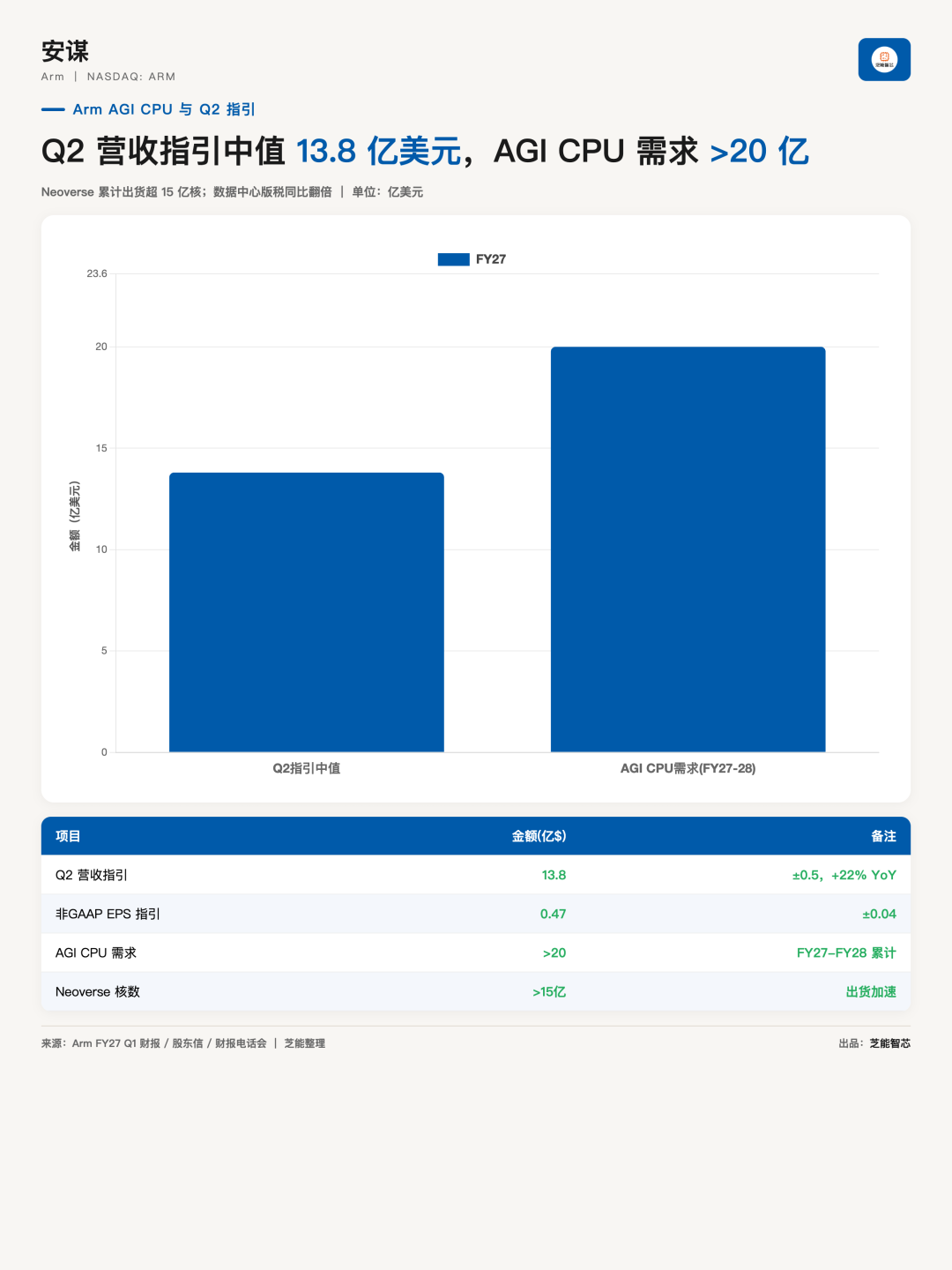
Next Quarter's Guidance (Fiscal Q2):
◎ Revenue of $1.38 billion ± $50 million, a 22% year-over-year increase.
◎ Non-GAAP EPS of $0.47 ± $0.04.
◎ Licensing expected to grow by 30%, with low double-digit royalty growth.
Management's guidance indicates continuity, forming a consistently upward trajectory. SoftBank's licensing deal adds another layer of security to this trajectory.
Record revenue, rising margins, strong cash flow, and solid guidance—this quarterly report is flawless.
Part 2: Executive Insights on Business Progress: How Far Along Is the Transition from 'Selling Licenses' to 'Selling Silicon'?
Rene Haas (CEO) stated in the shareholder letter that Arm is at a 'historic inflection point where computing is migrating from x86 to Arm architecture,' emphasizing that this quarter's data center progress 'far exceeded our early-year expectations.' 'The shift of compute to Arm is accelerating, and our data center royalty growth proves it.'
Jason Child (CFO) attributed the quarter's operating margin improvement to 'the dual drivers of high-value licensing and royalty structure,' noting that SoftBank's agreement contributed $193 million in licensing revenue, solidifying the licensing line with structural support and a fuller wallet.
Arm's AGI CPU is a major surprise—a CPU developed by Arm itself for AI data centers.
◎ Cumulative demand from FY27 to FY28 already exceeds $2 billion.
◎ Initial products have been delivered to multiple customers.
◎ To support opportunities worth $1 billion-plus, Arm has already secured production capacity in advance.
This is a crucial step in 'selling silicon': Previously, Arm only sold architectural blueprints; now, it must turn its CPU designs into products, find foundries, and handle delivery. The transition from IP provider to chip product company is happening faster than the outside world expected.
Neoverse's cumulative shipments have surpassed 1.5 billion cores in just 9 months. Compared to the time taken to accumulate the first 1 billion cores, the acceleration is visible.
Neoverse is Arm's flagship IP for servers, and its scaling directly corresponds to doubling data center royalty revenue. The faster cores accumulate, the larger the royalty snowball grows. NVIDIA's Vera platform, based on Arm architecture, achieves 50% higher CPU performance and doubles energy efficiency in mass production.
Google's Axion is used as the host CPU for TPUs.
◎ AWS and Meta have signed multi-year agreements to deploy tens of millions of Graviton5 cores.
◎ Microsoft's Azure Cobalt 200 is operational.
◎ Even Qualcomm has announced the Dragonfly C1000, based on Arm, entering the data center CPU market.
These customers are both Arm's licensing buyers and potential 'silicon-selling' competitors.
NVIDIA has its own Grace, AWS has Graviton, and Microsoft has Cobalt. Arm relies on them for licensing fees and royalties while competing with them through its AGI CPU. This relationship is delicate.
By using Arm for Vera, NVIDIA has handed cloud CPU architecture to Arm, and Arm's server-side software ecosystem has passed the tipping point. When the most discerning customers approve, the rest will follow suit.
Arm aims to become the default option for the entire track. Arm has accelerated server platform spending, doubling it in the last two quarters and surpassing x86. Forecasts for AI infrastructure spending in 2026 have been raised to nearly $500 billion. With abundant opportunities, Arm stands at the widest part of the river.
As Agentic AI spreads to edge and physical AI, Arm's expertise in end-side and low-power applications has been reinvigorated.
Part 3: A Few Challenges the Company Faces
Arm also faces the challenge of customer self-development. AWS Graviton, Microsoft Cobalt, and Google Axion are all custom cores developed by customers based on Arm architecture.
They pay licensing fees but retain the majority of profits for themselves. If customers ever feel they have 'mastered the architecture' and develop their own compatible cores, Arm's royalties could become irrelevant.
Revenue concentration is another issue. This quarter, SoftBank alone contributed $193 million in licensing revenue, accounting for more than 30% of the licensing portfolio. The licensing model inherently relies on top players.
Geopolitical and export controls bring us to China. Arm's position in the domestic market is an unavoidable topic. Huawei's Kunpeng and Phytium are both domestic CPUs built on Arm instruction sets.
Kunpeng holds a perpetual license for the Arm v8 architecture, and Phytium is also rooted in the Arm ecosystem, supporting a significant portion of the domestic information technology innovation and server market.
Whether Arm's latest Neoverse premium features and this quarter's flagship AGI CPU can be smoothly delivered to domestic customers is constrained by export controls. While Arm races ahead globally in the cloud, domestic players are limited to evolving on older architectures.
This disparity—'same roots, different fates'—is a reality the domestic semiconductor supply chain must confront.
Arm's shift from 'selling licenses' to 'selling chip solutions' poses direct pressure on China's supply chain but also serves as a reverse catalyst.
The pressure lies in overseas players capturing the architectural advantages of high-end CPUs; the catalyst is that it forces domestic players to accelerate efforts in RISC-V and self-developed architectures. As long as export control barriers remain, the domestic Arm story may stall at v8.
The more reliant on older Arm architectures, the less access to new features, locking performance ceilings at what others provide. The height of that ceiling is not in our own hands.
Summary
Arm's revenue records, royalty structure, margins, and cash flow are all robust.
-
![]()
Five Major Players Enter the Arena: The All-Out Battle for the Ultimate AI Office Super Gateway Begins
-
![]()
Why Does Changan Technology Abandon Internal Capital Injection and Embrace Marketization?
-
![]()
Royalties Outstrip Licensing Fees for the First Time: Arm’s Leasing Business Thrives
-
![]()
What changes will happen to the fate of Musk and Tesla?
-
![]()
Google’s Farewell: The Era of Large Models Steps into the ‘Garage Phase’
-
![]()
Blue Light Fades: The Dawn of a New Era for Intelligent Driving Lighting
-
![]()
Over 140,000 Charging Stations Undergo Spot Checks for Charging Accuracy; Non-Compliant Units Face Operational Ban
-
![]()
Tesla is Just the Start: China’s ‘Super Catfish’ is Set to Revolutionize Europe