SpaceX Lifts Ban in 72 Hours
 08/07 2026
 552
552
After market close on August 4 (Eastern Time), SpaceX is set to release its first earnings report since going public. Two trading days later, on August 6, up to 911.5 million shares held by employees and early investors will become eligible for transfer.
Calculated at the July 31 closing price of $108.37, this represents a market capitalization of approximately $99 billion, equivalent to 1.4 times the current free float. Eligibility does not necessarily mean selling; the actual amount entering the market depends on holders' willingness to sell. Caixin and Wall Street See both noted that this is the largest lock-up expiration in U.S. capital market history.
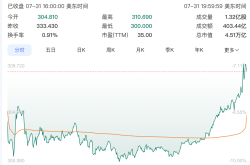
The market began trading ahead of this ban lift a month in advance. SpaceX's stock price fell from a high of $225.64 on June 16 to around $108, dropping below the $135 IPO price; its market cap shrank by nearly $1.2 trillion from its peak to approximately $1.48 trillion. Short positions piled up to about $24.6 billion, accounting for 34% of the free float.
We are no strangers to lock-up expirations—MiniMax and Zhipu just went through this ordeal. Can SpaceX escape unscathed?
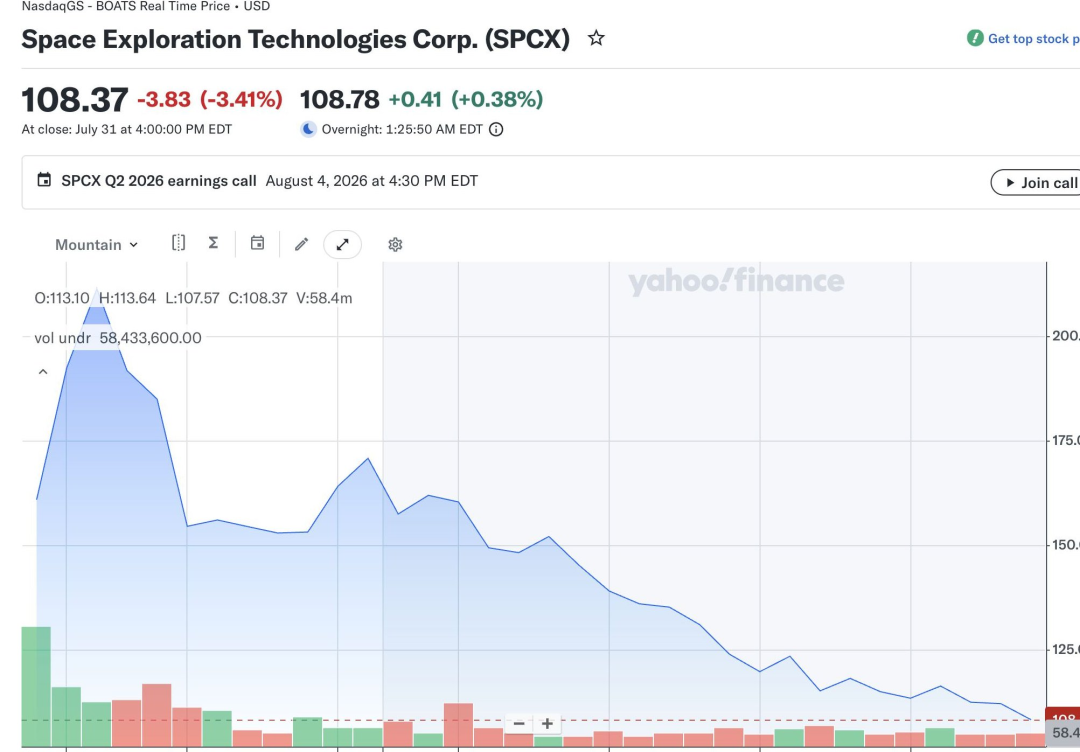
(Yahoo Finance Screenshot)
A Matter More Urgent Than Rockets
The standard practice for U.S. IPOs is a one-time lock-up expiration after 180 days, but SpaceX adopted a staggered approach: A maximum of 20% (911.5 million shares on August 6) becomes eligible on the second trading day after the first earnings report. Then, about 7% will be released on days 70, 90, 105, 120, and 135 thereafter; another ~28% (~1.3 billion shares) after the Q3 report; by December 8 (day 180), the free float will increase from 639 million to 5.33 billion shares, accounting for ~40% of the total share capital.
An untriggered condition remains: If the closing price exceeds $175.50 (30% above the IPO price) for five days within the ten trading days before the earnings report, an additional 10% can be released. Since mid-July, the stock price has remained below this level, so this portion of the lock-up will not expire. For employee shareholders, this 10% supply remains temporarily grounded.
However, Musk himself is not on the lock-up expiration list. His ~6.4 billion shares are subject to a 366-day lock-up, not expiring until June 12, 2027. Employees and early investors acquired shares at costs far below current prices; even selling at half the current price would yield multiple times their investment. Before the IPO, SpaceX provided employee liquidity through regular internal buybacks; after the IPO, this outlet shifted to the public market. If the earnings report disappoints, short sellers have been waiting for this moment. Thus, Musk must actively manage expectations to prevent SpaceX from taking a severe hit.
Over the past two weeks, Musk's pressure has centered on models. He has repeatedly interacted with Kimi on X and claimed that the 2 trillion-parameter model currently in training "may surpass Kimi."
Musk has never concealed his beware (alertness) toward Chinese models. One piece of evidence: On August 1, he followed DeepSeek's X account, just one day after DeepSeek-V4-Flash launched its API public beta. On July 23, in an interview with The Economist, he stated that China holds strong capabilities in robotics and AI and "could very well become a leader at some point," with electricity supply as a key advantage.
Musk's own hand is not strong. Grok has not established a leading edge; Musk himself publicly admitted that xAI "was not well-structured initially and is currently being rebuilt." Image models represent his most recent strategic focus: On July 22, he promised that Grok Imagine would produce a "historically accurate" full-length film adaptation of *The Odyssey* by year-end, challenging Nolan's live-action version, which grossed $264 million in its opening weekend. Currently, Grok Imagine's maximum video segment length is only 15 seconds.
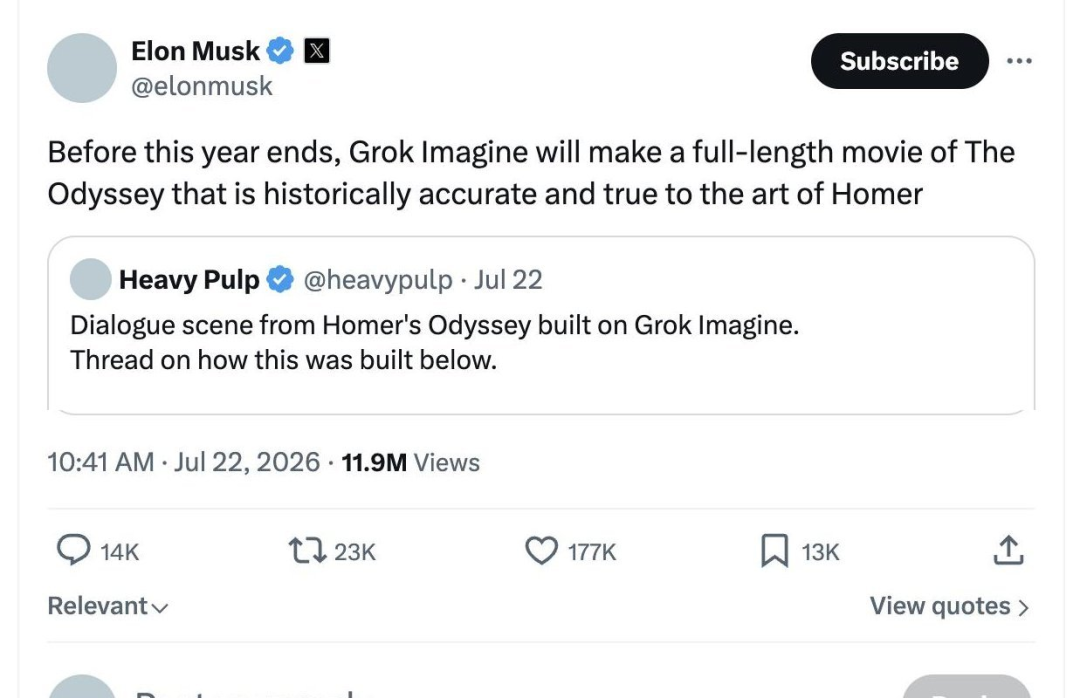
Musk's July 22 *Odyssey* promise post
If models fall short, acquire application-layer assets. SpaceX has already acquired Cursor for $60 billion in an all-stock deal, expected to close in Q3. Grok Build Beta launched on July 8, with API pricing set at $0.2 per million tokens for Grok 4.1 Fast.
The market is pricing in this strategy. At late-July stock prices, SpaceX's forward price-to-sales ratio is ~46x, with the bulk of its valuation premium tied to the AI narrative. The bond market is also repricing: According to off-exchange quotes reported by the market, SpaceX's 30-year bond yield rose from 6.7% at issuance to 7.4%, while its CDS spread widened from 110 basis points in late June to 158 basis points. Essentially, anyone buying SpaceX at a valuation exceeding $1.5 trillion is betting on a call option for its future AI business; Steve Eisman, the prototype for *The Big Short*, called the prospectus "a science fiction novel."
Since the bulk of SpaceX's valuation remains tied to the AI narrative, the possibility of a "shocking plunge" after the lock-up expiration cannot be ruled out.
Three weeks ago, MiniMax and Zhipu already waded through these turbulent waters. The difference: MiniMax released 153 million shares, accounting for over 48% of its total share capital, and closed 17.98% lower on the day, with cumulative losses exceeding 30% in the following week. Zhipu released 25.68 million shares, just 5.76% of its total share capital, and its stock price actually rose 13.35% on the day—though, regrettably, it has since halved.
This incident reveals a new market realization: The valuation method for large models remains undetermined.
From a supply structure perspective, SpaceX's lock-up expiration resembles MiniMax's: Early financial investors hold the majority, with costs far below current prices, and nearly 70% of shareholders have not pre-committed to lock-up extensions. The prospectus does not disclose a complete list.
However, the capital composition differs critically: Hong Kong IPOs feature cornerstone investor systems, which lock in shares for six months at issuance and allow pre-expiration commitments to lock-up extensions. Zhipu's cornerstone investors, primarily Beijing state-backed institutions and industrial capital, are inherently long-term funds. The U.S. market lacks such institutionalized stabilization mechanisms; SpaceX's lock-up expiration list includes only employees and early investors, with controlling shareholder Musk himself locked until June 2027. The expiration pool lacks even a single major investor capable of stabilizing morale.
The gaming mechanisms also differ. While Hong Kong stocks also have short selling and derivatives, SpaceX's options chain depth, securities lending scale, and existing 34% short interest volume are unmatched by Hong Kong's two large-model stocks.
The valuation environments are polar opposites: Hong Kong's patience for loss-making tech stocks is limited. After MiniMax's lock-up expiration pushed its market cap below $100 billion, it signed an A-share listing tutoring (coaching) agreement with CITIC Securities in late May. SpaceX, by contrast, faces a market willing to assign a 46x forward price-to-sales ratio to its AI narrative.
As for which scenario the stock price will more closely resemble, we will only know after August 6.
Poor Expectations
xAI effectively no longer exists. SpaceX acquired xAI in an all-stock deal, with a combined valuation of $1.25 trillion—the largest private corporate merger in history. In May, Musk announced that xAI would revoke its independent status, and its official account was renamed @SpaceXAI.
After the acquisition, SpaceXAI's financials were consolidated onto SpaceX's balance sheet. One criticism must be addressed upfront: Lock-up expirations concern supply, while models relate to fundamentals; the two cannot be conflated.
However, SpaceX structured the lock-up expiration as a staggered process, with each wave of supply before December hanging on the stock price: Earnings reports expose the economic viability of the AI division, while lock-up expirations expose holder patience toward this economic model. A declining stock price will not immediately withdraw raised cash but will weaken SpaceX's ability to continue raising equity for financing, M&A, and talent retention. It will also shorten the market's tolerance for AI losses.
SpaceX's AI division—including X advertising, subscriptions, data licensing, Grok, and computing infrastructure—generated $818 million in revenue in Q1 2026, with an operating loss of ~$2.5 billion and capital expenditures of $7.7 billion: For every $1 in revenue, operating losses were ~$3, and capital investments were ~$9.4. During the same period, SpaceX's overall loss was $4.28 billion, with capital expenditures of $10.1 billion, of which $1.3 billion went to Starlink, leaving $1 billion for the space business.
From 2025 data, xAI generated $3.2 billion in revenue, with an operating loss of $6.4 billion—a $2 loss for every $1 in revenue. Capital expenditures reached $12.7 billion, accounting for 61% of SpaceX's annual capex, rising to 76% in Q1 2026. The S-1 also disclosed that as of March 2026, all 11 xAI co-founders had departed.
SpaceX's AI revenue is somewhat complex: Anthropic signed a contract in May 2024 to lease computing power until 2029, paying ~$1.25 billion monthly; Google pays ~$920 million monthly, but its contract does not take effect until October and thus cannot be counted in current revenue.
Competitors, unable to match self-built capacity, also lease from xAI, meaning xAI's disclosed revenue includes contributions from rivals. At Q1's pace, annualized monthly capital investment intensity for the AI division exceeds $2.5 billion; capital expenditures form assets and do not directly equate to operating losses, but the $2.17 billion in monthly rent from the two companies still cannot cover SpaceX's investment intensity.
Currently, the primary offset to supply pressure comes from passive index buying, but it will not automatically appear as a one-to-one counterparty on August 6. SpaceX was rapidly included in the Nasdaq-100 just 15 trading days after listing, with Invesco QQQ now holding ~39.7 million shares. Only if subsequent index rebalancing expands the free-float definition for SpaceX will its weighting rise, bringing incremental passive capital.
SpaceX's current situation is not optimistic, especially regarding AI expectations.
This repricing is already underway. Zhipu's market cap halved from HK$1 trillion, MiniMax fell below HK$100 billion after its lock-up expiration, and SpaceX's market cap shrank by nearly $1.2 trillion from its peak. Across two markets, these three companies are being repriced by the same pool of capital using the same logic.",
-
![]()
Gross Margin Exceeds 50%! Apple Rakes in $30 Billion in a Single Quarter, Will Price Hikes Hit in Autumn and Winter?
-
![]()
Google’s Top Scientists No Longer ‘Call the Shots’
-
![]()
Google's Farewell: Large Models Are Entering the 'Garage Era'
-
![]()
Zuckerberg Challenges Liang Wenfeng with 'Benchmark' Tactics
-
![]()
Autonomous Buses: A Rigorous Stress Test for Physical AI
-
![]()
RAMageddon: AI is Devouring Global Memory, and Your Phone, Laptop, and Game Console Will Face Price Hikes
-
![]()
The 'New Oriental Cohort' Sparks a 'Wild West': How Will Live-Streaming E-Commerce Navigate Its Next Phase?
-
![]()
Tencent Breaks Through: WorkBuddy Tops the Charts in 60 Days