JD Delivers an 'Above Expectations' Earnings Report, but the Market Doesn't Buy It
 08/14 2026
 502
502
© Unbounded UnKnown
Edited by | Qian Jiang
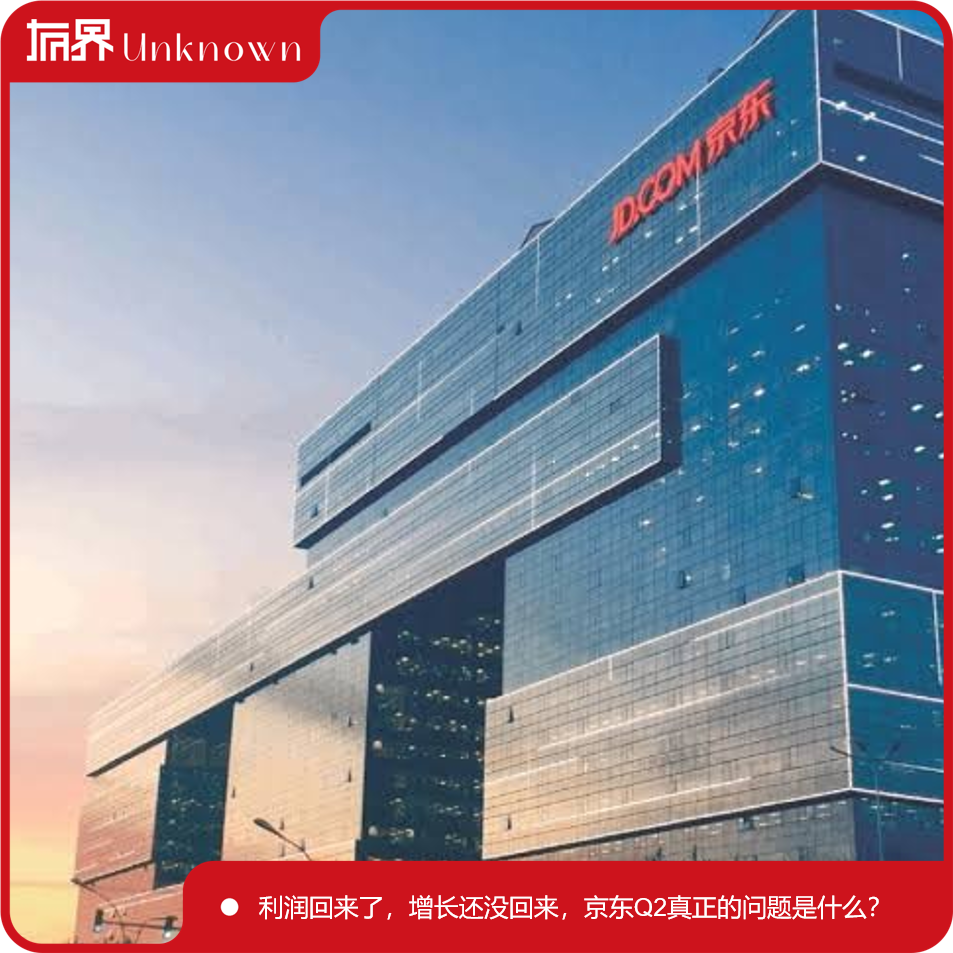
On August 13, JD released its Q2 2026 results.
Earnings data showed that JD's Q2 2026 revenue was RMB 346.4 billion, down 2.9% year-over-year; net profit attributable to ordinary shareholders was RMB 7.1 billion, up 15.4% year-over-year; under non-GAAP, net profit attributable to ordinary shareholders was RMB 8.9 billion, up 20.8% year-over-year, with diluted earnings per ADS of RMB 6.29.
According to consensus estimates displayed by Google Finance, JD's revenue was about 1.2% higher than expected, while earnings per ADS were about 11.9% higher.
On the surface, this was an earnings report where both revenue and profit exceeded some market expectations, but the capital market's response was quite the opposite.
After the earnings release, JD's U.S.-listed shares fell by about 8.7% during intraday trading and closed down 7.31% at $29.30, a significantly larger decline than Alibaba, Pinduoduo, and the China Internet ETF KWEB over the same period.
So, when profit, earnings per share, and revenue all exceed some market expectations, why are investors still choosing to sell JD?
Is JD Still Stuck in a Growth Dilemma?
It should be noted that JD's revenue growth rate has been rapidly declining over the past five quarters.
In Q2 2025, JD's revenue grew by 22.4% year-over-year; then it fell to 14.9% in Q3 and further to 1.5% in Q4. After a brief rebound to 4.9% in Q1 2026, it turned negative again in Q2 with a 2.9% decline. This marked the first time since JD's listing that quarterly revenue declined year-over-year.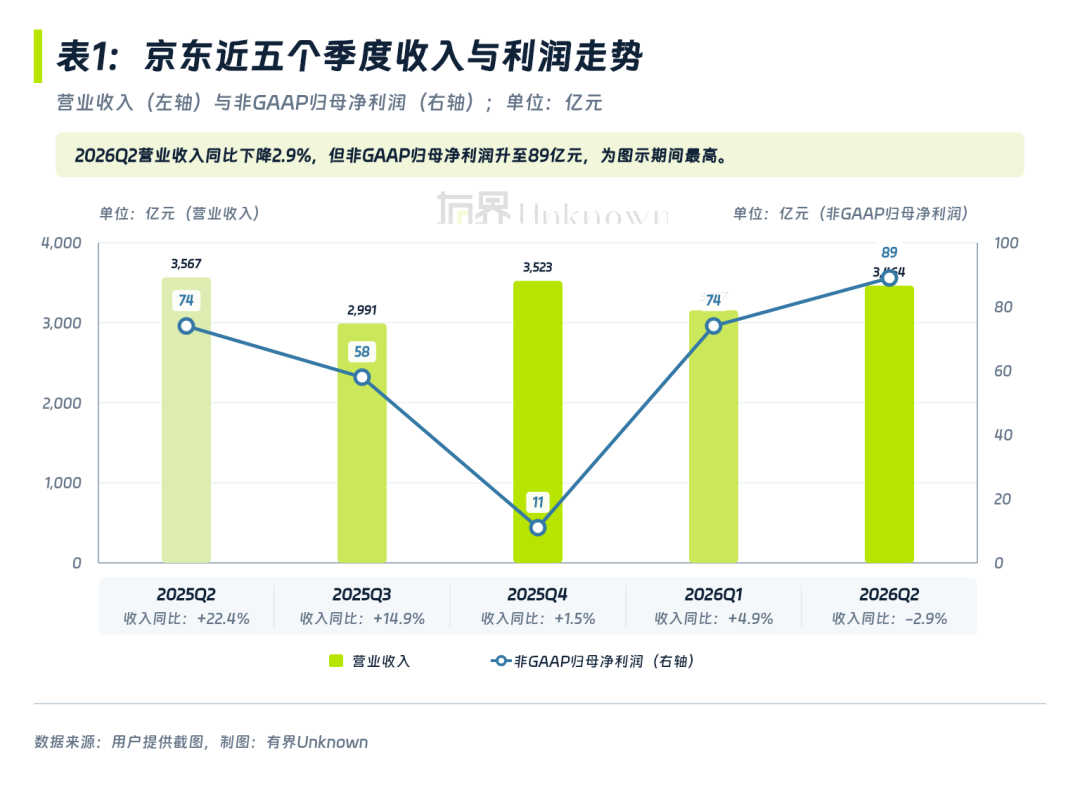
Meanwhile, adjusted net profit attributable to ordinary shareholders fell from RMB 7.4 billion in Q2 2025 to RMB 5.8 billion in Q3 and RMB 1.1 billion in Q4, then recovered to RMB 7.4 billion in Q1 this year and further rose to RMB 8.9 billion this quarter.
In other words, from the Q2 earnings perspective, while JD has clearly emerged from the profit trough since the second half of 2025, revenue has not yet shown synchronous recovery.
In the first half of 2026, JD's adjusted net profit attributable to ordinary shareholders was RMB 16.3 billion, still down 19.1% year-over-year. The single-quarter rebound in Q2 only narrowed the profit decline in the first half but did not reverse the year-over-year decline.
The revenue pressure primarily came from JD's most scalable categories—home appliances and 3C.
In Q2 this year, JD's merchandise revenue was RMB 267.1 billion, down 5.4% year-over-year; of which electronics and home appliances revenue was RMB 157.9 billion, down 11.8%. Management attributed this mainly to the high base effect from the 2025 trade-in policy and the impact of rising upstream component prices pushing up consumer electronics prices.
However, JD's revenue did not contract across the board. Revenue from daily necessities grew by 5.6%, while service revenue grew by 6.8%, including platform and advertising revenue growing by 8.3%. Management also disclosed that supermarket revenue grew by nearly double digits, while health and industrial products maintained double-digit growth; sales growth from third-party merchants also exceeded self-operated business for three consecutive quarters.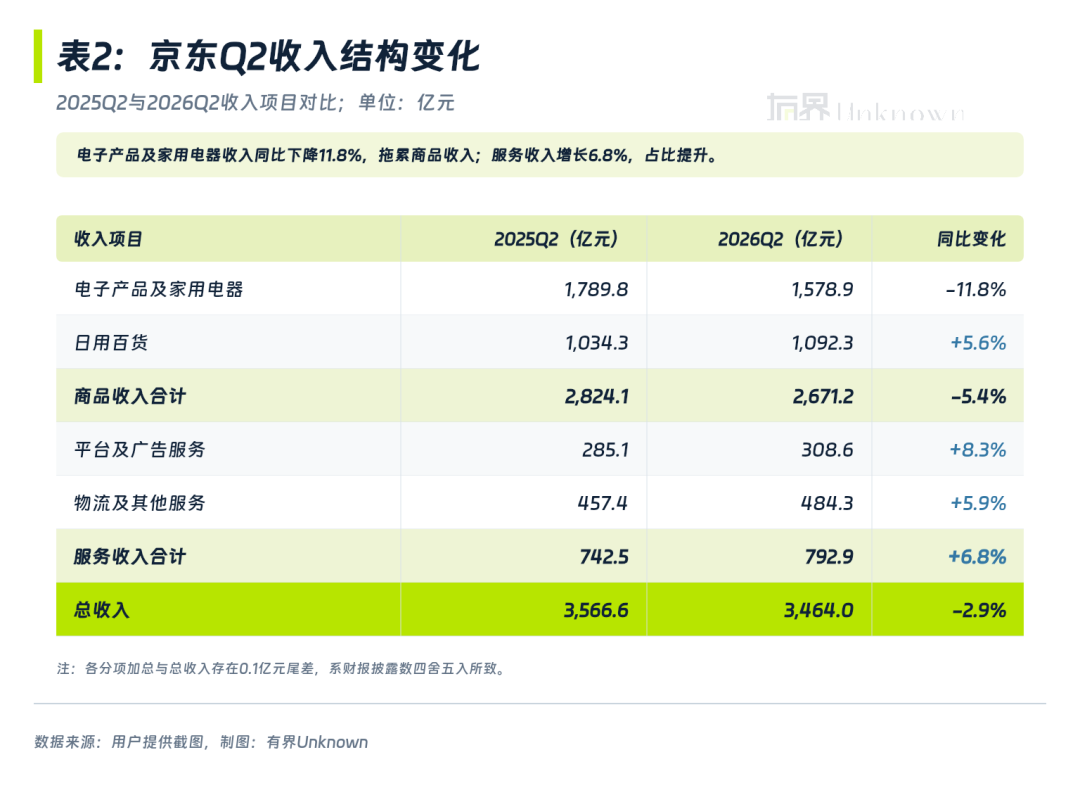
This means JD's revenue mix is shifting toward consumer staples, third-party platforms, advertising, and service revenue. However, at least in Q2, these businesses were not enough to offset the decline in home appliances and 3C.
The profit performance of the core retail business remained relatively stable. In Q2, JD Retail's revenue was RMB 295.4 billion, down 4.7% year-over-year; operating profit was RMB 13.5 billion, down about 3.3% year-over-year; the operating profit margin rose from 4.5% to 4.6%, hitting a new high for a major promotion quarter. Calculated by segment revenue and cost, JD Retail's gross margin was about 18.5%, up about 1.3 percentage points year-over-year.
This indicates that even under revenue pressure, JD can still maintain profit margins by relying on supply chain efficiency, improved merchandise gross margins, and a higher proportion of high-margin revenue from advertising and commissions.
However, the 4.6% operating profit margin was only about 0.1 percentage points higher than last year, and retail operating profit itself still declined. Therefore, this quarter was closer to "margin resilience" rather than a significant leap in core retail profitability.
Management expects that as the high base effect weakens starting in Q3, JD Retail will resume positive year-over-year revenue growth in Q3 and accelerate quarterly in the second half of the year.
But this remains primarily a qualitative guide from management. Since the company did not provide a specific growth range, the strength of the revenue inflection point in Q3 still lacks quantifiable evidence for early verification.
Profit Recovery Mainly Driven by Reduced Losses
The most significant changes this quarter occurred in new businesses and expenses.
In Q2, JD's operating losses from new businesses fell from RMB 14.78 billion in the same period last year to RMB 9.85 billion, a reduction of about RMB 4.9 billion or about 33%.
Among them, management disclosed that losses from the food delivery business fell by more than 50% year-over-year, with a significant decline in per-order subsidies, improved delivery efficiency driven by scale expansion, and commission and advertising revenue beginning to contribute.
Meanwhile, JD's marketing expenses fell from RMB 27 billion to RMB 20.3 billion, a year-over-year decrease of RMB 6.7 billion or 24.8%. JD stated this was mainly due to optimized promotional spending in new businesses. The group's gross margin also improved by about 1.2 percentage points year-over-year to 17.1%.
Driven by these factors, JD's GAAP operating profit turned from a loss of RMB 860 million in the same period last year to a profit of RMB 4.55 billion; adjusted operating profit rose from RMB 900 million to RMB 5.48 billion.
From a segment perspective, the core driver of profit recovery this quarter came from new businesses, especially the significant reduction in food delivery losses; from an income statement perspective, this change was mainly reflected in lower marketing expenses and improved gross margins. In other words, Q2's profit improvement came more from the rollback of previous high-intensity investments rather than operating leverage from revenue growth.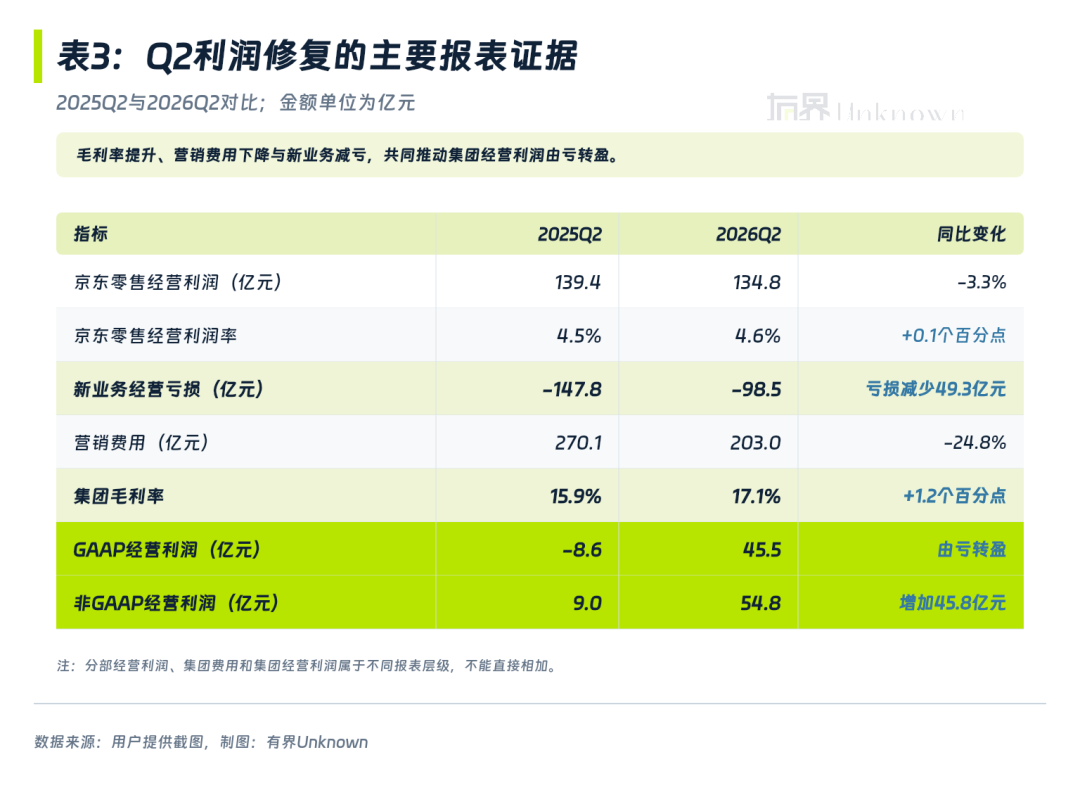
However, it must also be acknowledged that reducing losses in food delivery is not simply about stopping subsidies. The earnings call mentioned that since Q2, JD has seen a decline in per-order subsidies, higher order density, improved delivery efficiency, and the beginning of commission and advertising revenue exploration. This means the unit economic model of food delivery has indeed improved.
The issue, however, is that JD's new businesses (including food delivery, JD Xi, JD Property, and overseas operations) still incurred nearly RMB 10 billion in quarterly losses overall, and JD plans to increase investment in JD Xi and Joybuy's European operations.
Management stated on the earnings call that Joybuy's revenue in Europe has doubled in two quarters, but with order growth, logistics fulfillment capacity building, and service scope expansion, investments will increase in the coming quarters; JD Xi is also still expanding into lower-tier markets. The company emphasized it would maintain financial discipline and controllable investments but did not provide a clear quarterly target for overall losses in new businesses.
Thus, the market likely worries that the investments saved from food delivery will be reallocated to the next round of expansion.
Additionally, AI represents a long-term investment that continues to increase.
In Q2, JD's R&D expenses were RMB 7.3 billion, up 37.7% year-over-year, with the R&D expense ratio rising from 1.5% to 2.1%. Management explicitly stated that especially R&D investments related to AI applications will continue to grow for some time.
Unlike Alibaba or Amazon, JD does not separately disclose revenue and profit contributions from its cloud or AI businesses in its earnings reports. At this stage, AI's financial value to JD is more indirectly reflected in revenue growth and efficiency improvements through advertising recommendations, merchandise management, inventory forecasting, customer service, warehousing, and delivery.
Management stated that AI is improving advertising distribution and conversion efficiency; JoyInside has partnered with nearly 200 brands, with the number of connected devices more than tripling compared to the 2025 "Double 11"; JD Logistics is also expanding its deployment of autonomous vehicles and automated warehousing.
However, JD does not separately disclose AI-driven revenue or profit. Therefore, at this stage, metrics more important than "how many brands or devices are connected" are whether advertising revenue, fulfillment costs, inventory efficiency, and merchant ROI can continue to improve in the future.
Only when these efficiency improvements are sustain reflected in advertising revenue, fulfillment costs, inventory efficiency, and profit margins will AI more likely become a sustained valuation driver for JD, rather than just a technological story.
The good news is that JD still has sufficient cash to support these investments.
In Q2, the company's operating cash flow was RMB 37.7 billion, and free cash flow was RMB 31.8 billion, up about 44.6% year-over-year. As of the end of June, cash and cash equivalents, restricted cash, and short-term investments totaled RMB 235.1 billion. In the first half of the year, JD invested $1 billion to repurchase about 2.5% of its outstanding shares, with about $1 billion remaining under the current repurchase program.
However, improved cash flow cannot be simply equated with synchronized strengthening of end-demand or core profitability.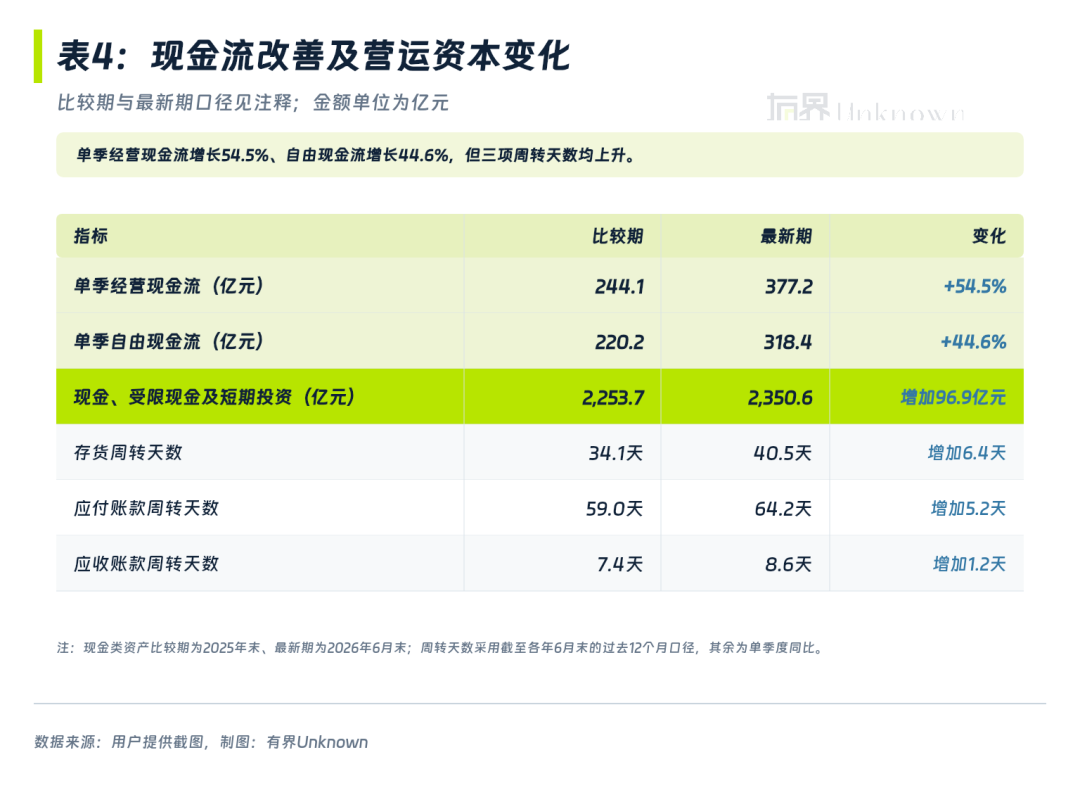
JD's free cash flow is also affected by changes in working capital. Over the past 12 months, inventory turnover days increased from 34.1 to 40.5, while accounts payable turnover days increased from 59 to 64.2, indicating changes in the working capital structure itself. Therefore, judging cash flow quality still requires combined observation of inventory, payables, and operating profit.
Overall, Q2 further confirmed that the profit pressure JD faced in 2025 is easing, but it has not yet confirmed that profits have entered an endogenous expansion phase driven by both revenue growth and efficiency improvements.
Why Didn't the Market Buy It?
JD's stock performance after the earnings release does not mean investors deny the reduction in food delivery losses and profit improvement. More accurately, the market has set a higher bar for the quality of growth in the next stage.
So, what will the market look for next?
After Q2, the issues facing JD are already clear: profit pressure is easing, but the next round of growth has not yet been validated.
Reduced losses in food delivery and lower marketing spending have improved group profits; the retail business has also maintained profit margins despite revenue pressure. However, these changes primarily address the profit pressure since 2025, not the growth issue. As losses in new businesses continue to narrow, the profit increment from "reduced losses" will gradually diminish.
Therefore, what truly matters next is whether JD can restore growth in its core retail business and make advertising, service revenue, AI, and supply chain efficiency replace expense reductions as new profit drivers.
This also explains why, despite revenue and profit exceeding some market expectations, JD's stock price still fell significantly. The market is not blind to Q2's improvements but is waiting for a more important answer:
JD has proven it can control losses; now it needs to prove it can also recover growth.
* All chart data in the article comes from JD's officially released earnings reports
- END -
-
![]()
The 'Lin Junyang Phenomenon' in AI Venture Capital
-
![]()
JD's Profit Increases While Revenue Stagnates: What is Liu Qiangdong After?
-
![]()
Creating "Liquid Lenses" with 70-Millisecond Focal Length Switching: Is XR Headset Zooming on the Horizon?
-
![]()
Xingyun Technology’s Remarkable Surge Over the Past Six Months
-
![]()
Chery Enters Korean Market with $75 Million Investment: A Strategic Model Combining Defense and Offense
-
![]()
JD Delivers an 'Above Expectations' Earnings Report, but the Market Doesn't Buy It
-
![]()
The 'Boxy' SUV Market Welcomes a 'Behemoth': Can the Great Wall H10 Stand Its Ground?
-
![]()
Half-Year Report | In the first half of 2026, sales volume of China's smart glasses market soared by 85.5%, with sales amount doubling; full-year sales volume forecast to reach 2.5 million units