Major Milestone: China’s Rocket Achieves Landing Leg Recovery for the First Time!
 08/19 2026
 412
412
On the morning of August 19th (Beijing Time), LandSpace, a Chinese private aerospace company that is vying to rival SpaceX’s Falcon 9, successfully launched its ZQ-3 reusable Yao-2 launch vehicle from the Dongfeng Commercial Space Innovation Test Zone. The launch precisely delivered the Honghu-03 satellite, independently developed by LandSpace’s subsidiary Hongqing Technology, into its predetermined orbit.
More significantly, the rocket’s first stage successfully executed a soft landing using its landing legs at the ZQ-3 landing site in Minqin County, Gansu Province, following a meticulously planned procedure.
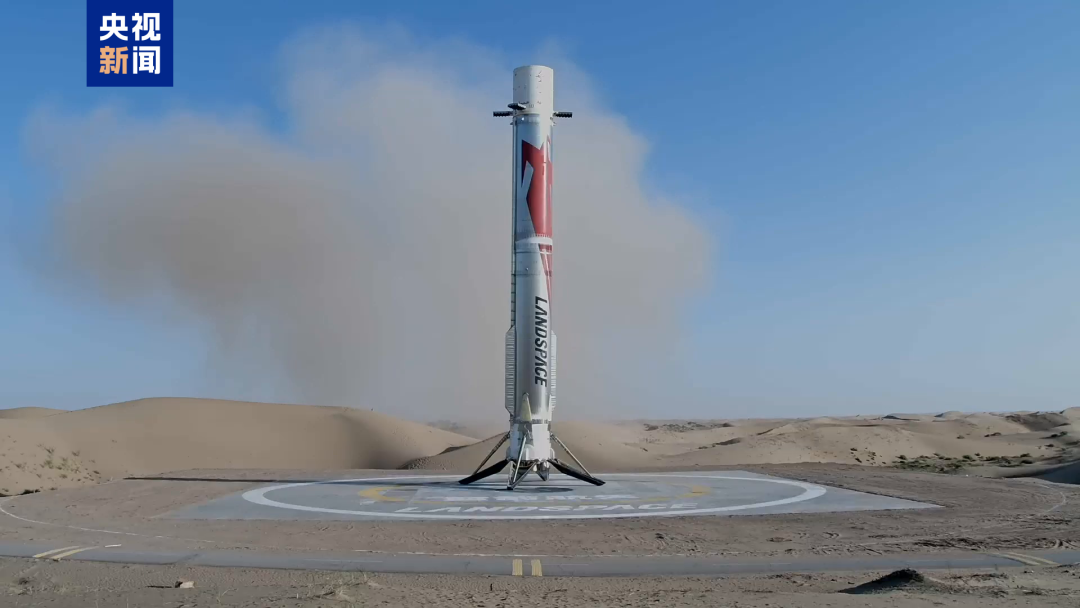
Specifically, after the separation of the first and second stages, the ZQ-3’s first stage commenced its return phase according to the predetermined flight procedure. It completed a series of critical maneuvers, including high-altitude return attitude adjustment, re-entry ignition for power deceleration, aerodynamic gliding control, landing ignition for further deceleration, and deployment of landing legs for cushioning. Ultimately, it achieved a stable landing on a 60m x 60m landing site using its landing legs.
This achievement marks another “zero breakthrough” in China’s rocket recovery domain, following the global first network-based recovery accomplished by China’s Long March 10B on July 10th. This time, the breakthrough lies in landing leg recovery.
As a result, China’s rocket recovery field has now validated two recovery technology routes: 1. Network-based recovery; 2. Landing leg recovery. Moving forward, additional recovery methods will be explored, such as SpaceX’s Starship’s tower mechanical arm mid-air capture recovery, also known as “chopstick recovery.”
LandSpace’s mission system has verified the engineering feasibility of the technical route combining “liquid oxygen-methane propellant, stainless steel rocket body structure, and vertical recovery with landing legs.” Moreover, it successfully launched the Honghu-03 satellite into orbit, demonstrating the closed-loop capability of reusable launch vehicles encompassing “design-production-testing-launch-recovery.”
More importantly, the Honghu-03 satellite represents the first experimental satellite of Hongqing Technology’s “Honghu-3” constellation. It undertakes three pivotal tasks: 1. In-orbit operational validation of three self-developed hardware components: the Baize onboard computer, Chiyu flexible solar array, and Jinwu Hall effect electric propulsion.
It also serves to validate the batch production processes at the Xiong’an Satellite Factory and the feasibility of the constellation’s overall communication scheme.
If all the aforementioned validations are successful, the “Honghu-3” constellation plan will proceed to the batch networking phase.
ZQ-3 + Honghu-3, representing LandSpace + Hongqing Technology, can be seen as China’s private-sector counterpart to SpaceX’s Starlink. The Honghu-3 constellation submitted its application to the International Telecommunication Union in May 2024, with a long-term vision for approximately 10,000 low-Earth orbit communication satellites. It is the third domestic communication satellite plan exceeding 10,000 satellites and the sole low-Earth orbit broadband constellation led by a private enterprise. Its services will rival those of Starlink, providing broadband access, satellite IoT, and emergency disaster relief communications across aerospace, maritime, and remote areas, as well as commercial operation services for enterprise and industry clients.
LandSpace and Hongqing Technology plan to deploy around 5,000 satellites for global coverage by 2030 and complete the full constellation by 2035.
Currently, based on actual flight validation, the ZQ-3 can transport a maximum payload of 14.2 tons into orbit in a single-use state and has the capability for multi-satellite networking with a satellite internet constellation in a recoverable state. This will robustly support the timely implementation of the Honghu-3 constellation plan, considering the time constraints of the plan submitted to the International Telecommunication Union.
LandSpace stated that following the inspection and maintenance of the recovered rocket body, the re-flight mission of the ZQ-3’s recovered rocket body will be executed within six months, striving to establish a closed loop of “launch-recovery-inspection-reuse.”
LandSpace’s successful implementation of landing leg recovery will significantly bolster its IPO progress.
Currently, LandSpace’s IPO application for the Science and Technology Innovation Board has been accepted, with a planned fundraising of 7.5 billion yuan.
There are also market rumors suggesting that “China’s Horse” (a nickname for a potential investor) might invest in LandSpace.
Should this occur, “China’s Horse” would compete with “America’s Horse” (a nickname for Elon Musk) in the commercial space sector.
Alibaba has also reaped substantial benefits from investing in and supporting national strategies, with its investment in Changxin Storage yielding a paper profit of over 150 billion yuan.
Alibaba and other internet companies should not confine their focus to the meager profits in vendors’ pockets but should venture into the vast expanse of space and serve national strategies! After all, “America’s Horse” has set a precedent, becoming the world’s first billionaire with assets exceeding 1 trillion US dollars.
Incidentally, Unitree Robotics, a leader in the embodied artificial intelligence field, is also set to list on the Science and Technology Innovation Board today, heralding the arrival of another future era.
Returning to the commercial space sector, currently, China’s commercial space development has fostered a competitive landscape where the national team and private enterprises collaborate, with parallel development of various technical routes.
Next, Galactic Energy’s Pallas-1 is scheduled for its maiden flight in mid-to-late August; Jianyuan Technology’s Yuanxingzhe-1 is expected to have its maiden flight by the end of the year; i-Space’s Hyperbola-3 plans for its maiden flight and maritime recovery by the end of the year; Orient Space’s Gravity-2 is anticipated to be ready for its maiden flight in the fourth quarter; Deep Blue Aerospace’s Nebula-1 has completed all power system tests before its maiden flight.
-
![]()
Securing 2 Billion Yuan in Financing and Supplying Inno-Light: This Optical Device Company Launches Its IPO!
-
![]()
Farewell to 'Card Stacking': 2026 Marks China's Computing Power Shift to 'Token Value Output' Era
-
![]()
Xiaomi Weathers Storage Price Surge, Q2 2026 Revenue Tops 100 Billion Yuan Again
-
![]()
Geely Bids Farewell to the 'Li Shufu Era': A Historic Power Transition in China's Auto Industry | Auto Circle
-
![]()
Baidu Prepares for Inclusion in Southbound Trading: Wall Street Reassesses the Value of 'AI ETF'
-
![]()
Revenue and Net Profit Dip, GPU Cloud Rockets 283%: Baidu’s AI Strategy Hits Payoff Period
-
![]()
How to Leverage AI Digital Humans for Overseas Live Streaming and Key Precautions
-
![]()
Can L1, the Shargeek AI Glasses That Once Stopped Production Voluntarily, Make a Resurgence? A Firsthand Account