Alibaba Leads the Way: Shareholders Start Footing the Bill for AI's Burning Costs
 08/26 2026
 458
458
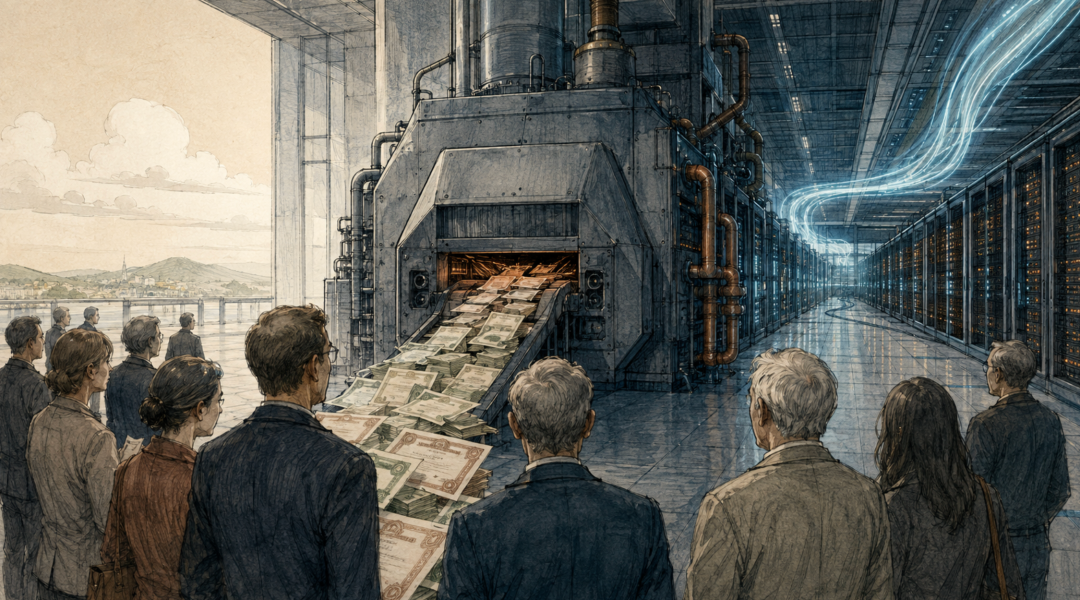
HK$80 Billion Placement: Shifting the AI Bill to Equity
Author|Dingshan
Editor|Xiaobai
Illustrations|AI Generated
Produced by|Qiangdiao Next
Mr. Ma Steps In to 'Save the Day'. On August 24, Alibaba's Hong Kong-listed shares closed down 8.54%, with the stock price at HK$112.5, slightly below the placement price of HK$112.7. The previous day, Alibaba announced the placement of 710 million new shares, raising HK$80 billion, with net proceeds to be fully invested in full-stack AI capabilities and infrastructure.
On the 25th, Jack Ma, Joe Tsai, and Eddie Wu successively used personal funds to buy Alibaba shares, expressing confidence and 'sincerity.' The root of the problem lies in the financial reports. Over the past week, major companies such as Alibaba, Tencent, Baidu, and Kuaishou have released their second-quarter financial reports. From these reports, it is evident that the pressure on large firms' AI spending is increasing and undergoing a significant change.
In the past, the costs of models and computing power were primarily hidden within R&D expenses, capital expenditures, and profit margins. Now, they are beginning to affect free cash flow, equity structure, and resource allocation among different business units. Model performance remains crucial, and large firms show no signs of stopping their AI spending. However, the second-quarter financial reports have made another issue more apparent: the ability to continuously pay the AI bill is becoming a more stable competitive variable than single-model rankings.
───
01
Large Firms' AI Investments Exceed Seasonal Cash Flow ■
Alibaba faces the most intuitive (direct) pressure. As of the end of June, Alibaba held RMB 474.5 billion in cash and other liquid investments, with RMB 22.9 billion in cash flow generated from operating activities in the second quarter. Capital expenditures during the same period reached RMB 67.68 billion, a 75% year-on-year increase, resulting in a net outflow of RMB 44.67 billion in free cash flow. While Alibaba is not short on liquidity, the speed of its computing power investments has clearly surpassed the generation of operating cash flow for the quarter. Tencent is in a similar position. Its capital expenditures for the second quarter were RMB 52.78 billion, a 176% year-on-year increase, with free cash flow turning from a net inflow in the same period last year to a net outflow of RMB 13.8 billion. Fortunately, Tencent still has stable profit sources from gaming, advertising, and fintech, allowing it to absorb these investments in the short term. However, the negative free cash flow indicates that AI has transitioned from an R&D project on the income statement to a long-term project on the balance sheet.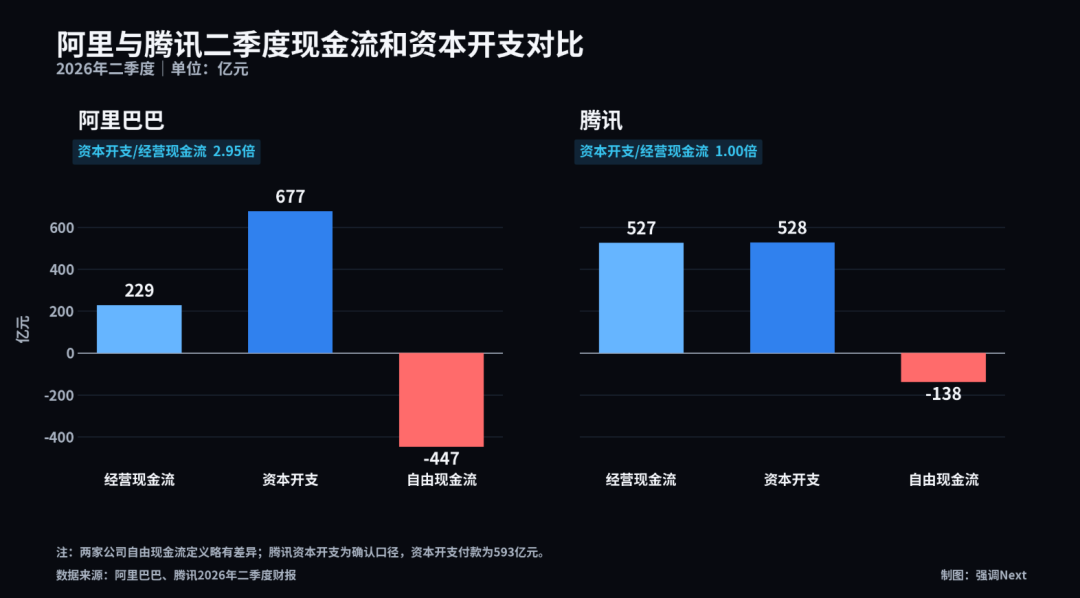
Capital expenditures do not fully appear on the income statement in the period they are paid. Data centers and chips are first recognized as fixed assets and then gradually affect profits through depreciation, while cash flows out at the time of procurement. Therefore, observing AI investments by looking only at net profit underestimates the current funding pressure, while focusing solely on capital expenditures can overlook depreciation costs over the next few years.
Kuaishou and Baidu face pressure from another angle. Kuaishou's revenue grew by 1.4%, while adjusted net profit fell by about 30%. As Kuaishou increases its investment in Kling, its short-video business also needs to maintain profits and shareholder returns. Baidu's operating cash flow remained at a net inflow of RMB 3.4 billion in the second quarter, but its financial capacity to continue investing in cloud, models, chips, and autonomous driving is being strained by its legacy businesses. The first divergence among large firms in the second quarter occurred between cash flow from core businesses and AI investments. Those whose legacy businesses can still provide stable funding have a longer investment horizon.
───
02
AI Generates Revenue but Hasn't Covered Costs Yet ■
Large firms are not without revenue from AI; it's just that revenue and costs are positioned differently along the industrial chain. Alibaba, for the first time this quarter, split its AI operations into two income statements. AI cloud and computing power services generated RMB 48.44 billion in revenue, a 45% year-on-year increase, with adjusted EBITA of RMB 5.63 billion, a 133% year-on-year increase. Among this, AI-related product revenue was RMB 12.38 billion, marking the twelfth consecutive quarter of triple-digit growth. Corporate procurement of computing power, model services, and cloud resources has already generated revenue, and infrastructure is beginning to release operational leverage. Models and applications, however, remain in a different state.
Alibaba's AI labs and application revenue were RMB 3.34 billion, with an adjusted EBITA loss of RMB 13.86 billion, a loss expansion of over RMB 10 billion year-on-year. The profit generated by Alibaba Cloud in one quarter cannot even cover half of the losses from models and applications, with larger-scale infrastructure investments remaining on the capital expenditures side. The faster Qianwen's user base grows, the faster inference costs increase, posing a significant challenge to the business model. The story of AI-powered e-commerce has not yet proven successful, and even if it does in the future, it will not address immediate needs. As a result, it is evident that the intensity of competition among large firms for AI entry points has significantly decreased this quarter, replaced by a 'race for AI office entry points,' where revenue can be seen more quickly. Tencent, Alibaba, and ByteDance have successively completed organizational and product adjustments for their AI office products, with the next quarter being a critical stage to see results.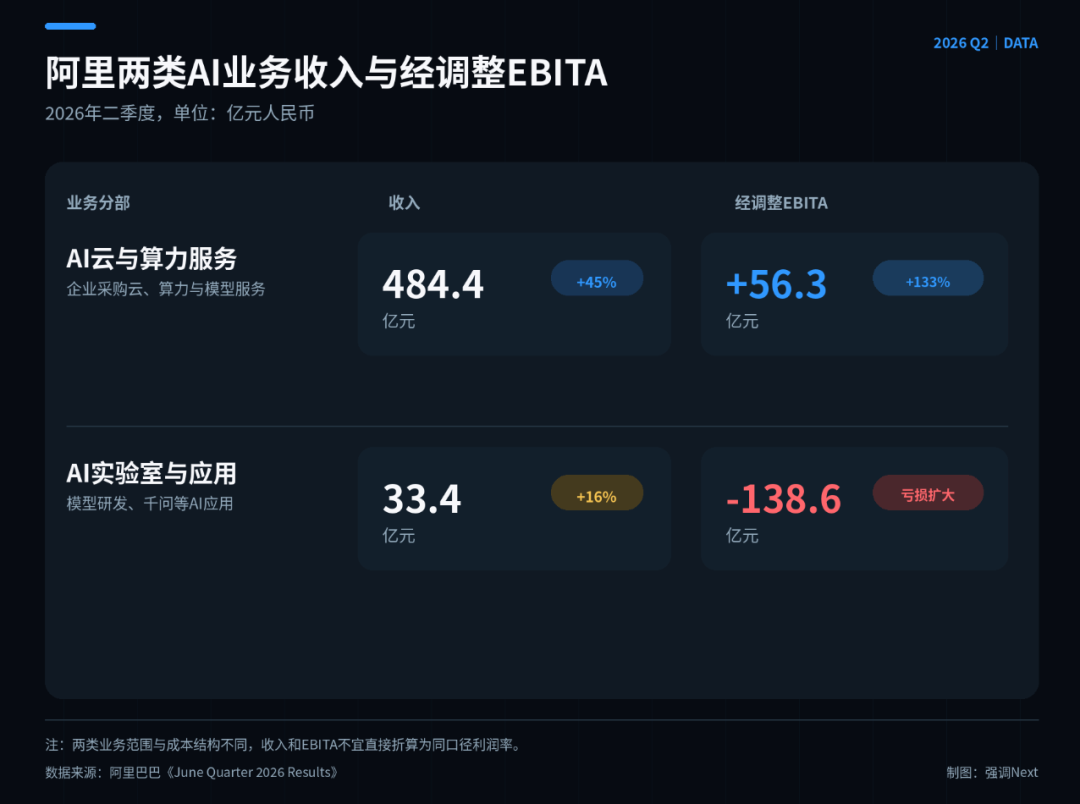
Tencent's revenue shows a similar stratification. Marketing service revenue grew by 22% to RMB 43.57 billion in the second quarter, with AI recommendations, ad placements, and content generation already integrated into WeChat's advertising revenue chain. However, new AI products like Hunyuan, Yuanbao, CodeBuddy, and WorkBuddy reduced non-IFRS operating profit by about RMB 10.5 billion. The first financial returns from AI come from advertising efficiency, while native AI products continue to consume profits.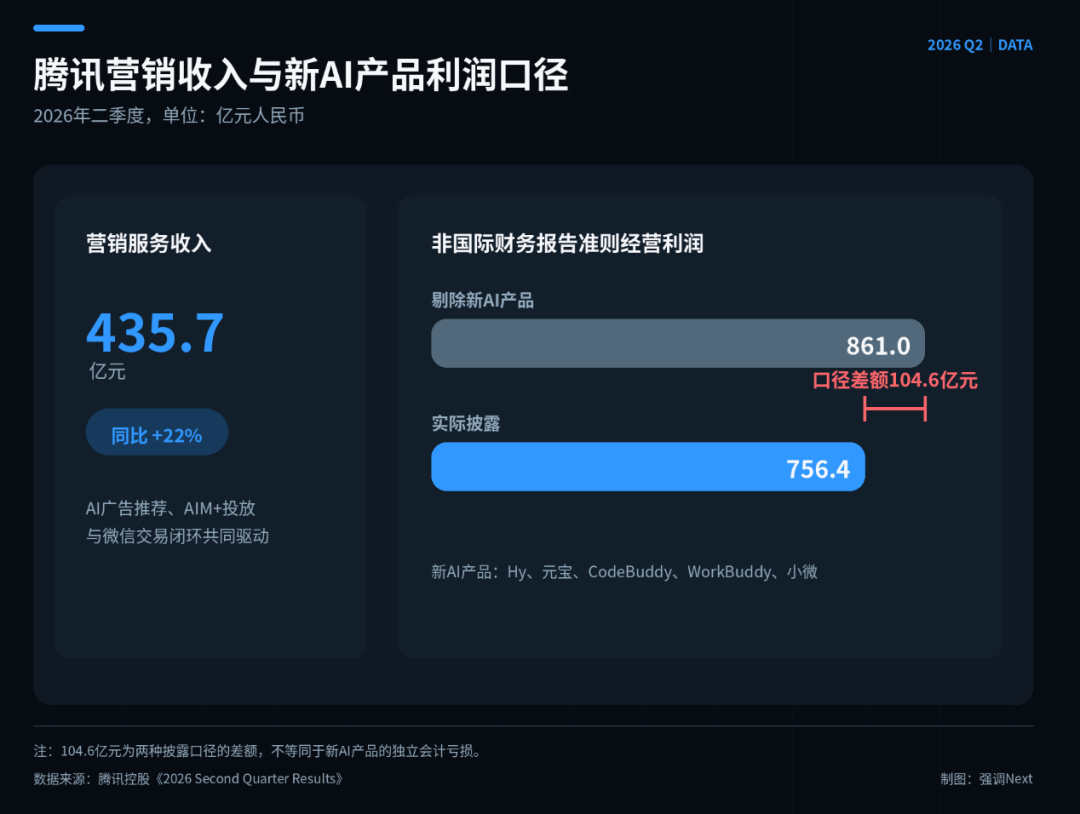
Kuaishou's Kling is already one of the few domestic generative AI applications with visible revenue scale. Kling's revenue exceeded RMB 850 million in the second quarter, a more than 200% year-on-year increase, but it only accounted for about 2.4% of Kuaishou's total revenue. It proves that there is demand for paid video generation, but its current scale is insufficient to alter the group's profit structure.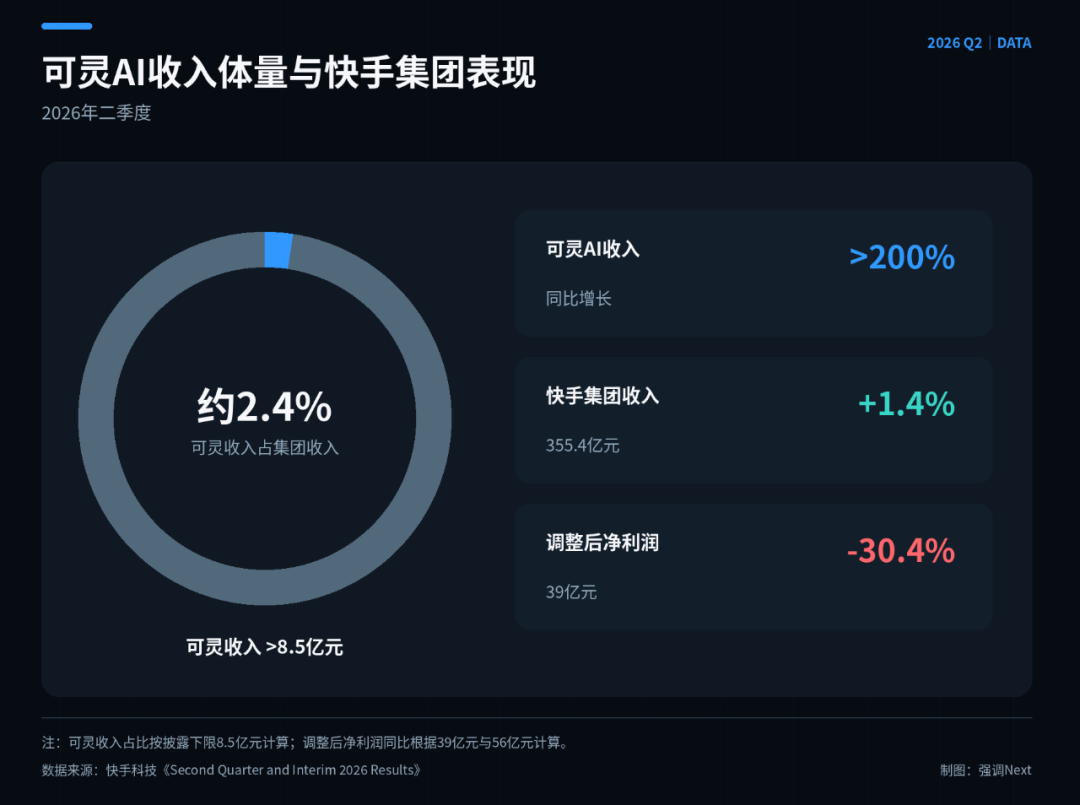
Baidu's situation goes further. Revenue from its core AI business reached RMB 12.5 billion in the second quarter, a 25% year-on-year increase, accounting for half of its general business revenue. Among this, AI cloud infrastructure revenue was RMB 7.3 billion, a 50% year-on-year increase. However, Baidu's total general business revenue still declined by 4%. While Baidu's new AI businesses are growing rapidly, their transformation speed has not yet surpassed the pace of revenue structure changes.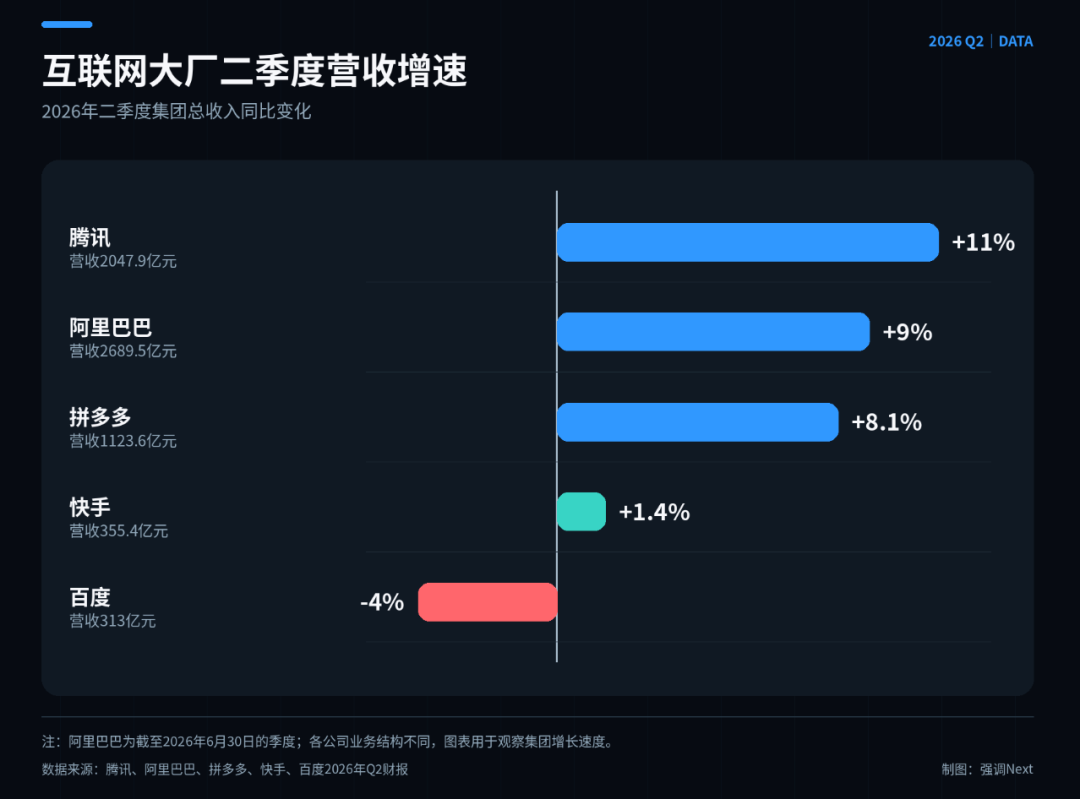
These financial reports all indicate that the first areas where AI delivers returns are cloud computing, advertising, and infrastructure, for which enterprises already have budgets. General-purpose consumer assistants and model R&D remain cost centers. Open-source models like DeepSeek continue to lower the technical barrier to catch-up and drive down model invocation prices. At this stage, the window for model leadership may only last a few months, while data centers and chips take years to recover costs. The mismatch between long-term capital and rapid technological depreciation is the most challenging contradiction in large firms' AI investments today.
───
03
AI Investments Won't Stop, but Funding Methods Diverge ■
The second-quarter financial reports reveal funding pressures, while Alibaba's financing and ByteDance's organizational adjustments offer solutions from different companies. Tencent currently relies primarily on internal funds. Profits from gaming, advertising, and fintech cover model and computing power investments, while products like WeChat can directly absorb AI capabilities. This model avoids equity dilution and has relatively low funding costs. The trade-off is reduced cash available for buybacks, dividends, and other investments. Internal funds also have opportunity costs, even if they are not immediately reflected in new share issuances. Alibaba has chosen to introduce shareholder funds at the group level. The HK$80 billion placement price was discounted by 8.4% from the previous closing price, with new shares accounting for about 3.6% of the enlarged equity. The discounted issuance itself pulls the secondary market stock price toward the placement price, so the August 24 decline cannot be entirely interpreted as market rejection of AI. The placement received about US$28 billion in orders, indicating that long-term funds are still willing to enter. The market's attitude is that capital can continue to support AI, but it demands a lower entry price and requires Alibaba to prove that future returns can cover equity dilution.
After the placement, Alibaba's core management also responded with personal funds. Public information from the Hong Kong Stock Exchange shows that Joe Tsai increased his holdings of Alibaba's Hong Kong-listed shares for two consecutive days, amounting to about HK$160 million, while Eddie Wu increased his holdings by about HK$40 million, totaling over HK$200 million. According to a report by Kechuangban Daily citing sources, Jack Ma recently increased his holdings of Alibaba's Hong Kong-listed shares by over HK$600 million.
However, even when including all three individuals' increases, the scale is only about 1% of the HK$80 billion financing. This aligns management's risks more closely with those of ordinary shareholders but neither eliminates equity dilution nor replaces the need to validate AI investment returns.
Kuaishou has placed its financing at the Kling AI level. In July, Kling secured over RMB 19 billion in financing, with a pre-money valuation of about US$15 billion. Investors include Tencent, Alibaba, and Baidu. After the transaction, Kuaishou is expected to retain about 68.3% of the shares. External investors bear a portion of R&D and inference costs and share in future valuation gains. Kuaishou retains controlling interest while limiting dilution to the AI subsidiary rather than the entire publicly traded company. Baidu is preparing to take a similar approach to the public market.
In January, Baidu officially announced the spin-off of Kunlunxin and applied for an independent listing in Hong Kong. In May, Kunlunxin initiated guidance for a listing on the STAR Market. Currently, Baidu holds about 57.7% of Kunlunxin's shares. According to a report by Reuters citing The Information, Kunlunxin seeks a Hong Kong IPO valuation of about US$50 billion, exceeding Baidu's market capitalization. Kling operates at the application layer, while Kunlunxin operates at the computing power layer, but their independent financing follows a similar financial logic. Subsidiaries can have their own balance sheets and valuations, reducing continuous investment pressure on the parent company. However, the trade-off is diluted shareholdings, with AI assets' future profits and valuation gains shared with new shareholders.
Alibaba's group-level issuance preserves the benefits of a complete business chain but immediately imposes dilution on all shareholders. The two approaches represent different risk allocations. ByteDance has not yet entered public market financing, but its recent integration of the TRAE and Kouzi teams into the Doubao system reflects a constraint on investment efficiency. Office, agent, and programming products now share brands, models, traffic, and commercialization systems. ByteDance is also learning from Tencent by reducing redundant products and teams instead of continuing to expand more independent entry points.
Thus, four funding paths have emerged in the large firms' AI competition. Tencent relies on internal funding from legacy businesses, Alibaba issues new shares at the group level, Kuaishou secures independent financing for its AI applications, and Baidu promotes the spin-off and listing of its chip assets. Different paths have no inherent superiority; the key lies in how capital prices, control rights, and future returns are allocated.
In the next financial reporting season, model rankings and invocation volumes will still attract attention, but more valuable indicators will be free cash flow after capital expenditures, incremental profits from AI businesses, and the financing costs companies pay for their next investments. Alibaba's HK$80 billion placement simply brings this shift to the forefront. AI investments will not stop, and shareholders are now demanding a clearer bill.
Data Sources: Second-quarter 2026 financial reports and announcements from Alibaba, Tencent, Kuaishou, Pinduoduo, and Baidu; public reports such as Alibaba's placement announcement. This article does not constitute investment advice.
- END -
-
![]()
Xiaopeng’s New Car is Popular, but Financial Results are Less Impressive
-
![]()
Dialogue with Lv Wenbin from Great Wall Motors: The 30,000+ Orders for Great Wall H10 is Just the Beginning!
-
![]()
Can Xiaomi Pengcheng N90 and N70 Recreate the 'Success Story' of the SU7?
-
![]()
Can Stellantis Revitalize Jeep’s Domestic Production in China via the ‘New Dongfeng Peugeot Citroen Automobile’ Initiative?
-
![]()
Xpeng's Q2 2026: Automotive Losses, Service Gains, and a Narrative Shift Toward Robotics
-
![]()
XPENG Motors Reports H1 Loss of 3.12 Billion Yuan, Accumulated Losses Hit 45.91 Billion Yuan
-
![]()
[In-depth Report] From 'Being Seen' to 'Being Remembered': The Next Big Battle for Chinese Automotive Design
-
China Mobile’s Mid-Year Earnings Dip: Telecom Service Revenue Falls, AI Business Struggles to Grow