The Final Frenzy? Has the Pivotal Moment Arrived? Sales of Several Emerging Auto Brands Set New Records
 12/02 2025
 477
477
On December 1st, a number of emerging Chinese automotive brands unveiled their sales rankings for November. Hongmeng Intelligent Driving led the pack with over 80,000 units sold. Leapmotor surpassed the 70,000-unit mark, emerging as the year's dark horse. XPeng and NIO also witnessed robust growth, while Xiaomi continued to exceed the 40,000-unit threshold. Additionally, domestic newcomers such as IM Motors, Avatr, and Voyah achieved record-breaking sales.
This raises the question: Is this the final frenzy in China's new energy vehicle (NEV) market, or has the true turning point for the automotive sector arrived?
Hongmeng Intelligent Driving: 81,864 Units
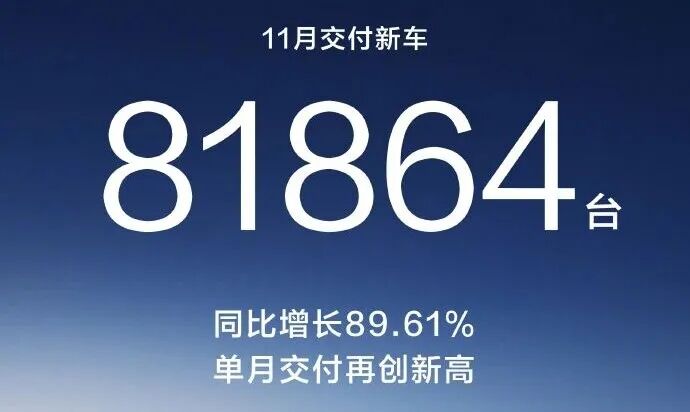
In November 2025, Hongmeng Intelligent Driving delivered a total of 81,864 new vehicles, marking an 89.61% year-on-year increase and setting a new monthly delivery record.
Hongmeng Intelligent Driving's consistent monthly sales records can be attributed to two primary factors. First, the introduction of multiple new models, including the AITO M7, M8, M9, Shangjie H5, Xiangjie S9, and S9T. Second, the official launch of Huawei's advanced intelligent driving system, ADS 4, in April of the same year. All AITO models, Xiangjie S9, and S9T are equipped with ADS 4, while the mid-to-high-end versions of Shangjie H5 also feature this system.
Compared to ADS 3, Huawei ADS 4 adopts a new WEWA technology architecture, comprising a cloud-based World Engine and an onboard World Behavior Model. This results in a 50% reduction in end-to-end latency, a 20% improvement in traffic efficiency, and a 30% decrease in the rate of hard braking. Thus, ADS 4 represents a significant upgrade over its predecessor.
These two factors have been the main drivers behind Hongmeng Intelligent Driving's substantial sales increase since the latter half of the year.
Leapmotor: 70,327 Units
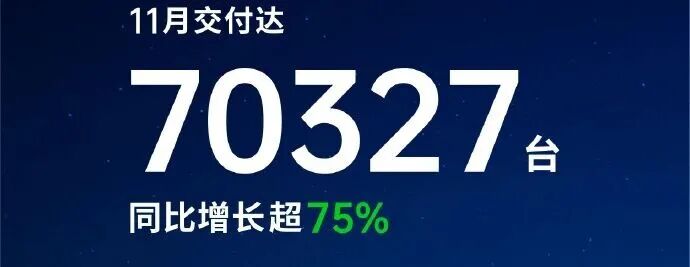
Leapmotor secured the second spot with 70,327 units sold in November, representing a year-on-year increase exceeding 75%. Leapmotor's ascent to the second position surprised many.
Prior to 2023, Leapmotor lagged significantly behind 'Weixiaoli' (NIO, XPeng, and Li Auto) in terms of both reputation and sales, even falling short of Neta and GAC Aion. However, in 2023 and 2024, Leapmotor ranked third among emerging auto brands for two consecutive years. From January to November of the current year, its cumulative sales surged to the top, significantly outpacing the second-place contender. Only by combining the sales of all five brands under Hongmeng Intelligent Driving could they barely compete with Leapmotor.
Leapmotor's sales boom has become a unique phenomenon in China's auto market in 2025.
Xiaomi: 40,000 Units
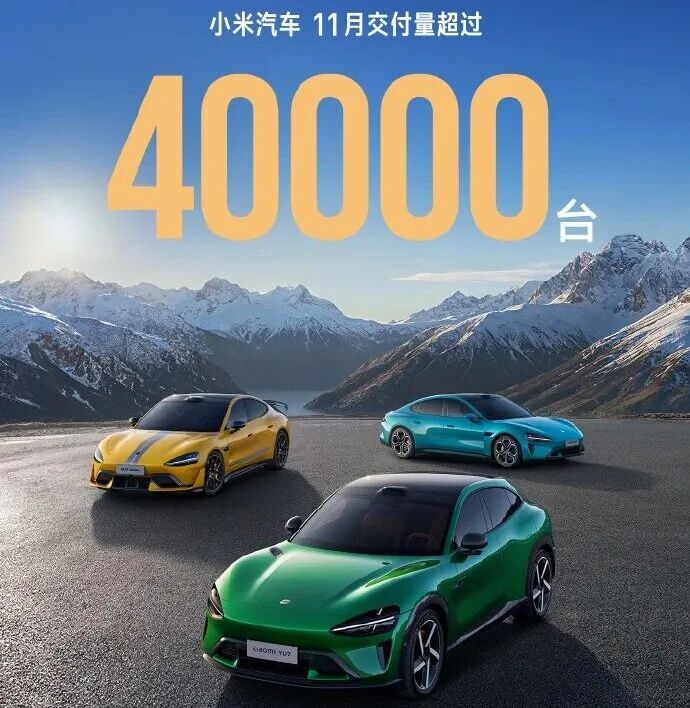
Xiaomi ranked third with 40,000 units sold. From securing over 289,000 orders within an hour of its launch to consistently maintaining monthly sales of 40,000 units, Xiaomi has created numerous highlights among emerging auto brands throughout 2025.
The only drawback was the occurrence of two major accidents on March 29th and October 13th of the current year, coupled with Xiaomi's inappropriate response, leading to a public relations disaster. Consequently, Xiaomi faced widespread criticism throughout the year, resulting in the replacement of its PR general manager, Wang Hua, and a transformation in founder Lei Jun's public image from approachable to cautious and reclusive.
However, judging by Xiaomi's consistent monthly sales in recent months, these negative evaluations appear to have had minimal impact on its sales performance.
XPeng: 36,728 Units
In November 2025, XPeng delivered 36,728 new vehicles, marking a 19% year-on-year increase. From January to November 2025, XPeng's cumulative deliveries reached 391,937 units, up 156% year-on-year.

NIO: 36,275 Units
In November 2025, NIO delivered 36,275 new vehicles, representing a 76.3% year-on-year increase. Among them, the NIO brand delivered 18,393 units, the Onvo brand delivered 11,794 units, and the Firefly brand delivered 6,088 units. To date, NIO has cumulatively delivered 949,457 new vehicles.
Both NIO and XPeng have set new monthly sales records, and both companies have announced plans to achieve quarterly profitability for the first time in the fourth quarter of the current year. From a market positioning perspective, as representatives of the pure electric vehicle sector, their sales growth and enhanced profitability indicate a positive trend for the pure electric vehicle segment. The entire business model is gradually proving viable.
Li Auto: 33,181 Units
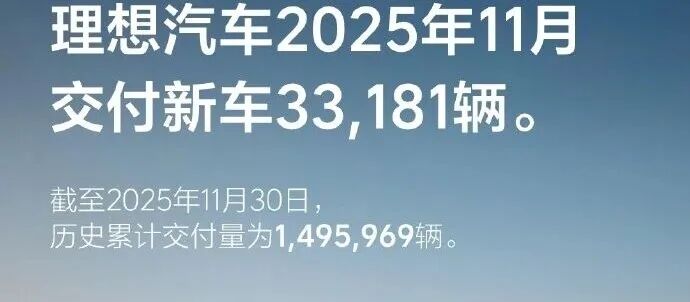
In November 2025, Li Auto delivered 33,181 new vehicles, representing a 31.92% year-on-year decrease. As of November 30, 2025, Li Auto's cumulative deliveries reached 1,495,969 units.
As a former key representative of 'Weixiaoli,' Li Auto is the only one among the three to experience a sales decline, and a significant one at that. This suggests that the extended-range electric vehicle (EREV) route has begun to wane in the Chinese market.
Market analysts predict that Li Auto's pure electric vehicle sales will soon account for over 50% of its total brand sales. This situation further confirms the strengthening of the pure electric vehicle route.
Voyah: 20,005 Units
Voyah delivered 20,005 vehicles in November 2025, representing an 82% year-on-year increase in cumulative sales from January to November. Voyah's surge is primarily attributed to its strategy of aligning closely with Huawei.
Avatr: 14,057 Units
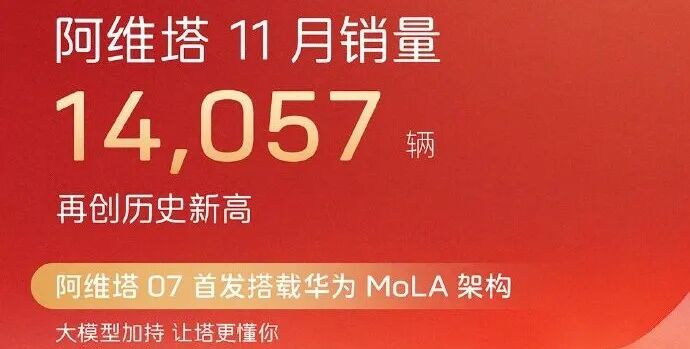
Avatr set a new sales record with 14,057 units sold in November. Similar to Voyah, Avatr's sales growth is mainly due to its deep integration with Huawei, with multiple models equipped with Huawei's intelligent driving system.
IM Motors: 13,577 Units
IM Motors achieved a new sales record with this figure. The primary driver was the launch of the new IM LS6. Not only did the new IM LS6 receive a comprehensive upgrade in configuration, but it also adopted a more competitive pricing strategy, making it more accessible to consumers. The subsequently launched IM LS9 followed a similar approach. The IM LS9 52 Ultra version is equipped with a 55 kWh extended-range battery and is priced at just 322,800 yuan, nearly 100,000 yuan cheaper than extended-range vehicles like the Li Auto L9 and AITO M9. This suggests that IM Motors' brand influence will continue to rise.
In fact, not only IM Motors but also Voyah, Avatr, and Arcfox have gradually begun to find their own market rhythms. IM Motors proactively adjusted its brand positioning, not only venturing into the extended-range vehicle market but also significantly lowering its prices to enhance competitiveness. Avatr and Voyah both chose to embrace Huawei's intelligent driving technology, aiming to ride on Huawei's coattails. Arcfox further refined its high-end positioning by launching the A0-segment Arcfox T1 and the Arcfox Alpha T5. The Arcfox T1 is priced at just 62,800 yuan, while the Arcfox Alpha T5's starting price dropped from the original 155,800 yuan to around 100,000 yuan in 2025. To some extent, Arcfox is reverting to BAIC New Energy's old strategy of producing affordable and compact vehicles, albeit with improved quality.
For new energy vehicles, especially pure electric vehicles, November was somewhat frenetic. The reason is that the end of the year is approaching, and according to relevant national industrial policies, starting from 2026, the policy of full exemption from purchase tax for new energy vehicles will be adjusted to a 50% reduction, and the technical thresholds for vehicle eligibility will be raised accordingly. This means some older models that do not meet the standards will no longer qualify for the policy. This has prompted many consumers to place orders for their desired models before the new regulations take effect.
Market insiders in the automotive parts industry have revealed to us that the recent sales boom in the new energy vehicle market has, to some extent, preempted demand for the first quarter of next year.
According to public data, in October of the current year, new energy vehicle sales accounted for over half of the total, reaching 51.6%.
This raises the question: Is the November sales surge for new energy vehicles a pre-subsidy-reduction frenzy, or has the turning point arrived where the sales share between fuel-powered and new energy vehicles is gradually widening? The market will soon reveal the answer.
-
![]()
ByteDance, DJI, and Xiaohongshu Secure Top Three Positions Among China’s Fastest-Growing Unicorns
-
Tesla's in-car voice system in China is finally learning to 'understand human language'
-
![]()
Foreigners Are Amazed: Chinese Electric Vehicle Drive Systems Unveil Innovative 'Poses'
-
![]()
700,000 Brothers and the Future of Robots: Behind JD.com's 'Nirvana Plan'
-
![]()
Zhipu's Trillion-Dollar Valuation: A New Chapter for China's AI
-
![]()
Is Laifen, a 'Dyson Alternative' on the Rise, Now Ensnared by the 'Alternative Curse'?
-
![]()
Beyond Patents: Insta360 and DJI Compete in Retail
-
![]()
Piercing Through Industry Chaos: The Curtain Rises on Compliance for Autonomous Driving