Li Auto Plummets by 30%! Is BYD Also 'in Trouble'? November Sales Rankings for New Energy Vehicles Unveiled
 12/03 2025
 493
493
Written by | Auto Observer
While LanTu soared with an over 84% year-on-year increase, Li Auto hit the brakes in the 'family car segment,' experiencing a 32% decline. Even BYD, a long-standing market leader, reported a rare 5.77% year-on-year drop.
As illustrated below, Auto Observer has compiled statistics on the sales fluctuations of key domestically produced new energy vehicles for November 2025, based on the latest disclosures. It's truly a tale of contrasting fortunes.
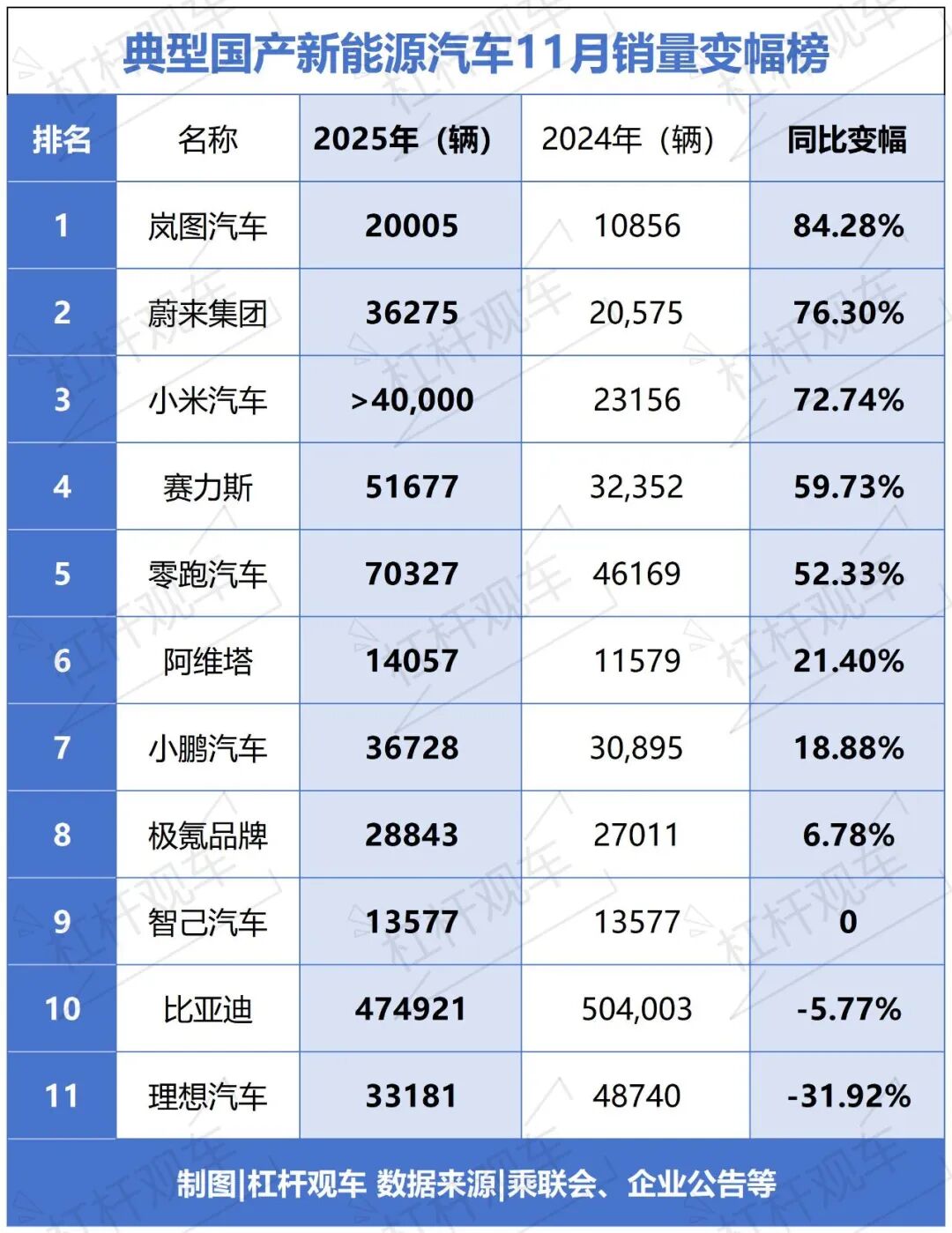
In November of this year, LanTu led the pack among 11 automakers with a growth rate exceeding 84%, closely followed by NIO at 76.3%. Xiaomi secured the third spot with approximately 72.74% growth, while Seres and Leapmotor claimed the fourth and fifth positions, respectively. It's noteworthy that Leapmotor's official year-on-year growth data exceeds 75%. However, Auto Observer's calculation, based on publicly disclosed data, yields 52.33%. Given the uncertainty regarding which part of November 2024's data Leapmotor used for its 75% growth claim, I have chosen to rely on the data I calculated from public disclosures.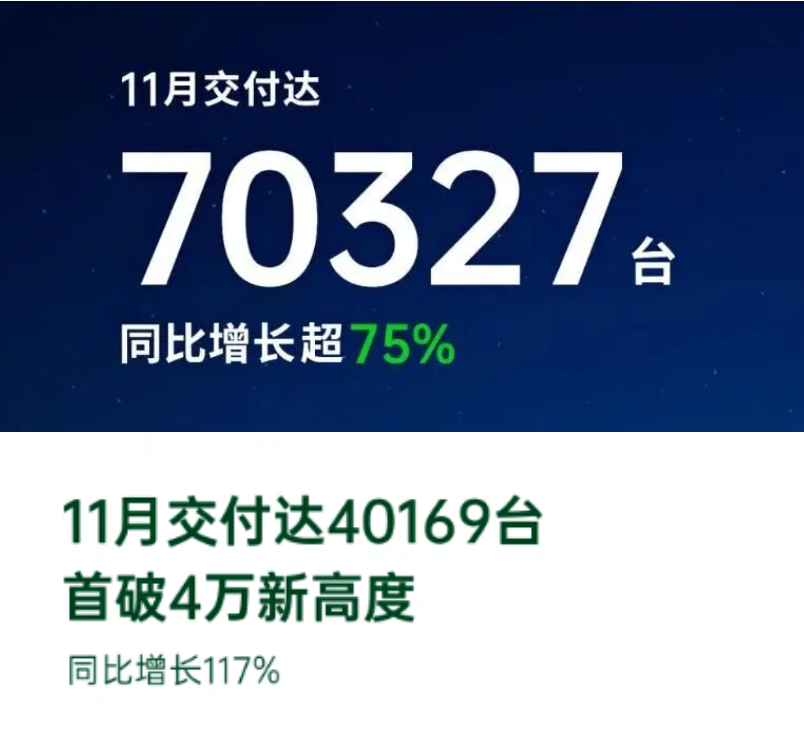
LanTu, supported by Dongfeng, has indeed garnered attention by claiming the top growth spot among these prominent automotive brands. Naturally, this is also tied to its relatively small sales base. Coupled with the impact of new vehicle launches and channel expansion in 2025, its subsequent performance is eagerly anticipated.
NIO Group's November sales surged by 76% year-on-year, showcasing the initial success of its multi-brand strategy (encompassing 'NIO, LEAPMOTOR, and firefly') and cost control measures. Meanwhile, the company's operational quality saw significant improvement, with its third-quarter vehicle gross margin rebounding to 14.7% and cash flow turning positive. Founder William Li has even outlined a clear profitability timeline, aiming for full-year profitability in 2026.
Xiaomi is no stranger to the spotlight; it made a remarkable entrance, instantly becoming a top contender with leading sales figures. However, in recent months, negative sentiment and controversies surrounding Xiaomi's vehicles have surged. More attention should thus be directed towards the sustainability of its sales in the future.
Seres has forged a deep integration with Huawei. Although its sales growth has slowed compared to previous periods, it remains steady. Nevertheless, with Huawei expanding its collaborative models (such as Luxeed and Enjoy), Seres must strategize on how to solidify its unique selling proposition and enhance profitability.
Leapmotor has made significant strides this year, positioning itself at the forefront in terms of both total sales and growth rate. Its success stems from its commitment to full-domain self-research and an extreme cost-performance strategy. By significantly reducing costs, Leapmotor has established a strong foothold in the mainstream market segment of RMB 100,000-200,000. Moving forward, Leapmotor needs to elevate its brand image through technological innovations (such as extended-range capabilities and intelligent driving) while maintaining its cost advantage, steering clear of a mere price war.
Additionally, there are three automakers with moderate growth: Avita, XPeng, and Zeekr. Amidst a generally positive outlook for the new energy vehicle industry, their growth rates, though not overly optimistic, are still preferable to declines. IM Motors presents a particularly intriguing case, with November sales remaining flat year-on-year—a rather striking coincidence. The two declining automakers that warrant attention are Li Auto and BYD, with November sales dropping by 31.92% and 5.77% year-on-year, respectively.
Li Auto experienced the steepest decline on the list, reflecting the growing pains of its strategic transition from extended-range to pure electric vehicles. Its successful positioning targeting family users and extended-range solutions are now facing stiff competition from strong contenders like Huawei's AITO. Meanwhile, the overall growth of the extended-range market has slowed, while Li Auto's pure electric models (MEGA, i-series) have yet to fully emerge as growth drivers. The company even reported a net loss in the third quarter, ending its streak of consecutive profits. With ample cash reserves and a clear AI technology roadmap, Li Auto's immediate priority is to stabilize the L-series' market position while accelerating the production ramp-up and market acceptance of its pure electric models to swiftly return to growth.
As the overall volume leader, BYD's decline this time is more of a normal adjustment following a 'giant's pivot' and industry diversification. Sustaining growth on a high base is inherently challenging. BYD's competitive edge lies in its cost advantage derived from full-industry-chain control and rapid technological iteration capabilities. In the short term, it needs to streamline its multi-brand strategy to prevent internal cannibalization; in the long term, its image in the intelligent driving sector still requires enhancement. While temporary growth fluctuations do not undermine its industry dominance, the market holds it to stricter standards.
In summary, the sales fluctuations in November 2025 serve as both a retrospective of the past year and a forward-looking indicator.
The meteoric rise of brands like LanTu and Xiaomi, alongside the deceleration of BYD and Li Auto, all signal that this market is far from settled, with ongoing reshuffling.
Charts in this article without cited sources are derived from publicly disclosed information from various channels. Special thanks are extended for this. The views expressed herein are for reference only and do not constitute investment advice.
-
![]()
ByteDance, DJI, and Xiaohongshu Secure Top Three Positions Among China’s Fastest-Growing Unicorns
-
Tesla's in-car voice system in China is finally learning to 'understand human language'
-
![]()
Foreigners Are Amazed: Chinese Electric Vehicle Drive Systems Unveil Innovative 'Poses'
-
![]()
700,000 Brothers and the Future of Robots: Behind JD.com's 'Nirvana Plan'
-
![]()
Zhipu's Trillion-Dollar Valuation: A New Chapter for China's AI
-
![]()
Is Laifen, a 'Dyson Alternative' on the Rise, Now Ensnared by the 'Alternative Curse'?
-
![]()
Beyond Patents: Insta360 and DJI Compete in Retail
-
![]()
Piercing Through Industry Chaos: The Curtain Rises on Compliance for Autonomous Driving