In November, Wasn't Leapmotor the Sales Leader Among the Emerging Automakers?
 12/05 2025
 798
798
On December 1st, major emerging automakers successively released their sales reports for November. Among them, HiMode took the top spot with 81,864 deliveries, closely followed by Leapmotor with 70,327 units. Together, they formed the 'first tier' of these new players. Xiaomi Auto maintained monthly sales exceeding 40,000 units for three consecutive months. Of course, a few emerging automakers also experienced sales declines.
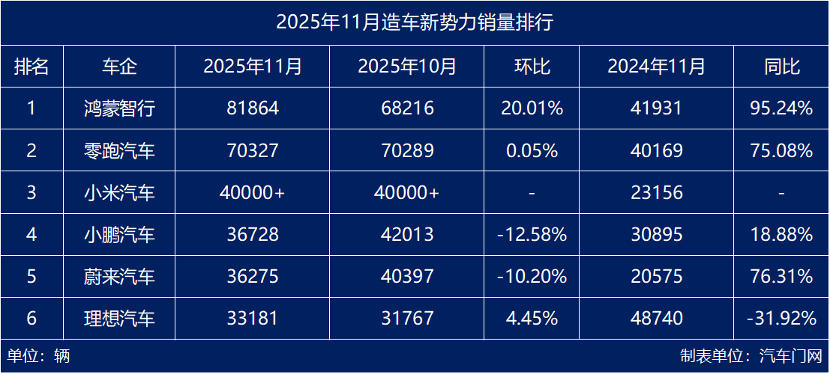
In November, HiMode delivered a total of 81,864 units, marking a 95.24% year-on-year increase and setting a new record for monthly deliveries. This achievement remains unmatched by any other emerging automaker, truly making it stand out.
Specifically, the AITO brand continued to be the main sales driver, with the AITO M7, AITO M8, and AITO M9 maintaining strong sales momentum. According to the production and sales report released by Seres Group, Seres Auto sold a total of 51,677 units. The Luxeed brand achieved delivery breakthroughs of over 10,000 units for two consecutive months, with the Luxeed R7 and Luxeed S7 showing gradual improvements after their refreshes. The Enjoyal brand sold 6,000 units, with Zunjie deliveries increasing to 2,500 units, and the Shangjie model, Shangjie H5, surpassing 10,000 monthly deliveries in November.
Today, HiMode's product lineup is becoming increasingly diverse. It is reported that HiMode's first flagship 9-series MPV has started its pre-launch promotions, and this model may be launched under the Luxeed brand. Zunjie also plans to introduce multiple new models next year, covering both SUVs and MPVs. Meanwhile, the next model from the AITO brand, the M6, has already been revealed by external sources. At that time, HiMode's delivery volume is expected to continue growing, striving to reach annual sales of one million units.

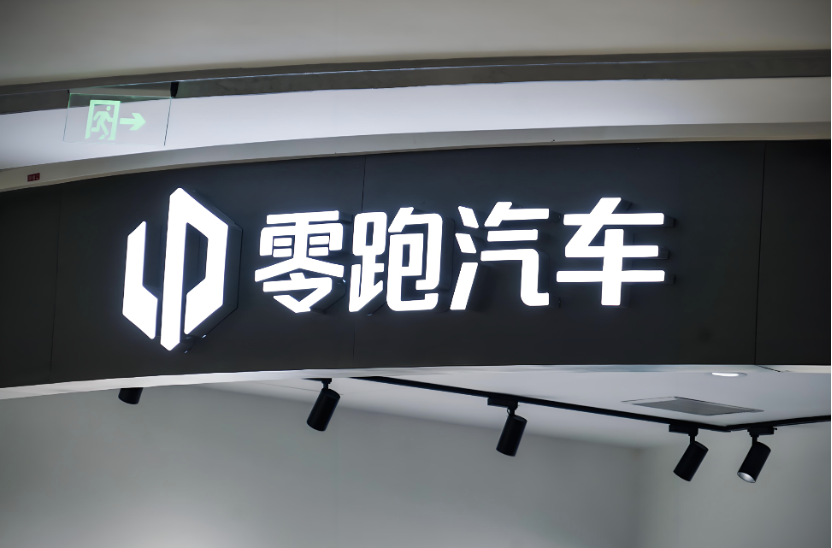
Although surpassed by HiMode in total deliveries, Leapmotor remains the champion among single brands. Over the past month, Leapmotor delivered a total of 70,327 units, marking a 75.08% year-on-year increase and setting another new record. Since March this year, Leapmotor Auto has maintained growth for nine consecutive months, enabling it to achieve its 2025 sales target 45 days ahead of schedule.
This year, Leapmotor's new products have all featured 'high specifications at affordable prices,' which is the core reason for its outstanding performance among numerous emerging automakers. Currently, models such as the Leapmotor C10, Leapmotor B01, Leapmotor C11, and Leapmotor B10 generally have monthly sales exceeding 10,000 units, all being popular models in their respective segments. Recently, the personalized compact car Leapmotor Lafa5 officially launched, with an official guide price ranging from 92,800 to 116,800 yuan. Some public opinions point out that with the combined efforts of multiple products, Leapmotor will aim to break the annual sales barrier of 600,000 units in December.
Next, Leapmotor has a stack of new models ready to be introduced. Currently, the first model from the all-new A platform, the A10, has made its debut at the Guangzhou Auto Show. The new energy flagship SUV, Leapmotor D19, will be delivered next year, targeting a higher price segment. Additionally, a new model developed in collaboration with FAW is also expected to be released next year. The arrival of multiple new models will solidify Leapmotor's market position. Cao Li, Senior Vice President of Leapmotor, stated that next year, Leapmotor will aim for 1 million deliveries.
In November, Xiaomi Auto also maintained strong growth momentum. Data shows that Xiaomi Auto delivered over 40,000 units, marking the third consecutive month of exceeding 40,000 units. Currently, Xiaomi Auto has already achieved its annual sales target of 350,000 units ahead of schedule. According to Chairman Lei Jun, Xiaomi Auto is expected to deliver over 400,000 units this year.
Recently, Xiaomi Auto's production capacity has been continuously improving, significantly shortening the delivery period. Among them, the delivery period for the Xiaomi SU7 has been shortened to 3-6 weeks, while the Xiaomi YU7 has a delivery period of approximately 28-38 weeks. To enable users to take delivery as soon as possible, Xiaomi Auto recently launched a spot car purchase plan (including brand-new spot cars, official show cars, and near-new cars), with some models offering discounts. This can also promote the conversion of Xiaomi Auto's orders. However, some media have pointed out that the launch of the 'spot car purchase' plan inadvertently sends two signals: either the models are about to undergo updates, or the supply-demand relationship may no longer be imbalanced.
Nevertheless, both scenarios indicate that Xiaomi Auto is at a critical juncture. It should also be noted that Xiaomi Auto is currently facing public opinion and trust crises, and how to properly handle these noisy voices has become an unavoidable challenge for the company.
Over the past month, XPeng's market performance has fluctuated. Data shows that in November, XPeng delivered a total of 36,728 units, marking an 18.88% year-on-year increase but a 12.58% month-on-month decrease.
Specifically, models such as the XPeng P7+, XPeng MONA M03, and XPeng G7 remained popular. Meanwhile, the XPeng X9 Super Extended-Range Edition, officially launched in November, quickly received a surge in orders, setting a new single-day record for the X9 series within one hour of launch, and may become a new growth driver for XPeng's sales.
As for why XPeng's sales declined month-on-month in November, some public opinions point out that the nationwide decline in trade-in subsidies has become the most crucial factor for the sales drop. Other analyses suggest that a large number of users are waiting for the Super Extended-Range versions of the XPeng P7+, XPeng G6, and XPeng G7, causing a slowdown in sales of the pure electric versions.
XPeng's sales decline this time is a temporary fluctuation rather than a decline in brand competitiveness. Subsequently, with the full rollout of extended-range models, XPeng's monthly sales are expected to return to 40,000 units and achieve steady growth.

Like XPeng, NIO's sales also declined. Data shows that in November, NIO delivered a total of 36,275 units, marking a 76.31% year-on-year increase but a 10.2% month-on-month decrease.
Breaking it down by brand, NIO's main brand delivered 18,393 units, marking four consecutive months of growth. The OnVo brand sold 11,794 units, over 5,500 units less than in October. The firefly brand delivered 6,088 units in November, setting a new record for four consecutive months. It is evident that NIO's delivery decline in November was mainly influenced by the OnVo brand's delivery drop. Previously, NIO Chairman William Li also stated that trade-in subsidies caused fluctuations in demand, primarily affecting the OnVo L90 and OnVo L60 models. However, some media have pointed out that to achieve its profitability goal for the fourth quarter of 2025, NIO has proactively tightened its product promotion policies, a strategic adjustment that has directly led to a decline in purchasing intentions among some consumers.
Nevertheless, even under these circumstances, the OnVo L90 remains the top-selling large pure electric SUV, while production capacity for the all-new ES8 continues to ramp up. Under these circumstances, NIO remains steady and solid.

In November, Li Auto's sales still did not show significant improvement. Over the past month, Li Auto delivered a cumulative total of 33,181 units, marking a 4.45% month-on-month increase but a 31.92% year-on-year decrease, marking the sixth consecutive month of year-on-year decline.
This slight rebound was primarily due to the production ramp-up of its first mass-market pure electric model, the Li Auto i6. However, the challenge of tight battery supply persists. Currently, Li Auto is addressing this with a dual-supplier model, expecting stable monthly production capacity of 20,000 units for the i6 by early next year. According to official financial reports, cumulative orders for the Li Auto i8 and i6 have exceeded 100,000 units. This implies that the true impact of these two new models may still require some waiting.
Additionally, to reverse its current downturn, Li Auto has implemented various measures. Reports indicate that Li Auto plans to shorten the major platform iteration cycle to two years and revert to the 'single hit product' strategy. Its core extended-range model series will also undergo an 'epic' generation change next year. Meanwhile, Li Auto's self-developed first-generation chip is expected to be deployed in flagship models and delivered to users next year.
However, these initiatives still require time to implement. Li Auto's period of adjustment is expected to continue for some time.

Summary
In November, despite month-on-month sales declines for XPeng and NIO, most emerging automakers maintained growth momentum in the market. Meanwhile, with the release of November sales figures for emerging automakers, their landscape has undergone significant diversification, with monthly sales of 40,000 units becoming a threshold for new players.
Next, emerging automakers will face an even more intense year-end showdown, and how the rankings will change is expected to be revealed soon.
(Image source: Internet, removed if infringing)
-
![]()
Surpassing the 'Storage Storm': Xiaomi’s Pivotal Moment
-
![]()
2026 China Auto Market: A 'Major Reshuffle' — Small Cars Decline, Large Cars Flourish, Is the Era of Fuel Vehicles Over?
-
![]()
Non-Recurring Items-Adjusted Net Profit Soars by 72.59%! Dongtianwei Records 502 Million Yuan in Revenue
-
![]()
Securing 2 Billion Yuan in Financing and Supplying Inno-Light: This Optical Device Company Launches Its IPO!
-
![]()
Farewell to 'Card Stacking': 2026 Marks China's Computing Power Shift to 'Token Value Output' Era
-
![]()
Xiaomi Weathers Storage Price Surge, Q2 2026 Revenue Tops 100 Billion Yuan Again
-
![]()
Geely Bids Farewell to the 'Li Shufu Era': A Historic Power Transition in China's Auto Industry | Auto Circle
-
![]()
Baidu Prepares for Inclusion in Southbound Trading: Wall Street Reassesses the Value of 'AI ETF'