Yu Kai Guides Horizon Robotics to Swift Ascent, Ushering in Intelligent Driving for the 100,000-Yuan Car Segment, Journey 7 Defies Moore's Law
 12/09 2025
 809
809
Stepping into a New Era
Author: Wang Lei
Editor: Qin Zhangyong
Horizon Robotics is gaining ever-greater clout.
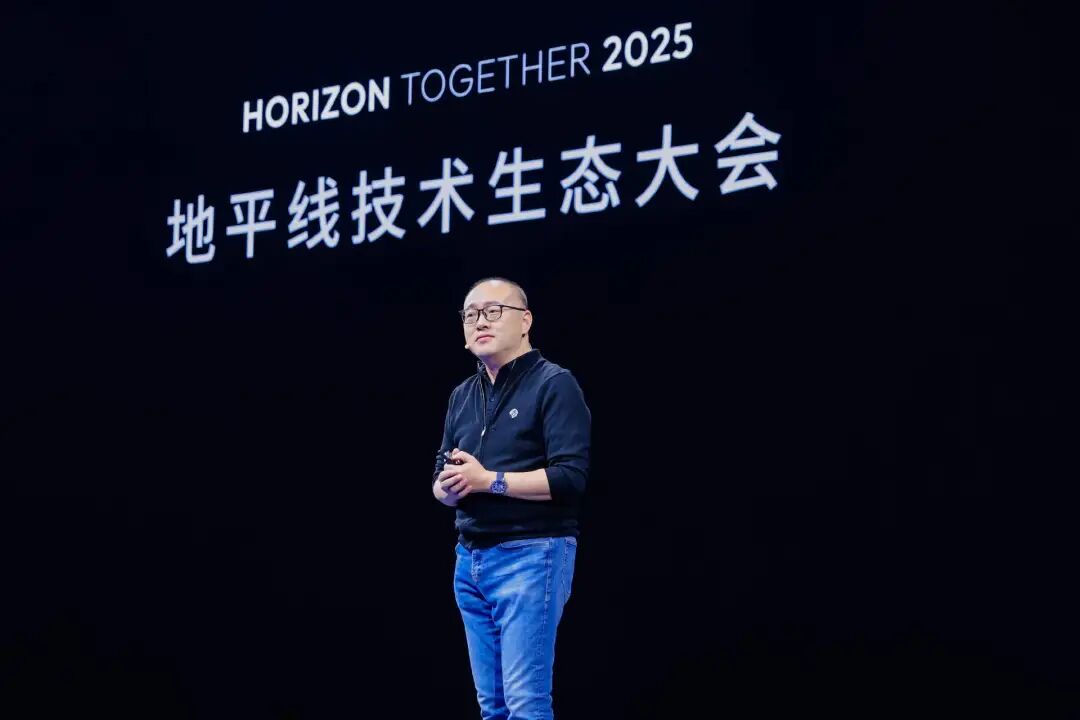
The inaugural day of Horizon Robotics' 2025 Technology Ecosystem Conference has just wrapped up, with a full day of activities planned for tomorrow (December 9). As the event organizer, Horizon Robotics has shifted the conversation from the widespread adoption of full-scenario intelligent driving to the collaborative building of ecosystems.
The venue buzzed with industry luminaries, including Thomas Ulbrich, CTO of Volkswagen China; Yang Dongsheng, Senior Vice President of BYD Group; Su Jun, Vice President of Chery Automobile; as well as executives from Bosch, Core Power, ZF, and Qingzhou Intelligent Navigation. Even Liu Jingkang, the founder of the innovative leader Insta360, who seldom makes public appearances, was in attendance.
Business collaborations thrive on mutual benefit, and such a significant influence would be unattainable without successful technology and business models.
Horizon Robotics has consistently embraced an 'altruistic' collaboration model, which explains why more and more automakers and suppliers are joining its ranks.
At the conference, Horizon Robotics CEO Yu Kai unveiled the fourth-generation BPU architecture—Riemann—and set a bold goal: to achieve mass production of urban assisted driving systems at the 10-million-unit scale within the next 3-5 years.
01
Bringing Urban Intelligent Driving to the 100,000-Yuan Car Market
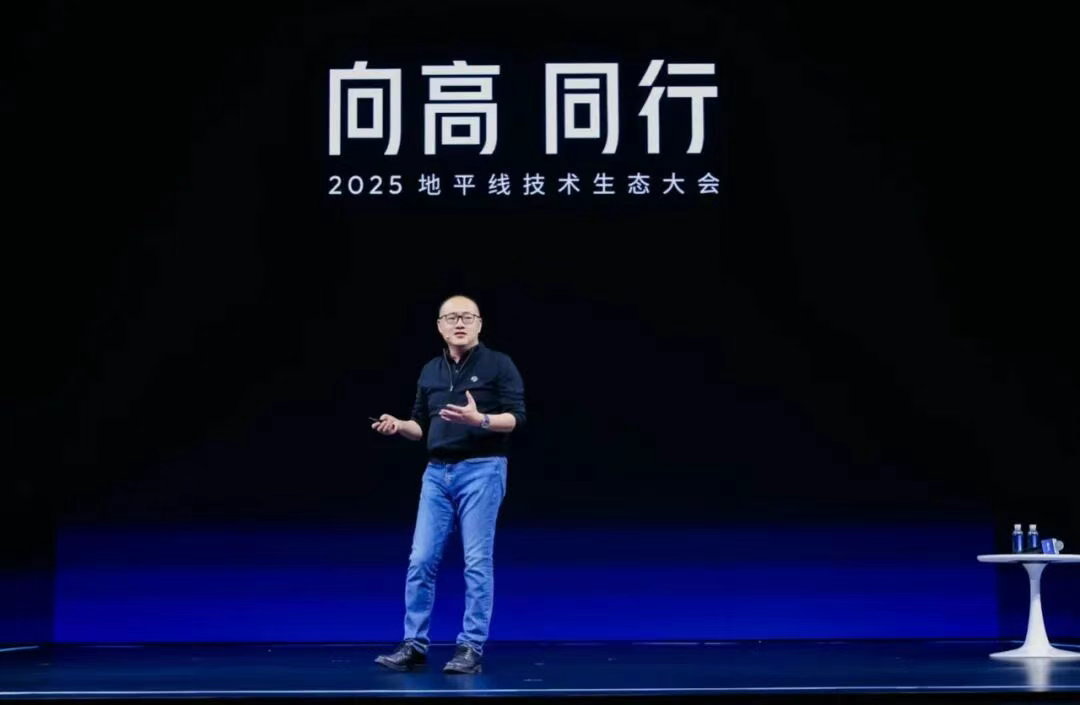
The theme of this conference is 'Toward Higher Grounds, Together,' whereas just a few months ago, Horizon Robotics' motto was 'Toward Higher Grounds.' The addition of a single word carries profound implications.
Since 2021, Horizon Robotics has been at the forefront of implementing high-level assisted driving. The cumulative mass production of chips from the Journey family has surpassed 10 million units, making Horizon Robotics the first domestic company to achieve this milestone. In April of this year, Horizon Robotics officially launched the Journey 6P and HSD. A month ago, with its first installation on the Exeed ET5, it officially became a reality.
Though it took over four years, the closed loop from 'chip to system' was completed in just one year, and the transition from technical release to mass production in vehicles took only seven months. Now, Horizon Robotics' HSD urban assisted driving system has finally entered the large-scale commercialization phase.
The shift from 'Toward Higher Grounds' to 'Toward Higher Grounds, Together' naturally requires confidence. Yu Kai announced at the conference that within just two weeks, the cumulative number of vehicle models with activated HSD reached 12,000, relying solely on two models.
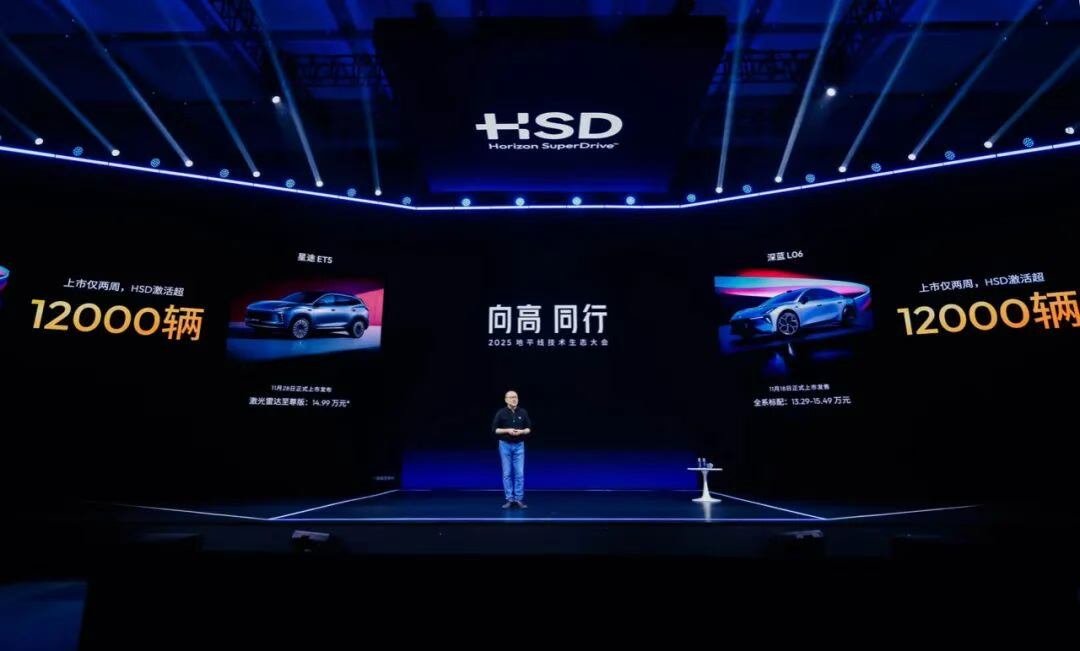
The concept of 'together' also signifies the democratization of technology. Currently, the only models on the market equipped with HSD are the recently launched Shenlan L06 and Chery Exeed ET5, both priced in the 150,000-yuan range.
Over the past year, urban NOA has predominantly been featured in vehicles priced above 200,000 yuan. Now, Horizon Robotics' HSD has lowered the bar, bringing urban NOA functionality, previously exclusive to luxury models, to the mainstream 150,000-yuan market.
In the first three quarters of this year, Chinese passenger vehicles priced below 130,000 yuan accounted for over 50% of the market share, while vehicles priced above 200,000 yuan made up 30%. However, high-level intelligent driving systems equipped with NVIDIA and Huawei computing platforms are primarily found in vehicles priced above 200,000 yuan. Where there is demand, there is opportunity, and Horizon Robotics aims to capture this 70% market share.
The 12,000 units are just the start. By next year, this number could increase exponentially.
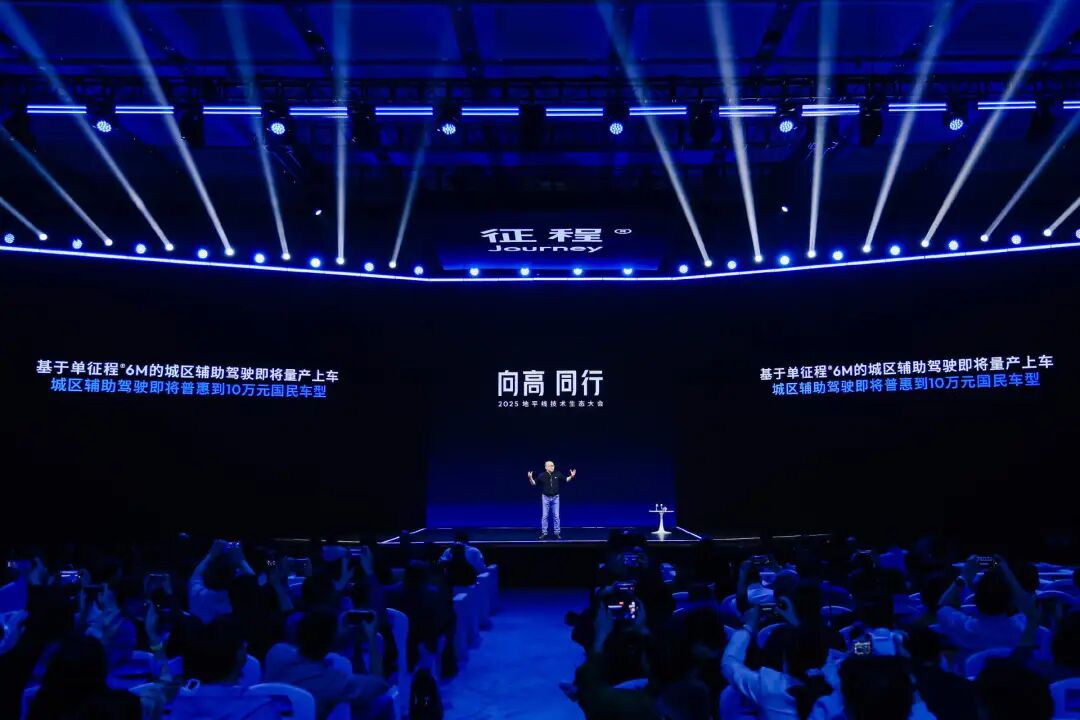
In addition to the over 20 designated vehicle models already in the pipeline, Yu Kai revealed another significant announcement at the conference: urban assisted driving based on a single Journey 6M chip can also deliver outstanding and smooth performance. Moreover, it is on the verge of mass production, targeting the national vehicle market priced above 100,000 yuan, which accounts for over 50% of the market share.
Yu Kai also presented a real-world test video of this solution at the event. The video demonstrated that in complex urban environments with narrow roads, the system can handle situations such as the absence of traffic lights, door openings, and sudden pedestrian appearances with excellent defensive driving. Yu Kai humorously described the system's capability using an internet meme: 'It remains calm and composed.'
The initial cooperation models for mass production of single Journey 6M urban assisted driving mainly fall into two categories: chip toolchain collaboration, with partners including Bosch, Zhuoyu, and Qingzhou Intelligent Navigation; and algorithm service collaboration, with partners including Denso (DANSO), Core Power (CARIZON), and Intelligent Driving Continental (neueHCT).
02
The Arrival of the Fourth-Generation BPU Architecture
In 2025, amidst a capital retreat and tightening regulations, Horizon Robotics did not showcase any unattainable 'PPT technologies' at this conference. Instead, it repeatedly emphasized mass production, implementation, and trust. In Yu Kai's words, Horizon Robotics aims to be 'the calm amidst the storm.'
This led Yu Kai to believe that one must seek the truth of the world rather than merely mimic human appearances. While everyone is desperately collecting human driving data, believing that more data makes AI smarter, this is not necessarily true. Human driving levels vary greatly, and many bad habits exist. If AI only learns from humans, it can at best reach the level of a 'professional race car driver' and never surpass it.
Horizon Robotics believes that 99% of user data is redundant or even detrimental. True evolution in intelligent driving requires simulation-based reinforcement learning in a virtual world to construct a 'self-regressive driving large model.' Computational power is no longer the bottleneck; efficiency is.
Hardware support has always been a key focus for Horizon Robotics. At this conference, Horizon Robotics officially unveiled its fourth-generation BPU architecture—the Riemann architecture, clearly paying homage to the mathematician Riemann. Yu Kai also explained the naming and rationale behind each generation of BPU.
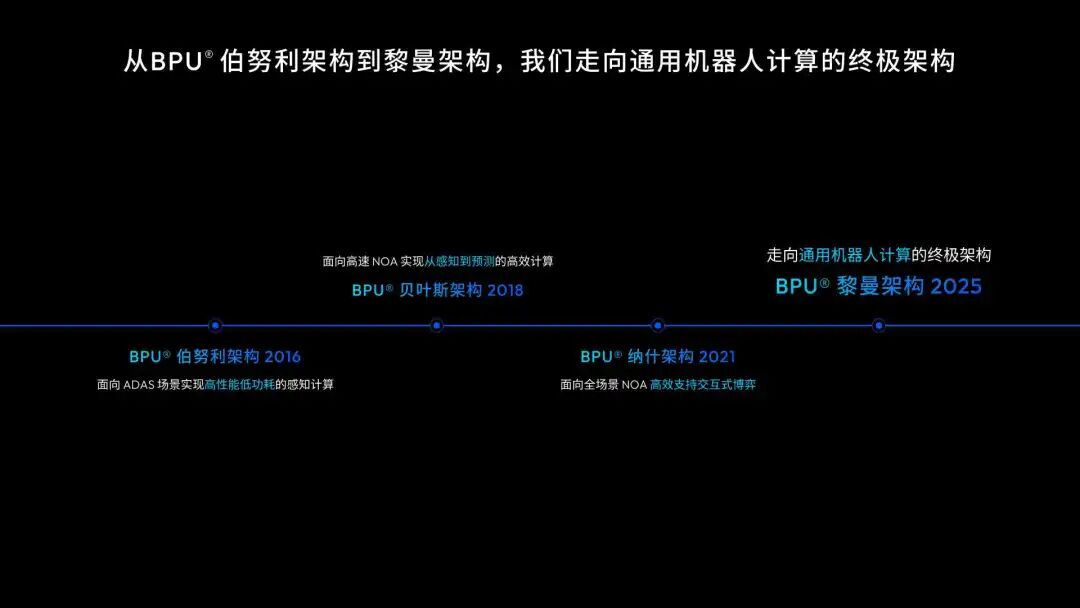
The first-generation BPU, named Bernoulli, was developed to address perception issues. The second-generation BPU, Bayes, began to tackle prediction problems, serving high-speed NOA. The third-generation BPU, Nash architecture, was designed to handle complex scenarios and multi-agent interactions, ultimately serving urban NOA.
It is evident that each generation of BPU is tailored to the functional requirements of its time, such as high-speed NOA and urban NOA. The fourth-generation BPU architecture aims to better comprehend this complex world.
How can we understand it?
Yu Kai made an intriguing remark at the conference: 'The truth of high-dimensional worlds is actually simple low-dimensional structures.' In simpler terms, it means using the mathematical technique of 'dimensionality reduction' to organize the extremely chaotic perception and decision-making data. By reducing high-dimensional data to lower dimensions, model efficiency is enhanced, optimizing the entire process from perception to prediction and decision-making.
Therefore, the Riemann architecture is not solely developed for assisted driving. Yu Kai believes that it will continuously approach the truth of the world and evolve toward the ultimate architecture for general robot computing.
In terms of raw performance, key operator computational power and the number of high-precision operator supports have increased by over 10 times. The support has shifted from Tensor to Vector full floating-point computation, with energy efficiency optimized for large language models, improving by 5 times. For example, the Riemann architecture's Transformer performance has increased by 150 times compared to the 2018 Bayes architecture.
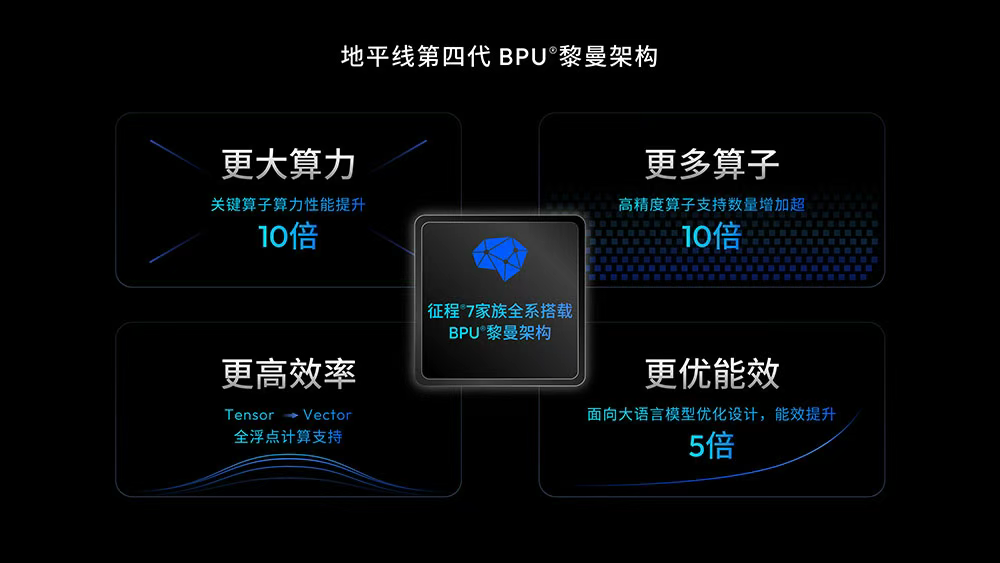
This architecture will be installed in the next-generation 'Journey 7' chip, fully competing with Tesla's AI 5 chip. Although Yu Kai did not disclose much information about the Journey 7 chip, during the ecosystem forum held in the afternoon, Marcus Hafkemeyer, CEO of Core Power, revealed a glimpse of Horizon Robotics' next-generation chip.
The chip developed in collaboration is based on the J7 (Journey 7) and also utilizes Horizon Robotics' fourth-generation BPU Riemann architecture. Named C7H, it employs a 3-4 nm process, with a single-chip AI computational power reaching 500-700 TOPS, supporting L3 capabilities.
Note the naming convention here—C7H. Referring to the J6 series of Horizon Robotics chips, which include multiple models such as J6B/L/E/M/H/P, if the H model has 500-700 computational power, the more advanced J7P model would likely start at 1000 TOPS.
Additionally, the fourth-generation compiler, OpenExplorer 4.0, was simultaneously released at the conference. Its core lies in using AI to optimize the code compilation process. Originally, compilation might take several hours, but now it is reduced to minutes, while also improving model performance by another 20%.

For the intelligent driving industry, the compiler acts as a 'translator' between chips and algorithms. The fourth-generation compiler can automatically balance algorithm accuracy and runtime speed, with compilation efficiency improvements keeping pace with the rapid iteration of intelligent driving algorithms. It also supports new algorithm architectures commonly used in intelligent driving today.
For automakers and development teams, the cost and time required to develop intelligent driving functions can be significantly reduced, allowing end-users to experience more mature intelligent driving capabilities sooner.
Furthermore, the Riemann architecture will evolve toward the ultimate architecture for robot computing. A lesser-known fact is that Horizon Robotics is China's largest consumer robot platform, with a wide range of robot products, including brands like Roborock and Insta360, equipped with Horizon Robotics' Diguang Robot computing platform.
At the conference, the embodied intelligent open-source models HoloMotion and HoloBrain were officially released, focusing on motion control and real-time reasoning, respectively.
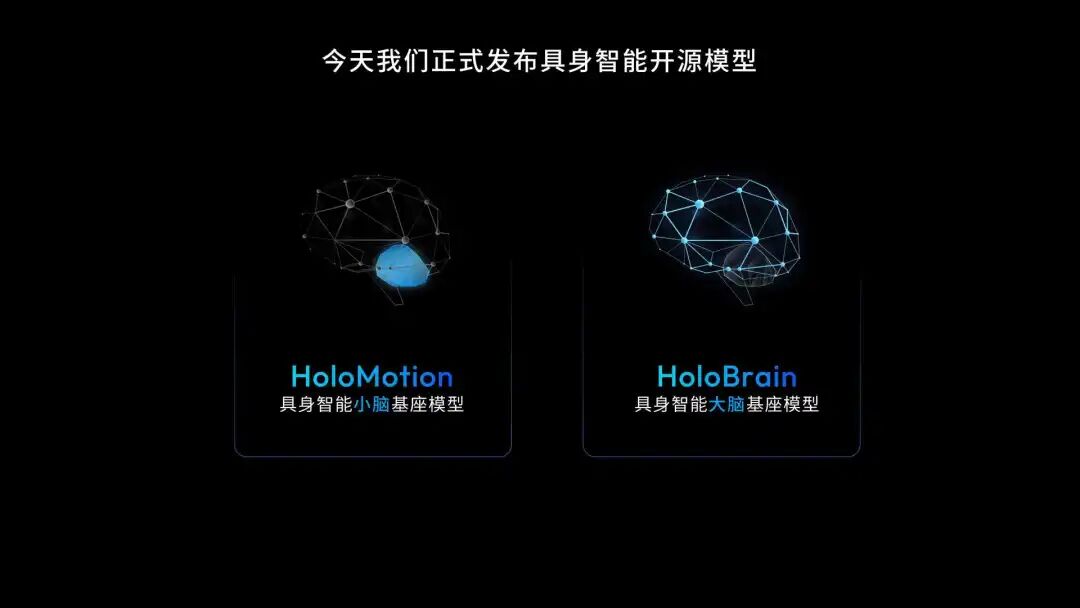
HoloMotion, as the embodied intelligent cerebellum base model, enables robots to learn to act like humans. Its open-source base model parameters and suite offer advantages such as achieving motion intelligence with a single model. Within a month of its release, it garnered over 230 stars on GitHub. HoloBrain, the embodied intelligent brain base model, features open-source, lightweight, and leading success rate characteristics, supporting real-time reasoning.
At this juncture, Horizon Robotics' role has effectively transformed, transitioning from a Tier 1 supplier in the automotive industry to a base supplier for the broader generalized physical AI landscape. While the industry is still preoccupied with competing over screen sizes and leather seats, Horizon Robotics has already advanced to the next dimension.
This heralds an even vaster and more fantastical blue ocean.
-
![]()
ByteDance, DJI, and Xiaohongshu Secure Top Three Positions Among China’s Fastest-Growing Unicorns
-
Tesla's in-car voice system in China is finally learning to 'understand human language'
-
![]()
Foreigners Are Amazed: Chinese Electric Vehicle Drive Systems Unveil Innovative 'Poses'
-
![]()
700,000 Brothers and the Future of Robots: Behind JD.com's 'Nirvana Plan'
-
![]()
Zhipu's Trillion-Dollar Valuation: A New Chapter for China's AI
-
![]()
Is Laifen, a 'Dyson Alternative' on the Rise, Now Ensnared by the 'Alternative Curse'?
-
![]()
Beyond Patents: Insta360 and DJI Compete in Retail
-
![]()
Piercing Through Industry Chaos: The Curtain Rises on Compliance for Autonomous Driving