Unveiling the Truth: Why New Energy Vehicles Are 'Prohibitively Expensive to Repair'—Intelligence as a Constraint, Data as a Barrier!
 12/15 2025
 752
752
'New energy vehicles offer better cost-efficiency'—a mantra repeatedly instilled in consumers, is now unraveling as countless owners confront staggering repair bills.
Recently, numerous vehicle owners have taken to social media platforms to share their experiences. One reported that a new car, purchased for 120,000 yuan, incurred nearly 6,000 yuan in damage assessment fees following a minor collision with a tree trunk. Another Tesla owner lamented that a mere 10-centimeter crack in the trunk necessitated replacing the entire assembly, costing nearly 20,000 yuan. A quick online search reveals further chaos in the realm of new energy vehicle repairs: 'A car priced under 150,000 yuan had its bumper replaced and painted, costing several thousand yuan,' 'A 4S shop insisted on replacing, rather than repairing, a scratched rear bumper, with a repair bill nearing 4,000 yuan,' 'A scrape below the right front headlight led to a diagnosis requiring replacement of the front bumper, front grille, right headlight assembly, and right front wheel liner, totaling over 20,000 yuan.'
These cases are far from isolated; they are, in fact, astonishing and almost unbelievable. A new energy vehicle costing tens of thousands of yuan can rack up repair costs ranging from thousands to tens of thousands of yuan for a minor scrape, sometimes nearing or even surpassing half of the vehicle's residual value. This dilemma of 'cheap to use, expensive to repair' is a growing concern for many new energy vehicle owners.
The Business Logic Behind 'Replace Only, Never Repair'
The aforementioned cases are not mere anomalies but indicative of a systemic issue. According to data from J.D. Power, which surveyed new energy vehicle owners with vehicles aged between 2 and 12 months, the repair costs for minor accidents in new energy vehicles are 2 to 2.5 times higher than those of fuel-powered vehicles. When the three electric systems (battery, motor, electric control) are involved, the cost disparity becomes even more pronounced. For instance, the cost of replacing a battery can exceed 50% of the vehicle's total price in some models.
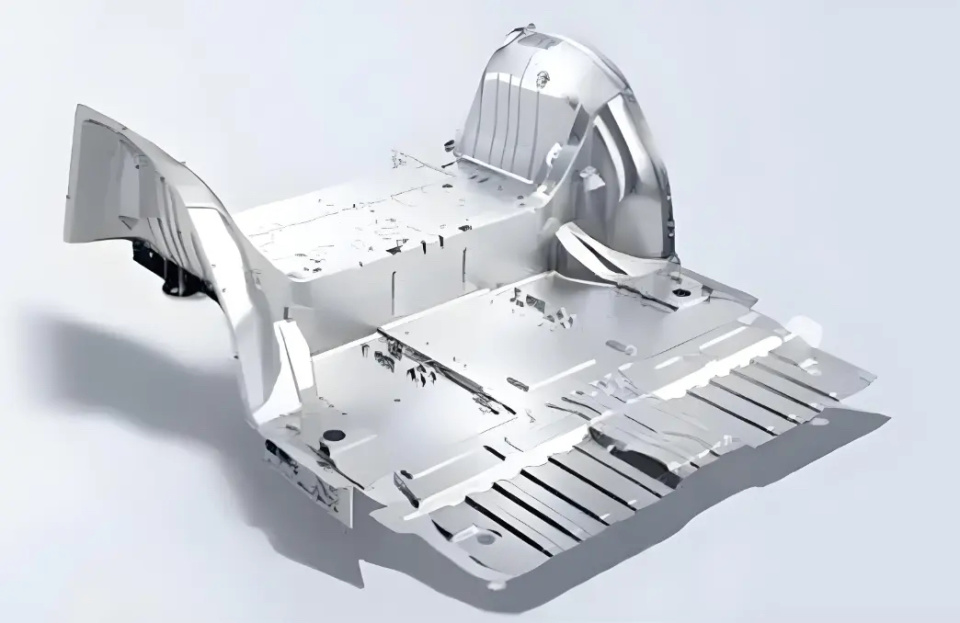
The exorbitant repair costs for new energy vehicles primarily stem from the widespread adoption of a 'complete replacement' strategy over localized repairs, often justified by 'highly integrated design.' For example, to enhance space utilization and structural integrity, many new energy vehicles employ technologies such as integrated die-casting and CTC (Cell to Chassis) battery chassis. While these designs benefit manufacturing efficiency and safety performance, they render localized repairs nearly impossible once damaged, necessitating 'complete replacement.' This marks a departure from the traditional fuel vehicle approach of 'repairing only the damaged part.'
What adds to the frustration is that even if owners wish to opt for more affordable third-party repairs, they often 'dare not' or 'cannot' do so. Most automakers explicitly state in user agreements that failure to maintain or repair the vehicle through authorized channels will result in the loss of lifetime warranty eligibility for the three electric systems. Automakers can utilize software to detect unauthorized operations, restrict relevant functions, or refuse system certification, effectively coercing owners back to official channels. In extreme cases, a repair technician faced legal repercussions for 'destroying computer information systems' after illegally hacking into a battery pack, deterring third-party technicians from battery repairs.

Behind this lies a profound commercial motive. Essentially, this represents a new business model spearheaded by automakers, leveraging technological barriers as a shield and after-sales profits as an anchor—a strategy we can term 'after-sales profit pre-positioning.' Automakers are shifting their profit focus from 'selling cars' to 'selling services,' akin to the metaphor of 'giving away a glucose meter and profiting from test strips.' The gross profit margin from after-sales services for new energy vehicles significantly outpaces that from vehicle sales, becoming a vital profit source for dealers and automakers.
Thus, 'replace only, never repair' is not merely a technical necessity but a meticulously calculated institutional arrangement—using safety as a pretext to erect barriers and integration as a cover for monopoly, ultimately confining repair choices within the official system. When a vehicle's 'repairability' is dictated not by the user but by algorithms and agreements, the so-called 'cost-effective travel' may prove to be just a consumer illusion.
Data Hegemony Restricts Repair Choices
Beyond the aforementioned commercial motives, the exorbitant repair costs of new energy vehicles also conceal a deeper, less perceptible struggle—the battle for data sovereignty.
Today's new energy vehicles have transcended their traditional role as mere transportation tools, evolving into highly intelligent and connected 'mobile data terminals.' From the real-time operational status of the three electric systems to the perceptual data of advanced driver assistance systems, and the continuously evolving software functions through OTA updates, the vehicle's operation relies heavily on the ongoing collaboration between onboard ECUs and cloud platforms.
At the core of this collaboration lies the vehicle data flow, exclusively controlled by automakers.
This data is not only utilized to optimize product design and train autonomous driving algorithms but also supports the refined operation of user lifecycle value. For instance, the charge-discharge curves, internal resistance changes, and single-cell degradation trends recorded in the BMS (Battery Management System) form the core basis for judging battery health (SOH). If this data were accessible to third parties, independent repair shops could offer precise battery balancing, module replacement, or lifespan extension maintenance services, significantly reducing user costs.
By restricting data access, new energy automakers ensure that only they can 'interpret' the vehicle and influence users' repair decisions. When owners cannot determine the true cause of a fault, they are left with no choice but to passively accept the 4S shop's 'recommendation for replacement.' When non-original parts are detected by the system, triggering speed limits or function deactivation, users are coerced back to official channels.
Over time, this fosters a form of 'planned obsolescence' in the digital age—not replacing hardware due to failure but because the system makes users feel 'they have no choice but to replace.'
Hence, automakers refuse to grant third-party repair institutions complete diagnostic interfaces, fault code parsing permissions, and core control parameters. The core reason is that vehicle operational data has become the automaker's most strategically valuable asset.
Therefore, the repair battle for new energy vehicles extends beyond wrenches and screwdrivers into the realm of code, protocols, and data permissions. Whoever controls the data controls the vehicle's 'interpretation' and 'disposition.' Under this logic, high repair costs may merely be a facade; the true cost is the gradual erosion of users' control over their purchased possessions.
Popular Vehicle Reviews
When 'intelligence' becomes a barrier and 'integration' transforms into a shackle, the popularization of new energy vehicles faces a crisis of trust. The promise of 'new energy vehicles being more cost-effective' is being undermined at the repair stage. This is not merely an economic cost issue but also a deprivation of consumer rights in the digital age.
However, technology itself is not inherently flawed; the problem lies in the power imbalance. From the EU's mandatory implementation of the 'Right to Repair Act' to Chinese courts supporting vehicle owners' data access rights, and industry associations promoting the establishment of repair standards for the three electric systems—signs of change are emerging.
Of course, we must also play our part in this process. Every question raised against 'replace only, never repair,' every call for data openness, is a small yet crucial force driving the industry towards a healthier ecosystem.
-
![]()
Registered Capital Slashed to 372 Million Yuan! Yutong Optical Finalizes Industrial and Commercial Change Registration
-
![]()
Zhuque-3 Successfully Lands, and 'Time Traveler' Secures Another ¥100 Million in Funding: China's Commercial Space Industry Experiences a 'Dynamic August'
-
![]()
Autohome Faces a Shrinking Window of Opportunity
-
![]()
Even a Titan Like Musk Has Faced Setbacks in Fulfilling Promises
-
![]()
AI Office: The End of the Racing Era, Context Becomes the Key to Success
-
![]()
Domestic Vehicle Chassis Revolution ②: The Steering Wheel Remains, But Mechanical Connections in the Steering System Are Decreasing
-
![]()
Exploring MiniMax Design: Can Video Editing Be as Simple as Speaking?
-
![]()
Why Can SenseTime Achieve Profitability While CloudWalk Still Faces Challenges, Despite Both Adopting Large Models?