Behind the USD 19 Billion Write-Down: Ford Motor's Updated Electrification Strategy
 12/22 2025
 587
587
In recent years, the global automotive industry has appeared to follow a unified narrative: 'Go all-in on pure electric vehicles, or face inevitable decline.'
However, when aggressive transformation meets the cold, hard realities of financial statements, even century-old automotive giants are compelled to reassess the situation. A USD 19.5 billion accounting adjustment, the cancellation of a flagship electric pickup project, and a highly confidential 'Skunkworks' initiative aimed at matching BYD's cost structure—these developments signal that Ford is undergoing a genuine 'strategic overhaul.' 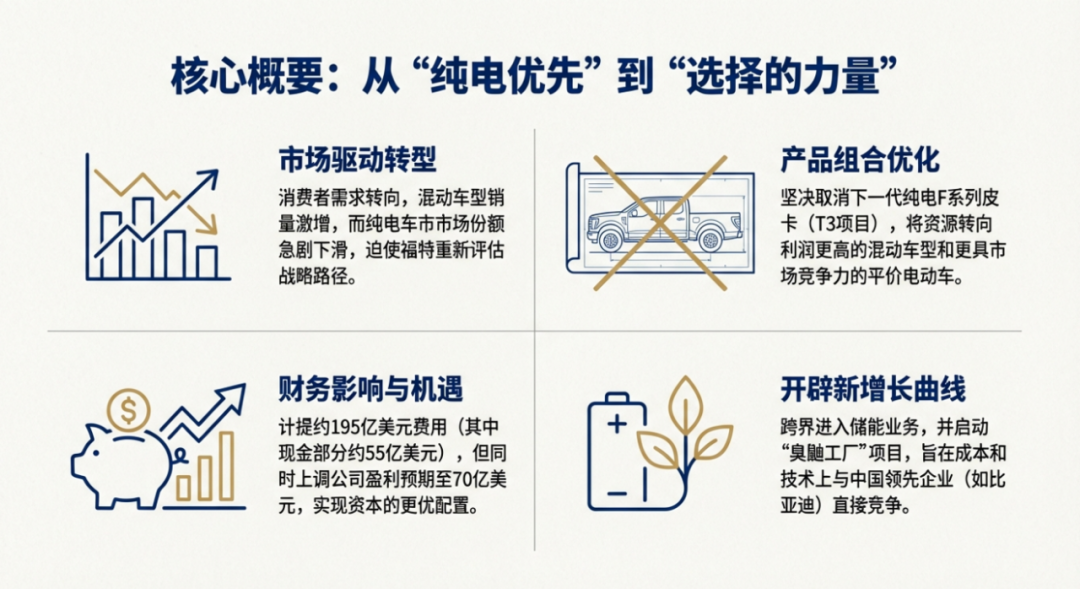
This is not merely a tactical withdrawal but a redefinition of the endgame in electrification. Ford is using tangible actions to convey to the market that in this round of industry consolidation, speed does not guarantee success; rather, sustainability ensures long-term viability.
This article will provide an in-depth analysis of Ford's latest transformation in electrification strategy: How has it transitioned from 'all-in' to 'strategically equipped'?
1. From 'Pure Electric' to 'Diverse Propulsion'
Ford CEO Jim Farley has made it clear that Ford's future objective is to achieve 50% electrification. However, this target will encompass a mix of pure electric vehicles (EVs), hybrid vehicles (Hybrids), and extended-range electric vehicles (E-REVs), rather than being confined exclusively to pure electric models.
The primary catalyst for this shift is evolving consumer preferences: demand for high-priced electric vehicles has decelerated, while demand for hybrids has accelerated. For instance, Ford's hybrid vehicle sales recently experienced a 30% increase, with hybrid market share in the truck segment reaching approximately 80%. Consequently, Ford has opted to provide customers with a broader range of choices through 'propulsion diversity,' while simultaneously reducing the company's carbon footprint. 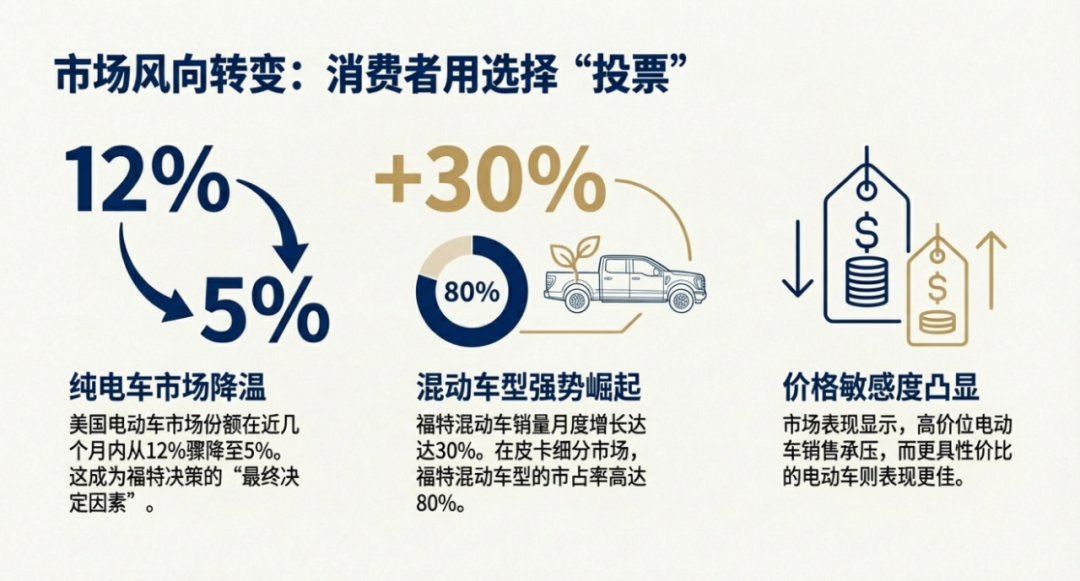
In reality, this shift is less about consumer behavior and more about a reorientation in government policy. For detailed insights, refer to our other articles on changes in North American electrification policies.
2. Product Line Restructuring and Price Competitiveness
To halt losses and enhance capital allocation efficiency, Ford took decisive action by canceling the next-generation electric F-Series pickup (Project T3), initially planned for production in Tennessee. Ford deemed it imprudent to continue investing billions in products projected to be unprofitable. Instead, the company is redirecting its focus toward developing more competitively priced electric commercial vehicles and trucks, such as plans to manufacture more affordable electric vans in Ohio and budget-friendly electric pickups in Kentucky. Farley emphasized that Ford possesses a robust customer base in the pickup and van segments, and future electrified products will concentrate on these areas where Ford holds a significant advantage and where market demand is strongest. 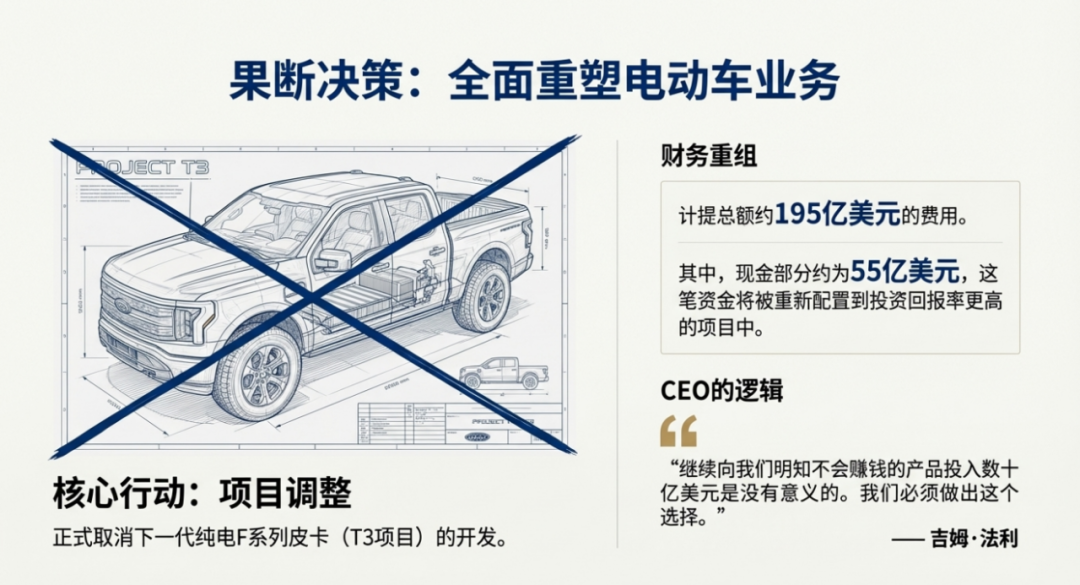
3. Emulating Chinese Cost Efficiency and the 'Secret Project' Profitability Objective
Ford aims to achieve profitability in its electric vehicle business by 2029. To accomplish this, Ford initiated a covert project dubbed 'Skunkworks,' focused on developing an ultra-low-cost electric vehicle platform. Farley stated that to remain competitive, Ford must attain 'BYD-level cost efficiency.' The project aims to achieve this through reengineering assembly processes, streamlining manufacturing components, and collaborating with new suppliers, potentially mirroring Tesla's assembly methodologies. Ford intends to produce cost-competitive electric vehicles in North America, ensuring profitability without dependence on subsidies. 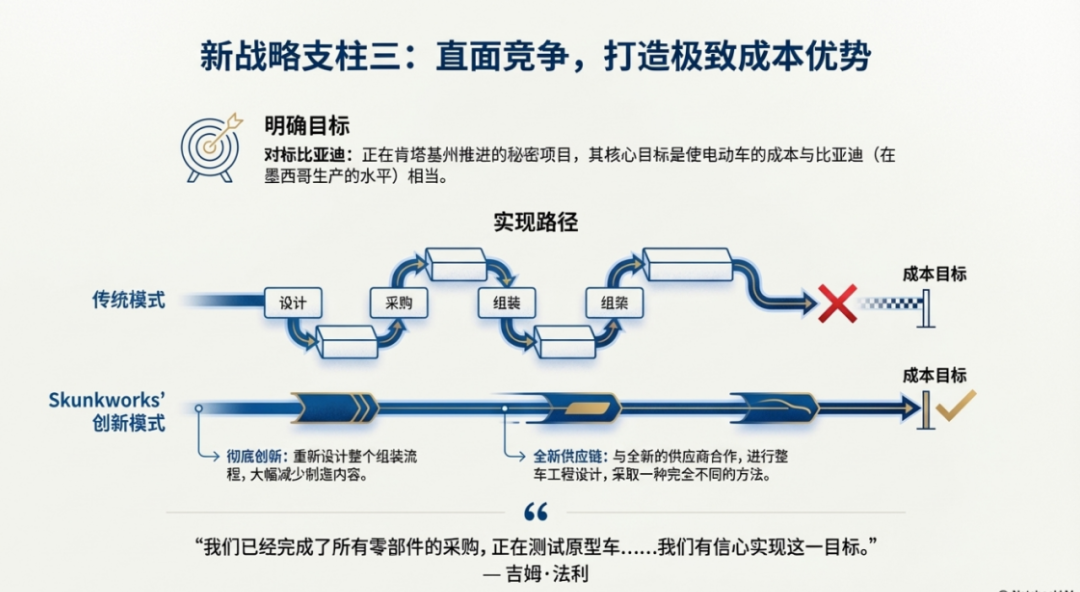
4. Expansion into the Energy Storage Sector
Another cornerstone of Ford's electrification strategy is its foray into the energy storage market. Ford is repurposing its battery factories in Michigan and Kentucky to manufacture 20 gigawatt-hours (GWh) of energy storage batteries utilizing lithium iron phosphate (LFP) technology. Ford not only intends to sell these large-scale storage units to utility companies and data centers but also to offer related service businesses. This venture is anticipated to commence in 2027 and is viewed as a new avenue for company profit growth. 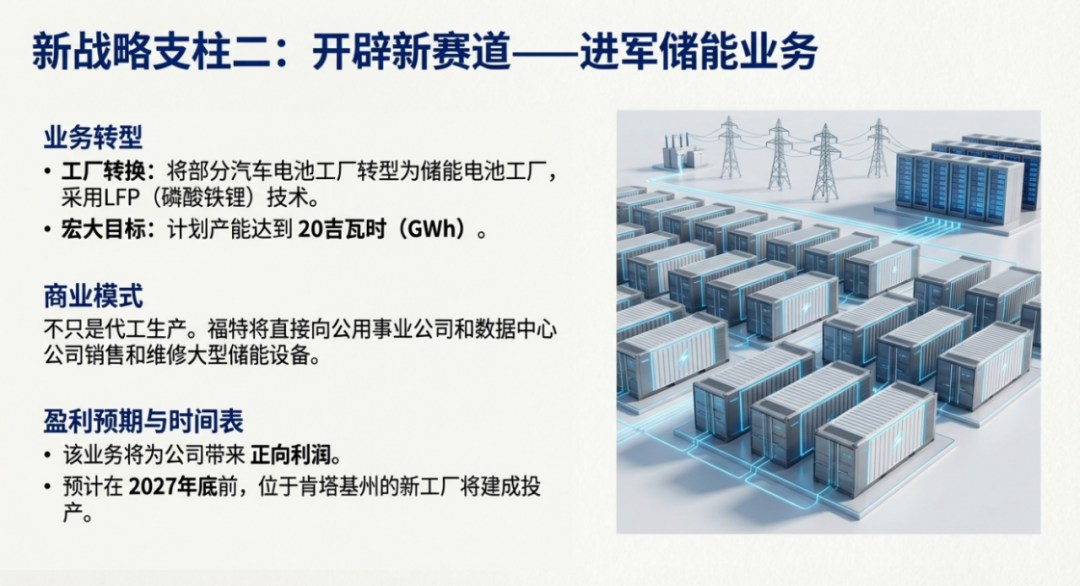
5. Localized Supply Chain and Technological Sovereignty
When engaging with Chinese enterprises, Ford has adopted a 'technology licensing + local manufacturing' approach. Ford insists on constructing battery factories and operating production lines in the U.S. with American labor, believing this to be the optimal method for mastering core intellectual property (IP) and competing with Chinese manufacturers. Farley contends that by remaining proximate to the technology source and leveraging Ford's robust manufacturing capabilities, the company can gain a competitive advantage over merely importing batteries, while simultaneously creating thousands of U.S. jobs. 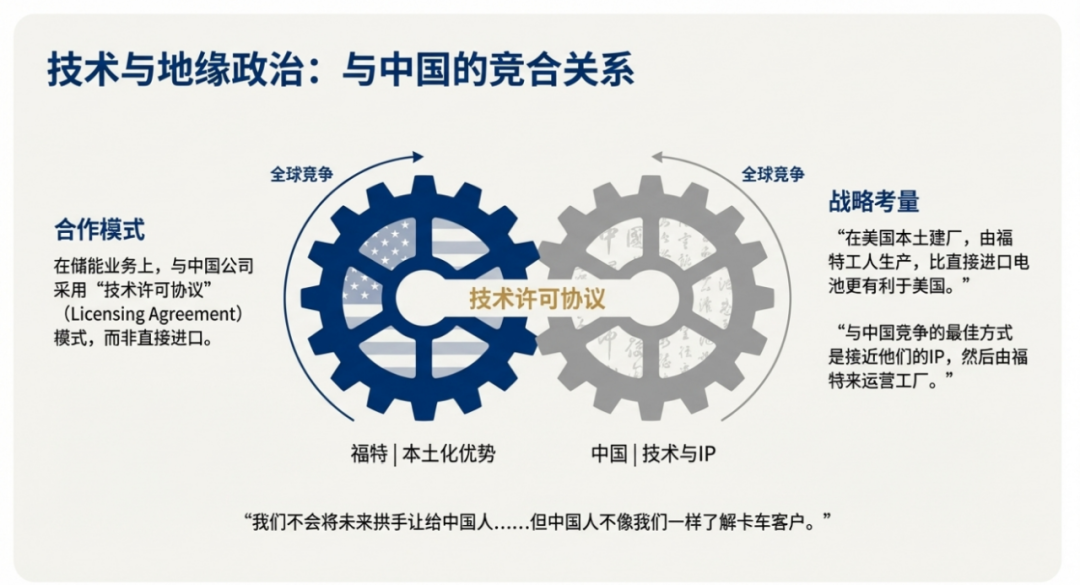
In summary, Ford's electrification strategy has evolved from an initial phase of expansion to a flexible model that balances defensive and offensive measures: preserving cash flow by terminating loss-incurring, high-cost electric projects, meeting current market demand with hybrid offerings, and covertly developing low-cost platforms for future global competition.
Ford's transformation has been aptly compared to transitioning from a '100-meter sprint' to a 'marathon.' It has equipped itself with hybrid technology as a 'hiking pole' and energy storage as a 'supply pack.' While the approach appears measured, pressing questions linger:
In today's rapidly evolving technological landscape, will a slower pace in pure electric vehicle development cause Ford to fall irreversibly behind in five years?
Can the enigmatic 'Skunkworks' team genuinely replicate BYD-level cost efficiency on U.S. soil?
What are your thoughts on Ford's 'defensive-to-offensive' maneuver? Is this the most pragmatic survival strategy for traditional automakers, or a desperate retreat in the face of China's electric vehicle onslaught? Share your perspectives in the comments section.
References and Images
Ford's Electrification Journey: A Decisive Strategic Transformation.pdf - Generated based on Ford CEO interview notebook summary
*Unauthorized reproduction or excerpting strictly prohibited-
-
![]()
Too Pessimistic! MiniMax Isn't Doing That Badly
-
![]()
The 150,000-Yuan SUV Market: A Tempting yet Elusive Prize
-
![]()
The Endgame for New Car-Making Forces Is Set: Only a Three-Year Window Remains, Who Will Be Completely Eliminated?
-
![]()
Who Crossed the 'Kill Line' After DeepSeek's Price Adjustment?
-
![]()
Profits Plunge by 61% in the First Half of the Year! The Rise and Challenges of Great Wall Motors
-
![]()
BYD Han Unveiled for Pre-sale with Striking Design, Sparking Netizen Debate: Is It Merely an Enhanced Version of a Ride-Hailing Vehicle?
-
![]()
BAIC Taitan 700 vs. Xiangjie G9: A Clash of Kin, How Will Yu Chengdong Navigate This Challenge?", "Taitan 700, Xiangjie G9, BAIC, Huawei Intelligent Driving, Pricing Showdown", "BAIC has unveiled its
-
![]()
Volkswagen's Layoffs and Factory Closures: What Should Car Owners Make of It?