A Touch of “Innovative Appeal” in This Generation of L3: Low Speed, Lane Restrictions, and No Lane Changes
 12/22 2025
 533
533
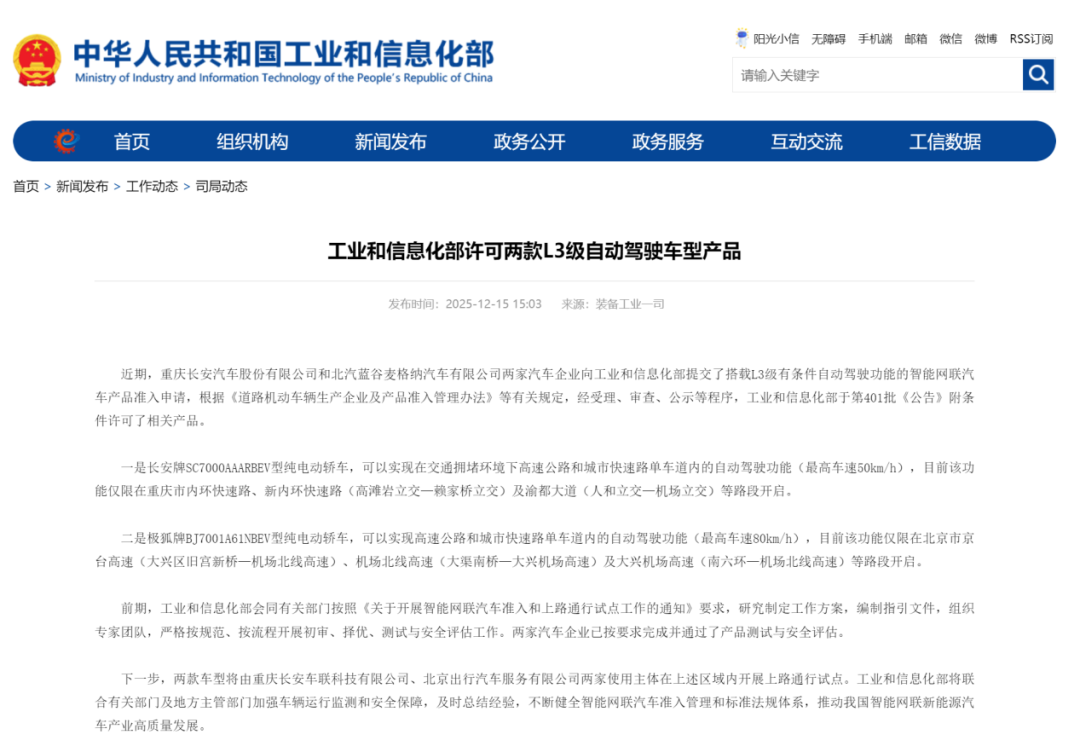
As the year drew to a close, the automotive world was set abuzz by a headline-making announcement: two vehicle models had secured conditional approval from the Ministry of Industry and Information Technology (MIIT) for L3 autonomous driving on public roads. The Changan Deepal SL03 and ARCFOX Alpha S6, representing the automotive prowess of the south and north respectively, became the first two to earn these coveted “tickets to the future.” On December 20, Changan Automobile was presented with the inaugural official L3 autonomous driving license plate, distinguished by the “Z” at its end, a symbol of self-driving capability. The news sparked excitement among some, who saw it as a sign that the autonomous driving era was within reach. Yet, for others, a closer examination of the terms dampened their enthusiasm: the technology could only be activated on specific road segments in select cities, with no automatic lane changes permitted and a capped speed limit. This seemingly cautious step forward perfectly encapsulates the broader trajectory of China’s intelligent driving evolution: on the stage of new energy vehicles, performance and intelligence may race ahead, but safety remains an unwavering priority that cannot be compromised.
The “Golden Ticket” for L3 Comes with a Comprehensive Set of Guidelines
The symbolic weight of these two approvals cannot be overstated. They mark L3’s transition from test tracks to public roads under regulatory scrutiny. However, a deeper dive into the terms reveals that this “golden ticket” is laden with conditions. The Deepal SL03 is authorized to activate L3 on designated congested road segments, such as Chongqing’s Inner Ring Expressway, with a speed limit not exceeding 50 km/h. The ARCFOX Alpha S6, meanwhile, is permitted on routes like Beijing’s Jingtai Expressway and Airport North Line Expressway, with an upper speed limit of 80 km/h. Both vehicles are explicitly restricted to single lanes, temporarily unable to execute automatic lane changes.
This reality seems to fall short of the “cutting-edge intelligent driving” narrative often promoted in the market. After all, many vehicles equipped with highway navigation assist (NOA) can already autonomously overtake and navigate ramps. Why, then, does the officially sanctioned L3 appear more restrained? The answer lies in the regulatory emphasis on safety above all else. Automatic lane changes demand the system to process far more complex environmental judgments and decisions, carrying significantly higher risks compared to steady following within a single lane. By confining functions to a single lane, regulators are proactively narrowing the system’s operational scope, repeatedly verifying the reliability of basic controls in relatively straightforward scenarios.
The nuanced differences in applicable scenarios and speed limits between the two models are also noteworthy. The Chongqing road section specifically targets “traffic congestion environments.” At lower speeds, both the system and human drivers have more reaction time, and collision energy is reduced—every detail seems designed to mitigate potential risks. This scenario-based, fine-grained management approach suggests that the current L3 rollout is more akin to a “pilot exploration” than a widespread deployment. Sources close to automakers mentioned that while lane-changing technology is not a technical hurdle, it was excluded from the initial approvals and is planned for later stages. This mirrors the learning process of driving: one must first master straight-line driving before venturing into lane changes and overtaking.
The Cautious March of L3 and the Unyielding Safety Red Line
The heightened sensitivity surrounding L3 stems fundamentally from the shift in responsibility. At the L2 stage, regardless of the system’s intelligence, the legal driver remains human, and so does the accountability. However, at L3, within the system’s operational scope, driving control transfers to the vehicle, and the balance of responsibility begins to tilt toward automakers. This transition entails a host of issues spanning law, insurance, technical validation, and even human-machine interaction.
Industry insiders often characterize L3 as a somewhat “gray area.” The system requires human intervention when it cannot handle a situation, but determining the right moment to request help and the adequate time for response is fraught with uncertainty. Research indicates that from a system alert to a potential accident, only a few seconds may elapse, while humans, transitioning from a relaxed state to effective intervention, typically need more time. This “handover paradox” poses an inherent challenge to L3. From this vantage point, stringent regulation acts as a protective barrier for this nascent transitional phase. By limiting scenarios, speed, and prohibiting lane changes, the likelihood of systems encountering extreme conditions beyond human reaction time is minimized.
Reflecting on the industry’s trajectory this year, this caution is palpable. Early in the year, expectations for L3 rollout were high, but the pace slowed significantly following some accidents and subsequent discussions. Regulatory focus then shifted to “strengthening foundations,” from standardizing L2 promotional language to advancing safety standards. This serves as a reminder to the entire industry: rather than chasing a prestigious label, it is wiser to first ensure safety in what can be controlled. While the competition in performance and intelligence is fierce, on the road to autonomous driving, safety remains the only non-negotiable standard. With clear red lines, the advancement of L3 cannot and should not be a race.
The Path to L3 May Be Closer Than We Realize
So, where does the true key to advancing to L3 lie? Perhaps not in flashy hardware specifications or aggressive marketing, but rather in the L2 systems we have already grown accustomed to. Some argue directly: instead of delving into the complex human-machine responsibility divisions at the L3 stage, it is better to first ensure safety and reliability at the L2 level. This sentiment resonates.
Currently, a significant proportion of new vehicles in China are equipped with assisted driving, yet inconsistencies in experience and vague promotional claims persist. Can high-speed cruising remain steadily centered? Can the system handle cut-ins or curves smoothly without abruptness? Are driver monitoring systems truly effective in preventing misuse? These are the fundamentals of L2 and the bridges that must be crossed to reach L3. If the system frequently requires urgent human takeovers under human supervision, then discussing full system handover in specific environments lacks credibility.
Some describe L3 as a mainstream phase that may persist long-term rather than a brief transition. This implies it is not a level to be “skipped,” but a state requiring highly reliable vehicles and deeply trusted users. Such trust can only be built through repeated safe, stable, and comfortable journeys within the L2 framework. For users, an assisted driving system that calmly handles lane changes by neighboring vehicles and delicately adjusts following distances on highways is likely more valuable than an L3 function with heavy restrictions and limited “autonomous driving” range. Perhaps automakers’ competitive focus should shift from “having L3” as a label to “perfecting L2” as an experience.
Conclusion
The two approvals issued by the MIIT this time encourage enterprises that patiently accumulate within safety frameworks and actively participate in rule co-creation. While the technological ceiling can be high, the foundation of commercialization must be solid. For consumers, there is no need to feel disappointed by the functional limitations of first-generation L3—this is precisely a sign of the industry’s maturity and responsibility. The future of autonomous driving is undoubtedly exciting, but the path to it must be paved by safe arrivals, one journey at a time. Perhaps one day, when L2-level assisted driving becomes as reliable and natural as seatbelts, the arrival of L3 will feel like a natural, truly anticipated moment. Until then, taking steady, solid steps forward may be the most correct development path for intelligent driving.
-
![]()
Too Pessimistic! MiniMax Isn't Doing That Badly
-
![]()
The 150,000-Yuan SUV Market: A Tempting yet Elusive Prize
-
![]()
The Endgame for New Car-Making Forces Is Set: Only a Three-Year Window Remains, Who Will Be Completely Eliminated?
-
![]()
Who Crossed the 'Kill Line' After DeepSeek's Price Adjustment?
-
![]()
Profits Plunge by 61% in the First Half of the Year! The Rise and Challenges of Great Wall Motors
-
![]()
BYD Han Unveiled for Pre-sale with Striking Design, Sparking Netizen Debate: Is It Merely an Enhanced Version of a Ride-Hailing Vehicle?
-
![]()
BAIC Taitan 700 vs. Xiangjie G9: A Clash of Kin, How Will Yu Chengdong Navigate This Challenge?", "Taitan 700, Xiangjie G9, BAIC, Huawei Intelligent Driving, Pricing Showdown", "BAIC has unveiled its
-
![]()
Volkswagen's Layoffs and Factory Closures: What Should Car Owners Make of It?