Jiushi Teams Up with Dongfeng: A Practical Alliance Between a Tech Giant and an Established Automaker, Unlocking the Long-Term Potential of L4 Autonomous Driving Across Diverse Settings
 12/25 2025
 478
478
Introduction
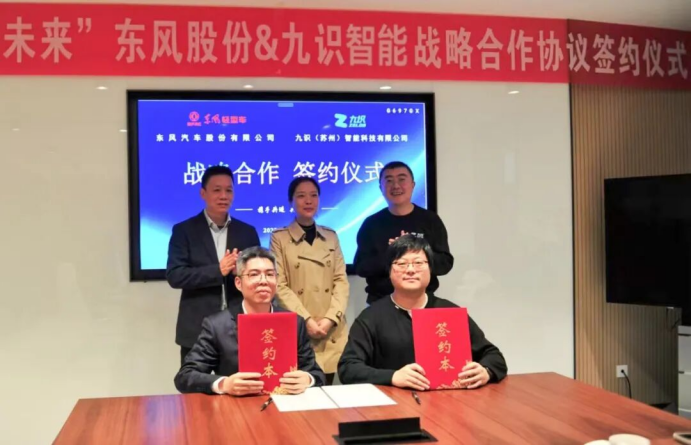
Recently, Jiushi Intelligence and Dongfeng Motor Co., Ltd. have forged a collaborative partnership. This alliance spans a comprehensive array of sectors, encompassing commercial vehicles, sanitation services, inspection tasks, and urban operations.
From Jiushi's technical perspective and its primary business sectors, this partnership signifies a concerted effort to commercialize L4 autonomous driving technology tailored to the intricacies of real-world urban settings.
(For more information, please refer to: "Three Titans of Unmanned Logistics Vehicles: Neolix, Jiushi Intelligence, and Baixiniu Convene in Zhengzhou for the Inaugural '2025 China Unmanned Logistics Vehicle Ecosystem Conference' on December 28th")
Technical Path Selection for Real-World Urban Settings
For L4 autonomous driving to be commercially viable, it must demonstrate consistent performance in the complex and ever-changing urban landscape.
Compared to passenger transport, freight transport faces fewer regulatory hurdles.
However, freight transport scenarios are no less intricate than those involving passengers: large vehicles often obstruct views, temporary construction sites emerge, road layouts evolve, and non-standard traffic participants appear unpredictably.
In such environments, relying solely on single-frame perception or rule-based decision-making can lead to unstable judgments.
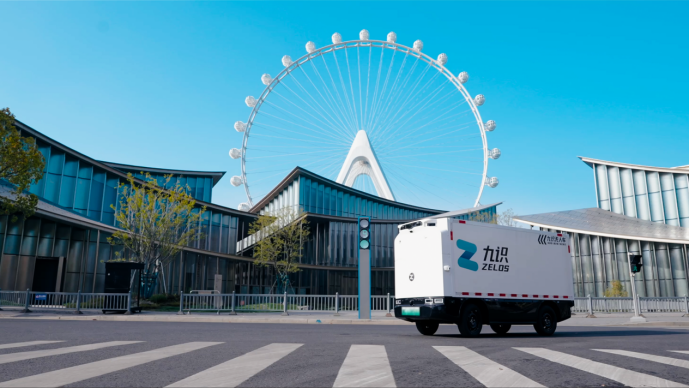
To address these real-world challenges, Jiushi Intelligence has introduced a temporal occupancy model based on Occupancy Networks (OCC) at the perception layer.
By dynamically modeling three-dimensional space using multi-frame temporal data, the system can not only pinpoint the current positions of obstacles but also discern their temporal patterns. This enables unmanned vehicles to maintain a continuous and stable awareness of their surroundings, even in the face of occlusions, irregular targets, and rare scenarios.
For larger freight vehicles and irregularly shaped sanitation vehicles with extended braking distances, this ability to "foresee risks" is particularly vital.
From an engineering standpoint, this technical path selection aims to mitigate safety risks stemming from uncertainties in real-world urban environments.
System Evolution from "Judgment" to "Comprehension"
As the application scenarios for autonomous driving expand, the challenges it faces intensify.
Vehicles must not only recognize objects on the road but also grasp the underlying semantic information in complex scenarios, such as construction zones, temporary road closures, and abnormal signage.
At this juncture, Jiushi Intelligence has introduced a cloud-based Vision-Language Model (VLM) multi-modal large model, equipping unmanned vehicles with the ability to comprehend scenes at a semantic level.
The system can transform complex scenarios into structured semantic information and collaborate with onboard perception and decision-making modules.
Significantly, this capability does not directly intervene in low-level control but rather provides "heuristic guidance" during the planning and control process, offering high-level behavioral references for the vehicle. This enhances the system's flexibility in unknown or changing scenarios while maintaining controllability and safety redundancy in the decision-making chain.
Supporting the continuous evolution of this capability is Jiushi's extensive operational experience in real-world scenarios.
To date, Jiushi's unmanned vehicles have amassed over 70 million kilometers of safe operation, spanning more than 300 cities nationwide and serving various industries, including express delivery, supermarket retail, tire and auto parts, and pharmaceuticals.
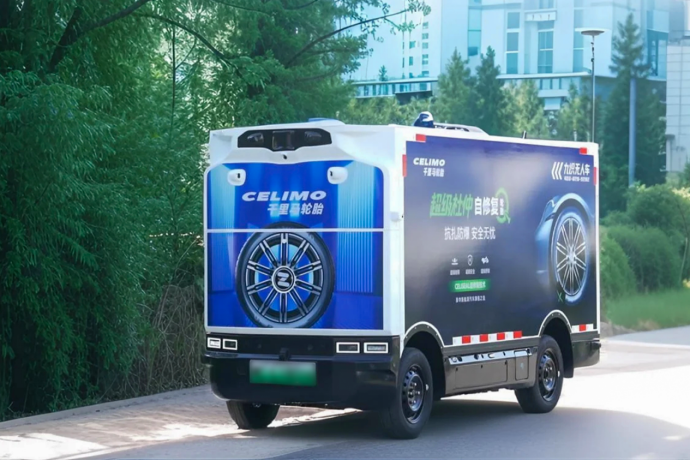
These real-world data are fostering a continuous and positive "data flywheel" effect—daily additions of complex scenario samples continually drive model optimization, enabling the system to evolve continuously during scaled operations.
Engineering-Oriented Technical System for OEMs
In collaborations with OEMs, while technical sophistication is crucial, engineering controllability and system scalability are equally paramount.
At the planning and control level, Jiushi Intelligence has developed an end-to-end PnC model that uniformly models perceived obstacles, map elements, and BEV features while simultaneously outputting predictive results for surrounding traffic participants and the planned trajectory of the host vehicle. This facilitates efficient decision-making in complex traffic environments.
This architecture not only enhances driving smoothness and safety but also provides a core foundation for system deployment across various vehicle types.
Combined with a light map technology route, it significantly reduces reliance on high-definition maps, enabling unmanned vehicles to enter new regions more swiftly and maintain lower deployment costs.
From an overall structural perspective, this technical system exhibits distinct platform characteristics, allowing flexible adaptation to multiple vehicle types, including freight vehicles, sanitation vehicles, inspection vehicles, and VANs. This provides ample technical extension space for Jiushi's collaboration with Dongfeng across a broader range of commercial vehicle categories.
Conclusion:
The core technical team at Jiushi Intelligence predominantly comprises members from Baidu Apollo, boasting extensive experience in autonomous driving technology research and development. Whether in the early days of Robotaxi or subsequent unmanned logistics vehicles, the team has navigated the journey from the autonomous driving startup boom to commercialization.
In August of this year, Jiushi established a joint autonomous driving technology laboratory with Shanghai Jiao Tong University. Leveraging its inherent technical strength and bolstered by robust external expertise, Jiushi Intelligence's technological research and development have accelerated significantly.
(For more information, please refer to: "Jiushi Intelligence and Shanghai Jiao Tong University Establish Joint Autonomous Driving Technology Laboratory")
Jiushi Intelligence's system-level technical system has formed its core competitiveness in securing collaborations with automakers.
From an industry perspective, the partnership also offers a more pragmatic pathway for the commercialization of L4 autonomous driving: leveraging engineering capabilities to gradually unlock the long-term potential of autonomous driving across diverse settings.
Unmanned Vehicle Insights (WeChat Official Account: Unmanned Vehicle Insights) Comments:
Jiushi × Dongfeng: Engineering-Driven Solutions to Autonomous Driving Deployment Challenges, A New Direction for "Scenario-Deep Diving" in L4 Autonomous Driving Commercialization
The collaboration between Jiushi Intelligence and Dongfeng Motor Co., Ltd. provides a highly valuable and practical pathway for the commercialization of L4 autonomous driving.
On one side stands a rising "tech giant" with proprietary full-stack technology and the world's largest L4 unmanned vehicle fleet;
on the other, a seasoned "automaker veteran" with deep manufacturing expertise and a nationwide distribution network.
Their objective is clear:
to jointly develop autonomous driving products encompassing multiple vehicle types, including freight vehicles, sanitation vehicles, and VANs, and to promote their large-scale deployment in scenarios such as urban distribution logistics and park logistics.
The core highlight of this collaboration lies in transcending the "tech showcase" trap and addressing the real-world pain points of urban settings with an engineering-driven mindset to solve autonomous driving deployment challenges.
The primary obstacle to L4 technology deployment lies in the uncertainties of complex scenarios.
Jiushi's choice of freight transport scenarios as a breakthrough point is not about taking the easy route but precisely balancing regulatory guidance and practical demands.
Its introduction of the temporal occupancy model and cloud-based multi-modal large model addresses traditional perception and decision-making instabilities in occluded, construction, and other rare scenarios from two dimensions: "proactive risk anticipation" and "semantic-level scene comprehension."
Jiushi Intelligence's unmanned vehicles have accumulated 70 million kilometers of safe operation across over 300 cities, forming a "data flywheel" effect that drives continuous technological iteration and lays a solid foundation for scaled deployment.
The key to collaborating with OEMs lies in technical adaptability and scalability.
Jiushi's end-to-end PnC model, combined with a light map approach, reduces reliance on high-definition maps and deployment costs. Its platform architecture flexibly accommodates multiple vehicle types, aligning perfectly with Dongfeng's diversified layout needs in the commercial vehicle sector.
This deep integration of "technology-vehicle type-scenario" transcends the limitations of single-scenario pilots, enabling the release of L4 technology value across the entire urban service chain.
From an industry perspective, this collaboration validates the core logic of autonomous driving commercialization:
technology detached from real-world demands struggles to deploy. Only by honing technology in response to real-world needs with engineering capabilities can L4 autonomous driving transition from "concept" to "value."
In summary, Unmanned Vehicle Insights (WeChat Official Account: Unmanned Vehicle Insights) believes:
Leveraging its Baidu Apollo heritage and reinforced by university collaborations, Jiushi is building core competitiveness through a system-level technical system. Its synergy with Dongfeng may serve as a model for scaled deployment in the unmanned driving industry.
What are your thoughts, dear reader?
#UnmannedVehicleInsights #UnmannedDriving #AutonomousDriving #UnmannedVehicles
-
![]()
Enflame Tech's IPO Journey: Navigating Over 5.9 Billion Yuan in Losses and Soaring Debt in Q1 This Year
-
![]()
Trillion-Yuan Giant Li Shufu 'Streamlines': Could Levc Be the Casualty?
-
![]()
AI Competes for Electricity and Generates Power in the Gobi Desert
-
![]()
The First Batch of Victims of the AI Bubble: Programmers
-
![]()
ByteDance, DJI, and Xiaohongshu Secure Top Three Positions Among China’s Fastest-Growing Unicorns
-
Tesla's in-car voice system in China is finally learning to 'understand human language'
-
![]()
Foreigners Are Amazed: Chinese Electric Vehicle Drive Systems Unveil Innovative 'Poses'
-
![]()
700,000 Brothers and the Future of Robots: Behind JD.com's 'Nirvana Plan'